

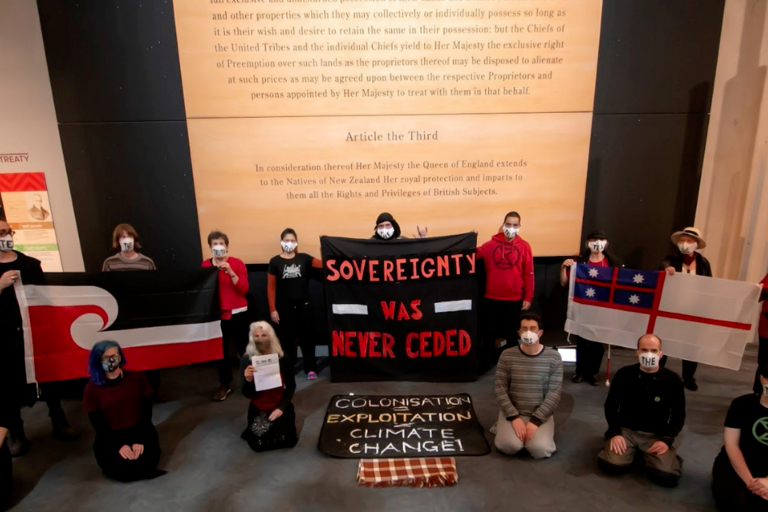
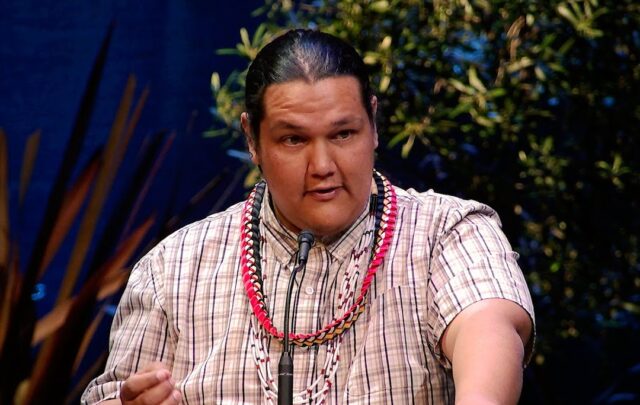
Agroecology Now!‘s Priscilla Claeys and Jasber Singh interviewed Catherine Murupaenga-Ikenn, a lifelong activist and a human rights advocate with deep roots in the Māori Indigenous movement.
Q: Catherine, can you tell us about yourself and the movement you are involved in?
A: I am a grandmother, a lifelong activist, and a human rights advocate with deep roots in the Māori indigenous movement. Since my granddaughter was born, I have felt a compulsion to do more of the activism work that I do already. When you become a mother, that kind of puts the fire under you. But when you become a grandmother, you just redouble your efforts. For some reason, it reinforces the need to do what you can to make the world right for them.
I grew up in a Māori Indigenous environment, with all the values and elements that are important to us and that we treasure. When we see these things being attacked, your natural inclination is to defend. Because of this, I have naturally aligned with many campaigns, be them civic campaigns, social justice ones, or environmental defense ones. I have worked both nationally in Aotearoa (New Zealand) and internationally, including within United Nations spaces, particularly in the fight for indigenous rights. I have been on the policy team for the Green Party and also helped with Māori Party policies. I have run for local government, and I have been very active in both local and central politics. In 2005 I got an Indigenous fellowship with the United Nations Office of the High Commission for Human Rights, and I got another Senior fellowship in 2020. That really set me on another trajectory, it opened my mind to all the mechanisms and instruments that promote and protect Indigenous People’s rights.
My work is fundamentally about defending Māori sovereignty and ensuring that our land, waters, and cultural practices are protected from ongoing colonial aggression. I have seen the UN become more and more fascist with the capturing of different UN agencies by corporate agendas. So now I am a kind of Trojan horse in those spaces. They keep inviting me to go back to their meetings, funnily enough, and they keep paying me grants to fly me over and put me up in hotels and the rest of it. It is just a weird way that the world works. They want me there, and I keep calling them out, but they keep calling me back. In addition to activism, I have played a role in academia and policy-making, working on documenting oral histories and indigenous knowledge systems to ensure they are recognized and integrated into contemporary governance frameworks. The ability to bridge activism with research has enabled me to push for legislative changes that respect indigenous sovereignty. The work is both exhausting and rewarding, but I remain driven by the responsibility I feel towards my people and next generations. Over the years, my role has expanded to include mentoring younger activists and engaging in grassroots mobilization to strengthen our collective voice. It’s not just about preserving culture—it’s about reclaiming our inherent rights and ensuring that our descendants live in a world where they are not subjugated by systems designed to erase them.
Q: Most of the people we have interviewed in this series associate with the food sovereignty movement. How would you define yourself and the key concepts or ideas at the heart of your movement?
A: As a Māori woman, I see our movement as fundamentally about sovereignty, especially in Aotearoa at the moment, where Māori leadership has explicitly identified our current government as the enemy. This has really ramped up a new wave of reconstruction of Māori sovereignty. When I say sovereignty, I mean food sovereignty, land sovereignty, or water sovereignty; they all intertwine. The fight for food sovereignty is essential because without control over our food systems, we are vulnerable to colonial and corporate control. We are currently facing a new wave of colonization which is corporate colonialism, and that includes industrial complexes, like the agriculture industrial complex. So it is still colonialism but it is kind of morphed, and it doesn’t just impact Indigenous Peoples anymore. Everyone is being colonized by the corporations now. So we have so much in common, Indigenous and non-Indigenous, and it is really about equitable distribution of power and wealth in the world. And I do observe, as many do, the Bill Gateses of the world trying to buy up land all over the place and different actors who are just consolidating their power over the food production system. And it’s very scary. People should be very scared, absolutely.
Food sovereignty, in particular, has been a critical issue. Colonization disrupted indigenous food systems, replacing them with monocultural, export-driven agriculture that harms both the land and people. Reviving traditional food practices not only strengthens our cultural ties but also ensures that we have control over our nutrition, health, and environment. The act of growing our own food using ancestral methods is itself a form of resistance against neocolonial economic systems. But as I said, this struggle is not just for Māori—it’s for all people. Economic and political structures continue to consolidate power away from communities, making it crucial for indigenous voices to be at the forefront of resistance and reformation efforts.
Q: What roles has spirituality played in this movement?
A: Spirituality is foundational to our activism. Our environment—our land, waters, forests, and animals—are not just resources; they are our ancestors, our kin. When we fight for sovereignty, we are fulfilling a spiritual obligation, not just a political one. The natural world is sacred, and the ongoing violations by the colonial state and corporations create disharmony, not just politically but in the very fabric of existence. Going back to my Māori roots and values makes me look at the world through a lens of the environment being related to us genealogically. That really changes everything. We are integrated. We are connected. We are very profoundly linked. Planet Earth is a living thing. She has her own consciousness. And the interesting thing here is the metaphysical activism.
We must have balance in the world. If we don’t, then you get what you see all around you: the world is sick, and it needs healing. The healing is all about making things right, in terms of ensuring we comply with the natural laws. From a Māori perspective, this is passed down by our ancestors: what is correct, what is right, what has integrity, what has compassion and understanding. If you align, then you will have harmony in the world. And as soon as you deviate from any of that, then you get disharmony in the world. This is very simple at one level, and that is what drives me personally. I look at a situation and I see what is imbalanced and needs healing. I try to bring it back into alignment with the basic principles we were taught. That is what I campaign on. Our activism is about restoring balance and healing those wounds. The desecration of sacred sites, pollution of water sources, and destruction of traditional food systems are all forms of spiritual violence that require deep, collective healing.
Sometimes it feels like you’re the only one in the room that’s thinking and speaking sanely, and everyone else is crazy. And the only reason I know I am the sane one in the room is because I’m aligning with the values that have been handed down to me. Without that compass, I would be lost. One example of how metaphysical activism works in practice is how we honor land through rituals and ceremonies before engaging in activism. When we organize direct actions, we begin with karakia (incantations) to ensure the presence and guidance of our ancestors. Many Māori activists view their efforts as fulfilling sacred duties rather than engaging in purely political struggles.
Q: How do you see the gender dimensions of this spiritual practice or system?
A: In Māori cosmology, there is a balance of masculine and feminine energies—Earth Mother and Sky Father, for example. This balance extends into our leadership structures, where both men and women hold significant roles. However, colonization disrupted these dynamics, imposing patriarchal systems that marginalized indigenous women’s leadership. Part of our decolonization work is restoring that balance, ensuring that women’s spiritual and political leadership is recognized and honored. The resurgence of female-led movements within our communities is a testament to the power of reclaiming our roles. We see it in the leadership of women revitalizing our languages, restoring traditional birthing practices, and leading environmental protection campaigns. Women have historically played vital roles as knowledge keepers, healers, and strategists within indigenous communities. By reclaiming these roles, we challenge the colonial frameworks that attempted to suppress them. In my own activism, I have worked alongside many powerful wāhine (women).The separateness that the colonizers brought, their divide-and-conquer strategies, are very effective. But that is another thing that spirituality can help us with. It can help us see the connections between us all. If we were able to see our shared interests and priorities and that we all want the same thing, really, all of us, regardless of our ethnicity, our gender, our socio-economic status, Global North, Global South, whatever- then it would be a very strong antidote to the colonizers’ divide-and-conquer strategy, and that is what I am advocating for.
Q: Any final thoughts?
A: The fight for justice is hard. Some days, it feels overwhelming. There is injustice in the world. People are suffering and dying. But the suffering we see calls us to something greater—to be the best versions of ourselves, to meet our highest potential. If it wasn’t for the suffering, I would probably be leading a mediocre life. It sounds like a weird thing to say, but it’s how I feel. I would love to be made redundant, but I don’t see myself being made redundant any time soon. But while I am doing this good work, I am just going to be the best that I can be in the face of it all. And what more could our ancestors choose for us than to meet our highest potential? You are not going to meet your highest potential just by having a cushy life, are you?
Activism is not just about political change; it is about spiritual alignment. And when we stand in that truth, we are unstoppable. We are living through a pivotal moment in history, and our resilience is our greatest weapon. If we can remain grounded in our spiritual and cultural foundations, we will continue to build movements that are not only resistant but regenerative.
This piece was lightly edited and condensed for length and clarity. While Resilience does not endorse any particular religious or spiritual perspective, we are sharing this conversation for Catherine Murupaenga-Ikenn’s perspective and experience as an activist.


Comments
We changed commenting systems on September 10, 2026 as part of a site-wide functionality and security upgrade. Your past comments have not disappeared, and you can still log in with your old Disqus account credentials if you wish. Contact us with any questions.