

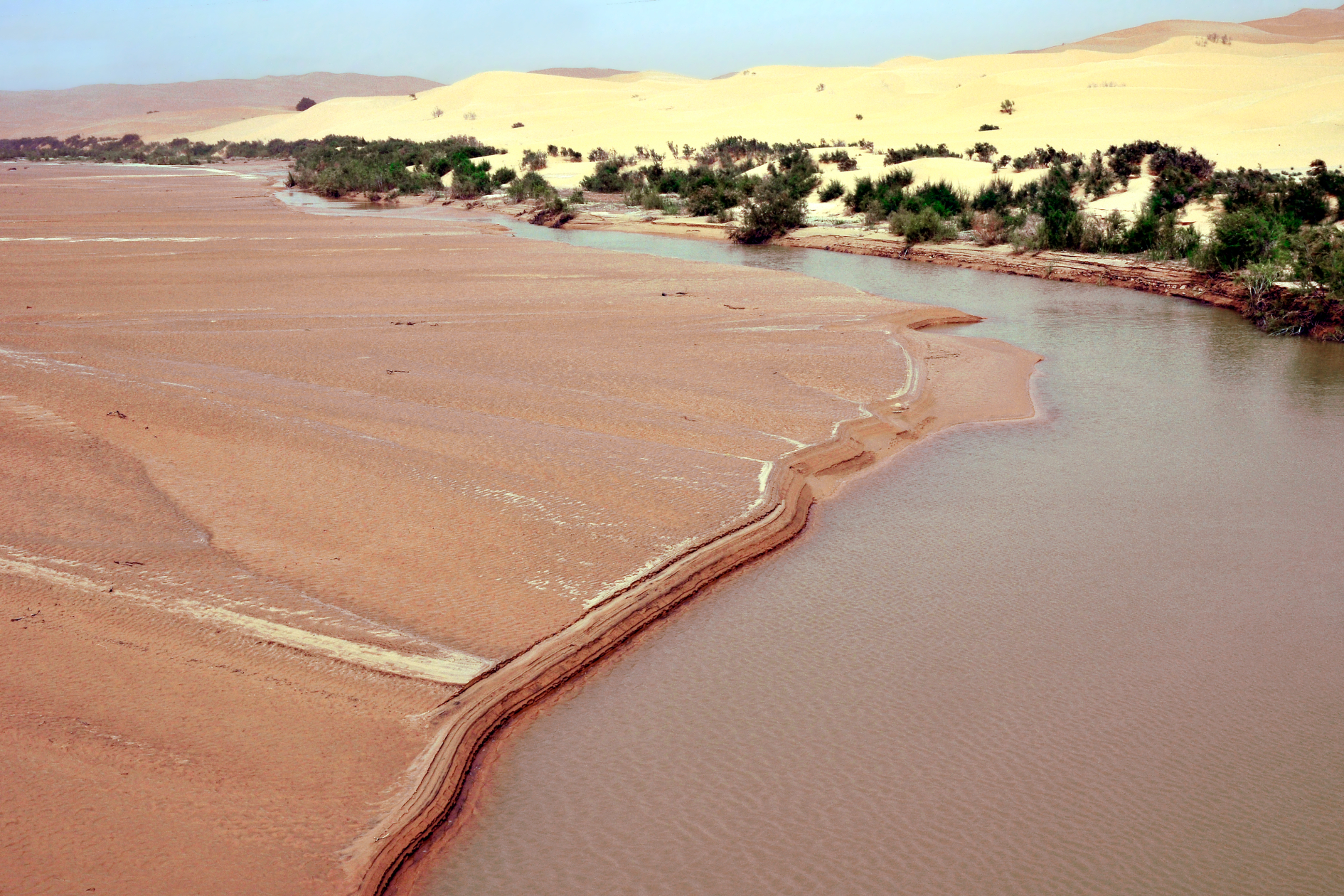
In September 2024, intermittent rainfall turned the northern Algerian Sahara, a region affected by more than a decade of drought, into an apocalyptic scene. In just 48 hours, more rain fell than the average of an 18-month period. Roads collapsed, bridges were destroyed, several neighborhoods around Béchar were temporarily isolated, and families had to be evacuated. The army was deployed for assistance.
Satellite images later revealed a striking phenomenon: lakes had reappeared in desert basins that had remained dry for decades. International media coverage mainly framed the event as a climatic anomaly — a rare “deluge for the Sahara”, according to NASA.
But seeing these waters flow through the Oued Saoura and eventually reach lakes located hundreds of kilometers into the desert raised a fundamental question: How can a region that prays for rain every season better retain such a vital resource in large quantities?
These waters passed through palm groves along the Wadi, eroded fragile soils, and accelerated land degradation. This phenomenon has troubled me for some time: where does all this water go each year as it passes through our region? And why does it become increasingly destructive? These are the very questions that have inspired my commitment to rainwater harvesting and hydrological restoration.
In Saharan culture, we learn that water is the source of all life. Yet over decades of urbanization, we have sought to remove water as quickly as possible: channeling it, draining it, mixing it with wastewater, expelling it from living territories.
By trying to expel water from living landscapes, we have turned its return into a threat.
Droughts started to occur, violently crossing landscapes that are no longer capable of absorbing it.
This is how I gradually came to understand that drought and flooding are not opposing phenomena, but two manifestations of the same hydrological imbalance. Ethics and economics alike should have led us to preserve these gifts of the sky and to ensure wastewater reuse. But on the ground, in autumn 2024, another rare phenomenon appeared.
The desert began to turn green.
Vegetation emerged in areas previously considered biologically dormant. Where soils were arid, water accumulated in basins and infiltrated the ground. Floods carried eroded soils rich in organic matter.
This event revealed not only climatic vulnerability, but also a latent ecological memory. The Sahara still bears the traces of ancient hydrological and vegetative equilibria, now largely forgotten.
From this observation, my Strategy for a Fertile Hydrology in the Sahara was born. In it, I argue that many water crises in arid regions are not solely due to rainfall shortages. They also result from the degradation of a territory’s capacity to retain water through soils, vegetation, windbreak green belts, palm groves, wetlands, and local hydrological and ecological systems.
Modern hydraulic systems are often designed to accelerate water: to drain it, channel it, centralize it, and evacuate it — sometimes even mixing it with wastewater — a sign of a profound rupture between modern urbanization and natural water cycles.
But when territories lose their organic capacity to slow down and infiltrate rainfall, and rapid drainage becomes the dominant planning principle, floods and droughts become two expressions of the same broken cycle.
The 2024 Saharan floods raise the question: What if the resilience of arid regions depends, above all, on our ability to retain water within territories, allowing life to emerge, reactivate soils, and transform the desert into a living environment?
My strategy explores this question through what I call “Fertile Hydrology”: an approach inspired by both contemporary ecological sciences and ancient Saharan oasis systems, which regard water not as a resource to be quickly evacuated but as a force to be slowed, infiltrated, and cultivated.
I propose a set of simple, progressive, and context-adapted solutions for arid territories: rainwater retention measures, flood-slowing systems, soil infiltration techniques, vegetation cover restoration, oasis rehabilitation, phytoremediation, small-scale water-retention structures, and the regeneration of local water cycles.
It is a plea for large-scale soil hydration and territorial fertilization.
Water has long crossed landscapes without resting within them.
To generate life, water must meet the soil, infiltrate it, remain long enough to nourish vegetation, recharge lands, and reactivate living cycles. We must prepare territories capable of retaining water, rather than merely suffering or evacuating it.
This document does not propose a distant utopia, but an operational trajectory: a set of concrete, progressive, and immediately applicable measures to rehydrate soils and restore the fertility of arid territories.
The Sahara today constitutes a full-scale laboratory of the hydrological transformations that arid regions of the world will increasingly face.
The phenomena observed in the Saoura Valley and Saharan oases may foreshadow the transformations that many semi-arid regions across the world will have to confront.
In my strategy, I attempt to rethink water, deserts, and resilience in an era where climate extremes are destabilizing arid regions worldwide. To propose a plan ready for implementation, because ultimately, the facts are there. The solutions exist.
This article was edited for clarity. An earlier version of this article was published in Savage Minds and republished here with permission from the author.



Comments
We changed commenting systems on September 10, 2026 as part of a site-wide functionality and security upgrade. Your past comments have not disappeared, and you can still log in with your old Disqus account credentials if you wish. Contact us with any questions.