

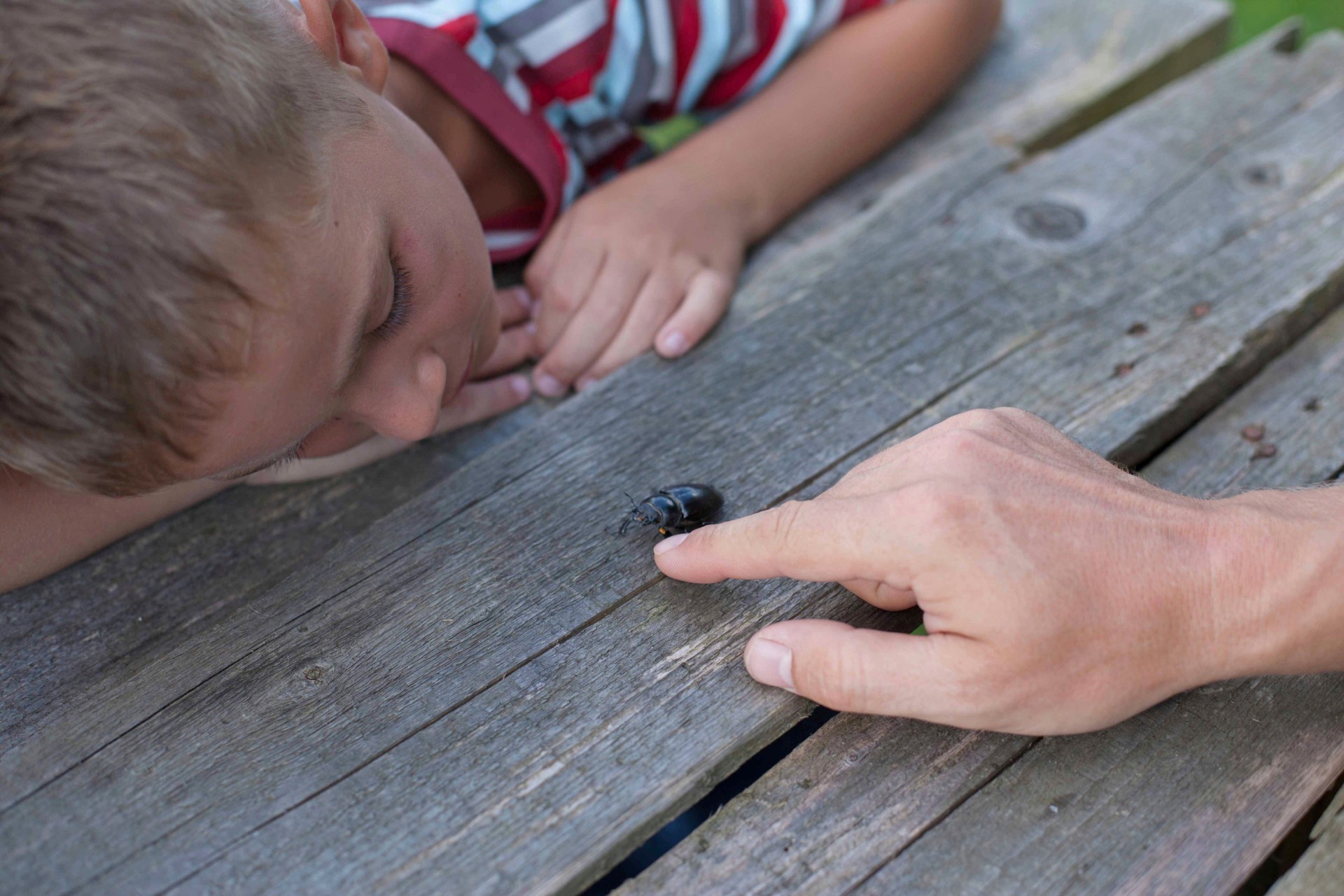
When we moved from our childhood home, we left behind a tract of land we called the prairie. Five houses stood between that home and the prairie. Our prairie covered an entire suburban block that ran parallel to a busy street and the hospital where most of my eight siblings, and decades later, two of my children were born. Thistle and dandelions sprouted out of rotting tree stumps and grass covered concrete chunks discarded from the renovation of a community hospital across the street from the prairie. A nearby stand of cottonwoods did not obstruct the skies above our summer playground.
For our parents, the prairie was a safe place to play because it formed a protective barrier from traffic. For frogs, earthworms, garden snakes, crickets, grasshoppers, beetles and spiders, the prairie’s nooks and crannies were ideal places to live. For us, it was a getaway from cyclone-fenced backyards. We played among ants, butterflies, bees, and ladybugs and lightning bugs, which, for unknown reasons, we didn’t consider bugs. But spiders? Daddy longlegs and especially banana spiders usually elicited a scream followed by intense scrutiny.
There are many types of banana spiders. I like to think golden silk orb weavers lived in our prairie. Golden silk orb weavers can spin silk stronger than steel. They are members of the Nephilidae family that includes the toxic-to-humans Brazilian wandering spider. Our banana spiders were not poisonous, but we did not know that at the time. Nor did we know that they protected us by eating mosquitoes. A little bigger than a quarter, the banana spider’s yellow markings made it stand out against dusty prairie plants. Hairy legs gave them a slightly menacing quality, perfect for the game.
For this game, we filled empty metal coffee cans—Folgers or Maxwell House—with worms, beetles or banana spiders, then plunged a bare hand up to the wrist into the cans for ten seconds. Banana spiders provided the ultimate challenge. We invented this game with little conscious understanding of the natural world. Maybe because insects were much smaller than us, we didn’t think we needed to show them the slightest respect. After proving our fearlessness, we decided to either dump the banana spiders back into the prairie or onto the street where cars would reduce them to yellow streaks on the asphalt. Usually we picked the street, yelping with glee at the slaughter. Secretly, I was grossed out and a little afraid. I never wondered if the insects were scared, too.
How did we determine banana spiders were ours to capture and kill? We thought nothing of the welfare of the insects. We saw them as an endless supply of mostly imagined threats who existed for us to conquer.
It took a while for me to learn—and longer to practice—peaceful, saner interactions with our insect neighbors. If one of the quadrillion arachnids living on earth today shows up in a shoe or under a table, my startled shriek is followed by a sigh of relief. They survived.





Comments
We changed commenting systems on September 10, 2026 as part of a site-wide functionality and security upgrade. Your past comments have not disappeared, and you can still log in with your old Disqus account credentials if you wish. Contact us with any questions.