

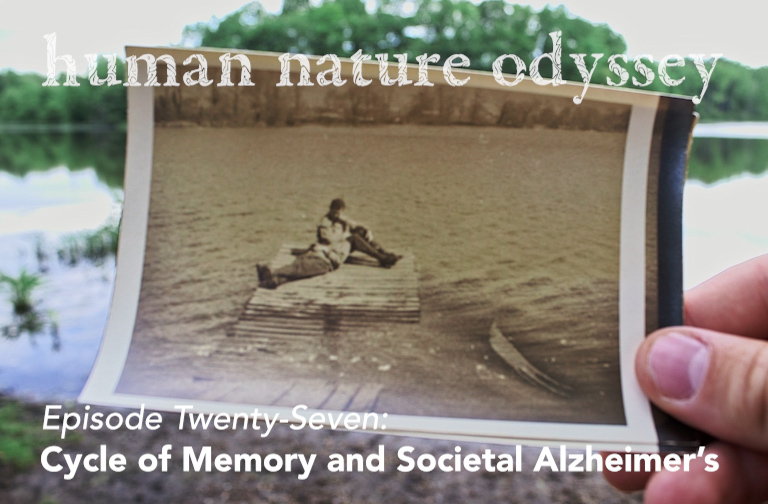
Show Notes
Can societies get Alzheimer’s?
From the pyramids of Ancient Egypt to cloud storage, humanity has gone to extraordinary lengths to preserve its memories. But what happens when memories fade, photographs disappear, and the stories of our ancestors are lost?
Using clips from Alex’s documentary Cycle of Memory as our entry point, we embark on a songline search through the history and meaning of memory. From Socrates and Gilgamesh to Aboriginal oral traditions and the 1939 World’s Fair, we explore how societies remember, what gets forgotten, and what’s worth passing down.
Along the way, we confront more personal questions: How do we stay connected to loved ones as their memories fade? What conversations should we have with our parents and grandparents while we still can? And what kind of legacy do we want to leave for the future?
Extras
If you’d like to support Human Nature Odyssey, please subscribe wherever you enjoy your podcasts and leave us a review.
Join us on Substack and get exclusive access to audio extras, writings, and notes.
For full episode transcripts and additional context, visit: resilience.org/human-nature-odyssey-podcast
Credits
Theme Music is “Celestial Soda Pop” (Amazon, iTunes, Spotify) by Ray Lynch, from the album “Deep Breakfast.” Courtesy Ray Lynch Productions © Ⓟ 1984/BMI. All rights reserved.
Transcript
If you’re listening to this, the year is 2076. I will be 83. How old, I wonder, will you be?

Come here. I want to tell you a story. It’s a story about my grandfather, your great-great-grandfather, Grandpa Mel, and an adventure he would remember for the rest of his life.

Until he started losing his memory to something called… Alzheimer’s.

When I was young, I made this documentary film.

Cycle of Memory. Have you seen it? Maybe so. Or maybe not yet. That’s okay.

I spent seven years making that film, trying to find out where our memories go, and what happens to us when we lose them.

The film was about Grandpa Mel but this… this message to you… is about something much larger.

As I speak these words, it feels like the world is coming undone at the seams. My fear is we’ve been handed something beautiful – like our grandmother’s prized vase –and in my lifetime I’ll watch it shatter into a hundred pieces from our carelessness.

And then what will I have to pass on to you?

Tell me, my grandchild, what does our world look like to you now?

What have you been handed?

When the present is overwhelming and you don’t know what to do, then it’s time to learn from those who came before, and consider those who’ve yet to come. That’s why I’m speaking to you.

Our lives are always an in-between. On one side is an ancient past. On the other side is an unknowable future.

So how do we connect the dots? What does it take to pass something on?

[theme music]

Welcome to Human Nature Odyssey. A podcast looking back into the past and reaching out to the future.

I’m Alex Leff.

Okay, let me explain…

I am holding a story. It was given to me by your great-great grandfather, Grandpa Mel.

It’s a story I want to pass on to you.

You see, Grandpa Mel, you, and me, we all grew up in very different times. Passing down our stories is the closest thing to a time machine we’ve got. Should we step into it together?

Grandpa Mel grew up in a Jewish immigrant community in Brooklyn during the Great Depression and the outbreak of the second world war.

And of all the stories he told us, the one he loved to speak of the most, was his bicycle adventure.

The story goes that when Grandpa Mel was a teenager he and his best friend George rode their rickety bikes from Brooklyn, through the farm fields and forests of New Jersey, all the way to the city of Philadelphia.

Have you felt that feeling of freedom yet? A youthful time away from home with a dear friend by your side?

I grew up hearing about this bike trip again and again. It moved from family history to family legend.

GRAMMY: I asked him when you came home from this historic trip what did your family say? Weren’t they thrilled for you? And he said my mother said, ‘go down and fix the furnace.’ I said, ‘Mel, I would have given you a parade and a luncheon!’

That’s Grammy. Your great-great-grandmother. She and Grandpa Mel first met when they were camp counselors. Grandpa Mel promised to build her a treehouse. They’ve been together ever since.

But then Grandpa started becoming forgetful, the stories he used to tell became fuzzy, he’d forget what he was doing, where he was, who we were.

GRAMMY: When he was first diagnosed with Alzheimer’s, it’s like watching a landslide.

GRAMMY: Grandpa Mel would say, ‘I’m not getting out of the car. This is not my house.’ I would say, ‘Mel, we lived here for 50-something-odd years, come in and I’ll show you your bed and the children’s pictures.’ And this happened two or three times. One day I said, ‘Mel, the woman whose house this is, she’s away on vacation and she said we could stay here until she gets back.’ He said, ‘okay.’ And I thought, creative lying! That’s what I needed to do.

GRAMMY: He wasn’t gonna go backwards. And the doctors used to use that term. They’d say I’m sorry this is an illness that he’s not going to get better. You will forget that you forgot.

In my time, 50 million people worldwide had Alzheimer's or another form of dementia. It was one of the most researched diseases. Perhaps it’s been cured in your lifetime. But maybe not.

What does it do? Well, it takes your memories. It hides them. Or erases them. You’re still you, you’re just you without your memories.

But if Grandpa Mel couldn’t remember the stories he’d tell us, what would happen to them?

When I was 16, I recorded a conversation with Grandpa Mel, and what he really wanted to talk about… was the bike trip.

MEL: I was trying to think of the timing and the timing as the same as your age.

ALEX: When you were 16?

MEL: This I never forget. I was able to get a bicycle. And… where the hell was I going with that?


What is memory, really? A way to hold onto yesterday, the afterglow of a sunset, the light of an already burnt out star?

The things I’ve done, the things I’ve seen, even though I’m no longer doing them, are here with me right now. What is this miraculous ability we have to remember?

A long time ago, there was an ancient Greek philosopher named Socrates who said memory is like an imprint on a wax tablet. According to Socrates, memory is a mark we make with our minds, so that even when the moment is gone, its impression remains.

The question is, where do we store all these wax tablet memories?

Are memories physical things hiding inside us?

If so, wouldn’t old people have to have giant balloon sized heads to make room for all their accumulated memories?

Maybe memories aren’t physical things to store away after all.

If our brains aren’t a pantry we squirrel away our memories for later, maybe we sprinkle our memories like breadcrumbs on the landscape.

After all, I’ve found that when I return to familiar places, memories come back to me right where I left them.

In Australian aboriginal cultures, there are pathways through the landscape where stories and intergenerational memories are placed and recalled as you make your way along the trail. It’s called a songline.

We see similar practices in other cultures, tied to their land.

I read that the Wampanoags of Massachusetts would dig a round hole in the ground in places where something significant happened - something they wanted others to remember. When people passed this hole in the ground they’d know to ask what happened there, and they would be given the story tied to that spot.

Author Sophie Strand has suggested that the Torah was first transmitted in a similar way. Many of its stories take place in real locations, like Mount Sinai, the Jordan River, the Dead Sea. The original listeners were meant to remember those stories and their lessons as they passed those places in their own lives. A biblical songline, in a way.

What if Grandpa Mel’s bike trip was sort of our family’s version of a songline?

My younger sibling Koby and I grew up going on bike trips inspired by Grandpa Mel.

And it got me thinking of an idea for a film.

Even if grandpa could no longer remember the bike trip, maybe we could find his lost memories if we retraced his steps.

GRAMMY: Holy moly.

ALEX: So the plan is we’re going to depart tomorrow morning. The goal tomorrow night is to get to Brooklyn. We’ll try to recreate those photographs. Based on the photo we’re gonna try to stage it so we’re in whatever position they are so we can see it side by side, exactly where George and Mel posed.

GRAMMY: Oh you’re making me want to cry. This is so unbelievable.

[pause]

As Koby and I embarked on our trip, these questions about memory swirled around in my head. Questions that were too big for the film.

Like how memories shape not just families but entire civilizations.

[pause]

I mean why did the ancient Egyptians build those pyramids? Did they just really like building stuff? Or were they afraid of being forgotten. Maybe they figured if they built giant pyramids in the desert, they’d be remembered for eons to come. It seems to have worked.

The Pyramid of Giza was the tallest structure in the world for 3,800 years. But in 1931 a tower of steel, three times taller than Giza, called the Empire State Building, was constructed. It was then Manhattan, not Egypt, that towered over the world.

Grandpa Mel grew up in the shadow of that skyline, in the immigrant neighborhood of Brownsville, Brooklyn. It was there he met his best friend George.

George was a legendary character in my family lore. But I never met him before. And if Grandpa could no longer tell us what happened on that trip–maybe George still could.

I asked Grammy if she had his number and gave George a call.

GEORGE: My name is George Pearlman. I’m roughly about 88 years of age. I was born in 1928. When I was five years of age I was enrolled in public school and that’s where I met my good friend Mel Schwartz.

GEORGE: We both enjoyed the outdoors. We both enjoyed discovering new areas and kind of doing things together so that prompted us to make a bicycle trip. That’s one of the highlights of our relationships when we were youngsters.

GEORGE: Mel and I had planned out the trip quite a bit from our home in Brooklyn to Philadelphia. My job was to keep up with Mel because he had a brand new bicycle. A bicycle that I really envied. It had the latest pieces of equipment on it. It had the 21 speeds. And Mel really loved that bicycle. I didn’t have a bicycle and I somehow borrowed 5 dollars from someone and bought a rinky dinky heavy balloon tired bike.

ALEX: How did you know where to go?

GEORGE: We had a map. We planned the trip. We started early in the morning and it took us something like 15 hours. To get to New Jersey there wasn’t any bridge going over there but there was a ferry that leaves at the foot of Brooklyn and cuts across to Staten Island.

ALEX: Are you still able, when you think about this, to really remember what it was like to be in that moment? Can you feel yourself as a 16-year-old on the bike ride?

GEORGE: As you think about it, you begin to go back, and your memory sort of becomes slightly more… uh… alive.

[pause]

I spent a weekend with George, asking questions, listening to stories.

It turns out George and Mel went on many adventures. When they were ten, New York hosted the World’s Fair. The massive international exhibition brought in 45 million visitors from around the world and lasted all summer long. Of course two adventurous kids from Brooklyn were gonna check it out.

When Koby and I retraced Grandpa Mel's bike trip, one of the first stops was the site of the World’s Fair - where exhibits promised a glittering future. But when we got there, we found the future they imagined hadn’t gone exactly as planned.

The 1939 World’s Fair was called The World of Tomorrow.

C’mon, let’s get in line for a ticket.

This was a vision of what the future would look like, or what the corporations and governments that sponsored the fair hoped it would look like. You can see it just beyond the ticket booth: wide boulevards lined with sleek modernist buildings, reflecting pools and majestic fountains. 62 countries from around the world have their own pavilion to explore. At the center? Oh that’s the Trylon and Perisphere, a massive white pyramid and sphere we can enter and check out some more exhibits.

That’s where George and Mel would have seen one of the earliest television sets. Or glimpsed General Motors’ giant dioramas boasting of a car centered future, one where asphalt highways would span the entire nation. I bet George and Mel got a kick out of Westhouse Electric Company’s robot named Elektro who could talk to guests and even smoke cigarettes.

But the 1939 World’s Fair wasn’t just trying to give visitors a glimpse at the future, it was trying to let them reach out and talk to it too. Among many wonders and oddities was the World’s Fair Time Capsule.

But 1939 would prove to be quite the time for a World’s Fair. By the time Goerge and Mel made it to the fairgrounds, empty pavilions for occupied countries like Poland and Czechoslovakia stood as ghostly reminders of the outer world’s chaos. There was a breakdown of international order. Then world war.

About 80 years later, when Koby and I arrived on our bikes, we didn’t find a gleaming vision of the future but rusty towers with faded paint across from overgrown soccer fields. Empty carnival-like structures lay like weary apparitions. There was a cop walking around and I asked her what these structures were for. She said she thought it had something to do with a fair, but she wasn't sure.

We’re only a few generations into the 5000 year future, and we’re already beginning to forget. Can societies get Alzheimer’s?

As the living memory fades of the World’s Fair and the World War that accompanied it, I too am living through the breakdown of international order. They say a society that forgets its history is doomed to repeat it.

But how could we forget when we document everything?

ALEX: I’ll take a picture of you if you take a picture of me.

GRAMMY: If I can just get it to work. I just got this little digital camera. Let me turn it on… One of the things I did, in your younger days, in my younger days, was I photographed you. I photographed you moments after your birth. I was one of these people - talk about documentarians - who wanted to capture your every everything. Everything you ever did I wanted to document. And now I can’t even know how to use a smartphone…

YOUNG ALEX: This is my first, very own, camcorder.

ALEX: I’ve been recording memories ever since I can remember.

YOUNG ALEX: This is the beginning of my documentary. This is my little brother Koby.

When Grammy and Grandpa were kids, they had just a few black and white portraits to document them.

When they became parents of their own, like so many American families in the 1960s, they bought a standard 8mm camera and my mom’s childhood was captured in moving color.

And my childhood? My Dad had our camcorder out for every parade, school performance, birthday party, and Fourth of July fireworks. It was like we were on a reality tv show.

DAD: Say goodbye to the camera!

YOUNG ALEX: Goodbye camera!

Nowadays, our cameras are in our pockets, and documenting has never been easier.

Over one billion images are shared on instagram every single day.

Five hundred hours of footage is uploaded onto YouTube every minute.

If you wanted to watch all the videos uploaded in 2026 alone you’d have to live over 30,000 years.

Practically every historical document ever created is now accessible and stored online.

I wonder, in your time, will your eyes record like our cameras did? Will you record everything, all the time?

If a tree falls in the forest, and no one’s around to take a picture, did it really happen?

ALEX: Oh that’s a great photo.

GRAMMY:  It must have been grandpa’s birthday.

GRAMMY: I don’t know what we’d do without pictures, you know? Otherwise time would just come and go and we wouldn’t note things the way we do.

Is that why we document - because we’re afraid of forgetting?

Memories are fragile things. We remember things differently. Accidentally make up details. But if you take a picture or video, it’s stuck in time, exactly as it was.

The summer I turned 16, my dad took me on a camping trip in Central Pennsylvania. It was my first time backpacking and I didn’t want to forget it. I brought my digital camera and snapped photos of everything I wanted to remember: the stream we forged, the ferns growing along the trail, and our campfires we settled down to at night.

When I got home I looked through the photos again and again. So much so that months later,I realized I didn’t really remember anything outside of those photos. The photos had sort of replaced my memories.

The next summer, my family rented an RV and spent three weeks exploring the National Parks out west. I was 17 and had never been west of Ohio before. That trip blew my mind. The Towering Redwoods, Yosemite, the Grand Canyon. I mean if there ever was a time to take a picture, this would be it. But I remembered my camping trip the year before. I wanted to remember the trip - not just rely on photos. So I decided to conduct an experiment.

What if I went the entire three weeks without taking a single photo? If I wanted to remember the trip, I’d have to do it myself.

One afternoon in Wyoming we went to Yellowstone National Park.

Have you ever seen Yellowstone’s boiling hot geysers?

The most famous geyser is Old Faithful. About every hour or so, the geothermal pool erupts with high pressure water shooting up over a hundred feet in the air. It’s quite the sight.

The scene was packed with tourists. We all made our way through the crowd to get a view.

There was another family in front of us. I watched as the dad directed his kids to pose for the camera with the geyser behind them. “Okay everyone, smile!”

One of his kids kept trying to turn around to see the tower of white water rocketing up but his dad told him, unironically, “Smile for the camera Jimmy! You can look at the geyser later in the photo!”

A week later we were in Oregon, driving through a faded green scrubland of sage and juniper.

Eventually the road climbed up towards the dormant volcano known as Crater Lake.

I don’t know if you’ve seen Crater Lake before but picture an enormous crystal clear lake, more blue than the sky, encircled by towering cliffs of the volcanic crater.

It was here my experiment was pushed to the test.

Here I was, staring out into this incredibly beautiful lake in a giant volcano and I found myself a little restless. I mean, what was I supposed to do? Just stare at this thing? How long is long enough to have fully appreciated it? What’s the point of looking at beauty?

I felt the urge to do the one thing I had been trained to do when confronted with something incredible: take a photo. But why, I thought? If I don’t take a photo what’s the point of me seeing this? And then I realized: ah - how much of our desire to document is just because we don’t know how to live in the moment?

Taking a photo is easy. Appreciating the beauty of something you may never see again, that’s something else.

We’re raised to document. We’re not taught as much how to appreciate

In my day, you usually can find more people filming a concert on their small screens than just listening to the music.

When I was researching audio recorders for Cycle of Memory, I came across this review for the Zoom H6 recorder. Here’s a quote from the review, “The idea of a sound that reverberates into infinity without anyone to collect it is a very sad thought. The Zoom H6 cures this particular brand of sadness.”

How much of our urge to document is to cure the sadness of letting the present moment come and go?

Has it always been this way?

Do hunter-gatherers have a different relationship with documenting and appreciating?

As a hunter-gatherer, you have to forage for your food. Maybe you find some. Maybe you don’t.

Remembering is kind of like foraging for food. Our memories are out there something, you have to recall them. Maybe you will. Maybe you won’t.

With the agricultural revolution, food became something we grew and stored in granaries. Where’s the food? Right there where we left it.

With the invention of photographs, audio recordings, videos, we’ve had a revolution of memory as well.

And long before there were cameras in our pockets, before photographs at all, there was still writing.

It’s easy to take writing for granted. But in the grand scheme of human history, this is a relatively recent invention. How did that change us?

It was Sumer, the very first civilization, located in modern day Iraq, that first invented a written language known as cuneiform.

Now why did the Sumerian invent writing when all the hunter-gatherer societies around them didn’t?

Did the Sumerians just have more stories to tell? More poems to write?

I don’t know about that, but they did have a lot more material goods to keep track of.

Writing began as an administrative tool.

Hey Lugal Zegezzi, how many tons of wool are we importing from the Euphrates? I forget.

Hmmm, put some markings on a clay tablet so we can count the wool. And boom, writing was born.

Obviously that’s an oversimplification. Writing didn’t start suddenly. It wouldn’t have been some big eureka moment. I mean, plenty of cultures made marks on cave walls and etched pictographs into rock. People love their symbols.

But Sumer was when symbol making got obsessive. If something wasn’t written down it couldn’t be taxed. And how do you do civilization without taxes?

But eventually, writing was used to record something much more interesting: stories.

The oldest story we know of that was ever written down is called… The Epic of Gilgamesh.

Gilgamesh was a Sumerian king who went on a search for immortality. It didn’t work. No matter how powerful Gilgamesh was, how many monsters he slayed on his quests, how impressive the buildings he constructed were, Gilgamesh died like all of us eventually do. His search for immortality ended in failure.

But while Gilgamesh the man did not live on, Gilgamesh the legend did. That is the power of writing.

But is it possible for a society to remember without writing anything down?

We talked about how songlines can pass down stories without writing, but how long can any of those stories go on for, really?

I live in an area where the native Pocumtuck people told a story about a hero defeating a giant beaver and breaking its massive dam. Cool story. Who doesn’t love a story about a beaver? But there’s reason to believe this wasn’t just a fantastical story but a sort of mythologized memory.

Abenaki scholar Marge Bruchac’s research suggests this oral story may be an ancient reference to the glacial dam that broke at the end of the last ice age, told by those actually there to witness it. Oral storytelling can be powerful.

Its weakness is, if the next generation doesn’t tell the story, it’s forgotten forever.

For a very long time, the Epic of Gilgamesh was forgotten too.

When the Babylonian Empire collapsed, so did all knowledge and memory of the ancient Sumerian king.

For over two thousand years Gilgamesh was entirely forgotten.

Until in the 1800s when British, French, and Iraqi archaeologists explored the massive mounds of sand that had long covered Sumerian ruins.

In 1872, some broken tablets were discovered, or should we say: re-membered – and on those tablets was the Epic of Gilgamesh. For the first time in two thousand years, the memory of Gilgamesh returned to the world, thanks to the power of writing.

But for a long time writing was the privilege of elites and administrators. The people had only the spoken word. And the spoken word may seem like a worse version of the written word. After all, it’s less reliable, and more prone to forgetting.

But what if the spoken word actually comes with its own advantages writing does not?

After all, ancient orators could become masters of their craft.

Stories that lasted for hours were memorized and recanted. And if you didn’t remember it perfectly, that’s how tales would change and evolve.

In her book Memory, author Anne Whitehead explains how oral cultures have a fundamentally different relationship with the past, since stories aren’t frozen in time but made relevant for a contemporary audience. In oral traditions the past is maybe more alive and present.

So how did people from oral traditions feel when writing was first adopted? Was this seen as a great advantage or a tragic loss?

One day in ancient times, Socrates was hanging out with his friend and fellow philosopher Phaedrus. Now, of course, Socrates and Phaedrus didn’t think they lived in ancient times. To them, they were living in the present. And these two philosophical friends were discussing the merits of writing versus oral storytelling.

Socrates told his friend a story, about all the way back in ancient Egypt when the gods themselves were kings. (Socrates didn’t know about Sumer and cuneiform which came a little before Egyptian hieroglyphics)

But anyway, in Socrates’ story, the Egyptian god Theuth was a master inventor. I mean what didn’t this old god invent? Theuth created arithmetic, geometry, astronomy, even dice to play with. But his greatest invention of all? Writing, for sure.

Now one day Theuth traveled up the Nile River to visit the god Thamus, who ruled over the people of Egypt.

THEUTH: Oh man, king Thamus is gonna be so siked to receive my brand new inventions. I can just picture the look on his face now…

When Theuth arrived, king Thamus received him in his royal palace.

THEUTH: Greetings old friend! I bring you my latest creations.

King Thamus greeted Theuth warmly.

THAMUS: Good to see you dear Theuth. Thank you for gracing our lands with your presence. What gifts do you bring us?

THEUTH: “Well,” Theuth said, reaching into his godly robe, “you’re gonna get a kick out of this one.”

Theuth pulled out the first creation he was to show King Thamus.

THAMUS: What is it?

THEUTH: Well my friend, I call it… astronomy.

THAMUS: Hmm. What is it for?

THEUTH: This shall give your people knowledge of the stars.

THAMUS: Wow, Theuth, not bad, not bad. You’ve done well. My people are going to love this. Who doesn’t like the stars?

THEUTH: Yes the stars are very good.

THAMUS: Indeed. Okay. Well, what else?

THEUTH: Ah. I give you… geometry!

THAMUS: What’s geometry?

THEUTH: Shapes! All kinds of shapes. Circles. Squares.

THAMUS: Hmm. What’s this one called?

THEUTH: This my friend, is a triangle.

THAMUS: Ah. Interesting. You think we should get the slaves to build a massive one of these for all to see?

THEUTH: Yes but if it’s three dimensional it’ll have to be a pyramid.

THAMUS: Pee-rah-mid. Very well. Okay, Theuth, have you another gift?

THEUTH: Of course I do. And if I say so myself, this one is gonna knock your sandals off. [rummaging in robe] Mmmm, here. Ta-da!

THAMUS: …what is it?

THEUTH: This? Why, this my dear friend, this is the gift of writing.

THAMUS: Rye-ting? But what is it for?

THEUTH: Why, it’s to give the people better memory. Have a thought? Write it down. Your favorite speeches and stories? Turn them into letters. That is writing.

But of this, King Thamus was not so pleased.

THAMUS: [sigh] Theuth, Theuth, my old friend. Inventors are not always the best at knowing what their invention will be used for.

THEUTH: Uh, what do you mean?

THAMUS: You say writing will give people the gift of memory but it will do the exact opposite. It will cause forgetfulness!

I’ll tell you exactly what Socrates tells us Thamus said for this last part, what you have discovered “is an aid not to memory, but to reminiscence, and you give your disciples not truth, but only the semblance of truth; they will be hearers of many things and will have learned nothing; they will appear to be omniscient and will generally know nothing; they will be tiresome company, having the show of wisdom without the reality.”

Damn.

Socrates doesn’t tell us what Theuth said in response to King Thamus’s poo-pooing the gift of writing as a curse of forgetfulness.

But you wanna know how we know about any of these stories from Socrates about the dangers of writing?

Because his student Plato wrote it down.

But what about when the writing itself is lost? Books fall apart. Photographs fade. Files get corrupted. They no longer sell that exact kind of USB cable you need to access your hard drive.
Sometimes the Library of Alexandria burns down.

So if our documents don’t last forever, and our own memories fade, where does this leave us?

In Socrates’s time, dementia was considered to be a natural result of aging, referred to as senility.

By the 18th and 19th centuries, dementia was beginning to be seen as a disease but no one understood how it worked.

By the early 1900s, scientists began poking and prodding into the brain of deceased patients, to try and unlock the secrets of the human mind.

One of these scientists was named Dr. Alois Alzheimer.

One of Dr. Alzheimer’s patients was Auguste Deter, a seamstress and mother in her early fifties, who became increasingly forgetful until her memory was entirely gone.

When Auguste died in 1906, Dr. Alzheimer wondered if there were any physical signs in her brain that would help explain her condition.

Under a microscope, Dr. Alzheimer discovered that parts of her brain had literally shrunk. And there were these strange deposits we now call plaques, Some of the fibers within the nerve cells were completely tangled.

Dr. Alzheimer had a new insight into the disease that would one day bear his name.

And I think this tells us something pretty crucial about memory as well.

I’ll be honest with you. I don’t fully understand the science or all the terminology here but it seems to me that memories are less like markings on a wax tablet and more like a network of connections we make with us and the world. Our senses, the places we pass through, and the people we pass through them with.
George visits Mel

When I was on the phone with George, he mentioned that it had been a few years since he last saw Mel. Maybe it was time for a visit.

A few months later, George and his daughter Marcia drove from their home in Buffalo to the nursing home on Long Island where Grandpa Mel now lived, after Grammy could no longer care for him herself.

GEORGE: Mel? You remember me? We were good friends, Mel. You and I. We grew up together. We rode our bikes. We really had a lot of fun when we were kids. We’ve been friends for a long, long time.

GRAMMY: You always talked about it. And you always talked about George.

GEORGE: Mel open your eyes and take a look at me and see whether I’ve changed or I’m the same. I don’t have as much hair on my head. But I’m still the same guy. I’m still your friend. Your very close friend.

GEORGE: I know that Mel was aware and pretty much enjoyed our friendship. And I don’t know whether he remembers much of it now but I do. And I think that’s important. That I can remember the friendship we’ve had. And I’m glad to see him in whatever condition he’s in.

GRAMMY: I think that’s the definition of a real loving relationship. To accept the fact that we’re getting older but the memories that you have are so precious and valuable. And your memory Goerge is so keen and so sharp it’s almost like you’re holding the memories for both of you.

I spent two years following Grammy, Grandpa, and George around with a camera.

At a certain point, you have to decide to stop filming. But life continues.

I moved out west with a good friend. Then lived with Grammy when the coronavirus hit. She was a great housemate. We watched a movie every night. Sometimes two.

Grammy gave me my love of documenting, but also of movies. As a kid she’d go to the theater and watch movies all day.

She told me how one afternoon, as the credits were rolling, she had the thought, but if I’m in here watching movies all day, who will go live my life?

Once the pandemic slowed and I moved out, it was time for her to move on too.

After five years living alone, it became too difficult. Too much to manage. So my mom helped her find a nearby apartment in town.

When we were moving Grammy out of the old house, it was incredibly hard for her to let go of all her things. After living in a house for sixty years, you can collect a lot of things. And she’d be the first to admit it, it was too many things. A few rooms became so cluttered with odds and ends it was impossible to step into them.

As we helped her part with the vast majority of her belongings, I realized that she wasn’t holding onto all this stuff out of a sense of luxury or even comfort - she was holding onto memories. There was a story tied to everything. But she couldn’t bring them all with her.

We never can.

By the time I was done filming and collecting archival tapes and reels, I had over 100 hours of footage.

But I can’t give you all that. Who will go live your life?

And so, editing a film is kinda like moving your grandma out of her old house. You’ve got to pick the important parts, the key moments that are worth holding onto. And the rest, you’ve gotta let it go. That’s my responsibility.

Your responsibility is to receive what you can, even if it is a hundred broken pieces of a precious vase, build from them something new, and retell our story the way you see fit, for a future generation I will never meet.

Will you tell them I say hi?

Thanks for listening.

Until next time, I hope you’ll consider the stories you’d want to gather, retell and pass on.

This episode was a companion piece to the documentary film Cycle of Memory.
And I’m very excited to announce that starting today, for the first time ever, Cycle of Memory is available to stream online at cycleofmemory.com.

Cycle of Memory first premiered in theaters back in 2022 as the winner of the Sunset Film Festival in Los Angeles. It was also the official selection of the Art of Brooklyn Film Festival, the Long Island International Film Expo, and a handful of others. Since then, we’ve held over 75 screenings at libraries and senior centers across the country. So this is a big milestone for the film to finally be available to the general public. Again, you rent or purchase the film at cycleofmemory.com. Right now sales are limited to those in the US but if you’d still like to see the film, there’s a place to reach out to us at cycleofmemory.com and we hope to make the film available where you are too.

And if you’d like to learn more about Human Nature Odyssey, watch bonus episodes, and connect with fellow listeners, then check out the Human Nature Odyssey substack. It’s a great way to support the show and help me keep it going for years to come.
Thank you so much to everyone helping make the podcast possible through your generous monthly donations.

Thank you to Maia for your feedback on this episode. Original Music from Cycle of Memory was composed and performed by Tim Johnson, Gestalt, Connor Irias, and Savannah Wheeler.

This series was made in association with the Post Carbon Institute. You can learn more at Resilience.org.

And as always, our theme music is Celestial Soda Pop by Ray Lynch. You can find a link in our show notes.

Talk with you soon.


Comments