

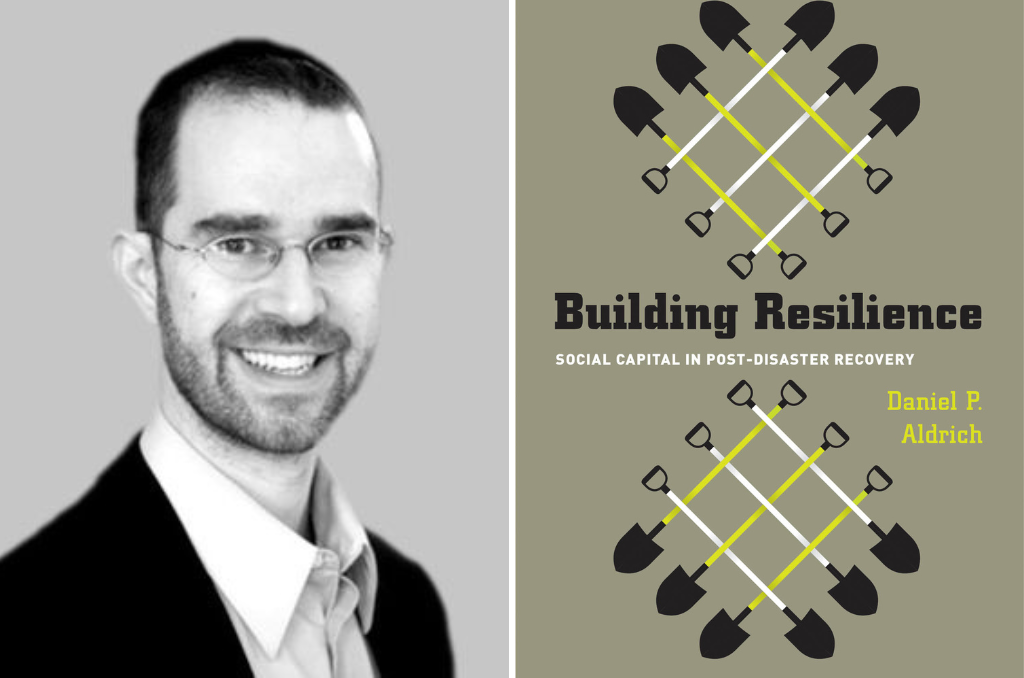
Daniel Aldrich is Dean’s Professor of Resilience at Northeastern University in Boston and author of five books, including Building Resilience: Social Capital in Post-Disaster Recovery and Black Wave: How Networks and Governance Shaped Japan’s 3/11 Disasters. He is an expert in social capital and disaster recovery whose research was shaped by fleeing Hurricane Katrina with his family and enhanced by service as an American Association for the Advancement of Science (AAAS) Fellow at the US Agency for International Development (USAID). His insights have obvious relevance for readers of Resilience.org and for everyone seeking to make our communities more robust in the face of the crises now bearing down on them.
After reading Building Resilience, I contacted Daniel and he kindly agreed to an interview.
RH: You were formerly a professor of political science at Purdue University. What led you to study resilience?
DA: Personal experience. In July 2005, my family moved to New Orleans so I could begin an assistant professorship at Tulane. Six weeks later, at four in the morning on the 28th of August, my wife and I packed our two small children into the van and drove west toward Houston as the first rains of Hurricane Katrina came down. A neighbor, Kathy, who understood the Gulf Coast, had warned us to leave. We grabbed toys for our two young kids, our slow cooker, and some photographs, and we left everything else behind. The eleven feet of water that poured into our Lakeview neighborhood from the Seventeenth Street Canal sat there for nearly three weeks and destroyed all of it.
What happened next shaped the rest of my career. We had arrived too recently to have flood or renters’ insurance, so we had no coverage at all. Our applications to FEMA [the U.S. Federal Emergency Management Agency, which assists those affected by natural disasters] were denied, and we received nothing essentially until our appeals finally went through the following March. During those months, I kept noticing who actually showed up for us. It was friends, friends of friends, acquaintances, and family who did the most. The government was slow and the market offered us nothing.
I was trained as a political scientist who studied Japan and focused on the siting of controversial facilities, not as a disaster researcher. But living through the failure of the standard recovery model made me want to understand it. I started reading the disaster literature and found very little agreement on what makes one community bounce back while another empties out. Our own experiences as evacuees showed that the two pillars of our society that we expect to assist—the market and the state—did little to help us back on our feet. But friends, faith-based organizations, and even people that we had never met stood us up. That gap became my research question.
RH: Much of the literature about disaster recovery focuses on wealth (richer communities presumably have more options and resources for rebuilding) and government aid. However, you say that social capital is a neglected key to community resilience. What led you to that conclusion?
DA: Most of the field and most government programs rest on a 1950s paradigm. The assumption is that recovery is a function of two things: how much damage you took and how much money flows in afterward. Rebuild the bridges, the power lines, the roads and homes, write the checks, and recovery follows. That framing treats people as passive recipients of aid and concrete.
When I went looking for evidence, the story fell apart. I built four original datasets covering 225 neighborhoods and hamlets across very different times and places: forty neighborhoods in Tokyo after the 1923 earthquake, nine wards in Kobe after the 1995 earthquake, sixty-some villages plus 1,600 survey respondents in southeast India after the 2004 tsunami, and 115 zip codes in post-Katrina New Orleans. I ran the quantitative models with the usual suspects in them, things like wealth, population density, damage levels, and the amount of aid received. Then I added measures of social capital.
The social variables consistently outperformed the standard ones. Neighborhoods with denser networks and more civic life recovered faster, even when they were poor and badly damaged and received little outside help. Wealthy, lightly damaged places with thin social ties often stalled. I am not claiming money and damage do not matter, because they do, and material aid saves lives in the first hours. But over the long run social resources turned out to be at least as important as physical ones, and the field had barely looked at them. Other scholars had called for exactly this kind of quantitative test, and the results pointed in one direction.
RH: Researchers often distinguish three kinds of social capital: bonding, bridging, and linking. Could you unpack what each one means?
DA: Of course. Bonding social capital is the glue between people who are a lot alike—your family, your close friends, the neighbors you would lend a ladder to without a second thought. Bridging social capital reaches across difference, connecting you to people in other ethnic, religious, or income groups, the acquaintances who widen your world beyond your own circle. Linking social capital runs vertically, tying ordinary residents to people who hold power and resources—a city councilor, a bank manager, an agency official, an NGO. Healthy communities carry all three. Bonding gets you through the first night, bridging brings in help from outside your group, and linking is how you get the authorities to actually pick up the phone.
RH: What are some examples of social capital, and how do they contribute to resilience?
DA: The clearest way to see those categories is in action. The sociologist Kai Erikson once interviewed a flood survivor in West Virginia who described a neighbor as someone whose kitchen you could walk into and pour yourself a cup of coffee without being asked. That easy, unspoken trust is bonding capital at work, and in a disaster, it is often what carries people through the first chaotic hours.
In a crisis, these networks do concrete work. Neighbors who know each other pull one another out of collapsed buildings and share tools, generators, and information about which forms to file and which office to visit. People with bridging ties tap resources outside their immediate group, so when a local network is wiped out, their wider connections still hold. Those with linking ties can get the attention of decision-makers and steer aid toward where it is needed. In post-Katrina New Orleans, one neighborhood needed five hundred signatures to push the utility to restore power, and residents collected more than a thousand in a single day. That is social capital converting directly into electricity.
I do want to be honest that this resource has a dark side. Strong bonding capital can curdle into exclusion or hostility toward outsiders, and groups with deep ties can pull resources toward themselves and push marginalized people further to the edge. After the 1923 Tokyo earthquake, rumor and tight in-group solidarity fueled mob violence against Korean residents. So, the goal is not simply more social capital. The goal is a healthy balance of all three types, with deliberate attention to the people who get left out.
RH: We both have some history with New Orleans—you as a former resident, I as an annual visitor for three decades [see Richard’s companion article to this piece]. As anyone who’s spent time there knows, the Crescent City has many easily identifiable and memorable cultural features, from its “Yat” dialect to its music, food, and architecture. People who were born there tend to stay, and New Orleans’ culture attracts new residents despite the heat, humidity, and hurricanes. I’ve wondered whether the city’s cultural richness is also a factor in its persistence in the face of severe environmental and infrastructural challenges. Would you agree that culture is a form of social capital? If so, how do you think it helps people work together in the face of crisis? Do you have any specific examples?
DA: I would, and in my own work I have used cultural participation as one of the ways to measure social capital. When I study a neighborhood, I look at things like turnout for local events and festivals, membership in voluntary associations, and involvement in shared rituals. Those are not just colorful background. They are the repeated, face-to-face occasions where people build trust and learn whom they can count on. A second line, a Mardi Gras Indian tradition, a neighborhood feast, a funeral or a wedding all do the quiet work of weaving people together long before any storm arrives. In my India fieldwork, regular attendance at funerals and weddings turned out to predict how much recovery aid a survivor could later mobilize.
New Orleans is almost a laboratory for this. The Yat dialect, the music, the food, the krewes, the churches, the deep habit of staying put across generations, all of it gives people dense, overlapping ties and a fierce shared identity that says this place is worth coming back to. The clearest example I documented is Village de L’Est, the Vietnamese American community in New Orleans East, anchored by the Mary Queen of Vietnam church. Father Vien Nguyen and other leaders drove to evacuee shelters across Texas, Arkansas, and Louisiana to find their scattered parishioners, photographed people so families could confirm one another’s safety, and ran Vietnamese-language radio broadcasts to coordinate the return. When the city reopened, those residents came back together, almost en masse, while more atomized neighborhoods trickled back one anxious household at a time. Cultural and religious life was the infrastructure that made that coordination possible.
RH: You extensively studied disaster and recovery in Japan following the earthquake, tsunami, and nuclear meltdown in the Tōhoku region in 2011. Considering the immense scale of the disaster, remarkably few people died. Why?
DA: It was an enormous event, a magnitude 9.0 quake and a wave that reached some sixty feet high, and more than 21,000 people lost their lives. Yet roughly 96 percent of the people living and working in the hardest-hit areas of Tōhoku survived, and smaller earthquakes and tsunamis have killed far more people in nearby China and India. So, the real question is why mortality varied so much from one community to the next.
Japan deserves credit for its hard infrastructure and its warning systems. But when Yasuyuki Sawada and I built a dataset of mortality across hundreds of inundated neighborhoods and roughly forty cities, towns, and villages, the variable everyone expected to matter most did not perform the way people assume. Wave height mattered and stocks of social capital mattered, while seawall height, coastal length, and the other physical measures showed little or no effect on who lived and who died. When we talked with survivors, the pattern became human. Many people did not move when the sirens sounded. The ones who evacuated often did so because a neighbor or friend urged them to or literally came to the door to make sure they got out.
That is social capital operating in the span of minutes. It matters most for the most vulnerable. For elderly residents and for people of lower socioeconomic status, deeper reservoirs of social capital were linked to lower mortality. An older person living alone may not hear the warning, may not be able to move quickly, and may hesitate. A neighbor who knows that person is there, and knocks, is the difference between life and death. High-trust communities where people actually knew one another came through at higher rates than otherwise similar low-trust communities. Concrete seawalls give a community a false sense of safety. Knowing your neighbors gets you to high ground.
RH: Are there other places you’ve studied that have important lessons for aspiring resilience builders?
DA: Several, and each taught me something different. Kobe after the 1995 earthquake showed me that within a single city, wards with more civic life and political engagement rebuilt faster than wards that looked similar on paper. Tokyo after the 1923 earthquake was the most sobering case, because it showed both faces of social capital at once. Tight neighborhood solidarity sped recovery, and that same in-group intensity fed deadly violence against Korean residents. That history is a permanent warning that strong bonds, by themselves, are not automatically a force for good.
India after the 2004 Indian Ocean tsunami taught me the most about who gets left out. In the fishing villages of Tamil Nadu, traditional caste councils and associations were powerful engines of recovery for the people inside them and were a wall to the people outside. Survivors with ties to NGOs and to authorities beyond their village pulled in roughly twice the aid of those who had only the government to rely on. The lesson for anyone trying to build resilience is that you cannot just pour resources into existing networks and assume they will spread. You have to deliberately invest in the bridging and linking ties of people on the margins.
More recently I have been drawn to the physical places that generate these ties in the first place. In Tōhoku, an elder-led community center called Ibasho became a hub that helped older residents stay connected and, in turn, supported survival and recovery. In Philadelphia, greening vacant lots reduced crime, and in the Sahel, radio programming helped counter extremist recruitment. Different problems, same underlying tool.
RH: You have a new book coming out in October, Beyond Common Ground: How Everyday Places Solve Big Social Challenges. Would you like to say something about it?
DA: I would, gladly. Beyond Common Ground grew directly out of that last thread. For decades our default answer to almost every threat has been what I call gray infrastructure: seawalls against floods, prisons against crime, hardened buildings against attack. The book argues that social infrastructure—meaning the physical and virtual places where relationships form and are maintained, such as parks, libraries, and radio programs—is often a more effective and far cheaper alternative.
The evidence base is broad. I draw on qualitative and quantitative work from nine countries across Africa, Asia, and North America to show how these everyday spaces build social capital and resilience, and I lay out practical policies for doing it well. The Ibasho elder center in Japan, the Philadelphia greening work, and the Sahel radio programs all appear as cases. My argument is that social infrastructure works as a kind of polysolution, one investment that pays off across climate, crime, health, and extremism at the same time, and that we keep treating it as a Cinderella service—underfunded and overlooked—when it should be central and distributed equitably.
The hopeful part is the part that has stayed constant since my own family fled Katrina. Unlike a fault line or a coastline, social ties can be built. We know how to strengthen them, and we know where the gaps are. The book is a love poem to the places that can both help knit our society back together and provide the launching pad for real transformative resilience.
RH: Thank you, Daniel! I have Beyond Common Ground on order; thanks for the preview. I look forward to reading it. Best wishes with all your work.



Comments
We changed commenting systems on September 10, 2026 as part of a site-wide functionality and security upgrade. Your past comments have not disappeared, and you can still log in with your old Disqus account credentials if you wish. Contact us with any questions.