

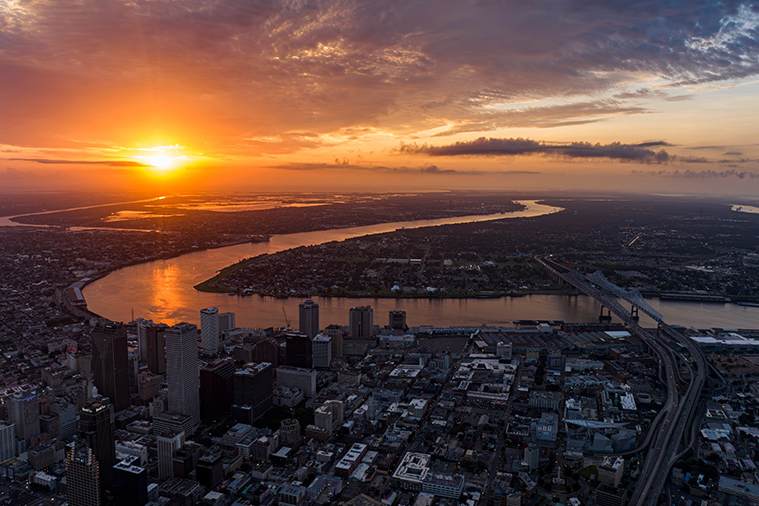
I’ve written repeatedly about community resilience over the years; for example, I penned an article in 2017 for Bloomberg on rebuilding for resilience after the devastating wildfires in Sonoma County, California, where I live.
In this piece, I want to tackle an even tougher case. The city of New Orleans dramatically exemplifies all the paradoxes, problems, and opportunities of resilience building. It is also a second home to me and my wife Janet: she was born there, many of her relatives still live there, and we spend at least a week each year in the Big Easy. So, I know a bit about New Orleans, and I care about the place and its people.
New Orleans also happens to be a lot of fun to write about. So, let’s go!
Vulnerable, precarious, beautiful
Just 21 years ago, New Orleans was nearly wiped away. Hurricane Katrina brought high winds and drenching rain; after levees and pumping stations failed due to human error, much of the city was flooded. It took 43 days to pump the floodwater into the Mississippi River and Lake Pontchartrain. Nearly all the surviving residents had been evacuated. They returned after weeks or months to find buildings destroyed, possessions ruined or gone, entire neighborhoods devastated, and the city steeped in the stench of decay. Over a thousand fatalities were recorded. The hurricane quickly achieved a mythic status and, today, every New Orleanian over age 30 has an emotion-charged story to tell about loss and survival.
This wasn’t the first hurricane or flood for New Orleans. The city is geographically disaster-prone, built on a subsiding river delta, mostly below sea level, with a bowl-like topography. The metropolis is squeezed between two major bodies of water, making it highly susceptible to catastrophic storm surges and flooding, which have taken a heavy toll on several occasions. One was Hurricane Betsy (September 9, 1965), a massive Category 3 storm that flooded eastern New Orleans. It was the first US hurricane to cause $1 billion in damages.
The Crescent City is kept habitable by a 90-mile system of canals and pumping stations, along with huge levees along the river and lakefront. The stations together can pump a staggering 24,300 cubic feet of water per second. Yet, during heavy rains, they sometimes struggle to keep up. That struggle is about to get harder in the context of more extreme temperatures, ongoing loss of coastal land, stronger hurricanes, and rising seas.
New Orleans also faces inherent economic challenges. Its revenues derive mostly from tourism, offshore oil and gas production, shipping, and fishing. Oil and gas production in the Gulf of Mexico is currently riding high, but oil is, after all, a depleting non-renewable resource. Tourism is sensitive to gasoline and jet fuel prices and dependent on tourists having disposable income. Fishing is vulnerable to a host of environmental and economic issues, including overfishing, oil spills, runoff pollution from the Mississippi (which has created a growing “dead zone” in the Gulf), and rising ocean temperatures.
The inherent challenges of maintaining New Orleans are so great that there’s an ongoing debate about whether the city should simply be permanently abandoned. I’ll return to that.
Still, New Orleans residents are fiercely protective of their city. And lots of folks who live elsewhere love to visit the Big Easy. That’s because New Orleans has some things going for it.
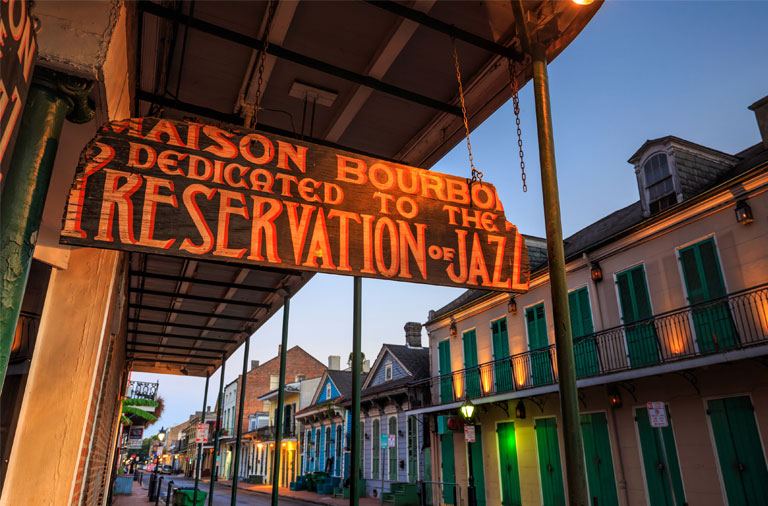
Is New Orleans America’s most magnetic city?
The Crescent City has a long, colorful cultural history; for a taste, I recommend Gary Krist’s book Empire of Sin: A Story of Sex, Jazz, Murder, and the Battle for Modern New Orleans. Today, the city’s culture persists in a unique dialect (“Yat,” derived from the common greeting, “Where y’at?”), as well as foods, architecture, and music that often make you feel you’re somewhere in the Caribbean rather than the United States.
Of all the city’s unique cultural achievements, its music is perhaps its greatest source of pride. Hundreds of full-time musicians carry on New Orleans-related traditions, somehow making a living alongside potential competitors. The fact that so many succeed is largely due to the city’s plethora of live music venues. WWOZ (a listener-supported radio station that plays New Orleans music of all varieties 24/7) publishes a daily online and radio-delivered summary of who’s playing where (the Livewire); even on a weekday, it usually takes the announcer several minutes to name all the performers and venues.
To illustrate the degree to which New Orleans’s music culture has gotten under my own skin, permit me to divulge a little personal info. When I first started visiting the Crescent City, I was a semi-professional classical violinist. Most of the music I listened to consisted of Bach, Brahms, and Paganini. Gradually I added a little Louis Armstrong to my sonic diet. Then, in 2021, a fingertip injury forced me to abandon the violin altogether. I decided to learn piano instead (its flat keys don’t trigger the same nerve pains that metal strings did). I started with a few easy pieces by Bach and Scarlatti but soon found myself gravitating to the New Orleans sound.
New Orleans boasts a long tradition of jazz and blues piano playing, stretching from Jelly Roll Morton in the early years of the 20th century to Fats Domino, Professor Longhair, James Booker, and Dr. John in the rock era; to Jon Batiste, Tom McDermott, Jon Cleary, Harry Connick, Jr., and many others today. There are currently so many great New Orleans pianists that WWOZ hosts an annual “Piano Night” of live performances, during which each of the invited piano pros is given 10 minutes to shine; the quality of their playing ranges from terrific to phenomenal, and the event typically lasts 5 to 6 hours. That’s plenty of inspiration for an aspiring keyboard novice like me. These days, I’m working on learning several songs by Jelly Roll Morton and one by Dr. John.
It’s a common story: many of the “New Orleans musicians” I’ve talked to were born elsewhere, but then became so enraptured by the relaxed, bluesy style of the city’s music that they decided to move to the Big Easy and devote their lives to its culture. One example is a band of forty-somethings called Tuba Skinny, whose 8-or-so members formerly played in grunge bands around the US (its leader, cornetist Shaye Cohn, had a legit musical education on piano). They individually moved to New Orleans after Katrina, then gradually coalesced into a street band with a shared interest in the collective improvisation of 1920s and ’30s jazz and blues. There are plenty of other trad jazz (and so-called Dixieland) groups in New Orleans, but Tuba Skinny has brought an admirable commerciality-be-damned dedication to their art. They can still be heard on the streets of the French Quarter playing for tips, but they also perform at many of the city’s music clubs, and they’ve recorded numerous CDs and toured North America and Europe.
Okay, so New Orleans has plenty of unique culture. What does culture have to do with survival in the face of past and impending disasters? Plenty, it turns out.
Community resilience, New Orleans style
Political scientist Daniel Aldrich, who was living in New Orleans as Hurricane Katrina approached, later decided to conduct a sociological study centered on the question, “Why do some communities recover more quickly and successfully than others in the wake of disaster?” He reported his findings in a book, Building Resilience: Social Capital in Post-Disaster Recovery.
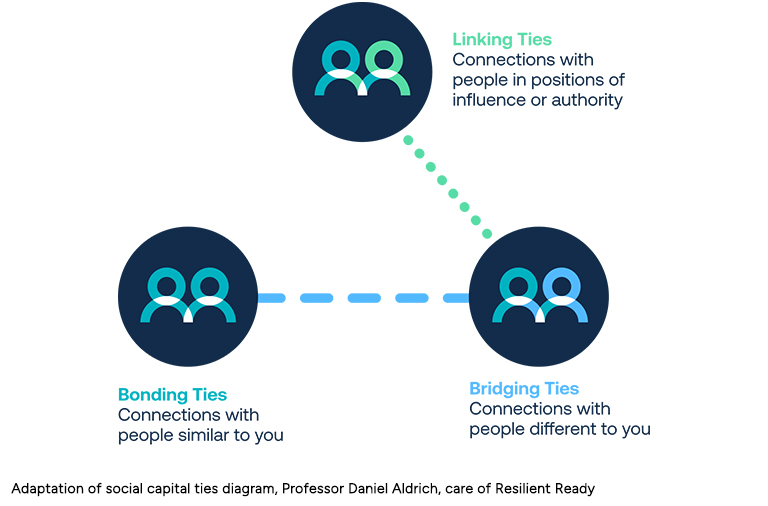
Aldrich’s research suggested that an important factor in determining how well communities recover from a crisis is social capital (specifically, the balance of three different kinds of social capital; see my interview with Aldrich). Social capital is essentially the relationships that people in a community have with one another, manifested in trusting neighborly relations, local gatherings and celebrations, formal and informal community “institutions” (e.g., a convivial neighborhood cafe; a quirky local tradition; a long-standing religious community), and participation in civic life, etc.
New Orleans has a lot of social capital, including not only thriving community organizations but also identifiable local traditions in food, architecture, and music. People talk to one another on the street and ask about their families. Still, as Aldrich found, this fabric of social connections does vary from one neighborhood to the next.
After Katrina, Aldrich studied two neighborhoods, both with approximately equal per capita pre-Katrina incomes: the Lower Ninth Ward, and the largely Vietnamese Village de L’Este in the northeast corner of the city. The Ninth Ward was still devastated years after the disaster, whereas Village de L’Este was 90 percent repopulated within two years. The difference: while there was plenty of one-on-one social bonding in the Ninth Ward, the neighborhood had poor bridging with government at all levels. Social capital isn’t just about the richness of direct contact between people (though that’s vital), but also the functionality of connections between different ethnic and religious groups within the community, and between ordinary people and the holders of resources and decision-making power both within the community and in the larger society.
Tragically, social capital is undervalued in modern society: globalization undermines it, and usually only deep cultural traditions and activist efforts can preserve it against the onslaught of atomizing trends. We stare at our screens rather than talking to our neighbors.
The New Orleans Chamber of Commerce lists 66 community and civic organizations currently active in the city—but this is a fraction of the institutions supporting social capital. There are countless informal clubs, interest groups, and associations, and the city is chock-full of locally owned businesses, religious communities, gorgeous parks and museums, vibrant music venues and art galleries, and is home to several community-oriented local radio stations.
In short, New Orleans has tons of social capital. But sadly, its cultural richness and rootedness may not be enough to enable it to survive much longer.
The last second line
I think a lot about the future of New Orleans, so naturally I watched Dr. Emily Shoerning’s recent climate video on the prospects for Louisiana in a 2°C world. Her forecast for the southern region of the state, based on the most recent county-by-county National Climate Assessment, is devastating. Later this century, New Orleans will be an island, effectively cut off from the Mississippi River and, hence, its main source of fresh water. Even if people continue living in the parts of the city that are still above sea level and they manage to harvest and purify rainwater on a sufficient scale, the prospects for maintaining anything like current levels of population and economic activity are dim indeed.
A recent study published in Nature Sustainability concluded that New Orleans residents should plan now to move away from the city. For the hundreds of thousands who live in New Orleans, and the millions of others, like me, who love the Crescent City, this is an incredibly sad conclusion. And it’s a conclusion that many other cities rich in culture and history will face around the world as sea levels rise.
Somehow, we must imagine ways to transplant the culture of New Orleans to other places. Musicians and listeners can adopt the city’s music anywhere, and chefs in Los Angeles and Peoria can learn to make decent beignets and red beans (many already do). But it would be even more important to identify one or two places where archives, people, and perhaps even some buildings could be rehomed. The American Resiliency climate video for Louisiana, linked above, suggests Lafayette or Baton Rouge as possible sites.
It’s been a life-changer to know New Orleans these last 35 years or so. I hope to keep going back as long as I can. I feel as privileged as the folks who knew Paris in the 1890s or Harlem in the 1920s must have felt. Those of us who’ve been to the Big Easy can make our own communities more resilient through what we’ve seen, heard, and tasted there.
Meanwhile, we’re all living in some version of New Orleans. Every place on Earth is now vulnerable, each community held together by ecosystems under attack and culture that’s unraveling. Still, if we face a century of crises, it’s good to have songs to sing, friends you can count on, and recipes that remind you of good times. Those are just some of the gifts of New Orleans.





Comments
We changed commenting systems on September 10, 2026 as part of a site-wide functionality and security upgrade. Your past comments have not disappeared, and you can still log in with your old Disqus account credentials if you wish. Contact us with any questions.
Like the inability to meet the challenge of increasing green house gases from fossil fuel usage, the eventual depopulation and abandonment of New Orleans is an example of how disintegrated Western civilization has already become. One of the most culturally significant cities of European colonized America will not be saved by responding to global warming with the 'social capital' the city, the US, or even Western Civilization has accrued the past thousand years. Tourists may bemoan the loss, but they cannot be persuaded to cease the exhaust of greenhouse gases that enables the pursuit of their happiness.
For thousands of years, cities have grown up near rivers or the sea, starting with Mesopotamia (literally, "land between two rivers"). This was originally a strength, but in this era of rising sea levels, it has unfortunately become a weakness.
Hmmm… Fertile Crescent civilizations salted the land inadvertently. It hasn't recovered in millennia.
We're raising sea levels non-inadvertently; following decades of careful consideration.