

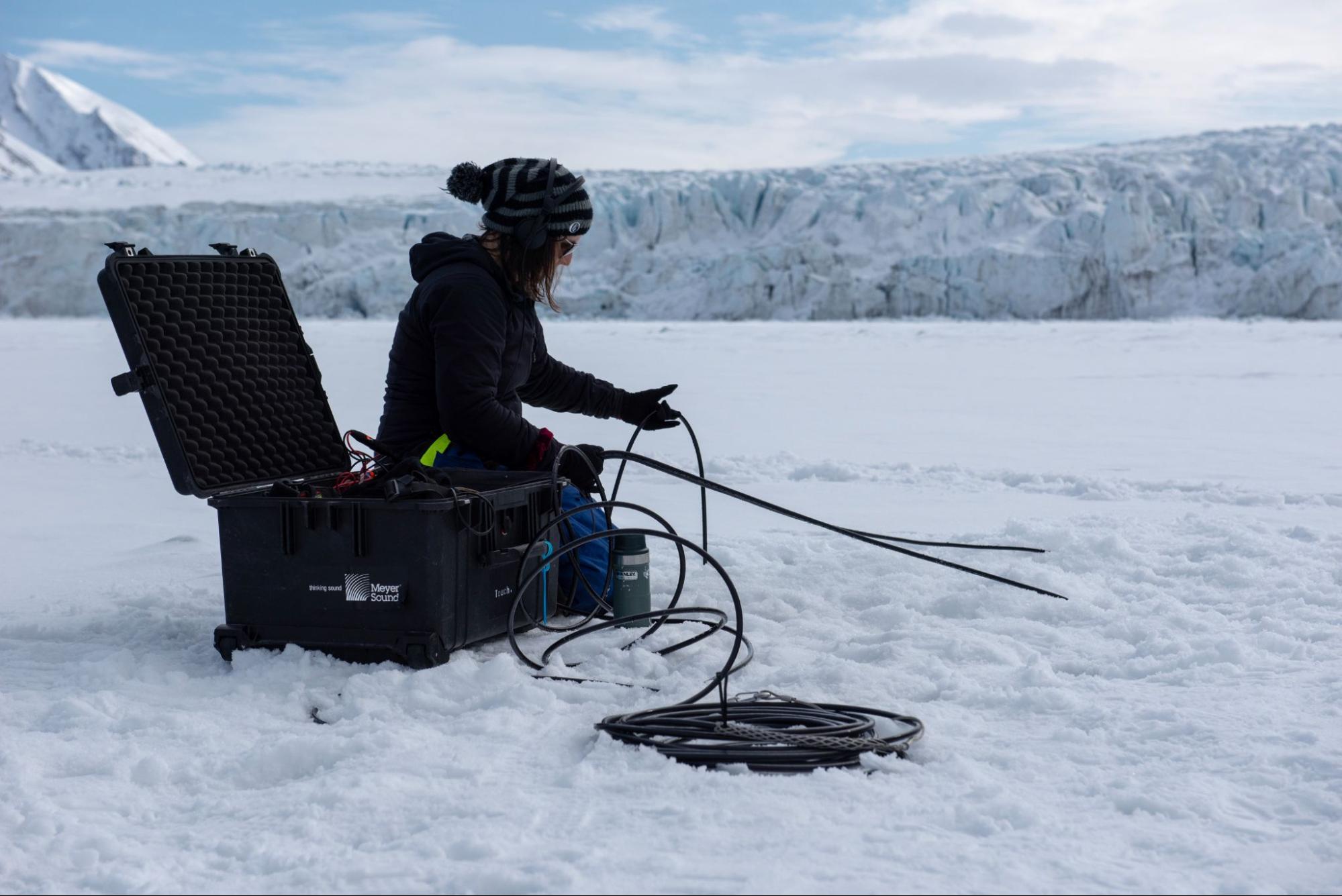
Jana Winderen recording bearded seals under the ice with three hydrophones at Svalbard, a Norwegian archipelago. Photo by Stuart Trowell in 2023.
What does it mean to listen to a planet in crisis? Scholars, scientists and artists are using sound to study biodiversity and the climate crisis, challenging us to consider how we listen to, and with, the living world. Recording technologies are making it possible to listen in unprecedented ways, taking on an increasingly crucial role as a tool for collecting data on species to support their well-being and survival, and as a way for humans to engage with the more-than-human world.
Kara Oehler, Director of the Institute for Climate Sound & Society and co-founder of Harvard’s metaLab, is a journalist and artist whose work focuses on sound, climate and data. In 2025, Oehler curated the “Copenhagen Climate Sound Series” at the University of Copenhagen’s Center for Applied Ecological Thinking, which featured three events. Each event featured a special guest speaker who explored listening as anything but neutral, from who records and controls sonic conservation data to what sound can tell us about the emotional lives of animals, and the soundscapes hidden beneath ice and water.
Among the speakers was Joycelyn Longdon, a researcher and writer working at the intersection of ecology, technology, and environmental justice, whose work examines who is included and who is harmed when digital and machine-learning tools are brought into conservation, Elodie F. Briefer, a biologist who studies acoustic communication and social behavior in captivity animals, and what their voices reveal about their emotional states, and Jana Winderen, an artist who turns her attention to spaces and species that are sonically and physically difficult for humans to reach: deep underwater, inside ice, or in frequencies beyond the range of human hearing.
Sound as embedded in structural reality
In October, Longdon joined Oehler as her first guest. She authored of “Natural Connection, What Indigenous Wisdom & Marginalised People Teach Us About Environmental Action” (2025) and is a PhD Candidate at the University of Cambridge.
Before diving into the many ways that listening technologies can support biodiversity, Oehler opened the series with a critical reflection on monitoring. Exploring the emerging field of Conservation Data Justice, a framework highlighting how neither conservation nor technology is neutral and the power dynamics that exist in both.
Longdon drew attention to the fact that sound monitoring is born in a political context: Sound surveillance, like any other surveillance, risks feeding into pre-existing systems of inequality.
While Longdon sees the many benefits of monitoring, she is also aware of the downsides from her work with forest conservation: “We must ask the same questions as we do with any technology: when the police have cameras, does this make the community feel secure or unsafe?” After all, surveillance and drone technologies are often designed and deployed in war.
Over the past four years, Longdon has conducted collaborative research with a forest-fringe community in Ghana, a country to which she has familial ties. It is in this context that Longdon reflected on the idea of “passive monitoring.” When we imagine a forest or jungle without inhabitants, it seems unobjectionable to place monitors in such a setting. But many people live in what we might consider wilderness.
Not only does monitoring equipment risk violating people’s right to privacy, she explained, it can also perpetuate the perception that communities in the Global South are part of the natural world rather than societies with their own rights and agency. Colonial anthropology often grouped colonized people into studies of flora and fauna. By treating nature as wilderness devoid of human life, we risk extending that taxonomic legacy.
Longdon underlined that trust is a crucial issue when introducing recording technologies into marginalized communities, as data extraction without community input can reinforce colonial practices. She proposed a partnership with local communities as a more ethical, inclusive, and alternative way for scientists and technologists to design and deploy conservation technologies. For her research in Ghana, Longdon and her team held a series of presentations, interviews, and workshops focused on designing conservation data work as a collaborative practice. She documented the workshops and gatherings where passive acoustic monitors were introduced and openly discussed the risks and tensions that emerged.
Because Indigenous peoples all over the world support the stewardship of nature, monitoring projects led by scientists from the Global North can be experienced as a disruption to daily life. At times, science projects even risk trespassing on sovereign territory.
“Biodiversity conservation can further marginalize peoples who are vital to conservation work itself,” Longdon argued. “We have to remember to ask: what are the risks posed by technology when collecting data? We should lead with justice.”
Sound as a tool to ensure animal wellbeing
In early November, Oehler’s second guest, Briefer, from the University of Copenhagen, discussed her work deciphering the wellbeing of animals based on their vocal communication. Most of her experiments take place on farms, where variables can be controlled, and the lived experience of animals in captivity can be observed and documented.
Briefer explained how sound can offer unique insight into animal expressions: “Sound encapsulates a surprising amount of information about the animals’ environment,” she said. “From listening, we know its sex and age but also its mental and physical state. In a way, the identity of the animal is sonic.”
Briefer noticed early in her career evaluating animal welfare that the emotional states of animals receive less attention than their physical health. In her experience, veterinary education emphasizes only physical health during examinations on farms. Thus, inspiring her interest in promoting greater concern for the emotional wellbeing of animals. While this might seem evident to some readers today, it is a relatively new conclusion, emerging only in the 1990s among pharmaceutical researchers. In developing medications to treat depression, researchers began to recognize the importance of assessing lab animals’ emotions during testing, prompting a major push for research on animal emotions as they realized that physical health alone is not enough to ensure good welfare.
Her research shows that vocalisations encode an animal’s affective state. But shrieks of joy and cries of pain are not always mutually intelligible between humans and animals. “There is a risk of transferring human knowledge to animals,” she said. “Human emotions cannot be directly translated into animal emotions.”
Briefer hopes that her research will be used to support better relationships between farm staff and animals, and to raise awareness among veterinarians and farmers of the importance of emotional welfare.
Sound as a way to connect with the otherwise invisible
The final guest for the Climate Sound Series was Norwegian artist Winderen later that month. Winderen’s practice pays particular attention to audio environments and to species which are hard for humans to access, both physically and aurally – deep underwater, inside ice or in frequency ranges inaudible to the human ear. She records the hidden soundscapes of underwater ecosystems, amplifying them to highlight the urgent issues facing marine life. Making these sonic worlds audible often underscores how human activities—from engines to industry—interfere with the delicate communication networks of fish and other species.
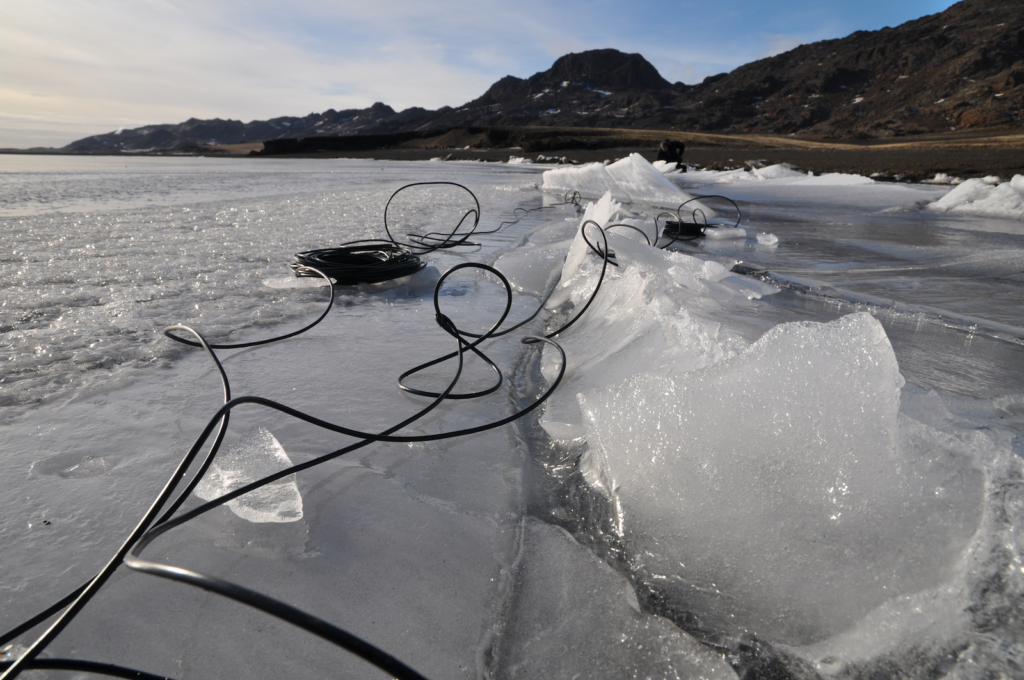
Winderen began her performance lecture by playing a sound that impacted her career – the grunts of wild cod. She first heard the sound of a cod in captivity at a marine research institute in Bergen. But that experience didn’t prepare her for what it would be like to hear cod in the wild, making grunts as part of a larger soundscape. She became fascinated by wild cod and arranged to join a research vessel trip with scientists to follow them as they migrated from the Barents Sea towards the coast of Norway, where they gather to spawn. It was on this trip that she learned that when researchers want to know how old a cod is, they remove the small, dense calcium carbonate “stones” from the inner ear called otoliths. In Greek, otolith literally means “ear stones.” These otoliths have rings that grow annually, similar to the rings in a tree trunk, and researchers can read them to determine age and growth. Remarkably, these ear stones not only carry the demarcation of time for a cod’s life, but they’re also what allow them to hear. They’re both an archive and an instrument of perception.
Winderen’s research has also led her to record creatures in freshwater, including the unexpected sounds of underwater insects such as beetles and backswimmers. Hearing them for the first time, she recalls thinking, “It sounds like underwater crickets!”
Around the same time, she met an underwater biologist who was studying the presence of certain insects in water samples as indicators of water quality. This conversation sparked an idea: if she could identify each insect by its sound, could she, in theory, assess the water’s livability by listening?
“We are making so much noise that we cannot hear that they are not there. We cannot hear the silence. We cannot hear when these sounds are disappearing.”
What events like the Copenhagen Climate Sound Series have demonstrated is that listening plays many roles in the climate crisis: it is a political act, a scientific tool and an artistic practice. Listening demands something of us. Sound is not just a scientific tool or an artistic medium, it is also a lens through which we can examine biodiversity and even the climate crisis itself, allowing us to respond with care and in partnership with the communities and species most affected.


Comments
We changed commenting systems on September 10, 2026 as part of a site-wide functionality and security upgrade. Your past comments have not disappeared, and you can still log in with your old Disqus account credentials if you wish. Contact us with any questions.