

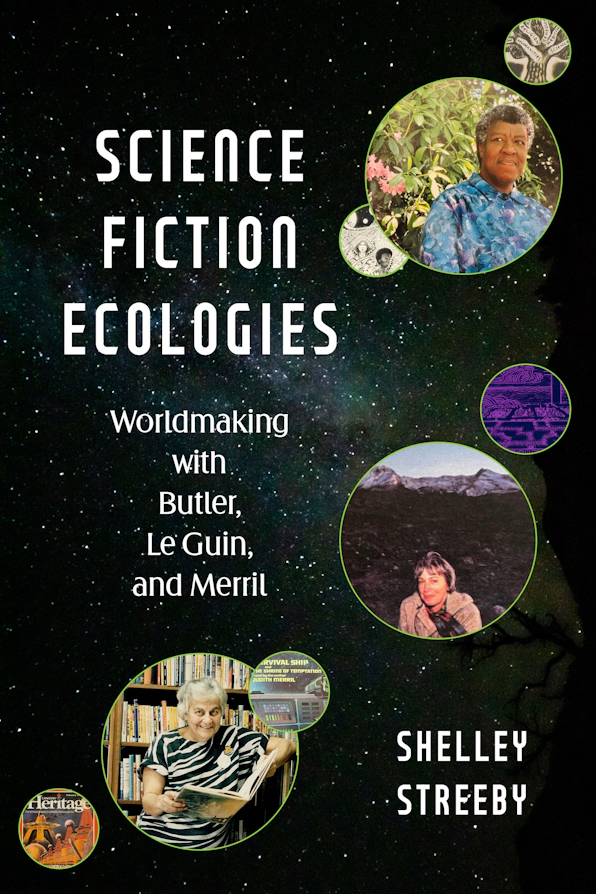
Science Fiction Ecologies: Worldmaking with Butler, Le Guin, and Merril by Shelley Streeby. (NYU Press. August 2026). 376 Pages.
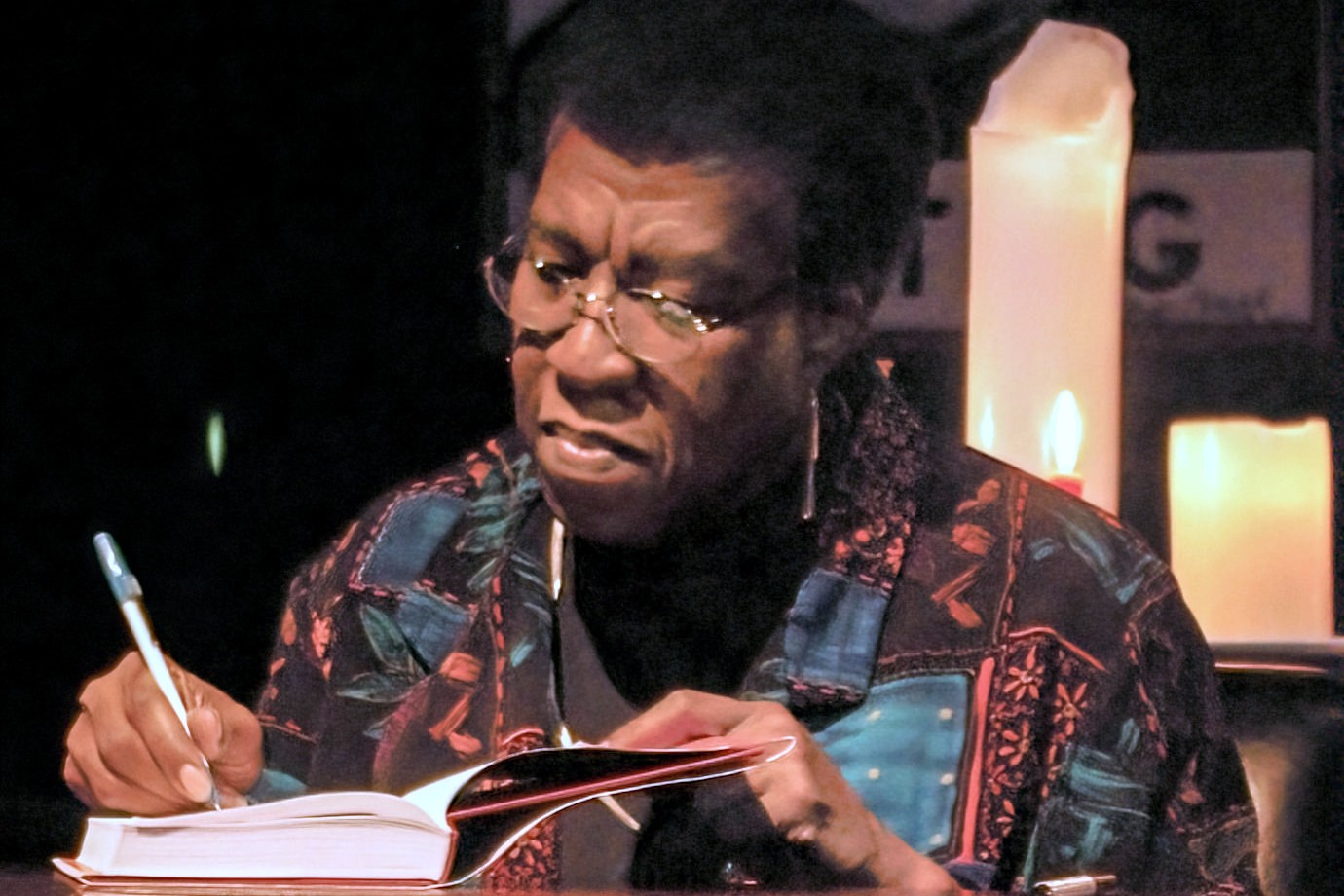
Octavia E. Butler often meditated on change, brainstorming across various archival forms on its meanings and how best to adapt to it. In wire-bound notebooks she used for journaling, Butler speculated in 1981 that “[science fiction] SF readers and writers were more prepared to deal with change since in their reading and writing they practice dealing with it.” Butler believed this made science fiction “one of our more useful and undervalued tools to combat the kind of shortsightedness that makes us fear change, deny it, or become unable to cope with it.” Atop another journal page, Butler wrote “Short-sightedness—the environment,” calling science fiction a way of “Lengthening the View.”
In 1991, Butler took notes on the words environment and ecology from Robert E. Ricklef’s 1973 book Ecology: The Economy of Nature, which she borrowed from the Los Angeles Public Library (LAPL). This book helped establish the field of ecology, went through many editions, and was widely used as a textbook in colleges and universities.
In a blue medium-sized spiral-bound notebook Butler kept during the 1990s to jot down her responses to readings and book tapes, Butler observes that the word ecology derived from the Greek word oikos meaning house or immediate environment. She also notes it now refers to “interrelationships between organisms and their surroundings.” Inside the notebook cover, Butler wrote “Sometimes the challenge is knowing how and yet not doing, sometimes the challenge is to exercise restraint.” She added in red ink, “This is about knowing the science, possessing the technology to do an exploitive thing, and not doing it.” Underneath that, Butler wrote, “Inspired by and too close in present form to The End of Nature by Bill McKibben,” the classic text on global warming and human-caused environmental destruction published in 1989.
This probably refers to Butler’s Parable of the Sower, which explores how a crew of survivors confront near-future environmental, political, and economic disaster together. Underneath it all, Butler wrote extensive notes on how insects adapt to new and toxic environments and, when deprived of their environment, take up new ones.
Two days earlier, Butler proposed to read a chapter a week of essential texts while researching her novel. “Hunt up an Ecology text at LAPL,” she encouraged herself. “Even an exceptionally slow person should be able to manage a chapter a week.” For cross-fertilization, Butler planned to read a chapter per week in two subjects: Ecology and Chemistry or some facet of history.
The word environment had multiple meanings for Butler. The environments, or secondary worlds, fantasy and science fiction authors create in their stories or novels was one important meaning. Butler’s fictional world-making involved painstaking creation of environments in this broad sense of settings and physical and geographical spaces and places that comprise her fictional worlds. To create environments, Butler had to learn about earthly environments. When finishing Kindred, Butler drafted a letter asking an unnamed historical director for help researching the “physical environment” of the Hudson Valley from 1865 to about 1700. Butler also thought about libraries as educational environments, speculating about libraries as material spaces in relation to people, communities, and adjacent, nearby, and faraway environments. Finally, Butler was interested in environmental racism, environmental struggles, and imagining different environments and ecologies that respected relations and responsibilities to the more-than-human world as opposed to short-term thinking and policy-making that intensified extraction and environmental destruction.
Throughout her life, Butler kept research files under the heading “the Environment”. As early as 1980, Butler researched and wrote about alliances between corporations and nation-states that caused environmental destruction, and about media colluding by parroting and popularizing corporate values. In one notebook, inside the cover and continuing her thoughts on a flap of paper she taped to the top, on December 15, 1980, Butler wrote of the Reagan years: “We’re exposed out, I think. Ralph Nader and company will not find themselves well received—if received at all.” Butler predicted “Environmental ‘trade-offs’ will be more readily made, then minimized or not acknowledged at all.” Calling it “Vast Rape,” Butler feared, “Industrial pollution will increase, talk about it will decrease, and complaints will usually fall on deaf ears.” Referring to the abandoned canal site filled with 22,000 tons of chemical waste produced by the Hooker Chemicals and Plastics Corporation that became a national scandal in the late 1970s, Butler predicted it will take a “Love Canal or more to get action, and the action will be inadequate.” A big reason for this was how media articulated US nationalism to corporate environmental destruction, Butler believed. Looking ahead, Butler warned it would become un-American to criticize the “destructive qualities of big business” and media “will minimize such criticism, cowed by governmental assertions that they stand in the way of getting America moving again, putting us back on top.”
When using the word environment, Butler was also inspired by earthly environments in creating fictional settings. In 1980s autobiographical fragments, she explains that her second novel, Mind of My Mind, takes place in modern-day LA County, while the characters afflicted with an alien virus in her fifth novel Clay’s Ark “have their earthly beginnings in the Mojave south of Needles,” which is “where the entire book takes place.” Butler elaborates on how she put together that world based on memories of spending time with her grandma, mother, and uncles in the desert between Victorville and Barstow. There, Butler encountered “Land so empty” that as a little girl she imagined the world ended “off to the east where I could see for miles and miles of greasewood bushes, Joshua trees, and weeds.” Although there were not many people or buildings on the land, Butler emphasizes how her grandma and her family thrived there. “Water was a problem, had to be hauled in for a while,” she remembered, but once they “had the necessary deep well” her grandmother raised chickens for eggs and for sale, along with “just about all the fruit and vegetables we needed for eating,” a few pigs, and a cow. In what some called a wasteland, Butler considered, “we lived very well.” Butler further reflects on how the idea that the desert was a wasteland was a misperception based on a lack of knowledge of the land, which “is taken to be wasteland by people who haven’t seen evidence of the richness of that sandy soil.”
Ecologies and environments were central to Butler’s research when working on the Xenogenesis trilogy in the 1980s. A major concern was the use of short-term thinking to justify environmental destruction. In a notebook, Butler wrote that the Reagan administration was “almost completely constituted of people who think this way—hit and run.” Instead of caring for the future, profit rules while “the holistic future is never considered” and “Only short term desires considered as needs,” Butler charged. In 1983, Butler reflected that those “species who cannot adapt to changing environments or escape those environments are doomed to extinction.” She worried “We ourselves have so altered our environment (most often without thought for consequences” or “considering only the desirable short-term consequences” that “it is becoming deadly to us in a number of ways.” Butler disagreed with environmentalists whose focus on overpopulation blamed working class people of color and Third World people for ecological problems instead of holding responsible corporations and states. Butler suspected environmental degradation was a more urgent problem than overpopulation.
In 1984, while beginning Dawn, Butler noted, “an environment must be created for the project.” While figuring out details for Xenogenesis, Butler was also concerned about her own world and how short term-thinking, corporate extraction, and militarism was reshaping, damaging, and destroying earthly environments. A little later, Butler wrote, “The environment is being altered slowly through greed, indifference, laziness, shortsightedness, ignorance.” Air was “being fouled,” while ground water” was being “poisoned,” and “tropical forest is being cut, leaving land to be leached and made desert,” Butler noted. The result was that “Plant and animal species are being driven into extinction.” Butler worried especially about the exhaustion of Africa. One of the biggest reasons for this, Butler considered, was corporate unwillingness “to consider the environment beyond exploitation and at best provision for future exploitation.”
In February 1985, Butler sought useful reading on the Amazon rainforest before doing research for the post-apocalyptic Earth to which Lilith Iyapo and her companions after aliens rescue them from nuclear war at the price of humans reproducing with aliens in a new sex/gender system that requires a third sex. On a notecard, Butler observed that she was interested in the rainforest because it was “an intense and complex environment” but regretted “human beings seem more intent on destroying it than writing good information books about it.” In 1977, Butler saved a Los Angeles Times clipping about investigations into how the flora and fauna of the Amazon in Peru and Brazil were affected by “the uncontrolled plunder of the jungle and by natural environmental changes.” The piece also commented on how “American scientists” were “studying Amazon plant and animal life just ahead of the power saw and oil rig.” That same year, Butler also saved an article on how in Brazil the “Amazon Land Boom” was “Pushing Indians Out” and threatening the “Hunting Grounds” and “Traditions of 42 Tribes.”
Butler’s trip was a UCLA “Tropical Ecology: The Amazon” class, offered in conjunction with the Los Angeles County Natural History Museum and the American Horticultural Society, and led by botanist Mildred Mathias from June 25 through July 18, 1985. Butler explained in a talk that because she was “a city person raised in a desert” she went “to the Amazon to get a feeling for the place—the rain forest” rather than “to collect facts.” Once there, Butler took detailed notes on the environment, including plants, animals, and humans she encountered. In Tambopata, she remarked on how “backwoods children” were intensely curious about her and wondered if she was “the first Black person” they had seen. She found the children beautiful but worried they were malnourished.
Butler kept detailed notes on her busy schedule, which included getting up and going birding from 5:30 to 5:45 AM, then a quick breakfast, a morning trip, and a lecture before lunch on the eve of motoring up the river “on a boat too small for us.” While taking a walk at a big lagoon and “large lake which was once an ox-bow in the Tambopata river,” Butler decided this was the setting for The Training Floor segment of Dawn. In her speech, Butler told listeners that during the day in the rainforest everything was “green, green, green,” and “desert person” that she was, she “never got tired of it.” On her last day on the Napo River in the Amazon, Butler was still dazzled by the “overwhelmingly green” world around her: “A Southern Californian confronting this would be startled, would notice the color first,” Butler speculated about Lilith, her main viewpoint character.
Later, Butler observed that “the essential Sower idea” was of a woman creating a religion to help “people live with their complex and shifting environment.” In her 1990s reading and book tapes notebook, Butler worried humans were creating and inheriting serious ecological problems such as toxic waste and radioactive waste and global warming. Butler did not know how to move people to act since “we’ve written about these things and read about them” until “they are almost passe as subjects.” Butler wonders what science fiction will be like, if it still exists, when “we have to deal with them more directly.” She fears there will be more “good old days” fantasy, new scapegoats and enemies who have supposedly caused all the trouble, more extraterrestrial SF, and more multi-media, immersive SF, which may encourage passivity and less forethought.
In a 2000 talk, Butler said Parable of the Sower’s main concerns were “Drugs, throwaway labor, illiteracy, the widening gap between rich and poor, our eagerness to fund prisons coupled with our reluctance to fund schools and libraries, and of course, our way of ignoring environmental ills—global warming in particular—even as they begin to do harm.” Butler declared the novel was also about “our tendency to hide from social ills behind neighborhood walls,” while “ignoring environmental ills such as global warming until they do great harm.” While working on Parable of the Talents and unpublished sequels, Butler considered how education would need to change to address environmental struggles, pausing to consider “forming alternative energy, tree/forest planting/desalinating efforts to protect from the effects of global warming.” This was part of a notebook passage where Butler dreams of helping young Black children in non-traditional ways, such as what Butler named learning center apartments–“low rent and child care assured as long as you cooperate, accept your responsibilities to our families and ourselves.”
In the wake of Parable of the Sower, Butler was fascinated by a 1970s theory formulated by chemist James Lovelock and microbiologist Lynn Margulis called the Gaia hypothesis. In her notebook, Butler mused, “Think of the Gaia hypothesis: we have torn ourselves away from the living tissue of the biota of earth and (xeno)transplanted ourselves to a new world.” According to this theory, Gaia is “the global ecosystem, understood to function in the manner of a vast self-regulating organism, in the context of which all living things collectively define and maintain the conditions conducive for life on earth.” This implies that the entire Earth is a “sentient ‘being’ that regulates processes in the natural environment by balancing various aspects of it against others” and that humans are not the center of the world. Another consequence is that life forms not only change in response to environments, but environments actively respond to biological changes.
As early as 1989, Butler considered creating a story about how “humans land on an alien living world and try to fight their way into the environment of the world which rejects them.” In her journal, Butler wrote, “This is a story of ecological misconceptions, immune reactions on a grand scale.” A decade later, Butler returned to this idea when writing the sequel to Parable of the Talents, which she tentatively entitled Parable of the Trickster. In 1999 notes, Butler deplored how “Environmentalism, aid to education, health care, racial equality, etc., are all dumped in favor of grabbing money, squeezing the environment for the last penny, screw trees and animals, water and air, people and progress.” Thinking of the story she was working on, Butler speculated, “On another world this is terrifyingly deadly in such an unforgiving environment.” Butler considered crafting a plot in which “One faction sees the planet as their enemy” while the other “accepts the world and tries to learn more about it, partner with it, and be of use to it.” In other notes, Butler wrote, “We can’t afford to go someplace else and make the mistakes we make here.” Drawing on the Gaia theory, Butler counseled an imaginary human audience not to expect that “another living world with its own biota and its own eons of existence” would “be able to tolerate our nonsense—our hunting and gathering—taking, and putting back nothing—or putting back poisonous waste.” At this point, Butler conceived of the novel as the story of her protagonist’s struggle to “defeat quick and dirty ecological methods, corruption, and tyranny in her colony’s partnership with one another and with their new world” in which “each one of them is tempted to the quick, corrupt, and dirty by a plague of hallucinations.”
Environmental struggles were still on Butler’s mind as she brainstormed in the last years of her life on her never-completed novel Spiritus. In Spring 2023, she summarized it as “the story of a reincarnating spirit who, once it understands its power, joins with a community of its kind to take over the country and eventually the world, aiming to run it without world wars, without starvation, with universal education, health care, and sustainable environmental stewardship so that we live more lightly on the earth.”


Comments
We changed commenting systems on September 10, 2026 as part of a site-wide functionality and security upgrade. Your past comments have not disappeared, and you can still log in with your old Disqus account credentials if you wish. Contact us with any questions.