

Why are worldviews so drastically different? Why is it that obvious truths to one person can seem like unhinged insanity to another? The incongruity can be especially pronounced when pertaining to divergences among people who are clearly smart and well-educated.
The last month or so has been dedicated to posts airing the moderated conversation I had with Dave Murphy about whether technology saves modernity or the whole enterprise lacks viability. The net result is probably best described as an impasse: neither of us seemed to move very far from discordant starting positions.
This post contains a bit of musing about the foundations underpinning the disconnect. Because it comes out of my meat-brain, it’s likely all wrong—but it’s the best I can come up with. Maybe the general principle advanced here applies to other disconnects we encounter with others, to some degree. In a sense, it’s all in our heads.
A new dope
What’s behind the disconnect, at base, may be a difference in opinion as to who’s the boss: humans or the universe? Is our brain-power so magnificent as to have flipped the script for the first time in Earth history, allowing humans to reject and transcend the constraints that have applied to all other beings? Are we now effectively and indefinitely apart from nature, in our sealed and controlled boxes? Do we put our faith in novel human thought, or in deep-time relationships—as expressed by the universe in realms like ecology?
Humans have been on this planet for about 3 million years, or 300,000 years in the form of Homo sapiens. The vast majority of that time has been ecologically governed/constrained. Another way to put this—the contemptuous way modernity might put it—is that humans once lived more like animals. They (not we, of course) were at the mercy of wild nature: not in full control as we are now. Human population was thus held in check, which modern mythology naively interprets as a testament to misery.
Human cognition facilitated the adoption of agricultural practices. The resulting mix of surplus/storage, settlement, possessions, division of labor, hierarchy, etc. instantiated numerous novel, positive feedback loops that quickly jumped population doubling time to 2,000 years from 20,000 years or longer—or sometimes contracting. Most in our culture throw this fact on the same pile of positive traits as all the other praise heaped on the agricultural innovation: unshackling humans from demeaning limits. But the innovation has an obvious fatal flaw: it sets us on a rapid and—by all appearances—unstoppable path to overshoot in a time that is short in ecological terms. The widespread adoption of agriculture was a big deal. A fuse was lit.
Dominant cultural beliefs went from a basis in animism—emphasizing gratitude and humility as part of an integrated whole—to a basis in exceptionalism: we’re apart from; on top of; masters of nature—as a separate category. The world is ours to use—created for us, in many tellings.
The inside/outside game
Perhaps counter-intuitively (certainly counter-cognitively), the best wisdom might derive from placing little stock in what goes on inside human brains (and what they write/produce).
Most of the universe is outside human brains, and has been since the beginning. Human brains are obviously a tiny—and new—subset of full reality…and also remarkably resistant to permitting this fact to truly sink in.
Inside human brains, fault-prone fragments of logic stripped of most relational complexity struggle to creep along at a few tens of bits per second.
Outside human brains, even the air particles in a single room are turning over information at rates around 1040 bits per second. The universe as a whole unfathomably outstrips what our puny meat-brains can track.
Inside human brains, modernity can be thought to be ecologically compatible. It’s so easy. Billions do it every day.
Outside human brains, a sixth mass extinction is underway. Most brains are unaware of or simply deny this paralyzing reality, which—importantly—they are completely free to do. Mental models suffer no constraint on truth or accuracy.
Inside human brains, agriculture is A-Okay: why shouldn’t it be?
Outside, an order-of-magnitude jump in the rate of population growth lit that fuse mentioned before.
Inside human brains, a 10,000-year fuse is deemed unimaginably long and, as such, effectively irrelevant. Nothing stops a brain from just deciding that.
Outside, 10,000 years is a blink on ecological, evolutionary, and geological terms. Nothing stops the universe from ignoring the brain’s slapdash assessment.
Before agriculture, when numerous ecological relationships—rather than cerebral imaginings—prescribed viable human modalities, the human population was approximately a proportional share of the 5,000 mammal species in terms of biomass, with 50,000 kg of wild land mammal mass per human. Today, it’s 2.5 kg: the furry critters have been almost completely displaced.
Inside human brains, humans are categorically separate from icky biology—and could even install themselves in sterile space if they wish hard enough.
Outside, no such thing actually happens beyond short-lived, phenomenally expensive stunts. Moreover, mentally fabricated categories are not binding to the universe.
Inside human brains, Likes need not be tangled with Dislikes. What a headache!
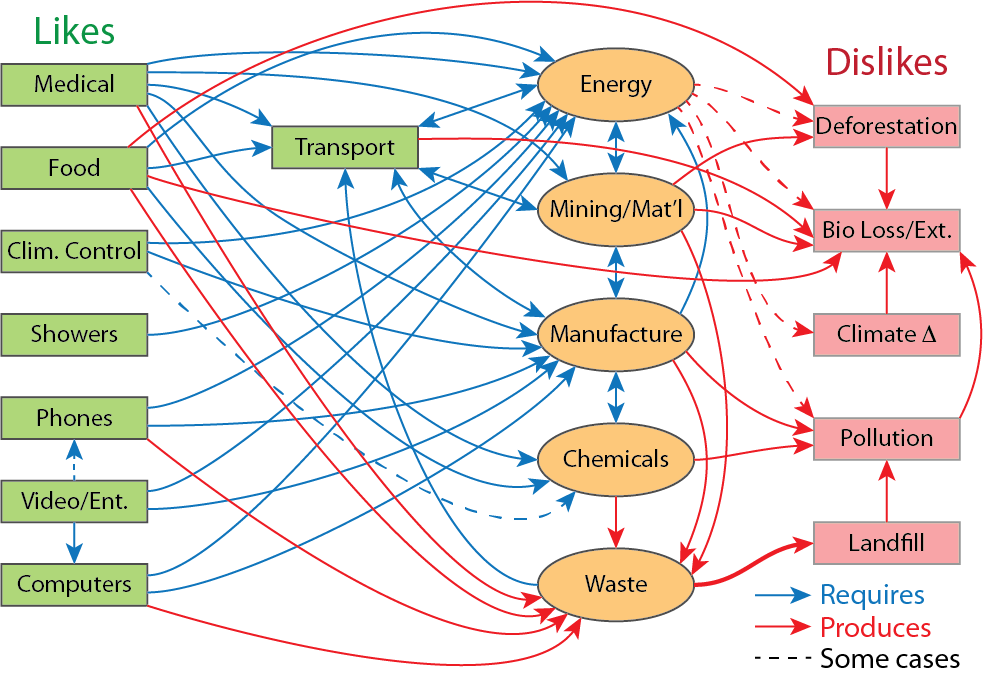
Outside, zero evidence obtains that they are separable.
For instance, inside human brains, a modern perk like medical care can be admired in isolation, sliced out as if served separately.
Outside, it is inextricably and bewilderingly hitched to every other phenomenon, including the most heinous practices of our day—even if our brains are oblivious to those entanglements.
Self-Deception
Human brains—and especially the modernity-promoted left hemispheres—love separation, categorization, abstraction, decontextualization, and logic. They are so proud of the matter we’ve pushed around, pretending to have created a viable alternative to a now-obsolete ecology—even if not commonly cast in those terms, exactly.
Our modernity-steeped culture is prepared to do anything to keep the sixth mass extinction fully underway—I mean, keep modernity intact. Same thing.
The point is, what goes on in our heads is an insubstantial veneer within a larger, robust reality. Temporary and patently unsustainable practices can easily fool our gullible brains into the convenient and flattering belief that we’ve invented the one right way to live, amplified by pride in this “accomplishment.” Unreserved praise of agriculture, technology, medical care, etc., is the norm. But in ecological terms, our brains have led us—and countless innocent species—down a dead-end path.
Across billions of years, not a single instance is known to us of a cognitively-fabricated way of life sustaining for ecologically-relevant timescales. For that matter, no species has demonstrated enduring genetic viability after removing most selective pressures—like essentially eliminating infant mortality, for example. Hello, baffling health crises! We’re really playing with fire on many fronts.
Even though the present experiment has spiraled in an ecological blink, inside human brains, we see no reason that we can’t cognitively concoct a viable template for living. Listen to that: we see no reason. That accidentally professed blindness goes an awfully long way toward accounting for the tragedy! We should be especially attentive to the fact that we stink at anticipating full consequences.
Dismissing thought?
Why is it that over millennia of thinking and writing, so few have thought to discount and distrust thought as a viable basis on which to structure the foundations of how to live, when nowhere else has it been shown to succeed? It seems an insight this profoundly relevant (and straightforward) would at least be well-discussed, even if a matter of unsettled debate. But how could debate even serve to refute the hypothesis? Is it at all valid to dismiss the idea via a process of thought? It’s sort of a self-destructive “Kryptonite Konjecture”. How many have even been exposed to a serious exploration of this theme? Is it just that scholars make a living on thought, and would never think to directly defile their primary tool? Is it back to the famous Upton Sinclair quote?
Brains can only know what they know and have an insanely strong tendency to believe they are right—as a byproduct of their necessarily limited capacities. In fact, show of hands: how many here think they have the wrong metaphysics? Given stark incompatibilities, they can’t all be right—if any of them are. Religion operates similarly, and it’s far beyond coincidence that billions swear by the religion they happened to be born into. In the case of the human-supremacist system of modernity that we were all born into, the least obvious premise—that for the first time in the universe, as far as we know, a viable bypass to ecology arises from neurons—is swallowed as obviously obvious. There’s a self-flattering glitch in there, somewhere.
Escape hatch?
How might we try to avoid the trap of our manifestly faulty brains? One approach is to rely as little as possible on cognitive products: those of ourselves and of others. If that seems to leave nothing, then you’re deeply ensnared in the myth of cognitive primacy. What else is there, you ask? Why, most of the universe, of course! Scientists working at the edge of knowledge learn to try multiple triangulating approaches to address the question “how do I know if this is right?”—generally by asking the universe in various ways and hoping to be receptive enough to interpret its answer. For any piece of “knowledge,” ask about its provenance. Did it come primarily from human brains within recent millennia, or is it printed in the stars and rocks and living webs and DNA across deep time? There’s plenty of the latter to admire.
It also seems prudent to seek the least anthropocentric, least individual-promoting view as a default. How many times must we learn the lesson that it’s not about us? Earth does not revolve around us, is not the center of the universe, and humans are one temporary product/variant of many millions falling out of evolution—sharing substantial DNA with microbes like amoebas. Oh…and if you prick us, do we not turn up elementary particles? Yet, plenty of mind-worshipers seem willing to cast even that as nothing more than an illusion created by the transcendent individual.
We might do well to place greater stock in non-cognitive deep-time arrangements that have arisen and proven themselves in a full ecological context. Blind faith in novel cognitive schemes is deeply risky and—given our demonstrated capacity for destruction—ultimately severely unethical to other species and to future humans. Let’s stop being the supervillains of the planet, just so we can have a few short-lived supervillain perks and pride of “accomplishment.” The only accomplishment that really matters in the long view is enduring viability within a diverse Community of Life. The flashes and bangs can go jump in a lake.




Comments
We changed commenting systems on September 10, 2026 as part of a site-wide functionality and security upgrade. Your past comments have not disappeared, and you can still log in with your old Disqus account credentials if you wish. Contact us with any questions.
It is true that all brains are faulty. Almost all of them (of any species) are strongly inclined towards their own individual survival. Humans use thought for their individual survival, but is it just us? I would like the author to elaborate on his concept of 'thinking' and behavior.
Self-preservation is common to meat brains through their natural lifespan, be it humans to amoebas to newts. Life is not easy. Organisms will change the environment in their favor when possible. For humans, their individual actions of humans led to agriculture. It's still keeping us alive.
By the author's description, the alternatives are undefined, collective, and far in the future. It may mean the extinction of humanity, which is not seen as necessarily a bad thing. At the very least, we should shed human cognition and live more like animals. As an individual human, I think that's worse.
The issue is modern culture. Humans fit into their ecosystems well enough for thousands of years by virtue of cultural beliefs that placed people within the community of life. Any indigenous society that survived thousands of years without farming is an example.
People in those societies did (and do) think, converse, compare ideas, love, and develop spiritually. They just don't make cars or try to separate themselves from the natural setting.
Yes, "the flashes and bangs can go jump in a [polluted] lake."
I found one passage that stirred my response: "Brains can only know what [they believe] they know and have an insanely strong tendency to believe they are right — as a byproduct of their necessarily limited capacities." Maybe that tendency isn't totally insane; maybe a significant portion of the subtly self-imposed limits are due to millennia-deep cultural indoctrination in the illusion of separation. Maybe our defensiveness is our own worst enemy.
Soon after the first seeds were planted by hominids, fences were erected, laws were enacted, and the doctrines of exclusion and hierarchy, ambition and competition and dominance all came to define "civilized" human culture. "Property" was invented, and then armies.
It would be thousands of years for humanity to produce an Abraham Maslow, to diagram human struggles as a pyramid. It took another stretch of time for a Marshall Rosenberg to point out that much of our interpersonal conflict is due to our (and/or others') unmet needs.
The aggressiveness, greed, and other ego-centered behaviors may just be compensations for deep-seated fears, socially conditioned. And the "…to believe they are right" may be a similar response, due the doubt engendered by the failure of cultural "story" to match the truth that nature displays, without compromise or explanation.
Maybe, had we not been collectively driven into deep insecurity (by the culturally reinforced "success" of dominators), we would still be celebrating the invention of the shovel, passed graciously from hand to hand. And maybe that shovel would be used to direct surface waters to the broadest coverage of the land, enhancing and enriching our own habitat and the biodiverse ecology that supports all of life.
A Man Said to the Universe
By Stephen Crane
A man said to the universe:
“Sir, I exist!”
“However,” replied the universe,
“The fact has not created in me
A sense of obligation.”