

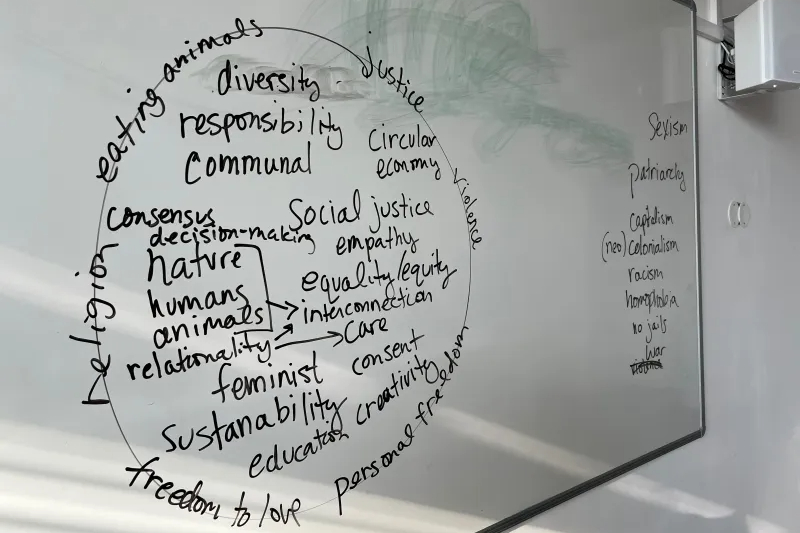
Author’s photograph of the described in-class project. Summer semester 2026.
Every year in my course “Feminism and the Environmental Movements,” we take a part of one class session about halfway through the semester and explore what an ecofeminist world should look like. I begin by drawing a large circle on the whiteboard, representing the world and as a class we discuss what belongs in the world. That information goes inside the circle. What we don’t think belongs within an ecofeminist world, I write on the far corners of the board. Then there are those topics about which no consensus can be made. Those I write along the edge of the circle, and we spend considerable class time debating the reasons why those ideas are controversial.
Consistently, various patriarchal institutions, and indeed patriarchy itself, find themselves banished to the far reaches of the whiteboard: racism; sexism; dualistic thinking; homophobia; transphobia; classism; capitalism; (neo)colonialism; and war. Those ideas that make it within the circle often include diversity, responsibility, nature, feminism, interconnection, care, relationality, community, consensus decision-making, animals, and nature. What stays along the edge is often ideas like eating animals, whether religion is necessary or not, violence, and so on.
I often push them on the religion issue, reminding them that while it may not be important for them, some people find great sustenance in their spiritual lives. When it comes to violence, the debate often comes down to whether or not humanity can ever truly rid the world of violence and whether or not human nature is somehow always minimally violent. Sometimes, the discussion around violence looks at how some animals kill other animals for sustenance and how that kind of violence is deeply connected to their needs. Other times, particularly this year, we discussed how eating animals requires violence if some of us want to continue to do so.
After we have this basic idea on the board and the discussion is well exhausted, I will then (time permitting) pose the question: how do we get from where we are to here? This is when the conversation often turns rather pessimistic.
Students often cannot think of examples of how to uproot capitalism in any meaningful way. They do not see ways in which they can convince people to stop hating others for the color of their skin, for whom they love, for their gender identity, and so on, nor can they decide how much democracy is or is not an ecofeminist system or, failing that, how to have large populations who practice consensus. So, they often say something along the lines of the following: we should recycle, buy second-hand clothing, eat fewer animals, eat locally, vote for individuals whose values match ecofeminist ones, and participate in activist movements for change.
I find that this list often leaves me wanting, as many of us already do these things and find it hard to see truly meaningful change in the system.
I thought that perhaps I need to branch out for answers and decided to come to this blog for inspiration. My question for the reader is twofold.
- What do you think needs to be included in our ecofeminist world?
- How do we work to bring about that world?
I would love to hear your suggestions. May an ecofeminist world soon become reality.
(Add your ideas in the comments below.)




Comments
We changed commenting systems on September 10, 2026 as part of a site-wide functionality and security upgrade. Your past comments have not disappeared, and you can still log in with your old Disqus account credentials if you wish. Contact us with any questions.
On how we get there, specifically in relation to racism, sexism, sectism, etc,: I think we need to recognize that the tendency to feel good about cementing oneself within a group by vilifying the Other is very likely hardwired in humans. This doesn't mean we shouldn't or can't circumvent it, but I think we need strong cultural precepts to work against it, first by naming and recognizing it, and then by instilling the idea that it's wrong and counterproductive to Other groups outside one's own, at least without provocation. There could be exercises, ditties, etc. learned in childhood: don't run with scissors, it's good to share, no one is bad just because they're different.
On your board, which I assume is representative of one of your sessions, I can see a lot of politically related ideas, but not much to do with clarifying and defining feminism, ecological practices, or ecofeminism. Of course, many of them are very closely related, but when it comes to eating the elephant, surely the path must be to do it one bite at a time. I find it helpful to start with some definitions: what is feminism? What is ecofeminism? My personal definition would be something along the lines of applying ecological principles in order to free women and girls from the patriarchy. It is frequently an issue that feminism becomes the engine for all socially progressive ideas, diluting its core objective. Unsurprising, when you think about it.
For me, as a radical feminist, I believe that identifying some of the mechanisms through which women and girls are acutely exploited and rallying against those is helpful: it is not possible to dismantle the patriarchy in one fell swoop, so I prioritise. This may come in the form of campaigning in person, attending rallies and conferences, donating to grassroots organisations, reading around the subject in my spare time, but the most transformative action I can do as an individual is quite low-key. I talk to people, I try to have those uncomfortable conversations with individuals who are not in agreement with me to explore our differences, I parent my children extremely consciously with particular focus on boundaries and emotional awareness. I garden, I meet others in my local community, I try to avoid limiting myself to others who think similarly to me. I found and work on projects that align with my philosophies, and those that are close enough.
There is no silver bullet to end the exploitation of women, girls and other female creatures, and there are no big, ego-boosting actions that we could take as individuals, but there are so many tangible, small, humble actions that taken together may effect the change. The first step is acknowledging how small your contribution actually is, looking to form bonds with others, even if there are seemingly intractable political difference, and doing something real. Whether any of this follows the ecological principles of ecofeminism, I don't know. It would be interesting to define what is ecofeminism precisely, separate from other social justice movements, so you understand what change it is trying to bring about.
Get women ELECTED- at any level, from President on down. The example of women being competent leaders will do a great deal to 'equalize' the current disparity. And, sure.. maybe 'we' get a Margaret Thatcher.. but we might get an Angela Merkel or a Mary Robinson. At any rate, women being visibly in charge would do wonders to change attitudes, ultimately. ^..^
Fundamental to an ecofeminist world would be a radical change in social values For example, instead of competition, cooperation, instead of domination, caring for each other, instead of private accumulation, sharing. There are other important values, but none more important than non-violence as the primary organizing principle of society and means for resolving conflict. Throughout recorded history, violence has overwhelmingly been perpetrated of, by and for men to establish and maintain the male-supremacist hierarchy. Until male violence, at all levels of society, can be reigned in there is little chance for an ecofeminist society.