

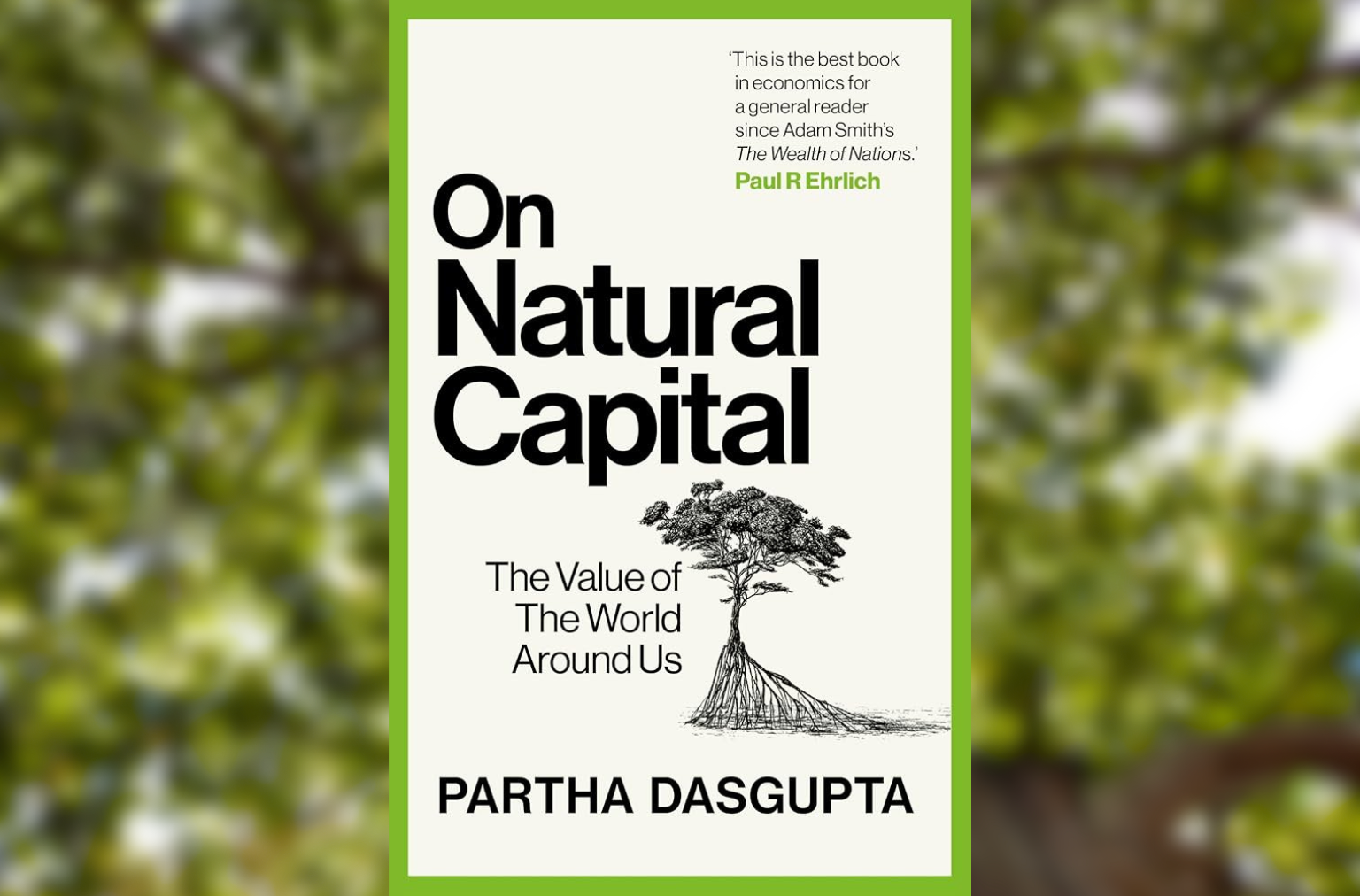
When you pick up this book, anticipating many hours in the company of Sir Partha Dasgupta, a distinguished Professor of Economics at the University of Cambridge, you are immediately met by three prestigious sign spinners, which he has earned through his career. The New York Times calls him “the most important person you’ve never heard of.” Sir David Attenborough writes, “Partha Dasgupta provides the compass we urgently need… By bringing economics and ecology together, we can help save the natural world at what may be the last minute — and in doing so, save ourselves.” While the late Paul R. Ehrlich goes so far as to describe this as “the best book in economics for the general reader since Adam Smith’s The Wealth of Nations.”
The book was born out of a report on the economics of biodiversity, commissioned by the UK government in 2019 and published by Partha in 2021 — the report was 610 pages. On Natural Capital is just 200, but he avoids the pitfalls of someone attempting to achieve such esteemed commendations using relatively little.
This is not a polemic reliant on reductionism and grandiosity. At every stage requiring nuance, Partha either delves into it or stresses that it is there. At every stage that feels prerequisite to purple prose, he avoids grand unifying sentences, instead jabbing the reader with a precise combination of relevant facts. On Natural Capital reads like an academic paper: one devoid of jargon, dead set on clarity, with a refreshing faith in the reader’s ability to consider his thesis at the level Partha delivers it — objectively.
And yet, despite his stressing complexity, the central thesis is, admissibly, simple: we cannot continue to take from the natural world at the rate we currently do. It’s immoral in the first instance and impossible in the second.
We have always known, haven’t we? The uncomfortable truth. Despite the unprecedented surge in global GDP over the past century and an increase in life expectancy from 47 to 73, nature is not boundless; our consumption cannot increase forever. And this paradox has led to kicking the can: let’s get richer, or at least less poor. Except this can has just hit a wall, and Partha forces us to look up at the shadow now looming over us.
In the past 50 years, wildlife populations have declined by 73%. The size of low-oxygen areas in the ocean (because of algal growth, because of our actions) has increased by an area roughly the size of the European Union, and the number of zero-oxygen areas has quadrupled. The extinction rate is currently 100 to 1000 times the previous average. Owing to asteroids the size of cities or incomprehensibly severe volcanism, there have been five mass extinction events in Earth’s history — we are currently living through the sixth, according to Partha.
Since the publication of this hardback in January, the UK government has released a report concerning global ecosystems. The report was not about natural heritage or food standards, but about the biodiversity crisis as an urgent matter of national security (if the supply chain and food security collapse, geopolitical instability will ensue).
Much of the nature we exploit is an “open access resource”: we don’t pay for its exploitation, and implicit in our economic models — such as GDP — is an assumption that these resources will last forever. Acting in self-interest, we are collectively plunged into a “tragedy of the commons”, where it is always incumbent to overuse and deplete an open-access resource (because if you don’t, the person next to you will).
Natural capital, however, takes time to regenerate. If we do not allow it enough time before taking again, stocks will invariably decrease. And we are not giving the natural world enough time. Partha cites estimates that, at our current rate of consumption, we would need 1.7 Earths to sustainably provide us with resources (and, interestingly, that we only crossed the threshold of needing one Earth in the early 1970s).
The side effects of our exploitation, which economists call “externalities”, are also not incorporated into mainstream economics (and therefore pricing). When we buy shrimp from a shrimp farm, we pay for the cost of production; we do not pay for the costs incurred by the local community for the loss of their biodiversity.
Natural capital does not exist in a vacuum, however. The nature we use relies on complex ecosystems, which provide “maintenance and regulation services” that facilitate overall persistence (natural stocks require seed dispersal, pollinators, and waste decomposition, for example, all of which themselves require other processes, and so it goes on).
This cross-reliance that powers an ecosystem is complicated — so complicated that we do not fully understand it (and much of it is invisible, occurring in the soil beneath our feet, or in deep oceans). When we desecrate an area, we can inadvertently set into motion a chain of events that leads to ecosystem collapse.
All this culminates in a fundamental truth of our existence — we are embedded within nature, not separate from it. And Partha grounds his vision in a utilitarianism which extends into the future. We cannot plunder indefinitely because we will run out of resources, and externalities are influential, as they damage how reliable and resilient natural capital is.
We must therefore pay for what we use. Either directly, such as rent on the open seas, or indirectly, such as rent paid to countries not to exploit their own natural capital. Rainforests, for example, are a public good — we use their oxygen to breathe, their carbon sequestration to offset our emissions and their biodiversity for our own wellbeing (even if we never visit). Since we use these things for free, however, countries are incentivised to exploit the land.
He acknowledges the crudeness of this, but we are the arbiters of a balance sheet which our ancestors will inherit, and this balance sheet must include nature. We must therefore update economic measures to account for our impact on biodiversity, align our incentives with the public good and find ethical ways to facilitate stable population levels.
Here, then, is the can: metropolises, agricultural fields, prosperity. And there is the wall: unstable climate, ecological collapse, human extinction. Solutions were never going to be easy. But even when juggling these stakes, Sir Partha remains coolly academic, formally taking us through the rationale for the continuation of human civilisation — this being the hidden foundation of meaning in our own lives.
We live in an era of culture wars, where stances on anything are dismissed as little more than an expression of factional loyalty. A cynic will read On Natural Capital primed for this accusation, but the book works outside our discourse: it is a mature, spiteless, ideology-free work of illumination. This makes it a masterclass in persuasion, and an honest blueprint for how we must proceed.



Comments
We changed commenting systems on September 10, 2026 as part of a site-wide functionality and security upgrade. Your past comments have not disappeared, and you can still log in with your old Disqus account credentials if you wish. Contact us with any questions.
Thanks for the review — it makes me want to read the book. Two thoughts arose right off the bat from your description of Dasgupta's premise: (1) We're stuck in a finance/economics worldview rather than an ecology worldview (as revealed by terms like "natural capital"); (2) I believe Dasgupta is right, but he is ecologically literate — the folks in charge of banks and boardrooms tend not to be — and we've been unsuccessful for decades in doing away with exploitative, profit-seeking rules and institutions. The biggest questions aren't about what needs to change economically to achieve a sustainable and fair society. The biggest questions are about how to get from what we have now to what Dasgupta is recommending.
We have to acknowledge that 'the environmentalists' lost. The neoliberal/consume/grow brigade won.
Which has implications for the future – the System will collapse through lack of the growth it needs, plus growing entropy. But those setting up the replacement formats – and I suspect they will be many and local – need to keep that flawed human trait front and centre. There is no 'somewhere else' to shift to, when you run the experiment globally.
Hi Rob – thanks for your comment! I agree with your sentiment, and on a podcast somewhere Partha was challenged on exactly this. His answer was to say that he is, in the end, an economist and not a politician.
If a politician asks him for the economic solution to a particular problem, he can provide that solution — but it is ultimately the politician/societies job to find a way to actually implement this, and you are right to say this has proved difficult.
He did say he thinks the biodiversity crisis has some advantages over the climate crisis, in that it is more relatable to peoples every day lives (people see and appreciate nature every time they go outside, whereas the "climate" is a somewhat abstract concept for a lot of the public), and that this cross-cultural appreciation for the natural world could be harnessed to find political consensuses.