

With permission from r3.0 (Redesign for Resilience & Regeneration), a nonprofit that reimagines how the global economy can truly support people and the planet, we’re publishing selected chapters from its Seeds Series Volume 2 as part of an ongoing series.
This new volume explores a vital question: how can societies intentionally dismantle collapsing systems and replace them with regenerative ones that can endure and help life flourish?
Read the full series here, beginning with the Executive Summary.
Humanity faces a predicament – one of our own making, no less. In his 2008 book The Long Descent, John Michael Greer famously writes,
“a problem calls for a solution,” while a “predicament, by contrast, has no solution.” Greer continues: “Faced with a predicament, people come up with responses. Those responses may succeed, they may fail, or they may fall somewhere in between, but none of them ‘solves’ the predicament, in the sense that none of them makes it go away.”
This distinction between solution and response is pivotal when faced with what some call a polycrisis, or conjoined cascading crises that can aggregate into existential threats, and others call a metacrisis, or meaning-making crisis, which adds that the logics (the ontologics and epistemologics, if you will) causing these crises are also cognitively and culturally embedded in the solution space, paradoxically creating self-reinforcing feedback loops that further lock-in our predicament. Prominent leaders and predominant institutions in our contemporary civilizations don’t realize that the solution is the problem.
Civilization is Predicament: Class-based power defines civilization & ensures collapse
The very term “civilization ” demonstrates the paradox of the predicament quite well. The term carries two important connotations, one quantitative, the other qualitative.
Quantitatively, civilization simply implies size – a large society, typically one that knits cities together (the term civilization derives in part from the Latin civitas, or city). A common usage has emerged that’s shorthand for sufficient societal scale to impact at systemic levels, and it is commonly used in solution spaces to indicate a kind of gravitas of scale: “don’t worry, we’re thinking big, big picture,” the use of the term signals.
Qualitatively, however, the notion of civilization carries much heavier baggage, most problematically, its inherent supremacist nature. Civilization is predicated on class (and often race and sex) hierarchies, enforced via state monopolization of violence. “Civilization concentrates power,” according to Wikipedia, the broadest consensus source available, “extending human control over the rest of nature, including over other human beings”.
Interestingly, it is this very cleaving of access to power that dooms civilizations to collapse.
Let’s unpack that sentence slowly, starting with the last part first.
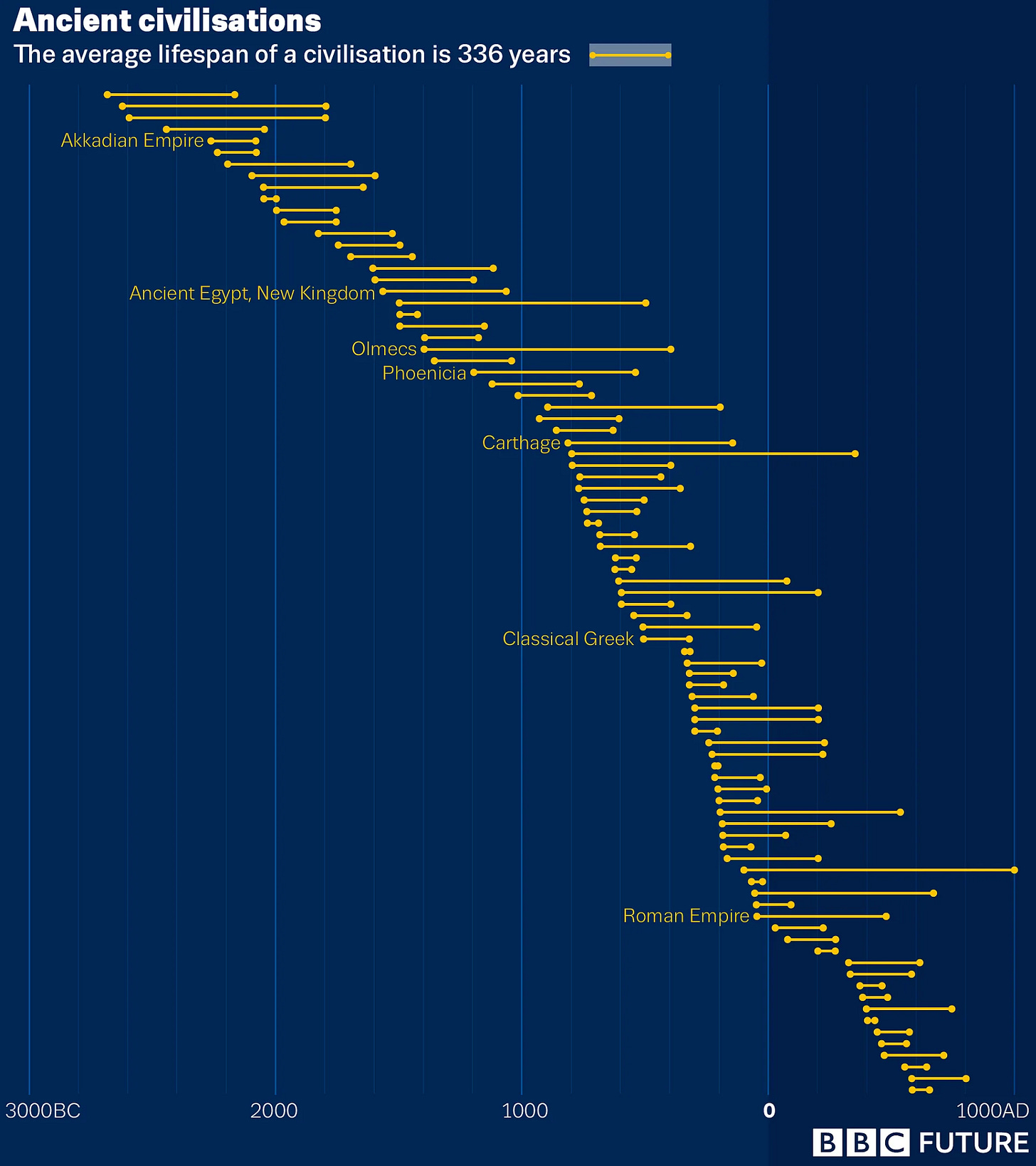
The average lifespan of civilizations is 336 years, according to Goliath’s Curse author Luke Kemp, and their common destiny is certain death – they have all “overshot their ecological and social carrying capacities” according to Joe Brewer (one of our Interviewees).
Now, perhaps more importantly (from a causal perspective), let’s unpack the first part of the sentence: Peter Turchin’s cliodynamic (scientific study of history) database identifies elite overproduction (or competition for limited power) as the single most constant factor in civilizational collapse. Turchin writes:
“As we explain in Secular Cycles, all large-scale complex societies experience periodic waves of political instability … a general social dynamic that all complex societies share, ever since they arose some five thousand years ago… We call such periodic waxing and waning of political instability Secular Cycles because each cycle consists of two secular trends—a positive (increasing popular well-being, internal peace and order) and a negative (declining well-being, growing political instability that often culminates in a civil war or revolution)…”
Below is a striking snapshot of the Secular Cycles of elite overproduction compared to popular well-being from 1780 to 2010.
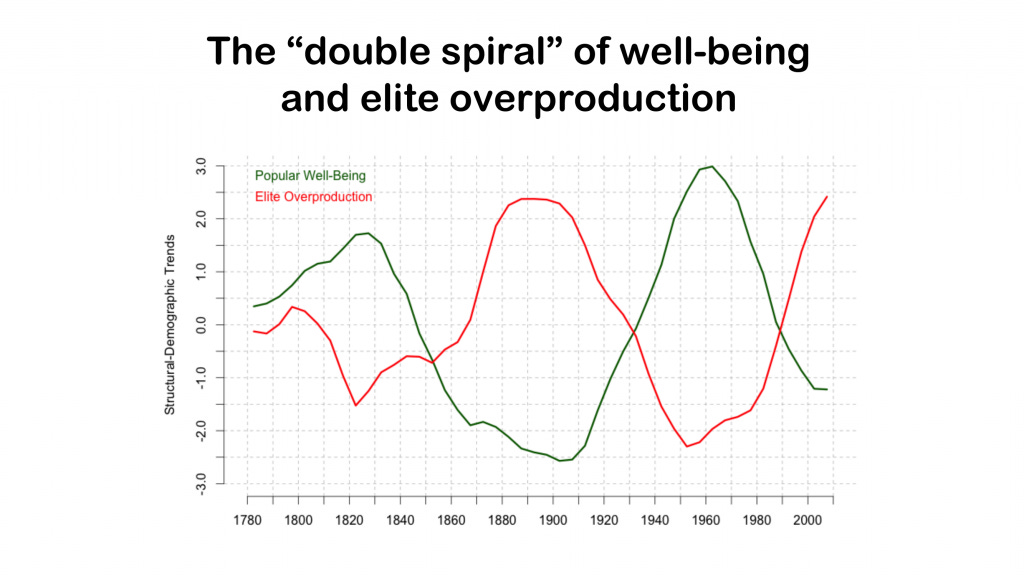
Distilling this dynamic down to its essence: hierarchical power defines civilization; and competition for this concentrated power dooms civilization.
The irony is that the very term “civilized” (derived from the Latin civilis via the French civilisé) has long been weaponized to gaslight societal cultures deemed “inferior” (uncivilized / barbaric / savage) for lacking the distinguishing features of civilization – and yet these very cultures have proved the most resilient and sustainable, outliving the swell-and-topple, swell-and-topple, swell-and-topple dynamic of their larger (more “civilized”) neighbors.
In other words, civilization is predicament.
We know that we cannot solve predicaments. But if we make our predicaments (just as we make our civilizations), can we not unmake them, and then, consciously now, remake something different – here at the edge of dissolution?
- Something without its own collapse baked into its genetic code?
- Something necessarily uncivilized?
- Something collapse resilient?
As noted above, the we who make civilizations that swell and topple, swell and topple, swell and topple, is not all-inclusive of humanity. Indigenous communities throughout Oceania, for example, have persisted for 60,000+ years by continually refining their cultures and self-governance practices in dynamic, intimate, reciprocal, regenerative relationship with Mother Earth. These are the very cultures that civilized cultures distinguish themselves from, branding them (explicitly and implicitly) uncivilized, inferior, unrefined. It seems civilizational culture suffers psychological projection.
In sum, while civilizational culture cohabitates with collapse (by definition), other cultures have evolved high degrees of collapse resilience.
Unfortunately, civilizational collapse patterns are no longer self-contained, but have expanded to systemic and existential scales, with social collapse dynamics triggering ecological collapse dynamics encompassing entire earth systems at planetary scales, and furthermore, civilizations (as well as “uncivilized” societies and cultures) are entangled in common fates globally. We’re all in it together.
Again, we cannot solve our predicament, but we can respond. How? Following our line of thinking here: by unmaking our civilizational collapse patterns, and remaking societies and cultures that are collapse resilient.
This Second Volume of the Seeds Series explores this question – which requires us to first understand a little bit more about collapse resilience.
Collapse Resilience: De-patterning & Re-patterning
We at r3.0 recently proposed a Collapse Response Continuum, formulated within the current context of civilizational collapse patterns.
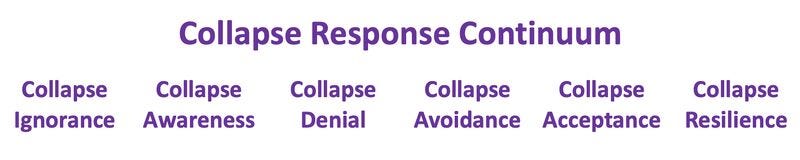
Here’s how we provisionally defined these terms:
- Collapse Ignorance: Unaware of the inevitable ecological and social systems collapses that are impending or already unfolding.
- Collapse Awareness: Recognition of the potential for ecological and social systems collapses.
- Collapse Denial: After becoming aware of the potential for ecological and social systems collapses, some respond with denial of this potential and/or denial of the impending or unfolding status of these collapses.
- Collapse Avoidance: The belief that ecological and social collapses can be averted if we only work feverishly enough (often, within the very paradigms creating the collapses in the first place).
- Collapse Acceptance: Coming to terms with the impending and unfolding inevitability of ecological and social collapses.
- Collapse Resilience: Recognizing the inevitability of ecological and social collapse by enhancing resilience that can 1) mitigate the severity of collapses and 2) adapt to emergent post-collapse scenarios.
The second element of Collapse Resilience points toward a nuance in the understanding of the equilibrium → perturbation → equilibrium dynamics of resilience, where re-equalibrating is commonly understood as a return to the pre-perturbation norm. This assumes that that norm is sufficiently desirable to attract a return.
But what if it isn’t? That’s the question Shalanda Baker explores in her Harvard paper on what she calls “anti-resilience,” where she proposes viewing perturbation (in the case she explores, energy system transition toward climate resilient renewables) as an opportunity to re-equilibrate out of an undesirable norm (in this case, socially oppressive renewable energy systems) into a new norm (in this case, energy systems that are both ecologically and socially sustainable and regenerative).
While her term “anti-resilience” hasn’t caught on, the idea of leveraging perturbation as an opportunity for transformation has increasingly embedded itself into the term “resilience.” We believe this understanding of resilience as responsive (not simply elastic) aligns with the living systems dynamics described in the Adaptive Cycle that we explored in the Seeds Volume 1 Introduction.
“CS Hollings conceived of the Adaptive Cycle to represent ecosystemic lifecycles as recursive loops through four phases: a “front loop” of 1) growth or exploitation (r) and 2) conservation (K); and a “back loop” of 3) collapse or release (Ω) and finally 4) reorganization (α). “Hereby, the adaptive cycle is deduced from the interplay of three essential variables: potential, connectedness and resilience. Together, these span a space within which system development is depicted by the characteristic ’lying-eight’ gure.” (Castell & Schrenk 2020)”
We focused attention on the back loop, in particular the transition from Omega (collapse) into Alpha (reorganization). In the latter, the two-letter prefix (“re-”) carries a heavier load than the 12-letter stem (“organization”) in the sense we’re exploring here – namely, the transformative opportunity of perturbatory resilience. In Seeds Volume 1, we considered Nafeez Ahmed’s Planetary Phase Shift theory, which likewise sees perturbation as opportunity. Here’s the final bit of of our quoting from Ahmed:
“the ultimate direction of travel is clear: to collectively shepherd a new civilisational life-cycle entailing the metamorphosis of the superorganism from a dissipative structure into a regenerative one.” [emphasis added]
Note that Ahmed retains legacy-system language (civilizational) in advocating for a metamorphosis; we assume he infers civilization’s scalar connotations, and not its entrenched collapse patterns: but can we separate them?3
That’s the question we explored in further clarifying our working definition of Collapse Resilience, recognizing the value of de-patterning away from the entrenched template of civilizational collapse cycles, and re-patterning toward a pluriverse of alternative ways of organizing and structuring human societies and cultivating human cultures in ways that harmonize with more-than-human life, including the living systems of Gaia, or Mother Earth.
We therefore added these de-patterning and re-patterning dynamics as a third element to our working definition of Collapse Resilience.
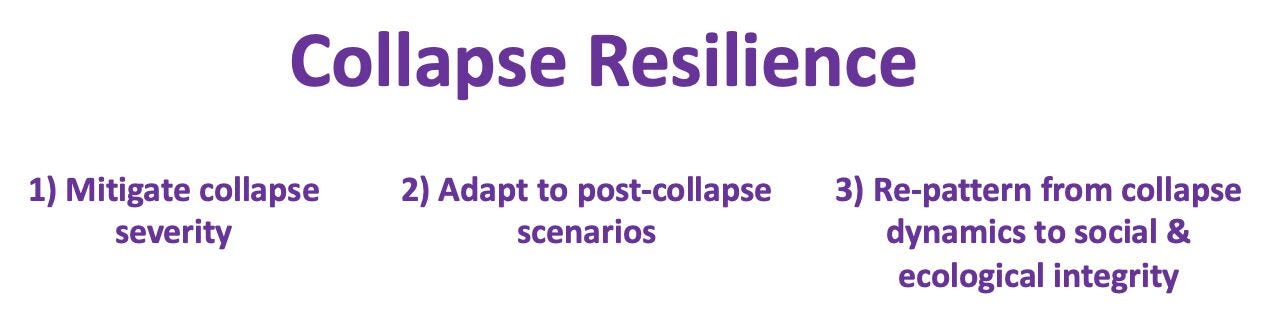
As noted above, the primary patterning that feeds civilizational collapse is supremacism: the segregation of society into superior and inferior classes – elites and commoners – with power concentrated amongst elites, whose vying for limited power causes civilizational collapse. (In Designs for the Pluriverse, Arturo Escobar notes that Latin American critical theory defines coloniality as “the hierarchical classification of peoples in terms of race and culture” – thus identifying a strong overlap between civilization and coloniality.)
So, the focus of de-patterning is to reject all forms of supremacism (and hence coloniality), including: white supremacism – the mistaken belief that one race is inherently superior to all other races; patriarchy – the erroneous belief that men are inherently superior to women, and that masculine dynamics should dominate over feminine dynamics; class supremacism – the misguided belief that one class of humans is inherently superior to other classes (in Seeds Volume 1, Carol Sanford countered this with the notion of contributionism – namely, that all beings make valuable contributions to the whole.)
In other words, human beings make supremacism (it is not inherent), therefore we have the capacity to unmake it, among many other counter-productive dynamics – the fundamental flaws of cultures that were the focus of Seeds Volume 1.
This unmaking through de-patterning makes space for re-making through re-patterning – the focus of the document you have in hand, Seeds Volume 2. In this volume, we focus on the fundamental imperatives of regenerative economies and cultures, as well as the transformative pathways – the just transitions – that guide the de-patterning to re-patterning process as responses to our predicament.
These two focal points – the fundamental imperatives and just transitions of regenerative economies & cultures – are the second and third questions we asked of the 20-odd prominent thinkers and doers we interviewed for this project, the responses to which form the basis of this Seeds Volume.
The critical mass of thematic focus in these responses clustered (in Aligned Findings) around a handful of ideas:
- Systemic;
- Relationality;
- Mindsets/Paradigms/Worldviews;
- Regeneration;
- Story & Narrative Framing;
- Solidarity;
- Indigeneity; and
- Community- and Place-Based.
In this Volume, we explore interviewee perspectives on each of these themes, in particular focusing on how these perspectives synergize (or not). We also look at a few Idiosyncratic Analyses that stood out as unique but significant factors:
Before diving into these explorations, we first pause to offer a story that helps illustrate the centrality of some of these themes.
Multiple Systems Failure: An Illustrative Story
In the mid-1970s, my family moved from the Midwestern US, where I was surrounded by loved ones – a swarming hive of grandparents, aunts, uncles and cousins and lifelong family friends – to an East Coast state that my 7-year-old self had never heard of, and struggled to spell. As my father was settling into his new role as Chair of Yale University’s Department of Surgery, he wrote a “classic 1975 editorial” for a scientific journal where he introduced the concept of Multiple Systems Failure.
In it, he described how the body’s organ systems – previously considered in isolation by the surgical field – could now be understood as intimately interconnected, such that these systems experience cascading collapses in response to acute trauma, and so must be treated as interrelated, interdependent systems within larger systems (the human body, and its life context). Just as the interdependence of organ systems triggers cascading collapses when traumatized, their intertwining regenerative capacities enable chain reactions of cyclical healing.
My dad built his career on deepening his field’s understanding of Multiple Systems Failure, around which emerged a global community of researchers and practitioners from Lebanon, India, Japan, Germany, and elsewhere, devoted to addressing it. They developed a solidarity around their research and practice that crossed cultural boundaries. Their work transformed mindsets, paradigms, and worldviews in the surgical and broader medical fields, shifting from a mechanistic mindset that treats bodily organs in isolation to a more holistic paradigm of treating organ systems as interwoven elements within our dynamic anatomical systems.
Despite his success, Dr. Baue was ousted from his position at Yale for prioritizing excellence in research & care and patient well-being over institutional power dynamics. This pattern repeated itself at St. Louis University, where he was ousted as Vice President for the Medical School and University Hospital.
In retirement, he spiraled into debilitating, dehumanizing alcoholism (wine replaced coffee in his morning mug), forcing me to set painful emotional boundaries that distanced me from the father I’d loved very deeply.
In 2011, months after my mother passed away unexpectedly, I cancelled (at the last minute) a two-hour drive down to visit my father; later that day, my sister called to tell me he’d died alone in his nursing home apartment. I don’t remember crying at the news: I’d already been mourning him for years.
So: Multiple Systems Failure remained a biographical detail until sometime in the past 5 years, when I was in a hospital for a Covid vaccine, and I overheard a doctor mention Multiple Systems Failure. In the moment, it was a pleasant reminder that my dad’s legacy continues to enhance public well-being, a welcome respite from my own painful emotional distance from the dysfunctional alcoholic who had once been a wonderful father with a mischievous sense of humor that retained child-like exuberance.
Soon thereafter, though, out of nowhere, a proverbial lightning bolt struck. A realization suddenly crystalized – a connection I’d failed to see, even though it was hidden in plain sight: exploring how systems experience cascading collapses in response to acute trauma, and so must be treated as interrelated, interdependent systems within larger systems was not only my dad’s lifework, but my own as well – simply in different contexts, and at different scales.
What spurred this transformation was my realization of how what I previously considered to be an isolated factoid from a distant past was, in fact, deeply intertwined in the core of my being, a living element of my ongoing evolution as a dynamic being. I came to understand the meaning behind the memory.
While my father focused on the human body as a (set of) complex adaptive system(s), my lifework focuses on broader ecological and social systems – the earth’s disrupted climate regulatory system and water cycles, for example, and the violent and unsustainable (to use Vanessa Andreotti’s couplet) global capitalist economic system, and systemically unjust, patriarchal, and racist structures. The realization that I walk in my father’s footsteps has helped me heal my fraught relationship with him – to learn to love him again.
Now: why tell this story?
To illustrate and enliven some of the key findings of this Seeds inquiry, such as the intertwined relationality amongst organ systems and their regenerative capacities, the value of solidarity amongst research and practitioner communities to trigger profound shifts in mindsets, paradigms, and worldviews in the field. And finally, the power of narrative in recognizing the underlying meaning of a story. And, as with any good metaphor that would lose its power if it were a perfect fit (according to researcher Peter Elbow), our overlap is not complete – the themes of Indigeneity and community/place-based don’t factor into this story – and we don’t have to force-fit them in order for the story to support understanding.
Another reason for telling this story is to humanize and personalize the act of inquiry; just as I have an intimate relationship with the themes of this exploration, so too do I invite you, dear readers, to explore how these themes resonate in the marrow of your bones.
You can access and read the latest Seeds volume, entitled Unmaking & Remaking at the Edge of Dissolution: A Meta-Conversation on Re-Patterning for Just Transitions to Regenerative Economics & Cultures, in full here.




Comments
We changed commenting systems on September 10, 2026 as part of a site-wide functionality and security upgrade. Your past comments have not disappeared, and you can still log in with your old Disqus account credentials if you wish. Contact us with any questions.