

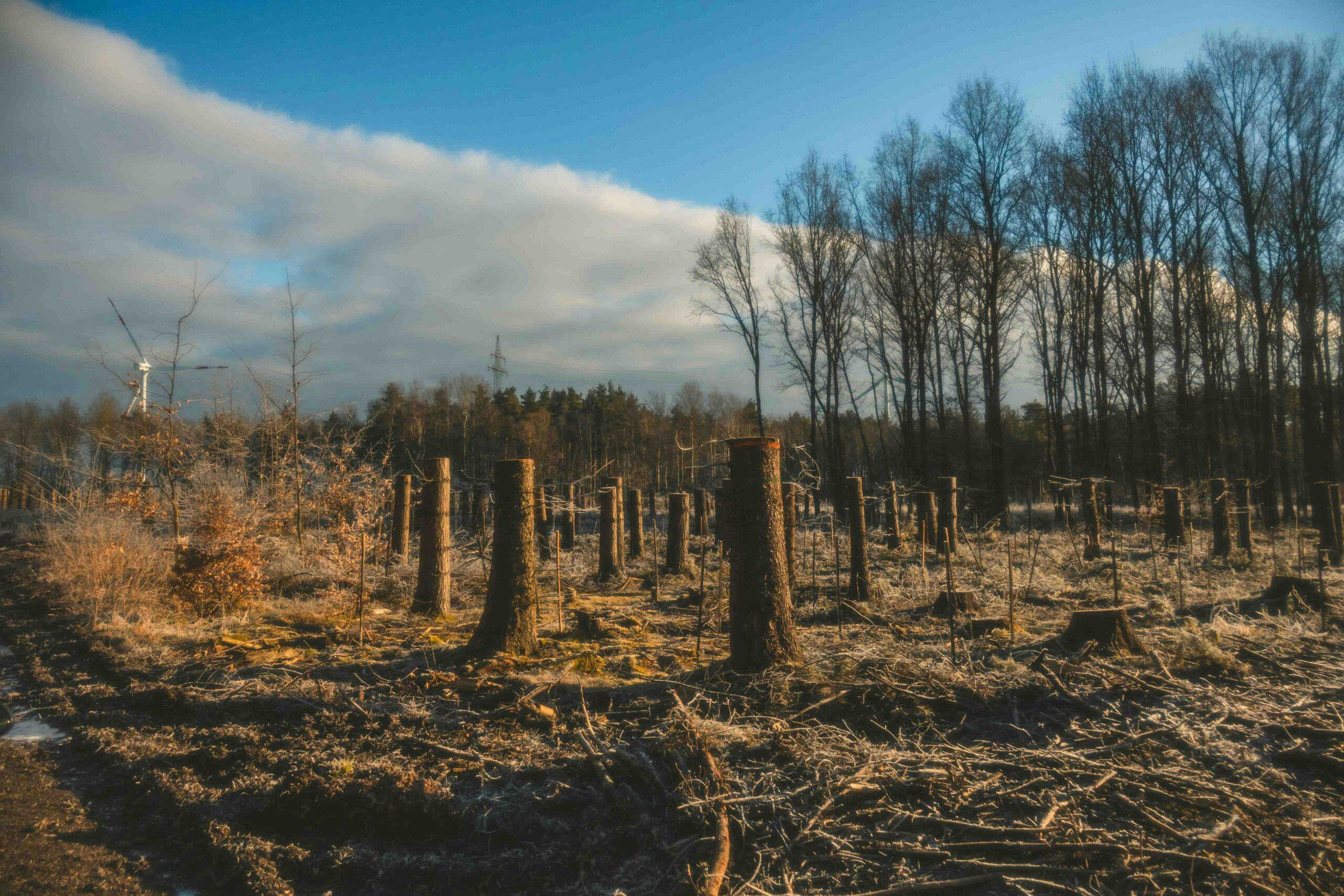
Welcome to the final installment of the series, Are We Giving the Land Something Like Alzheimer’s? As I described in Part I, nine years ago, I attended a reading of Crazy Horse: The Lakota Warrior’s Life and Legacy in Bellingham, Washington. While standing in line to purchase a copy I heard a young indigenous man say that elders were reporting “something like Alzheimer’s” in the Hills, as though the mountains were “forgetting.” Since I’d been helping care for my brother-in-law with Alzheimer’s, my ears perked up. But I hadn’t expected to hear it applied to land, and the implications seemed ominous. I carried my newly purchased book to the parking lot wondering how “something like Alzheimer’s” could happen to a forest.
Years later, a friend sent me an article about the extensive thinning conducted in the Black Hills in response to a Mountain Pine Beetle epidemic from 1999 to 2016. Could that thinning, I wondered, along with beetle kill, have created “something-like-Alzheimer’s” there? I decided to investigate.
I first looked (parts II, III, and IV) at what Western science has to say about the existence of intelligence and memory in plants and forests, which turns out to be a lot. There’s now convincing evidence that plants perceive, communicate, make decisions and remember. Forests, in more complex and less understood ways, do as well. In other words, it’s conceivable that a forest could be given “something like Alzheimer’s,” a disease characterized by loss of memory and intelligence, because there is memory and intelligence there to be lost.
But now I’d like to turn from the Western-science approach and look at the matter from a Lakota perspective. Describing this perspective, however, isn’t as simple as it might sound. I’m not Lakota, and I’ve not been able to find the person who spoke those words or the elders he referred to, and to inquire any further would be intrusive. I’m not an anthropologist, either. My knowledge is scant and touches only the surface. Further, the words in question were spoken between indigenous people, not to me personally. But they were spoken in a public venue and in a public way, and the implications, that we may be unwittingly stupefying the lands around us, seem of public importance. The best I can do is be transparent about my intention, which is to illuminate what seems to me a very important matter regarding our treatment of forests—that such treatment fails to recognize the resident intelligence of natural communities, with consequences we’ve yet to even consider.
So let’s return to where this exploration began, with: Crazy Horse: The Lakota Warrior’s Life and Legacy. It is a unique and remarkable book. For it’s an oral account, told more than written, based on family memory passed down amongst Crazy Horse’s own descendants. There are no references in the back of the book because there are no written references for what is remembered, nor for what has been passed on privately by Crazy Horse’s relatives. The authors, the ones telling the story, are Crazy Horse’s grandnephews: Douglas War Eagle, Floyd Crown and Don Red Thunder. Bill Matson, a trusted filmmaker who helped them record a documentary of the story, provided the writing.
You may remember from the previous post that, in the summer of 1874, Custer led an expedition through the Black Hills to scout locations for future forts and to assess the region’s mineral, timber and agricultural resources. In particular, he sought to verify claims that there was gold in the Hills. Little did Custer know that Crazy Horse, who would two years later wipe out Custer and much of his regiment in the infamous “Battle of Little Big Horn,” was in the Black Hills too, watching him. The authors recount, “he was checking on our family’s burial sites as our elders from the south had asked him to do during his hemblacha (vision quest) over fifteen years earlier.” That’s when he spotted the massive expedition winding up a valley, and “watched them survey the land and take pictures with a camera. He also noted that they were carrying mining equipment.”
For Crazy Horse, the sight must have felt like a betrayal, as only six years earlier the US government had signed the 1868 Treaty of Fort Laramie with the Lakota, Article 2 of which guaranteed them “absolute and undisturbed use and occupation” of not only the Black Hills, but surrounding lands totaling more than thirty-one million acres. He sent six young warriors to keep an eye on Custer’s wagon train and began spreading the word. Others, according to the authors, “hurried into the Hills to get ahead of the soldier’s advance so they could take down our (burial) scaffolds and bury the bodies before the soldiers could rob them in their quest for souvenirs…”
Custer’s expedition marched a month through the Hills, but never discovered any of the burial sites, which the Lakota there were grateful for. But Custer’s expedition found something else, which would change everything. “After the soldiers left, we expelled a sigh of relief until we found out that they had told their nation that gold was in our sacred Black Hills. After that, the miners flooded in like never before.” This was a turning point. “We now understood that the white man was eventually going to try to take away our Black Hills. We would have to fight to keep them from building their houses on top of our grandparent’s bones. We would have to fight for our very existence as a people.”
And fight they did, surprising the US Army by winning a string of battles, the most famous being when Custer was routed at Little Big Horn, a place the Lakota refer to as Greasy Grass, for the slippery quality of the sandy soil there when it rains. These victories, however, only inflamed white anger, resulting in calls for outright extermination. Meanwhile, the wagon trains kept coming and the army kept growing its garrisons. The authors say “When the US Army finally did convince Crazy Horse to turn himself in, he did so because he had obtained a promise from the army that his people would continue to roam the Sacred Black Hills as they always had. He considered his surrender a small sacrifice compared to what his people’s continued presence in the Black Hills meant to them.”
Here we see how fundamental the Black Hills are and have been to the Lakota people, standing at the heart of their resistance to occupation. And note that Crazy Horse was checking on ancestral grave sites when he first observed Custer’s expedition. The centrality of the Black Hills is not just geographic or material—it’s spiritual, as the authors state early on in the first chapter: “The spiritual center of our people’s world are our sacred Black Hills.”
A spirituality of relationship
That spirituality is inextricably entwined with other living things. “We believe that the four-legged, the winged, the insects, the fish, the grass, the trees, the two-legged, and everything else are all here to live in their own way without restraints,” the authors say. “We do not believe that one species has the right to dominate all others. We all have the same mother. Our mother is Earth. She is who we owe our lives to.”
I am particularly struck by the phrase: “all here to live in their own way without restraints.” Begin with the word all. The Lakota don’t construct hierarchies between living things, and they don’t place themselves above the non-human world. Rather, they consider themselves a younger brother on Earth, a late-comer to the scene, in which every organism, down to the smallest insect or microbe, matter. “They are all equal to each other” and part the same mystery, which they refer to as wakan.
And those beings are here to live, the second part of the phrase. That may seem obvious. Isn’t everything here to live? Not necessarily. American public-lands management philosophy officially sees land as here to be used. Thus the phrase “land of many uses,” a credo of the US Forest Service. It was originally articulated by America’s first Chief Forester, Gifford Pinchot, according to his philosophy of “multiple use.” This multiple use doctrine has guided public-lands management for over a century, and while containing an attempt at balance and sustained yield, it does betray a utilitarian view of other living things. And it should be noted that over 97% of the landmass of the lower 48 US states is already put to some sort of use, leaving less than 3% that’s simply here to live.
Which brings us to the third part of the phrase: in their own way without restraints. The authors seem to be not only recognizing a right to freedom for other living things, but implying a vital role for that freedom, that it’s necessary for the well-being and proper function of the whole.
Victor Douville, a Lakota elder and educator, points to the term Mitakuye Oyas’in, meaning “all my relations.” When a Lakota speaks this term, they are acknowledging their relationship to all living things. “All have souls and are created for a purpose,” says Douville. “The destruction of these lifeforms silences the contribution of their purpose in life. Symbiotic relationships stem from their purpose of life. Once a significant portion of these lifeforms are destroyed, then it impacts all lifeforms in a domino effect.”
This sounds a lot like the behavior of what science would call an ecosystem, only in more personal language. Here is a graphic describing in simple terms the Western-science perspective on ecosystems.
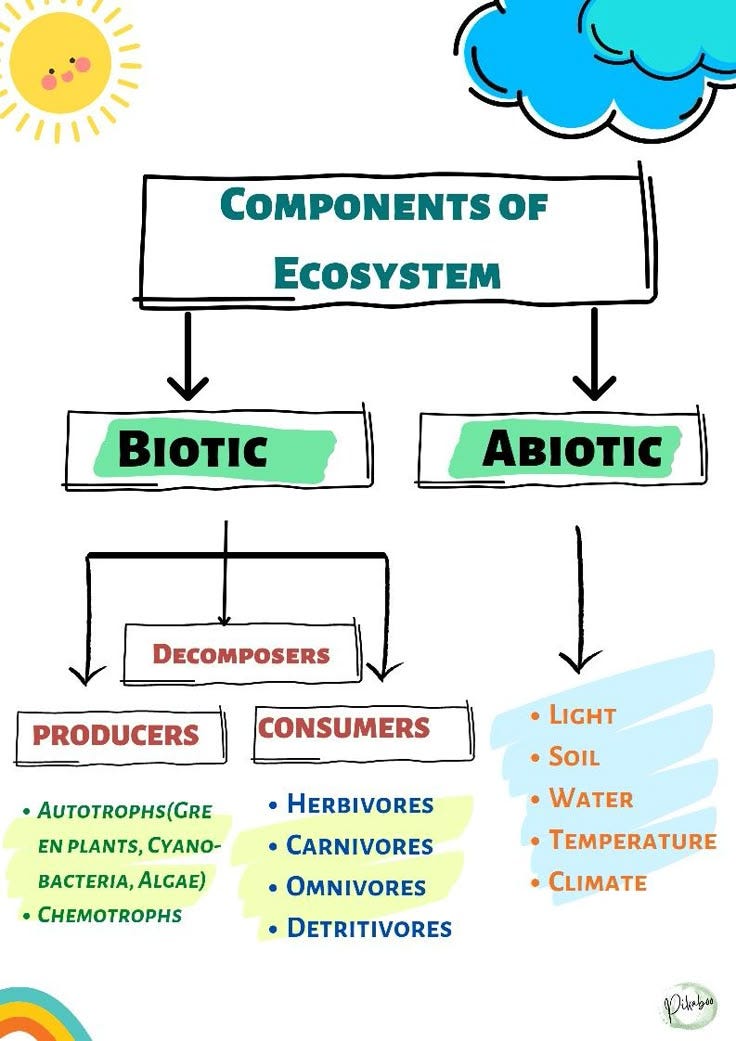
The first thing you’ll notice are the divisions. First, the ecosystem is divided into biotic and abiotic, living and non-living. Then those categories are divided yet again. This is scientific reductionism, the slicing of things into smaller and smaller parts to see how they work. In fact, the Proto-Indo-European root of the word “science” is skei- ,”to cut, split.”
The second thing you might notice is the list of “abiotic” factors. Though some of the items on the list can be understood and measured in purely physical terms, they’re also intrinsically entangled with the biotic realm.
Take soil for instance. Without biology, all you have is sand, silt and clay, a purely mineral substrate. It doesn’t become soil until it’s leavened with life, bound together with strands of mycelia and the gooey, carbon-rich exudates of soil organisms. Only then is it truly “soil” and able to do the things we depend on soil to do, such as gather, hold and cleanse water, maintain cool, ground-level microclimates, and of course, grow more life, thus feeding everything above.
Then there’s water. The Lakota say Mni Wiconi, which translates to English as “water is life,” describing a unity between life and water almost universally recognized by indigenous peoples. The “is” is like an equals signs, reaching both ways. Yes, as we all recognize that where there’s water there’s also life. But the phrase points the other direction as well—where there’s life there’s also water. Life begets water, water begets life. The two amplify each other in seamless mutuality.
As for Temperature and Climate, imagine standing on the asphalt of a parking lot, a purely abiotic surface, under a hot, midday sun. Heat is not only pounding on your head, it’s radiating up from the asphalt. It’s like being in an oven, and you’re grateful for your shoes, protecting the tender bottoms of your feet from the hot griddle beneath. Near the edge is a woodland, and you wander in for relief. Almost immediately the temperature drops tens of degrees Fahrenheit. You are not only shaded by the sun, but cooled by the evapotranspiration of leaf and soil, as if the woods themselves were a quietly running air conditioner. The air is moister and calmer, and you want to take of shoes and socks off to soothe your feet on the cool ground. You are standing in a biotic climate, a climate made by life.
All this raises the question of what’s lost when complex systems are reduced to their individual, separate parts, when life is divided from water, soil and climate. Is our understanding improved or confused? And can the sheer, virtually unknowable complexity of such systems ever be fully comprehended by analyzing their parts? What if you simply observe and inquire of the whole?
This is the approach the Lakota take. And again, it begins in relationship. Mitakuye Oyas’in—all my relations. They don’t split things apart to understand them because you don’t do that to relatives. But you can observe, both the particulars and the whole, intensely, and over long periods of time. You can also ask first, and put yourself in a receptive position. And you can believe what you see without having to subject it to the labor of proof and the slicing and dicing required.
An immersive understanding
“Observe” is also a relative term. Darwin, through clever experiments devised in his cottage, was able to “observe” what he called plant circumnutation: the small, slow, circular rotations of plant shoots, leaves and root tips during growth. Time-lapse video also helps us capture this movement, quite vividly. But some Lakota and other indigenous report seeing such movements without the assistance of scientific design or video technology. According to Lakota teacher, Tiokasin Ghosthorse, such knowledge is nothing new to them. “We already knew that trees communicate. We knew that they moved. We knew that energy passed beneath in the ground.”
The implications here are fairly profound. If you consider direct observation to be the first and foremost means of gaining information about the environment, then the indigenous appear to have developed capacities that in ways exceed those of Western science. They not only see differently, they seem to see things we miss.
Perhaps that shouldn’t surprise us. Science, historically disdainful of the possibility of consciousness in anything but humans, ends up circumscribing it’s own capacity for observation. It filters its own lens, whereas the Lakota, in mutual relationship with their subjects, keep the lens fully open and are thus better prepared to see and communicate with all that’s there. To them, land doesn’t just exist. It teaches.
Language is critical in this regard. Tiokasin Ghosthorse and Dr. Leroy Little Bear, a Blackfoot scholar, point out that, unlike modern English, a noun-based language, the language of the Lakota is verb-based, describing the world less as a collection of objects and more as a weave of activity, interrelation, flux and energy. They believe such languages are better able to hold deeper truths about reality such as found in quantum physics.
Indeed, the renowned quantum physicist David Bohm, in the early 1980’s, attempted to create a verb-based language for that very purpose. The effort failed, but in the last year of his life, at a Sharing Circle organized by Leroy Little Bear and others, he found confirmation of his original intent. There, according to David Peat, author of Blackfoot Physics: A Journey into the Native American Worldview, he “found a people whose metaphysics strongly mirrored his own, and whose language, not to mention the role it played in their reality, echoed his own.”
Intuition is another key ability. As with plant intelligence, it’s a phenomenon science is only now beginning to accept, describing it in terms of “pattern perception.” That’s part of it, but Tiokasin Ghosthorse sees something deeper at work. For him, It has less to do with much about than thinking with. It has “Earth in it,” he says. Indeed, it could be considered our most sophisticated sense, a simultaneous sensing of the all the other senses at once, a synthesizing of information too complex for logical analysis. Lightning fast and deeply wired within us, it’s the all-at-once perception of the earth-body. And as with observation, it’s a skill that can be developed.
And of course, indigenous people aren’t passive in their observing and relating to the more-than-human world. They’ve developed ceremonies and practices that assist and guide them. As Victor Douville wrote me, “Our spiritual elders…hear the spirits and commune with them especially when they have a lowanpi (singing and praying ceremony)…”
Relationship, observation, language, intuition, ceremony. To me, these describe a highly-developed, and I would say practical, means of understanding and communicating with the intelligence of living beings and communities, one based not on distance and analyses, but on embeddedness. If a forest is “forgetting itself, losing memory and function, it’s not hard to see how elders, with such abilities and with long relationship to land held sacred, could perceive it.
As different as these two ways of knowing are, they’re in many ways complementary, and there are increasing attempts to weave the two. Mi’kmaq elder, Albert Marshall, proposes a method of Two Eyed Seeing, “…learning to see from one eye with the strengths of Indigenous ways of knowing and from the other eye with the strengths of Western ways of knowing and using both of these eyes together.”
That’s what I’ve tried to do here.
So where does this leave us? What have we learned?
Well, we’ve learned that Western science, through it’s own reductive methods, has found plentiful evidence of what indigenous have long asserted, that plant-life is sentient in ways that reveal intelligence and memory. We haven’t proven that repetitive logging has damaged that intelligence and memory in the Black Hills, but we’ve laid out a picture of plausibility. It’s possible to imagine how the simplification of complex forests into even aged classes, with consistent removal of older trees and the disruption of long evolved relationships, could damage the memory and intelligence that is so vital to ability of plants and forests to function.
We’ve also learned that the Lakota have developed their own means of understanding and receiving information from the more-than-human world, involving a sophisticated interplay of observation, intuition, language, ceremony and direct communication. If there is “something like Alzheimer’s” afflicting the Black Hills, it’s entirely plausible, to me at least, that elders would be able to perceive it. Again, this doesn’t prove anything. In fact it can’t be proven because the attempt itself would violate the relationship upon which the knowledge is based.
And here, for me, lies the heart of the indigenous worldview—the absolute centrality of interrelatedness, of “all my relations.” Diverse indigenous cultures around the world all seem to share this principle. And everything seems to emerge from it, a cosmological observation that blends into ethical obligation, into successful ways of living.
Modern science also has a relationship with the more-than-human-world, but doesn’t talk about it, derived as it is from notions centuries old, biblical in origin. But its institutions, methods, language and stubborn resistance to the notion of other-than-human intelligence, all reflect a legacy of dominion, an anthropocentricism repeatedly countervailed by scientific knowledge itself. Yet the relationship, murky and untenable as it is, persists.
Of course, science didn’t create this relationship. As part of broader society, it inherits it, and is more often than not, used by it. Thus, after centuries of scientific progress, we confront a planet in collapse. Continental interiors drying out, topsoil washing away, species going extinct left and right, an ever increasing array of toxic chemicals and plastics overloading systems, which, in their degraded states, can no longer cope. Science can be a powerful, fascinating, and for those that practice it, immensely enriching undertaking. But, in the absence of respectful, mutual relationship with the more-than-human, it can result in great harm.
Currently, in my opinion, the US Forest service is on such a path under the rubric of “restoration,” “forest health,” “wildfire resilience” and the like. Armed with scientific studies and models, they are targeting millions of acres of naturally regenerated forests for “fuels reduction treatments” that just so happen to deliver lots of big trees and tight-grained lumber to the feller bunchers, mills and timber executives. That these forests contain the last legacies of original biotic intelligence on the landscape isn’t even considered.
There’s more that can, and should, be said about this, but we have cogitated enough. Let’s close instead with the words of Crazy Horse, as attributed by Archie Fire Lame Deer. They speak to the Lakota perception of time, as something that moves in circles, completing cycles of continual renewal, maintaining the relationships that maintain the whole.
I can’t think of a better prayer right now.
            My friend,
            They will return again.
            All over the Earth
            They are returning again.
            Ancient teachings of the Earth
            Ancient songs of the Earth.
            They are returning again.
                               --Crazy Horse




Comments
We changed commenting systems on September 10, 2026 as part of a site-wide functionality and security upgrade. Your past comments have not disappeared, and you can still log in with your old Disqus account credentials if you wish. Contact us with any questions.
I don't think it's fair to blame science for the harm done by the callous and greedy. Science is a tool–it can be used for all sorts of purposes, including as here, to justify destruction.