

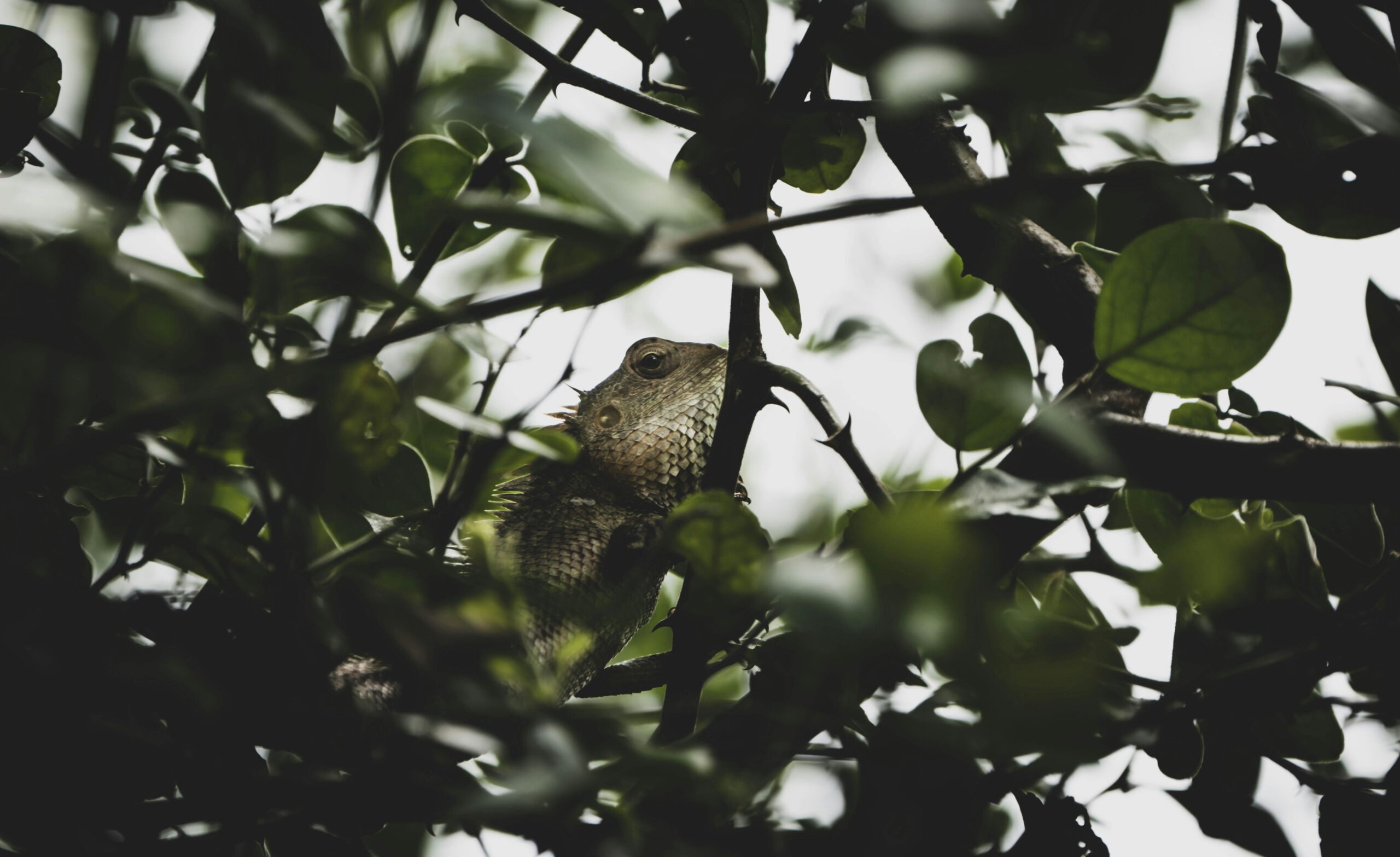
A new video from Ze Frank is out, this time about Geckos. True to form, Frank masterfully illustrates the genius of other life forms. One amazingly intricate evolutionary adaptation after another leaves us grasping to make sense of the various superpowers manifesting in the living world. If Ze Frank’s videos don’t leave your mouth agape, there might be something wrong with your jaw (the anatomical feature best suited for expressing awe). I admire his skilled and unabashed use of anthropomorphism to imbue these characters with personality and desire. He’s not wrong, and our culture could use a great deal more appreciation for the shared engagement of all life.
But the main point of this post is to reconcile the genius of microbes, fungi, plants and animals (of which we are part) with their obvious “dumb” qualities as well. To wit: a spider can weave an elaborate web I’d have no hope of replicating, yet when stuck in a sink will repeatedly try—and fail—to climb the steepest wall. Clinging to spider webs for a moment (they’re like that), birds also weave nests using spider webs and other bits of fluff, moss, twigs, spit, and many other seemingly random elements. I know I couldn’t pull it off, even if I were allowed unlimited spit. But a bird in a garage with the door wide-open can exhaust himself trying to fly into the ceiling, never realizing he can fly right out the enormous opening. A honeybee has many jobs in her lifetime: rearing, feeding, storing food, cleaning and maintaining the hive, patrolling and defending, foraging and finding new nest sites—communicating by both dances and chemicals. Yet, trying to escape a house, she will bump into a window until she dies—never “getting” the whole glass concept. In the opposite direction, ants innovate in their foraging strategies so that they find ways into (and back out of) a house that would never occur to us—often repeatedly outwitting us as we try to block one route or another. But their brains are tiny, and they’re not even on social media.
What I want to briefly explore is this contrast between genius and dumb-as-a-brick (a recent post explored human dumbness). How are both true at once, and how might we, as humans, be both different and basically the same?
Feedback
Firstly, the secret to the superpower-genius of living beings all traces to feedback in an evolutionary context. The gecko’s feet are as amazing as they are because that’s what works well for them—honed over deep time. If their sticky feet didn’t have clever ways of dealing with dirt, water, or an enormous range of surface conditions, then they wouldn’t be here.
I think part of the reason that we experience awe when delving into the inner mysteries of gecko spatulae or hummingbird tongues derives from our distorted perspective as cognitive designers. The dumb machines we fashion have great difficulty dealing with rather routine environmental challenges—like rain, dirt, thermal cycles, corrosion, etc. Our bicycles don’t self-lubricate, self-clean, self-inflate tires, self-replace stretched chains, self-replicate (with variation) or any of the other amazing self-care feats common to life of every sort. It is in this sense that the inventions of evolution appear to have miraculous capabilities: we’re comparing to truly stupid (largely open-loop) inventions of our own lowly cognitive origin.
Compared to evolutionary innovations, our contraptions do not emerge embedded in a strong web of (negative) feedback loops in a deep-time complex of contexts. They have no hope of being impressive. Yet we call ourselves geniuses for making these pathetic—and incidentally destructive—assemblages.
Dumbness
This site often emphasizes the genius of other life—in part to counter the culturally-prevalent view of animals as dumb (and plants as not even capable of being dumb).
How might we square this emphasis with the fact that it is not difficult to spot examples of animals being dumb: a deer paralyzed by rapidly-approaching headlights; a beta fish getting riled up by its own reflection; a cat reaching behind the television to get at a bird pictured on the screen; a dog trying to bury a treat on the carpet by scraping imaginary dirt over it; a raptor getting smacked by a windmill blade; a fatal encounter of a bird flying into an ordinary, stationary window. I’m sure pet owners have no shortage of amusing stories about the cognitive shortcomings of our companions.
Yet, surely animals find humans to be inexplicably dumb in the ways in which they themselves excel. If bats had YouTube, they’d be obsessed with videos of humans running into obstacles in the dark. Most mammals must laugh to watch us run: such slow-pokes for all that flailing motion! Dogs can’t fathom our lack of olfactory awareness: totally oblivious to the stories laid out plain as day in front of our noses. Birds witness our grounded inferiority, only able to get airborne in these loud and heavy hunks that lack almost any of the grace exhibited by birds (watch a bird zip into a dense tree and come to an immediate stop on a twig deep within—and imagine an airplane doing anything of the sort!).
Context
In most instances, we might deduce that animals being dumb share a common element. They are “dumb” in their inability to cope with an artificial (non-ecological) environment of human fashioning. Our roads, buildings, and other technologies are not part of their evolutionary context.
It is in their native domains that the genius of life shines. And it kind of has to. Otherwise, these beings would not be here. That’s the feedback part: what it means to be deeply embedded in a loop. The universe is a challenging, varying, not-wholly-predictable place with plenty of randomness to go around. Any living being—microbes and all—has to be a genius to even persist in this place. As a reminder, we still don’t know how most of it works/interacts, and presumably never will.
But here’s the thing: humans are also a species out of context. Many elements of our present-day existence are not part of our evolutionary history either, having only been around for the last 10,000 years (or even 10, in some cases). And guess what: we’re being totally dumb about it! Yeah: we’re blowing it. We can’t handle the truth. We’ve initiated a sixth mass extinction (6ME), and it’s quite hard to come up with an example of animal dumbness any more profound and consequential than this. I mean, really: a wasp bouncing against a window isn’t anywhere near the same league of “dumb” as a species initiating a sixth mass extinction in an evolutionary blink.
So, when you pull humans out of context, we’re pretty dumb, too. Much as the wasp bounces against glass, we bounce against planetary limits, unable to perceive—in aggregate—that there even is any such thing.
Many of us know in our bones that this existence isn’t right, but can’t see what it is we’re bumping up against. We continue to deceive ourselves that a cognitive-based solution exists. We’re that dumb. Bump. Bump. Bump.
Now, to be fair, what humans do have that’s special is an unusual degree of cognitive flexibility that allows quick adaptation to unfamiliar contexts—within limits. It’s an evolutionary adaptation that has sufficient utility to warrant exploration, but may well prove to be a step too far into maladaptive territory (6ME). I hope not, for the sake of our species, but only time will tell.
One of our chief problems (and forms of blinding dumbness) is that we tend to emphasize this cognitive veneer and pretend it’s the only way of being smart: the very definition, in fact. All other forms of life are measured against this severely flawed scale. Because plants, fungi, and microbes lack even a single neuron, it then makes no sense to speak of their intelligence. Yet these beings carry out impressive acts of problem-solving every second of every day—by means that elude our cognitive processes. Another Ze Frank video features microbes solving mazes, designing transit systems, learning and passing on knowledge—all without a trace of what our limited perspective labels “cognition.”
My conclusion, then, is that every being (something that bes) is genius within its ecological context—having been shaped by evolutionary feedback over deep time in multi-layered elaboration that can’t be anything other than genius. Mixing Shakespeare with a hint of DayKart: To be is to be a genius. Simultaneously, every being is dumb when taken out of their context. As we have removed so many beings from their ecological contexts (including humans), we are inundated with examples of how dumb (other) life is. We define the scale so that we win, while in truth, everybody loses (6ME), including us.
Sadly, modern humans are masters of contorting—and conjuring—novel contexts. In doing so, we promote our own and other living beings’ failure. We’re not remotely capable of replacing the wisdom of deep-time ecology with our own devisings. It’s far beyond our pay grade. Yet, here we are pretending that this is exactly what we can—and should—do, wrapping ourselves in a mythology that creating novel context is our destiny; our unique privilege; our birthright. Enough with the nonsense. Bring back the humility. It is within our evolved context that human genius is most convincingly expressed.
This piece has been edited and condensed for length. You can read it in full here.




Comments
We changed commenting systems on September 10, 2026 as part of a site-wide functionality and security upgrade. Your past comments have not disappeared, and you can still log in with your old Disqus account credentials if you wish. Contact us with any questions.