

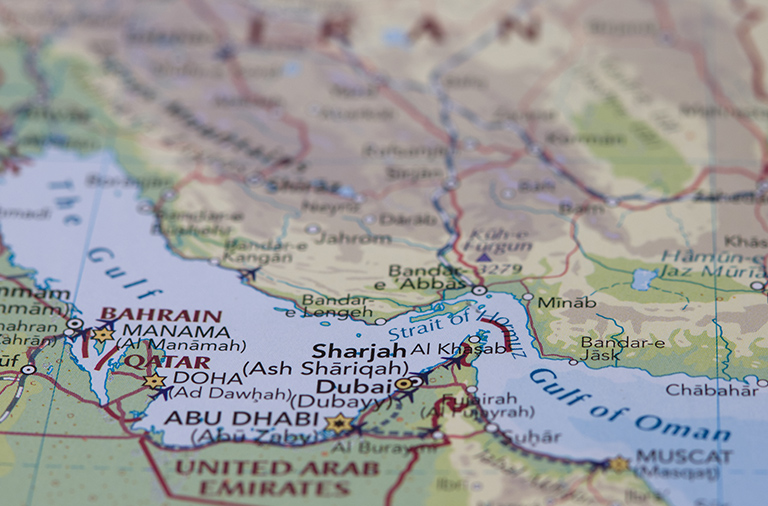
It’s unclear how long the United States’ war against Iran will last. Some reports suggest President Trump might declare victory and cease attacks within days; others foresee a long campaign with American boots on the ground. The lack of clear US objectives invites speculation. Even if hostilities end soon, the war highlights a perennial vulnerability of industrial societies: their systemic dependency on fossil fuels.
The 24-mile-wide Strait of Hormuz in the Persian Gulf, through which roughly 20 percent of world oil shipments pass, is an obvious pinch point for a vital industrial resource. But it also serves as an apt metaphor for the brittle global supply chains upon which the entire economy depends.
The US/Israel/Iran conflict has led to dramatic oil price volatility, with a swing of nearly 40 percent recorded on a single day. Most economics commentators understand that higher oil prices can be a drag on the economy, but prices are only part of the story. The war is likely to lead to long-term damage to oil production, storage, and shipment infrastructure in the Middle East. In the best-case scenario, if hostilities end immediately, the world’s crude deliveries could be stabilized in six months. But stability would likely resume at a lower level of output, since the ongoing oil production capacity of Iraq and other Middle Eastern producing countries is likely being compromised.
Iraq is the second-largest producer in the region after Saudi Arabia. If oil can’t be shipped or stored, production must be cut—not a light decision, as shutting in oil production can damage wells. But that is what’s happening: Oil production from Iraq’s main southern oilfields has dropped by 70 percent thanks to the effective closure of the Strait of Hormuz. Saudi Arabia, the UAE, Kuwait, and Qatar have also reduced production due to the war. Iran even hit oil facilities in their closest ally in the region, Oman.
While spot prices for crude oil have spiked and fallen in recent days, futures prices are stubbornly high. Savvy oil investors and industry analysts don’t expect this oil crisis to be resolved quickly. A week and a half after the start of the war, US gasoline prices were up nearly 60 cents per gallon on average; historically, higher gasoline prices driven by oil shortages have persisted for weeks or months after oil prices normalized.
Then there are secondary impacts, largely overlooked by the economics commentariat. So far, the Iran war has effectively closed off one-third of the world’s helium supply. Helium is a depleting non-renewable resource, like fossil fuels. Qatar’s Ras Laffan facilities, which produce 17 metric tons of helium daily, are now offline. Experts warn that if the Strait is closed to shipping for longer than two weeks, months-long global helium shortages could ensue. Helium is indispensable in advanced semiconductor production processes.
While semiconductors are staples of high tech, food is a more basic necessity for humans. Roughly one-third of the world’s fertilizer supply passes through the Strait of Hormuz, and fertilizer prices are spiking. Unless the war ends within days and shipments resume quickly, global food prices will inevitably rise throughout the year.
These developments underscore a message that we at Post Carbon Institute have been repeating for over two decades. Oil and other fossil fuels are the basis of the modern industrial economy. They’re polluting but they’re also depleting. And in the case of oil (and, increasingly, natural gas) they’re internationally traded at massive scales, raising geopolitical risks. This is a system destined to fail.
But when? During and shortly after the US invasion of Iraq in 2003, the all-time peak in world conventional oil production seemed to be at hand. Indeed, in the last two decades, conventional global oil output has exceeded its 2005 rate in only a couple of years.
However, total oil production has continued rising largely due to the soaring contributions of tight oil from the US, oil sands from Canada, and deepwater oil from Brazil. These unconventional sources of crude entail higher production (and environmental) costs than conventional oil. Indeed, oil prices have generally remained higher, in inflation-adjusted figures, than was the case pre-2005, though low enough to enable global economic expansion to continue at a slower pace.
During the same time, efforts to battle climate change took the form of an energy transition from fossil fuels to renewable energy sources—mainly solar and wind power. While a shift toward renewables makes sense on many levels, the messaging from renewables promoters was sometimes overoptimistic: they promised that the world could replace fossil fuels with solar and wind quickly and completely, while still growing the economy. Our analysis suggests instead that the shift will take decades, during which energy consumption for non-transition purposes will have to decline significantly, and that total energy usage over the long haul, especially in highly industrialized countries, will be a fraction of current levels if civilization is to be sustainable. Further, supplies of minerals essential to the renewable energy transition are again globally traded and pose still more geopolitical chokepoints.
And here we are, 20 years past the effective conventional oil production peak, with the energy transition still in an early phase (fossil fuels now provide 82 percent of world energy, down from 85 percent five years ago). Installation of solar panels in the US fell in 2025, due to Trump administration anti-renewables incentives and penalties. Fracking is nearing its limits, with US tight oil production set to possibly begin its inevitable decline this year. The electrification of the economy (electricity currently accounts for about 21 percent of all energy usage) is essential to the energy transition, but the sudden growth of electricity demand for new data centers threatens to delay if not defeat the goal of shifting all energy usage—for transportation, manufacturing, agriculture, and more—to wires.
So, what a fine time for a war in the Middle East! If the war drags on for weeks or months, the economy and politics, local and global, will likely come unglued. If you want a longish analysis of what’s at stake, Craig Tindale has the best I’ve seen. Short version: an extended energy crisis will lead to global stagflation, food shortages, and increasing political instability. This could all get very ugly on many levels at once.
Even if Trump TACOs and ends the attacks early, the war represents a significant shift in the trajectory of the modern industrial economy. Financial bubbles are likely to get punctured by increased overall economic uncertainty. The US Federal Reserve’s plans to reduce interest rates will likely be derailed by higher energy and food prices. Robust oil prices will surely incentivize more investment in high-cost petroleum drilling, slowing the decline of tight oil production, thus putting off the energy transition even longer.
And remember, from the US perspective this is a war of choice, not necessity.
The current fixation of world attention on the Strait of Hormuz should remind us of the inherent brittleness of an economy in which our food and energy security, and our livelihoods, are intertwined with depleting and polluting resources and expectations of perpetual growth. More chokepoints loom.
As always, we advise community resilience as the best strategy for coping with what’s coming. Localize production and consumption, reduce your dependency on global supply chains, and get to know your neighbors.
This is going to be an interesting year.






Comments
We changed commenting systems on September 10, 2026 as part of a site-wide functionality and security upgrade. Your past comments have not disappeared, and you can still log in with your old Disqus account credentials if you wish. Contact us with any questions.
Okay, I'll say it. Isn't it possible that a disastrous trajectory, devastating for the economy and many current people's lives…might be a godsend for life on Earth, for humanity in the long term? because humanity as a whole (which is to say, the few hundred people who actually have agency) is refusing to make that energy transition, refusing to stop wasting resources on war, refusing to actually do anything about climate change and to even talk about biodiversity loss, refusing to put a stop to dangerous and destructive experimentation with AI, bioengineering, geoengineering, and universal surveillance, refusing to cooperate internationally on ending nuclear proliferation. The trajectory we're on leads to mass extinction, including humanity. Stopping that trajectory via global economic collapse might not be the neatest way–nuclear materials and dangerous chemicals will still be everywhere, some of them leaking–but it might still be, as Nate Hagens says "better than the default." No?
Absolutely right!
Economic collapse and population dieoff is coming no matter what we do, but the sooner it happens, the better.
Why? Because world human population is still rising, CO2 emissions are still rising, biodiversity loss is still increasing, ocean acidification is still increasing and the global climate is warming at an accelerating pace.
All of these ecological disruptions, and more, are only going to get more and more catastrophic as time goes on. They need to stop right now. It would be nice if there were a planned stoppage, but the time for doing that elapsed long ago.
It's going to be horrific when all these ecological disruptions stop, because destroying the planet is the way 8 billion people are kept alive, but, as I said before, the sooner the better. No matter what we do, the present population is in extreme overshoot and there is only one way that overshoot can be resolved.
Perhaps, in a few thousand years, all this destruction will only be a faint memory and future generations can carry on living with minimal impact on the rest of the living world. A rapid collapse will give those future generations a fighting chance. They will need all the help they can get.
Well, it depends on one's viewpoint. I happen to agree with what you've written, but I don't welcome the end of modernity if it happens in my last 20 years, or so, on the planet. I'm probably too old to cope, not that many could cope without modernity.
Whilst humans have wrought far wider damage on the environment than any natural disaster ever has (apart from, perhaps, the evolution of photosynthesis), the earth has already seen 5 major extinction events and many smaller ones. Yet, here we are, proving that life has some resilience (if the maintenance of life is the overriding aim of nature – which is subjective). I feel sure that there will be an abundance of life at some point in the future, long after we're gone.
But, yes, a rapid collapse would give future generations of all species a better chance of long term survival. However, I'm not convinced there is a good argument for making that a priority.
What will be will be.
It may be not so much that humanity is refusing to make that energy transition but that such a transition is impossible. People generally want modernity to continue. I'm not convinced that would happen with the energy transition to non-renewable infrastructure for harnessing renewable energy (sometimes shortened to "renewable energy"). Even renewable energy needs fossil fuels and to have a viable fossil fuels industry in an era of degraded reserves in increasingly remote places would be difficult.
Still, if a transition is ever made, the collapse of civilisation is still guaranteed. It might just take a little longer.
One of Richard's more trenchant and apropos pieces. One point not discussed (here or in Tindale's piece) is the well-known fact that in an ideal economy (material and financial), such changes in resource availability are compensated for by what economists call "substitution." For example, while the cheapest source of sulfur is as a by-product of refining sour crude, there are plenty of other sources of that particular element out there, and once developed the price of copper would probably not rise very much if they had to be used instead. Unfortunately, such things do take time, and that's exactly what the current supply shock(s) don't give us. Instead of an energy and materials transition, we are headed for an energy and materials rout.