

In the Spring of 2020, through the early months of the COVID-19 pandemic, grocery store shelves sat empty while local farms had plenty of lettuce growing in their fields. The disconnect between food growers and locals begged the question: Could there be a better way to get local food to the wider community?
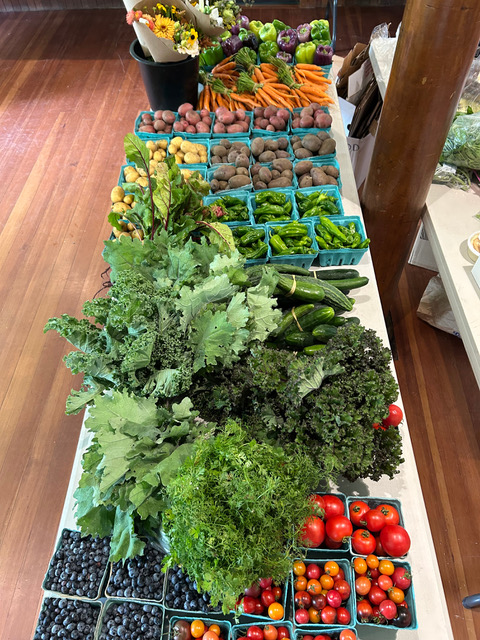
Five years later, the Guilford Food Hub has become a model of community resilience that has kept $204,000 in the local economy over the past four years. Here, customers can buy grocery list staples—potatoes, yogurt, cheese, tomatoes—from a range of vendors, including farmers and locals growing produce like shiitake mushrooms on a small scale.
As early as 2014, Hanna Jenkins, Guilford’s then Farm to School coordinator, had been running a buying club out of the Guilford school, aggregating orders from Food Connects, a regional distributor. Co-founder Anna Klein recalls that it wound down as Jenkins focused on growing her own farm business.
When the pandemic hit in 2020, Jenkins revived the buying club. As Klein remembers, “people were afraid to go to the grocery store.” This was an era when many were sanitizing their groceries on arriving home. Jenkins moved operations outdoors to her farm stand where people felt safer.
“There was this vibrant return of interest in buying local food,” Klein said. “This felt like a way for Guilford to be more resilient around food.”
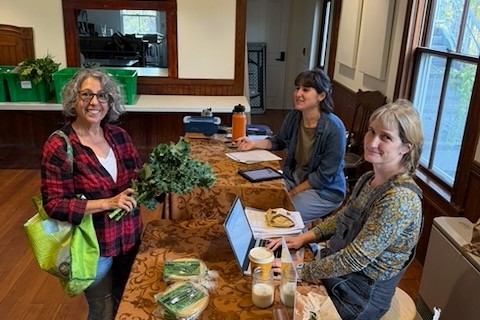
Through a regional distributor, the hub connects buyers to 21 other vendors ranging from established farms to local food growers. It has also sparked a little more togetherness in a spread-out rural town, becoming what co-founder Anna Klein calls “one more of those times where we bump into neighbors.”
The idea of becoming more locally self-reliant wasn’t new for Klein, and it built on discussions she had been part of for years. “In 2019 I was part of a community conversation with farmers about how to be more resilient and how Guilford might better support local agriculture,” she said. “It was kind of funny that happened the year before the pandemic.”
Even when Jenkins stopped the buying group for the summer, interest endured. A Facebook group for Guilford food sovereignty sprang up, and it was there that a resident, Jody Hauser, asked if anyone had extra freezer space. That led to discussions about community food storage and a desire for a real-life group to tackle these food issues.
Verandah Porche, who was part of the Facebook discussion, played what Klein calls a “matchmaker” role, connecting Klein and Julie Beet, and telling them there were others in town interested in these issues. Porche, who recently retired from the Guilford Selectboard after nine years, sees the Food Hub as embodying something deeper than just food distribution. “Neighborhood Roots draws on and updates the rural principle of mutual aid: collective action among equals, rather than charity,” she said.
People were very interested in forming a group. At the first meeting at the Guilford fairgrounds in August 2020, that interest distilled into a committed trio: Klein, Beet, and Hauser. The three met weekly for months to discuss their vision, write bylaws, and create a nonprofit, the Neighborhood Roots Food Collective.
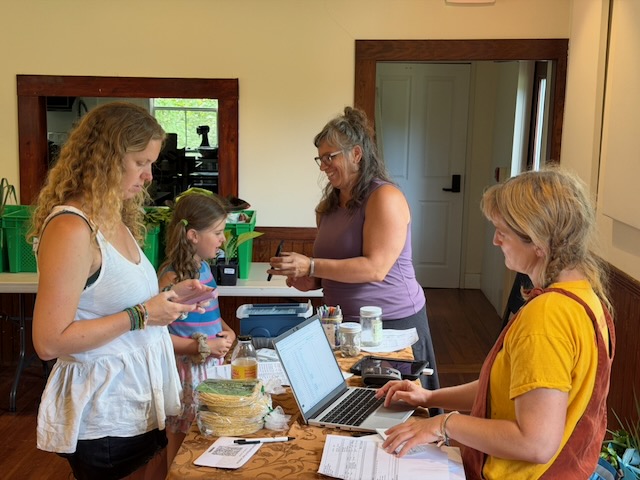
That fall, Klein organized her East Mountain neighborhood to buy from Food Connects, with Beet’s Sweet Pond neighborhood joining in shortly afterward. Their combined efforts, about 20 families, met Food Connects’s minimum delivery requirement. With Beet’s garage as a base, the food hub system began to take shape.
Starting Small, Growing Organically
Using a spreadsheet to aggregate orders and buy from Food Connects, they created what Klein describes as “basically grocery shopping together with our neighbors.” Klein remembers: “It felt really good—people were really grateful for it, and even for the chance to just see neighbors once a week.”
This neighborly approach reflected what Beet identifies as core Vermont values. “People need to eat—that’s the common denominator. But as Vermonters, no matter where you are on the political spectrum, people value farmers and they live in Vermont because this is a beautiful place and people value that land.”
Today, Guilford Food Hub operates from the centrally located Broad Brook Community Center, a historic Grange hall. They moved there in 2023 after two years in Beet’s garage, and the center charges the organization a small annual partnership fee for their use of the space. Their setup can handle about 50 orders per pickup cycle. Farmers list what they’ll have available a week in advance through an online platform. Customers place their orders online by Sunday for Wednesday pickup. On pickup day, farmers deliver their goods to the community center in the morning, collect their checks, and leave. Volunteers sort produce into bins that are labeled for each customer for a 3–6 p.m. pickup window.
What sets Guilford apart is its very low fee model. “One of the things we really wanted to do is make it so that to be a vendor, there’s a low barrier to sell through the food hub,” Klein explains. The Hub got off the ground with no markup and no fees—the farmer charged $5 for carrots and got $5 from the Hub. Now the hub recently decided to introduce a 5% fee on orders to support administrative costs, which Bete says vendors supported.
The Guilford Food Hub operates at a scale that falls outside most national tracking. The biennial National Food Hub Survey, conducted by Michigan State University’s Center for Regional Food Systems, tracks food hubs nationally, with institutional sales to schools and hospitals showing “great promise” as a growth area. But those surveyed hubs are typically focused on wholesale and institutional purchasing—aggregating produce from multiple farms to supply school districts, hospitals, and restaurant chains with consistent volume.
Guilford’s “micro-hub” model serves a different niche entirely: individual household buyers purchasing directly from hyperlocal producers, with no minimum order. The Farm to Market platform the hub uses was created specifically for this small-scale direct-to-consumer model, and its creator has worked with dozens of similar operations. His observation? “They come and go, with the key ingredient being the time and energy of the organizers.” Yet he remains optimistic about connecting local farms with local buyers for basics like honey and eggs—precisely what Guilford does.
Economic Impact: Real Money, Real Difference
The numbers tell a compelling story of economic relocalization. Over three years, the food hub has kept $204,000 in the local economy, with $90,000 going directly to hyperlocal vendors. Klein puts this in perspective: “That’s like one person’s yearly salary that could have gone to Price Chopper but is staying in the community.”
The number of direct vendors has more than tripled from 12 to 29, while average market sales have grown from $2,162 in 2023 to $2,888. This year, 119 unique households have made purchases—in a town of roughly 2,000 people, that represents meaningful community participation.
The Farmer’s Perspective: Growth and Challenges
Margaret Stoltzman of Hermit Thrush Homestead has seen her sales through the hub grow from $1,200 in her first year to over $5,000 in her third year. That’s only one-sixth of her annual $30,000 produce business, but Stoltzman is happy to have the outlet. “I’d love to sell more to them,” she said.
The food hub fills a crucial niche that larger regional food systems can’t address, says Stoltzman. “One of the things that the food hub does that no one else is doing is catering to super small food production,” Stoltzman observes. “Most of the regional food hubs that exist are only working with larger farms. They have insurance requirements and certification requirements, and if you’re a small business, it makes such a big difference with those extra costs tacked on.” Stoltzman’s neighbors don’t mind that her food isn’t certified organic—they can drive by her farm any day and see her out weeding and harvesting by hand, and they can taste the quality and freshness in her produce.
The hub has also solved a practical problem for Stoltzman: winter sales. She can produce fresh greens year-round, but “they’ll freeze solid within 20 minutes in my farmstand” once November rolls around. The Food Hub becomes her sole outlet during those winter months, providing a heated space for food distribution.
From Mushrooms to Lemon Bars: The Magic of Hyperlocal
To read the list of Food Hub farm vendors is to discover farms that might not have farm stands or sell at the Brattleboro Farmers Market, let alone at local grocers like the Brattleboro Food Coop: Hermit Thrush Homestead, Sirius Garden, Blue Toad Farm, Sylvan Moon Farm, Ancient Blessings Wellness, Radical Rose Botanicals.
“It’s everything from just a home gardener who has an abundance to established farms,” Klein explains. “Somebody could say, ‘Oh my gosh, I grew so many tomatoes this year, I’m gonna sell them at the food hub.'”
“We have a neighbor up our hill who just grows mushrooms, and it’s such a gift when they show up in the market. People are so excited because they’re gorgeous. That might only be a couple times a year, but it’s magical.”
Or consider Lynn Symons of the multigenerational Paul A. Boyd Farm. Ten years ago, a car accident left her with 21 surgeries and long-term disability. “I created this little business through the food hub to be able to keep feeling like I was earning and doing,” she says. “It’s made me feel not useless.”
Her lemon bars have become legendary among Food Hub customers. “People buy all this kale and vegetables,” says Klein, “but what really gets them excited is ‘Oh, I got my lemon bars from Lynn!’ They have a connection to her.”
For Symons, the Food Hub provides more than the roughly $10,000 she earns annually. “It’s giving me another purpose to keep going, and I’m helping the community I love too.” That connection could mean upwards of $500 in sales for the Boyd Farm on a good pickup day—not bad for home-baked goods.
“No farms, No Food” is a popular bumper sticker, but turning that slogan into action is going against the tide. Vermont saw a 44% decrease in small dairy farms from 2012 to 2022. The long-term trend in farmland loss to development has continued in recent years, with Vermont losing 1.6% of its total farmland to development from 2012 to 2022.
For Guilford, the Food Hub means more farms, more food. Beet points to a hay field on a busy state highway where multiple farmers now operate. The Food Hub had looked at it as a potential permanent location. Though they didn’t pursue it, the Hub became a matchmaker. “Footbridge Flowers came to us looking for land, and we sent her there,” says Beet. “Sylvan Moon Farm is growing on that land,” expanding its operations. “They sell through the Food Hub. A brand new farmer started this year there who just last week sold his first harvest to the Food Hub.”
Stoltzman of Hermit Thrush Homestead was an established small farm that has found the food hub invaluable for handling the business side. “Growing food is hard and has a lot of challenges,” she says, but that’s just the start. “As a small business, you end up doing everything because you don’t have the economic resources to hire out for anything, and so you do everything else, like marketing and customer service and troubleshooting orders. It’s so awesome to have that outsourced, and not paying for it is amazing.”
The system runs on about 20 hours of coordinator time per order cycle, split between Klein and Beet, plus pickup-day volunteers.
Despite its precarious economy, the Food Hub is banking social capital. Pickup days become community events where “some people end up staying for an hour or two having conversations.” It has created what Klein calls “a real social connection place.”
The Food Hub’s founders are clear about their mission: they’re building long-term food security and affordability. Volunteers have put considerable effort into removing barriers to participation. The hub accepts EBT, the electronic system that allows a Supplemental Nutrition Assistance Program (SNAP) participant to pay for food using benefits. There’s a “pay what you want” table with extra produce, and the separately run Guilford Food Pantry offers another option from the same community center.
About 6% of Food Hub orders are paid with EBT, and they’re averaging $1,000/year in produce subsidies with the Crop Cash program, a discount run by Vermont’s organic farming group (NOFA-VT).
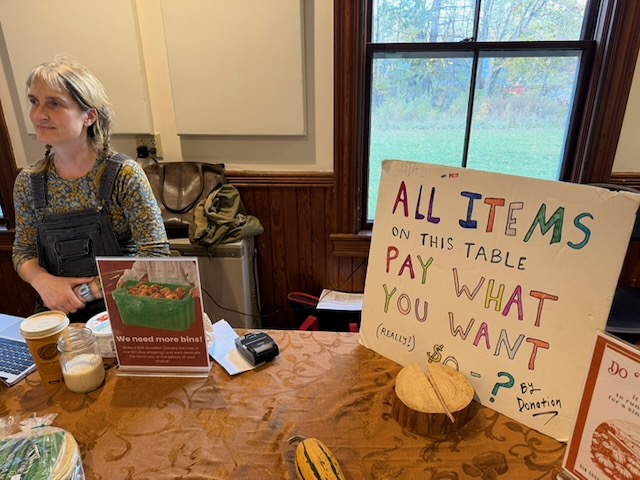
With recent cuts to SNAP benefits, organizers continue to refine the ways they ensure locals in need can access food through their program, including pooling donation money for a Food Security Fund which helps subsidize a portion of costs for families and individuals.
Lessons in Community Resilience
The Guilford Food Hub addresses multiple needs simultaneously: economic, social, practical, and strategic. Asked what other communities could learn from Guilford, Klein emphasizes scalability: “My dream would be that this is something we’re just planting a seed for, and other people are going to come and be part of it and influence it,” she said.
“I’ve watched the revolution in eating options,” Porche reflects, and she has witnessed decades of food system evolution. She was part of the Total Loss Farm commune in Guilford in the 1960s, a founding member of the Brattleboro Farmers Market, and part of a food-buying club that predates the Brattleboro Food Coop.
“If we have a crisis in our country, we have a system that we could ramp up for a lot of people,” Beet said.
Five years in, with 119 households participating and $151,000 circulated locally, it’s a quiet revolution—one lemon bar at a time.
Read more stories from the Resilient Neighbors series.
Tristan Roberts writes from Quill Nook Farm in Halifax, Vermont, where he grows and teaches about heritage plants. He was elected to the Vermont U.S. House and served from 2023 to 2025, and is also the founder of Metricorps, a community for sustainability practitioners.





Comments
We changed commenting systems on September 10, 2026 as part of a site-wide functionality and security upgrade. Your past comments have not disappeared, and you can still log in with your old Disqus account credentials if you wish. Contact us with any questions.