

After writing five rather technical pieces on nitrogen, it is time to switch theme.
Can there be a market economy without capitalism? That is the question of today’s post. A post where I encourage my readers to make their own opinion or perspectives heard.
Let’s start with some definitions.
Depending on who uses the word and in which context they have different meanings. Some use “capitalism” and even more “capitalist” as a slur, while others see it as something positive. While I am very critical of capitalism, I don’t put any judgement into my use of the word. My own definition – which I believe is fairly mainstream — of capitalism is: An economic system in which the means of production—factories, tools, machines—are owned by firms (individual proprietorship, corporations and even state bodies). Production and distribution of goods and services are carried out with the purpose of generating a profit (i.e. accumulation of capital) for the owner. Markets are used for allocation of resources and distribution, including markets for labor and capital.
The main difference between capitalism and the (mostly feudal) systems preceding it is not that someone is rich and has a lot of capital, feudal lords and pharaohs also had that. The difference is rather that the riches are obtained through profits in production, “truck, barter and exchange” (to talk with Adam Smith).
A market economy is a system in which production of a large share of goods and services (including labor) is determined by supply and demand and exchanged for money (in a wider sense). “Markets” have existed in numerous forms all throughout history, under ancient empires, feudalism and even under Soviet socialism. In a similar way as the existence of capital is not the same as capitalism, the existence of markets doesn’t constitute a market economy. In a market economy, a major share of necessities, services, labor and capital assets are mediated in markets.
Clearly, even in extreme market economies, there will always be a considerable share of human activities also outside of the market, household work, raising of children, welfare systems, defense and police. Notably markets can play a big role also for these as most resources needed for their execution, including labor, can be acquired through markets.
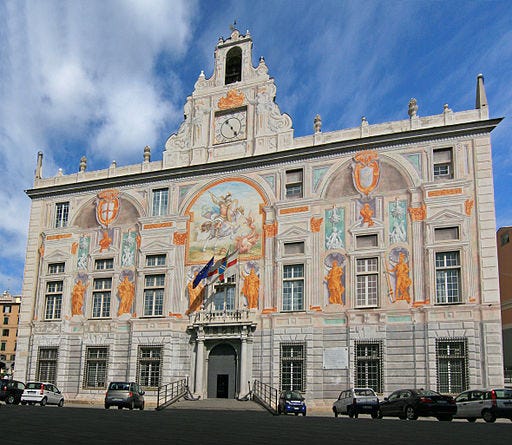
Photo: Jensens, Public domain, via Wikimedia Commons
Ten years a go I made a “pilgrimage” to the origins of capitalism and visited Banco di San Giorgio in Genua, officially Casa delle compere e dei banchi di San Giorgio, was founded in 1407, making it one of the oldest chartered banks in Europe, if not the world. Giovanni Arrighi, in his masterpiece, The Long Twentieth Century, Money, Power and the Origins of our Times (a must-read), sees Genoa as the first representative of global capitalism and the bank was the most important institution.
Quite often, I encounter the opinion that many of the ills of the world are caused by capitalism, but that capitalism is a perverted market economy where mostly big companies have gained control and manipulate both markets and the state. With a “free(d)” market economy most of the ills of capitalism would wane. This reasoning seems to be most widespread in the culture dominated by Anglo-Saxons, by agrarian populists or other groups promoting small business.
However, I fail to understand how a free market economy would not evolve into capitalism by its own inherent properties and drivers. Even in a hypothetical scenario where we would all start by being equal and running our own proprietorships sooner or later some will be successful, accumulate property (capital), lending money to others (for a rent), hire those less fortunate etc. Capitalism would evolve. Just as it did.
This is further amplified by the division of labor that is inherent in technological development, which makes the production process more resource demanding and the need for investment and planning apparent.* I just read an interesting story about how the Swedish iron making was transformed from being performed by cooperating bergsmän, mining-peasants, into work by corporations, largely driven by the new technologies that were introduced.
As far as I can see a market economy could only in the long term be non-capitalist if there are no opportunities to make profit**, accumulate property or take rents. But is that a market economy?
In my view it is hard to see how a non-capitalist market economy could look like. But perhaps you have a better idea?
* Even if may sound like a contradiction, capitalist production is to a large extent a planned production. This is probably also the reason for why very large corporations, and in particular conglomerates trying to control the whole value chain, tend to lose their dynamism and be challenged by new smaller and quicker upstarts, especially in markets with a rapid technological development.
** Some people seem to misunderstand the concept of profit and say that you need profits in order to reinvest in the business. But to repair broken machines and keep buildings in a good shape, even to build a new one similar to an old one is part of the costs of a business and is in most countries therefore also tax-deductible as depreciation. Profits come over and above that, allowing a considerable expansion of the business or to be used for other businesses or just spent on personal consumption.


Comments
We changed commenting systems on September 10, 2026 as part of a site-wide functionality and security upgrade. Your past comments have not disappeared, and you can still log in with your old Disqus account credentials if you wish. Contact us with any questions.
I think you are missing the underlying principles that make the question an important one. Humans are social animals economically (and in many other ways). Our societies seem to be most (subjectively at least) fair economically, when the income/wealth of families and individuals seem to be similar – fall within a range that most consider fair. In a market economy of individuals and individual owners of enterprises, in Japan, centuries ago, an owner's income was limited to 5 times that of the lowest paid employee. Recent research has suggested that across several societies, that workers tend to define a fair income distribution somewhat similarly, with the highest paid receiving 20-30% of the lowest paid.
Capitalism presents several challenges, particularly as economic enterprises grow into very large enterprises. The first is that structurally, capitalism puts workers and owners (shareholders) into a complicated relationship. The interests of owners (shareholders) and management have one goal – maximize profit. Structurally, that means that shareholders and management, are likewise required to minimize worker income ,with or without, depending on the finances, lowering their productivity. However, this sets up a de facto social/economic class system, in which the elites have more income /wealth, often 100s or thousands of times that of workers, and far more economic and political power as well, more often than not. E.F. Schumacher, An English Economist, wrote a book proposing a number of ways to make capitalism more equitable – requiring that 51% of shareholders be workers, limiting the size of enterprises to the size of the physical facility in which it is housed, and many others (see "Small Is Beautiful: A Study Of Economics As If People Mattered", 1973.
An important, but as far as i can tell, not well-researched area is the effect of capitalism on the people in various economic enterprises; individual owners, shareholders, management, and workers; in regards to how various divisions of labor shape the beliefs, values, skills, quality of life, and other aspects of the lives.
Another, I believe, largely unexplored area is an unmentioned type of free market economy – cooperatives, in which the workers are the owners. Cooperatives could, given their structure, minimize issues of equity, while simultaneously permitting growth of technologically sophisticated enterprises, and provide a structure for minimizing conflict regarding income.
In summary, I disagree that any free market will "evolve " into a capitalist one. In light of the widespread dissatisfaction with current capitalist economic systems among many, I would argue that free markets that "grow" in the current iteration of capitalism, are devolving, not evolving.
Did Banco di San Giorgio in Genua approve your loan?
You didn't say.
And have you paid it off?
I'm not kidding: What I meant to say is that debt and the legal architecture that sustains and expands it is a barrier to escaping capitalism. I can't seem to get outside a system where profit is necessary to paying interest.
What is a hundred billionares' heads on pikes on Wall Street? A good start!