

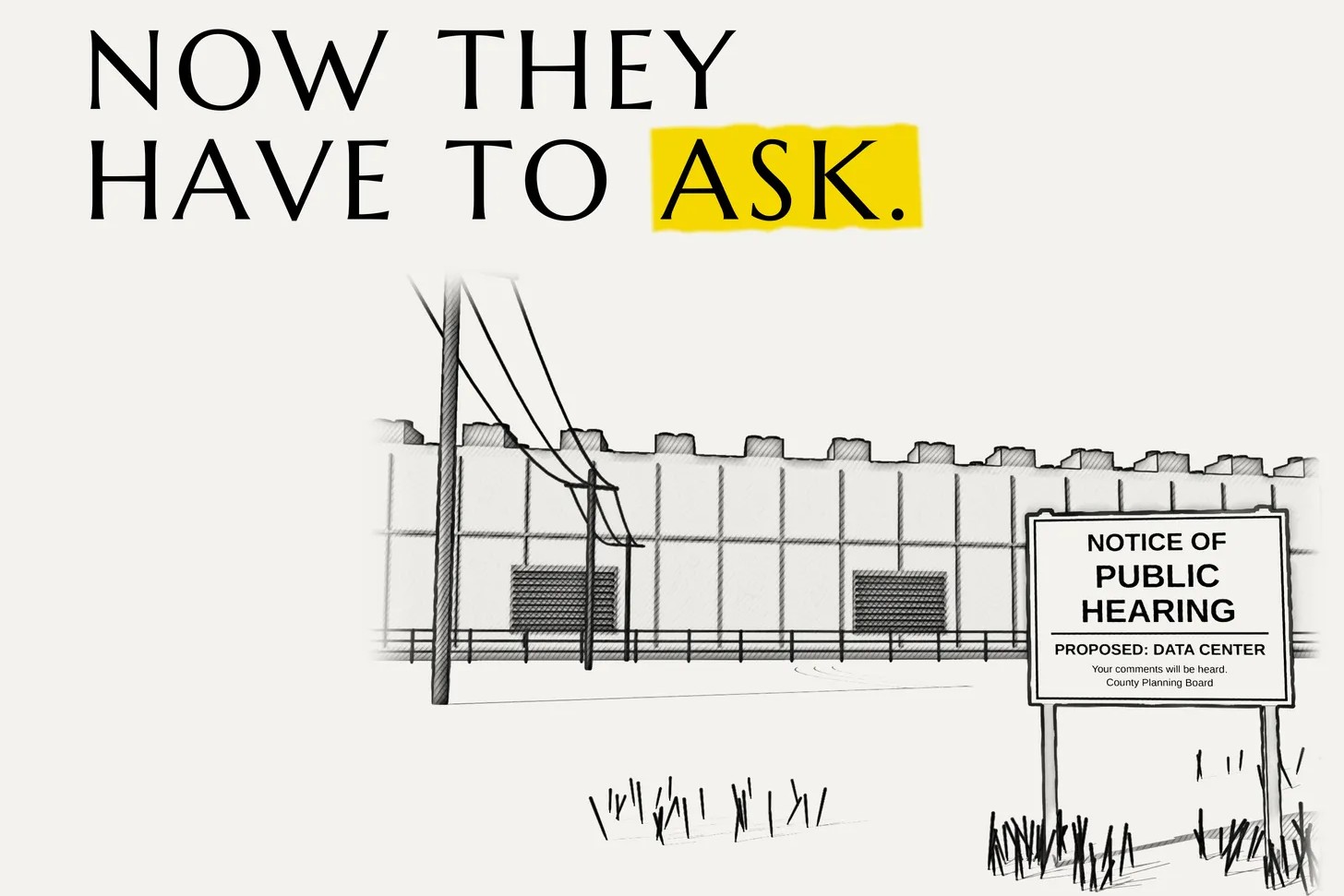
The fight over data centers is only partly about data centers. The buildings stand in for AI, and AI stands in for something older, which is the trust Americans once gave the technology companies without asking for proof. That trust used to be assumed. Now it has to be inferred from what the companies do, and the inference is fraying. This essay argues that the opposition to data centers is best read as the public’s answer to that longer history, given at the one place where these companies have to ask permission.
The signal
What needs explaining is how quickly and how widely opinion has turned. In the summer of 2025 voters were evenly split on having a data center built near them, and a year later three in four were opposed [1]. Seven in ten Americans now oppose one in their own area, including clear majorities of Democrats, independents, and Republicans [2]. In Ohio the Republican and Democratic nominees for governor both want to pause new projects [3]. Americans agree on very little right now, so when people who disagree about nearly everything else agree on this, the agreement is a signal, and the question is what it is a signal of.
The two usual answers do not go far enough. One holds that the complaints about water, electricity, and noise are exaggerated [4], and some of them may be. The effect on household bills so far looks small in most places, though prices have jumped on the mid-Atlantic grid, partly because of data center demand [5][6]. The other answer holds that the opposition is manufactured by foreign adversaries. Some of the online activity is, but what has been documented is small and its effect has been overstated [7]. Both questions are worth settling on the facts. Neither one explains how three in four voters came to the same view in a year.
The first stand-in
A better explanation begins with what kind of thing a data center is. AI is hard to see, even for people who use it every day, and a data center is the one part of it that sits in a particular place, where it can be seen, measured, and voted on. Others have already said that the buildings have become a stand-in for AI itself [8][9][10], and the evidence gives them some support. Only 8 percent of opponents know of a data center anywhere near them [8]. Americans are more opposed to a data center in their area than to a nuclear plant [2]. When opponents explain themselves in their own words, about one in eight talk about AI taking jobs, and a similar share say they dislike or distrust AI [2]. Neither has anything to do with a building down the road.
That reading is only part of the truth. Most opponents still name water, power, land, and bills, and one pollster who looked at the reasons people give concluded that the idea “isn’t exactly right” [11]. But it points in the right direction, because people are bringing more to the building than the building itself explains.
The second stand-in
This essay goes one step further. If the buildings stand in for AI, then AI stands in for distrust of the companies that build it, and that distrust is much older than AI. Others have pointed toward this as well [9][12], and an earlier essay argued that the change people fear from AI began years ago, with the smartphone and social media [13]. What this essay adds is an account of what happened to the trust.

It helps to separate two kinds. Assumed trust is given in advance, before anyone checks. Inferred trust is worked out from what a person can observe: what a company did last time, whether it fixed what went wrong, and whether anyone outside the company can verify what it says. A forthcoming book, Governance, Bureaucracy, and Organization, draws the same line about competence in organizations [14], and it carries over to trust.
For years the technology companies enjoyed the first kind. In 2015 seven in ten Americans thought these companies were good for the country, and by 2019 only half did [15]. Confidence in them has since fallen to the lowest level since Gallup began asking in 2020 [16]. Each party has taken its turn, Republicans first and Democrats now [16][17], for different reasons and in the same direction. So AI did not arrive to a public ready to assume the best. Half a year after ChatGPT appeared, more than eight in ten Americans, in both parties, already said they did not trust the companies developing AI to do it responsibly [18].
The puzzle is that almost everyone kept using the products while the trust drained away. Nine in ten adults now own a smartphone [19], and nearly half of teenagers say social media is bad for people their age [20]. One experiment shows how both can be true. College students put a real value on their own access to TikTok, and yet on average they were willing to pay to have it switched off for everyone on campus, themselves included [21]. They used it because everyone else did. Albert Hirschman observed that a person unhappy with an organization can leave or can speak up [22]. With phones and social media most people could do neither, because leaving meant losing touch with family, school, and work, and there was never a meeting to speak at. These products arrived one phone at a time, and nobody held a vote.

So people stayed, but they stopped taking the companies’ good faith for granted and began judging them by what they could see. That is the move from assumed trust to inferred trust, and it explains how use could keep rising while trust kept falling. The same pattern is already visible with AI, where about half of adults now use chatbots and most have little confidence that the companies will handle the technology responsibly [23].
The inference is fraying
Inferred trust depends on evidence, and the evidence the public has been given this year is poor. On March 4, seven companies signed a pledge at the White House to pay for the power their data centers need [24]. Two of them were Meta and Google. Three weeks later one jury found that Meta had knowingly harmed children’s mental health, and another found Meta and YouTube negligent toward a young woman who had started on their platforms as a child [25]. Both companies dispute the verdicts. A pledge is a statement about the future that asks to be believed, which means it asks for assumed trust, and this one is mostly not yet backed by rules that can be enforced [26]. Two months later three in four Americans, including majorities of both parties, said they were not confident the companies would keep it [27].
That is what a frayed inference looks like. The companies made a promise aimed directly at the stated complaint, and the public’s answer was that it did not believe them. Opposition to data centers kept climbing through the spring [1]. No poll tests this whole chain, and this essay cannot prove that distrust of the companies is what turns people against a building. But the pieces fit. The distrust is older than AI, both parties share it, and it showed itself the moment the companies asked to be taken at their word.
The speed of AI makes this worse. Most of what people hear about it is forecast, some of it bright and some of it dark, and the experts disagree. Much of it also comes from the companies themselves. A public that trusted the companies might be willing to wait and see, but this one has little trust left to draw on.
These products arrived one phone at a time, and nobody held a vote.
Why it lands on a building
For almost twenty years these companies did not need the public’s permission for much, because a phone or an app is adopted by one person at a time. A data center is different. It needs land, water, power, and a permit, and the permit is decided at a public meeting close to home. That makes it one of the few things these companies need that a community can turn down. When the question finally came to a vote, people brought those twenty years with them.
What follows
If this is right, much of the debate is aimed at the wrong things. Checking the water figures treats the stated complaint as the whole complaint, and so does searching for bots. Both are worth doing, and neither touches the distrust.
Opinion. It also means that most of what the companies are doing does not repair the trust. A pledge is a promise, and a fund for the towns that host the buildings [28] is a gift. Both may be sincere, but both ask for assumed trust, and in this essay’s opinion assumed trust is gone for good, because people who have learned to check rarely go back to not checking. Inferred trust can be rebuilt, but only slowly, and only from conduct that outsiders can see and verify.
The public seems to know this. Asked what would raise their confidence in the pledge, people most often named laws that would require the companies to keep it, followed by checks from the government or from independent groups [27]. Some of that has begun, from outside the companies. This summer the Democratic governor of Pennsylvania barred state agencies from signing nondisclosure agreements on data center projects [29], and the Republican governor of Texas ordered an audit and paused new grid connections [30].

A county board cannot settle any of this. It can say yes or no to a building, but it has no say over what these companies do with AI, or over what they did in the years before it. That larger question belongs with legislatures, regulators, and the companies themselves.
None of this is a criticism of AI. It does not say that people who oppose data centers are confused, or that people who use these products are hypocrites, and it is not a forecast of who wins these fights. The argument over water, power, and noise should continue, and it should be settled on the facts. But the people in those county meetings were asked about a building, and the size and speed of their answer suggest they were answering a larger question, one that had been growing for almost twenty years.
- Robinson Meyer, “Exclusive: 75% of Americans Now Oppose Local Data Center Development,” Heatmap News, August 19, 2026.
- Jeffrey M. Jones, “Americans Oppose AI Data Centers in Their Area,” Gallup, May 13, 2026.
- Riley Callanan, “Data center boom puts Republicans in a bind before midterm elections,” CBS News, October 12, 2026.
- “The moral panic over data centres is foolish,” The Economist, September 3, 2026.
- Kiran Garimella, “Are Data Centers Raising Your Electric Bill? Mostly Not. Yet.,” New Jersey State Policy Lab, Rutgers University, June 22, 2026.
- Energy and Environmental Economics (E3), “Understanding the Drivers of Rising Electricity Rates and the Role of Data Centers,” May 2026, prepared for the Data Center Coalition.
- Loreben Tuquero, “Is US data center opposition a ‘China PR thing,’ as Trump says? Experts say that’s exaggerated,” PolitiFact, September 23, 2026.
- Megan Morrone, “Data centers become the face of AI backlash,” Axios, June 22, 2026, reporting a Milltown Partners poll. Milltown advises AI companies.
- Tom Wheeler, “Data center backlash signals a fight over AI power,” Brookings, July 7, 2026.
- “Data center backlash is proxy for discomfort toward AI, says author and professor Walter Isaacson,” CNBC (video), September 4, 2026.
- UMass Amherst Poll, “Just 1 in 9 Americans Support AI Data Center Construction in their Local Communities,” September 14, 2026.
- Brian Merchant, “With the backlash to data centers, Flock and AI glasses, a mass opposition to big tech is underway,” Blood in the Machine, August 27, 2026.
- John Elijah, “Wrong Date, Wrong Institution, Wrong Scale,” Substack, October 2026.
- Governance, Bureaucracy, and Organization: Stewardship, Drift, and Administrative Capacity (Routledge, forthcoming).
- “Americans’ views on tech firms turn sharply negative: poll,” AFP via Tech Xplore, July 2019, reporting Pew Research Center figures.
- Lydia Saad, “Confidence in U.S. Institutions Remains Near All-Time Low,” Gallup, July 13, 2026.
- Lydia Saad, “Confidence in Big Business, Big Tech Wanes Among Republicans,” Gallup, July 19, 2021.
- Mallory Newall, Johnny Sawyer, and Bernard Mendez, “Few Americans trust the companies developing AI systems to do so responsibly,” Ipsos, July 27, 2023.
- Pew Research Center, “Mobile Fact Sheet,” November 20, 2025.
- Pew Research Center, “Teens, Social Media and Mental Health,” April 22, 2025.
- Leonardo Bursztyn, Benjamin R. Handel, Rafael Jiménez-Durán, and Christopher Roth, “Product market traps in social media: Evidence and policy implications,” Brookings, June 2, 2026.
- Albert O. Hirschman, Exit, Voice, and Loyalty: Responses to Decline in Firms, Organizations, and States (Harvard University Press, 1970).
- Allison Steffens Herrera, “Half of Americans now use AI chatbots, but 40% think AI will make society worse and two-thirds don’t trust the government to regulate it,” The Next Web, June 17, 2026, reporting a Pew Research Center survey.
- The White House, “Fact Sheet: President Donald J. Trump Advances Energy Affordability with the Ratepayer Protection Pledge,” March 4, 2026.
- Sarah Shamim, “Jury finds Meta, YouTube liable for social media addiction: What we know,” Al Jazeera, March 26, 2026.
- David M. Klaus and Mark MacCarthy, “The pledge to protect ratepayers from AI data center costs needs enforcement,” Brookings, July 9, 2026.
- Consumer Reports, “New Survey finds Americans are Skeptical of Big Tech’s Pledge to Pay for All AI Data Center Energy Costs,” June 23, 2026.
- Jim VandeHei and Mike Allen, “Behind the Curtain: The new existential threat to AI,” Axios, August 19, 2026.
- Katie Meyer, “What Shapiro’s new data center order does — and doesn’t — force developers to do,” Spotlight PA, August 25, 2026.
- Emily Medeiros, “Abbott Orders Audit of Texas Data Centers, Pausing Future Grid Connections,” The Daily Signal, August 6, 2026.




Comments
We changed commenting systems on September 10, 2026 as part of a site-wide functionality and security upgrade. Your past comments have not disappeared, and you can still log in with your old Disqus account credentials if you wish. Contact us with any questions.
I find this really irritating, with its suggestion that people opposing data centers and naming power use, water use and noise as chief reasons are “really” opposed because they don’t trust the companies. And then the blithe “the data center is the one thing they get asked to approve.” Yeah? Maybe in some places. I live in West Virginia, where the legislature passed a bill in 2025 taking away all rights to decision-making from localities and counties, and also taking 70% of the property taxes. They are also redacting the permits and telling us we have no right to know how much water they’ll use. They’re also going to decide shortly on allowing two long distance, high voltage transmission lines, to power the data centers in Virginia; and the rules say our ratepayers have to ante up for these towers and lines inflicted on us even though none of the power will be used in WV. They will use eminent domain to seize the land. They’ve held Open Houses, mostly to collect complaints and try to choose a route that garners the fewest–but we have no right to simply refuse this. In many places, people found out about the data centers after they were under construction, and found that local authorities who allowed them had signed NDAs to hide the details. SOME places give citizens veto power…many don’t.
So the real reason we don’t like data centers is just that we don’t trust the companies? Sure that’s true, but we also see myriad harms from social media, and see AI as an extension of that and see a whole slew of new harms–mass surveillance to feed a burgeoning police state, AI being fed into an increasingly unhinged and dangerous US military, young people losing cognitive abilities because of disuse, everyone being increasingly unsure of what’s real with all the deepfakes.
And then there are the direct harms of data centers. They are enormous buildings taking up huge amounts of land wherever the techbros damn well feel like putting them, they are horribly noisy if you live close, many are put where water is already scarce, and we already have the example of Ireland, an early adopter which during a drought, rationed water use–but exempted the data centers. Aside from the effect on water and power bills, if there is an outage or drought, will these data centers be prioritized over residents, because they “have to” run 24/7? If not they’ll using diesel backup generators, heavily polluting what’s often already dirty air.
And–we are at a point where we DESPERATELY need to reduce emissions, as climate change is beginning to spiral out of control. I’ve seen a variety of numbers on how much power–most of it from fossil fuels–this industry wants to use, but it’s hardly trivial. At a time when we so urgently need to be cutting emissions, adding significantly to them for a project few people want should not be dismissed so cavalierly.