

 Excerpted with permission from Escape from Overshoot: Economics for a Planet in Peril, Peter Victor (April 2023, New Society Publishers.
Prologue: A Planet in Peril
Homo sapiens became established on planet Earth at least 200,000 years ago, and perhaps well before.1It took until the year 1800 or thereabouts for the human population to reach one billion. A second billion was added in only 124 years, with successive billions added at intervals of thirty-three, fifteen, twelve, twelve, twelve, and thirteen years, surpassing eight billion in total in 2022. Most of the one billion humans living at the beginning of the 19th century had a very low material standard of living. Billions still do today, but for billions more living standards have increased by leaps and bounds, faster even than the increase in population. Meanwhile, the planet has not increased in size at all. Essentially the same amount of sunlight is intercepted by the Earth each year, providing life-giving energy which, through photosynthesis, supports virtually all life on Earth, including humans.
The combination of billions of people and the gargantuan quantities of materials we use to enrich our lives is imposing a burden on the Earth’s ecological systems that cannot be sustained. It is in this sense that the planet is in peril. Earth itself is not in danger. It will be here long after humans have come and gone, but we are imperiling it as a home for our species and that of many others not because we want to, but because so far have been unable to stop depleting and degrading the capacity of the planet to sustain us all.
There is overwhelming evidence that human impacts on the zone of life on Earth — the biosphere — have surpassed sustainable levels in several crucial respects. We are in Earth overshoot. Of course, there are huge differences in how much different people and nations have contributed to overshoot and its effects, both historically and now. There is also a disturbing disconnect between those primarily responsible for overshoot and those most vulnerable to its consequences, and the situation is getting worse.
None of this is to deny the remarkable improvements in many aspects of people’s lives experienced by the most recent generations. Material living standards have reached unprecedented levels for literally billions of people, though billions more still languish in abject poverty, still hoping for a better future for themselves and their children. Many believe that the technological advances, fuelled by cheap fossil fuel energy, that led from the steam age to the widespread, innovative uses of electricity, computerization, and remarkable achievements in the life sciences, will overcome any and all obstacles. But these advances have come at a cost. Great damage has been done and continues to be done to our Earthly home, and to the other species with which we share it. There have been occasional gains such as the reduction in acid rain in the 1980s and 90s in the USA and Canada, and the partial recovery of the stratospheric ozone layer, though not without strong corporate opposition and government hesitancy. However, despite the seemingly endless succession of international commitments and well-intended plans for reducing greenhouse gas emissions, protecting biodiversity and endangered species, and addressing numerous other aspects of overshoot, we are figuratively and literally losing ground. What is to be done?
There is no simple solution to such an entanglement of complex problems. But there are ways of thinking and acting that can help.
Some of these come from economics, which has a rich stock of ideas and insights developed over the past two centuries as well as from more contemporary sources, from which we can draw. The aim of this book is to bring to a wide audience the fruits of several decades of research that describes and explains humanity’s predicament and points towards a more attractive future than if current trends continue.
The emphasis is on economics because the economic activities of production and consumption are so intimately related to overshoot, and as an economist, it is what I know best. But just as fire, police, and ambulance are routinely called to emergencies, we will need all the best ideas that humanity has to offer, not just from economics, to find an escape from overshoot. And the escape plan, to the extent that one can be synthesized by a single author, is intended primarily for high-income countries which, as a matter of justice and efficacy, should take the lead in reducing their impacts on planet Earth.
The book begins with an account of overshoot drawing on peer-reviewed and government sources. It tells a very disturbing story. Since we are concerned about the future, evidence for overshoot is followed by a discussion of the difficulty — impossibility even — of predicting the future. But prediction as normally understood is not the objective of this book. Any prediction of the future is contingent on what we decide and do today. This book is intended to help us make better decisions, informed by careful, systematic consideration of their possible and probable consequences. This is our best chance of finding an escape from overshoot and a better future for all.
The immediate cause of overshoot is the combination of the massive increase in the number of people and what we produce made possible by the rapid and grossly uneven experience of economic growth of the past two hundred years. In many parts of the world, economic growth has become virtually synonymous with the idea of progress.
This did not happen without critical commentary, including some from influential economists, which was, however, largely ignored. In this book we will hear their voices once again and maybe this time we will listen more closely.
It is common in academic disciplines for members to coalesce around a few key ideas or principles, giving rise to different schools of thought. In mainstream, neo-classical economics, environmental problems have generally been seen as a problem in microeconomics — the economics of individuals and markets. The same is true of issues relating to the depletion of natural resources. From this comes useful insights about the failure of markets — where they exist at all — to register environmental damages and excessive rates of resource use. Policy proposals that flow from this microeconomic analysis emphasize the use of various types of emission charges such as a carbon tax, grounded in the belief that if we ”get the prices right” markets will automatically yield the right quantities of polluting emissions and rates of resource utilization. An alternative approach arising from this neo-classical perspective, is to establish markets where none exist — say of permits to emit pollutants or to catch fish — and allow the permits to be traded with their price determined by demand and supply.
These microeconomic approaches to environmental and resource issues have a place in the menu of policy options, but they fall short of what is required to escape from overshoot. The reason for this is that emission charges and tradable permits are designed to make markets more efficient — to assign inputs of all kinds to their best uses. But overshoot is less a problem of efficiency in this sense than one of scale, of the physical size of the economy in relation to the physical size of the Earth and its ecological systems on which economies depend. Overshoot is first and foremost a problem of macroeconomics, of the whole economy. So, for this reason, most of the economics used to address overshoot in this book comes from macroeconomics, with its scope expanded to encompass this essential dependency of economies on the environment.
The predominant economic system in today’s world is some form of capitalism and so we will compare, at a macro level, how several of these schools of thought analyze capitalism. We will see that they differ greatly in the different features of capitalism that they highlight, suggesting different obstacles to and possibilities for an escape from overshoot, though this was not their originators’ main concern. However, it is the concern of several current proposals for more sustainable economies, such as steady-state economics, doughnut economics, and degrowth, from which we can draw elements of an escape plan. These proposals all draw on ecological economics, a new branch of economics founded on the understanding that economies are sub-systems of the biosphere, entirely dependent on Earthly supplies of materials (including fossil fuels), air, land, and water. Ecological economics recognizes that inputs to the economy are transformed and degraded through production and consumption, which, when excessive, upset the balance between humans and the rest of nature.
One way of delineating future possibilities is to draw a conceptual map of the terrain based on key topics. The map of the future sketched in this book consists of points of interest such as consumption, technology, work, and equity but, like an ordinary printed map, it does not prescribe a particular route. Some routes — green growth and the circular economy for example — are promoted based on the questionable belief that economic growth can be permanently decoupled from resources and wastes. An alternative is to look forward to a post growth future and the various forms that it might take, starting in high-income economies.
Simulation of various scenarios are featured, culminating in a list of what needs to change to get the future we choose, rather than the one that ignorance, vested interests, and complacency will otherwise oblige us and those who follow to take. Examples of positive change are not hard to find, and we look at a few. Their very existence gives grounds for hope. The challenge is to ramp them up quickly to a level sufficient to escape from overshoot, and this book helps point the way.
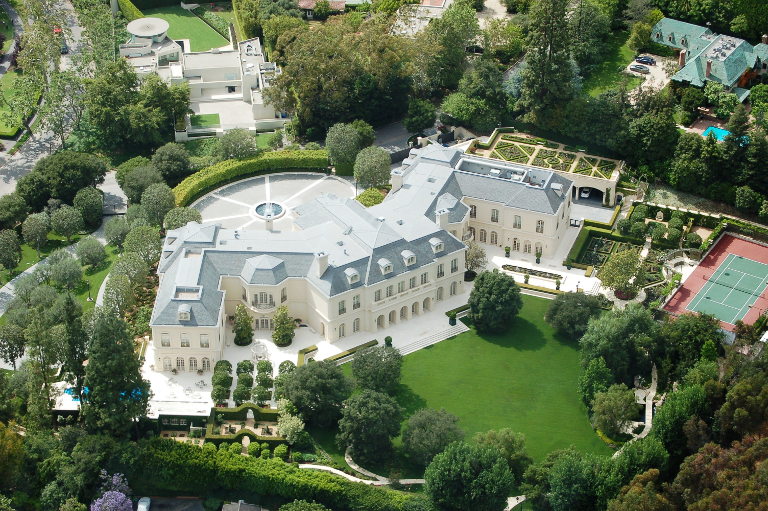
Teaser photo credit: An affluent house in Holmby Hills, Los Angeles, roughly 12 miles from downtown. By Atwater Village Newbie – Spelling Manor, Holmby Hills, CC BY 2.0, https://commons.wikimedia.org/w/index.php?curid=7614947



Comments
We changed commenting systems on September 10, 2026 as part of a site-wide functionality and security upgrade. Your past comments have not disappeared, and you can still log in with your old Disqus account credentials if you wish. Contact us with any questions.
Bill Mollison once said that all problems have a solution, usually an embarrassingly simple solution. Simple can be very difficult, however.
Photosynthesis splits off oxygen from CO2. O2 goes into the atmosphere, and C goes into the Calvin Cycle, which transforms C into sugar to feed soil life that has yet to succumb to the petrochemicals at the heart of industrial farming.
The Calvin Cycle transforms carbon into sugar. Soil microorganisms eat that sugar. That carbon has returned to the soil, as sugar, not carbon.
Healthy soil does not emit carbon. Healthy soil has only sugar that soil life eats.
The soil carbon sink is now badly broken by petrochemicals. Soil microorganisms need sugar to eat. It’s not provided by the petrochemicals at the center of industrial agriculture.
So a lot of soil dies.
Soil has no microorganisms to eat the sugar made by the Calvin Cycle, which was discovered in 1957. Calvin got a Nobel Prize for it.
The Carbon Cycle moves carbon from sink to sink – the ocean carbon sink, the soil carbon sink, and the atmosphere carbon sink. Due to petrochemicals that don’t provide sugar, but only carbon from a refinery, there is not enough living soil life to eat enough sugar from the Calvin Cycle, so the Calvin Cycle stops transforming carbon into sugar at optimum scale for soil life to eat.
The carbon cycle can’t deposit carbon in the soil carbon sink because too much of the soil is dead.
Tilth, not crop yields, is the indicator of good soil.
Farms that stop using petrochemicals soon have good soil, with tilth – soil life poop – that is the best fertilizer in the world, so there is no need for petrochemicals.
That’s where we get into politics. Petrochemical refiners have tons of money and the American Chemical Council to stay in the soil picture they should leave.
Because capitalism must be imposed for it to live. No one chooses capitalism.
Restoring soil life that eats the sugar that the Calvin Cycle produces doesn’t work with petrochemicals.
The Calvin Cycle, with far more soil life than petrochemical farming allows, would, given the chance, stop climate change by transforming a huge increase of carbon into sugar while feeding the hungry, as Gaia intends it to be.
The Calvin Cycle is part of Gaia, Earth’s life system.
Petrochemicals prevent the Calvin Cycle from working at its optimal scale. Working at optimal scale, the soil carbon sink, three times bigger than the atmosphere carbon sink, accepts more carbon, reducing the overload in the atmosphere carbon sink and the ocean carbon sink.
Climate change is the carbon imbalance due to petrochemical damage to the carbon cycle.
Carbon emissions from soil are petrochemical emissions.
If we take petrochemicals out of everything to do with the soil, climate change goes away, and that gives us enough food to return to a sustainable human population in a humane manner.
Because if Gaia has to restore biospheric balance her way, no one will like it.