

The most successful movement in the twentieth century
In Friedrich Hayek’s opinion, the world was heading perilously in the wrong direction, and he was determined to change its course. Born in Vienna, Hayek had joined the London School of Economics in 1931, where he quickly became recognized as a leading economic theorist. He viewed with dismay the polarizing battles between fascism and communism that defined the period. However, the Keynesian middle ground that dominated Western economies was, in his view, equally dangerous. In The Road to Serfdom, published in 1944, he argued that any government control of economic decision-making would lead inevitably to the destruction of individual liberty.
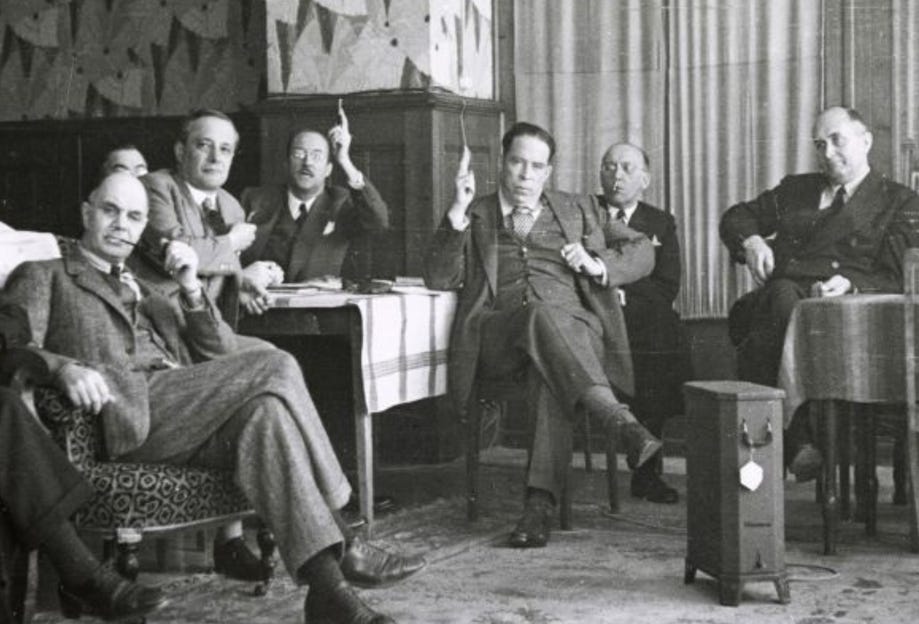
To Hayek and like-minded thinkers such as Milton Friedman and Ludwig von Mises, it was as though they were shouting unheard in the wilderness. In 1947, forty of them from both sides of the Atlantic met at a hotel near Mont Pèlerin, Switzerland. They spent ten days discussing what had gone wrong with the world and how to change it. By the end, they agreed to set up a society and issued a statement of aims beginning with the somber words: “The central values of civilization are in danger.”
The Mont Pelerin Society, formed during those fateful days, is arguably the most successful change-making entity in modern history. The policies they espoused — individual liberty, free markets, limited government — form the foundation of the neoliberal ideology that has since taken over the world. At the time, though, success at such a scale would have been unthinkable. The group’s founders were considered fringe crusaders, unmoored from economic reality. Nearly twenty-five years after the Society formed, Republican president Richard Nixon could still proclaim in 1971 that “we are all Keynesians now.”
Within a few years, however, all that would change. Beginning with the military coup of General Pinochet in Chile, the forces of neoliberalism were unleashed on the world. Consolidating in the corridors of power after the elections of Ronald Reagan and Margaret Thatcher, the ideas propagated by the Mont Pelerin Society went on to conquer the rest of the world, generating the system that has led to the devastation we experience today. How did they do it?
Shifting the Overton Window
The set of ideas deemed acceptable to mainstream thinking is known as the Overton window, named after neoliberal policy analyst Joseph Overton. During the decades following the launch of the Mont Pelerin Society, its advocates set about assiduously shifting that window toward their preferred constellation of ideas — slashing regulations, marketizing public services, crushing trade unions — through a series of coordinated, interconnected strategies.
They built academic hubs, most famously at the University of Chicago, to develop and lend intellectual credence to their ideas. They pioneered the creation of think tanks — the Cato Institute, the Heritage Foundation, the American Enterprise Institute — to transmute theory into practical policy proposals. They circulated ideas through media outlets such as the National Review and the Saturday Evening Post to influence the general public. And they systematically cultivated alliances with the business community, churches, and broadcast media. All of this was generously funded by wealthy philanthropists and foundations who stood to gain from the instillation of free market economics into increasingly broad swathes of society.
Their success was the result not just of these strategies, but of a larger set of overarching principles. Above all, they were driven by a moral commitment to their long-term vision. As Hayek wrote in 1949:
We need intellectual leaders who are willing to work for an ideal, however small may be the prospects of its early realisation… men who are willing to stick to principles and to fight for their full realisation, however remote.
They remained, as a result, uncompromising in their core values.
At the same time, they exhibited unswerving pragmatism, pouncing on every crisis as an opportunity to score even partial victories. As Friedman famously observed: “Only a crisis — actual or perceived — produces real change. When that crisis occurs, the actions that are taken depend on the ideas that are lying around.” When Reagan became president in 1981, the Heritage Foundation handed him a thousand-page manual filled with concrete neoliberal policy proposals. An estimated 775 of them were subsequently adopted.
A shared manifold of meaning
What can the movement for an ecocivilization learn from all this? There are, of course, significant differences. The Mont Pelerin Society consisted of mostly elite white males with ready access to funds from wealthy benefactors and institutions that would profit handsomely from their success. A movement for an ecocivilization would naturally be more distributed, incorporate widely diverse populations, and find its source of power not so much in financial capital as in the hearts and minds of the billions of people around the world who desire a better future for themselves and their offspring.
But there are structural lessons worth taking seriously. Looking back at the Mont Pelerin Society, it might appear as though its activities were the result of a focused master plan. That was not the case. There was no central command post. On the contrary, its members argued constantly over crucial principles around government, markets, and democracy. In hindsight, the neoliberal narrative appears far more cohesive than it did as it was being formed.
There was, however, a shared overriding motif that provided a central manifold of meaning: a belief in the preeminence of individual liberty. Individuals and institutions frequently acted autonomously — competing and collaborating, some fading away while others rose to prominence — but they were driven by a shared overarching vision. Their collective actions formed a vigorous, evolving ecosystem that spurred innovation and nurtured the most successful ideas and approaches.
Many successful change-making movements follow a principle that characterizes all living systems, known as reciprocal causality. Each component pursues its own path, integrating with other elements to create the system as a whole, while the holistic identity of the system coheres the activities of each part. The whole and the parts exert a reciprocal causal effect on each other — as we experience in our own bodies, where each cell and organ is differentiated but acts in a coordinated way according to a shared overall identity and purpose.
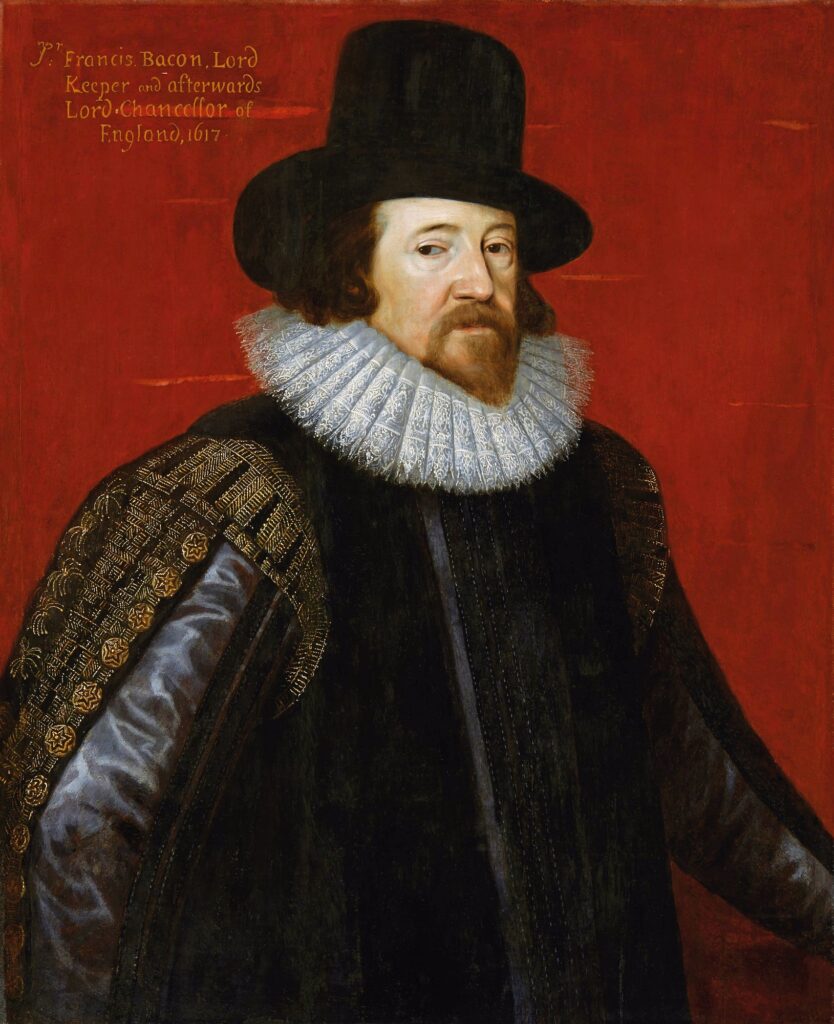
We can see this at work in the most transformative movements in history. A unique set of conditions that arose in Song dynasty China in the eleventh century — a sophisticated economy, movable-type printing, large-scale iron production, productive agriculture — had little effect on China’s historical trajectory. When those same conditions arose in early modern Europe, they led to the transformation of the Scientific Revolution. A major reason for the contrast was the shared manifold of meaning that emerged in Europe around the vision of “conquering nature,” championed by Francis Bacon and his contemporaries. That overarching narrative integrated disparate breakthroughs in mathematics, philosophy, and empirical science into a new coherence that led to one of the great phase transitions of history.
The potential exists for the shared vision of a life-affirming civilization to similarly cohere the various movements around the world that are currently pursuing their goals as separate threads of a tapestry yet to be woven—many of which I describe in my new book.
Catalyzing transformation
A crucial aspect of catalyzing the needed transformation is reducing the friction between related groups, revealing areas of mutual synergy, and thereby motivating different groups to work collaboratively and more effectively. The history of the LGBTQ movement’s campaign for marriage equality is instructive.
The outlook for same-sex marriage looked grim after President Clinton signed the 1996 Defense of Marriage Act. Yet within twenty years, the U.S. Supreme Court established marriage as a fundamental right guaranteed to same-sex couples nationwide. How?
When a leading group of LGBTQ activists met in 2005, the movement was fragmented. Some wanted full legal marriage equality; others thought it more practical to push for civil union arrangements; still others wanted to focus on reducing discrimination more generally. Their breakthrough was to embrace each of these tactics for different states depending on what seemed doable, while coordinating them as part of a global strategy to move the entire country toward equality. The working plan they developed, endorsed by major LGBTQ rights groups, gave a differentiated but meaningful role to every party — ensuring they were all pulling together across the entire spectrum of tactics.
How might such an approach be applied to the worldwide movement for transformative change? The Three Horizons model offers a helpful framework. Consider four major Third Horizon cornerstones I’ve covered in earlier posts which, if fully established, could form a solid foundation for systemwide transformation: Universal Basic Income; a triple bottom line requirement for corporations; Rights of Nature; and deliberative democracy.
In the case of UBI, exemplary First Horizon initiatives already exist. In Mexico, a system of cash transfers begun in 2018 reduced the number of people living below the poverty line by more than 13 million in six years — a reduction of over 25 percent. Successful outcomes like this open the Overton window to Second Horizon ideas such as national UBI pilot programs funded by a wealth tax or land value tax. Third Horizon thinking, meanwhile, can validate these innovations by offering a transformed moral paradigm — reframing such initiatives not as government handouts but as the rightful distribution of everyone’s social dividend from the commonwealth of our shared historical legacy.
Similar patterns can be seen in the other three pillars:
- Requiring corporations to report the social and environmental impact of their operations can open the door to broader stakeholder governance;
- The Rights of Nature movement is already achieving legal recognition of personhood for animals and ecosystems in courtrooms, with glimmers of breakthrough in reformulated national constitutions and the campaign to establish ecocide as a prosecutable international crime;
- The proliferation of citizens’ assemblies is creating pathways from immediate problem-solving toward a Third Horizon transformation of democracy itself.
A recurring pattern in all these cases is that the Third Horizon doesn’t just exist in a distant future. Its ideas can be injected into current policy debates and germinate there. In the jostling give-and-take of current political life, the vision of an ecocivilization can act as a moral compass — establishing the direction of true north and orienting activities in the here and now. This is a crucial lesson from the Mont Pelerin Society: be pragmatic and exploit opportunities, but never compromise on foundational values.
Along with augmenting the islands of coherence already prefiguring the world of an ecocivilization, the strategies of shifting the Overton window and integrating disparate movements into a coherent whole have the potential to reweave society’s fabric even as it unravels in the years and decades ahead.
The future is not a spectator sport
Is such a positive outcome possible in the face of the unyielding destructive forces of contemporary capitalism? As we flounder from incessant news transmitting the ruthless violence of authoritarian regimes and corporate power trampling on human dignity, it is only too easy to surrender to hopelessness. In those moments, it is crucial to realize that the future is not a spectator sport. It is something we are all co-creating as part of the interconnected web of our collective thoughts, ideas, and actions.
Many of us are also implicated in the very structures of violence that have led to the suffering of billions of our fellow beings, both human and non-human. The dominant culture is designed to make its structural violence virtually invisible to those holding privilege. Once we realize our entanglement in these systems of oppression, however, we can choose to accept the ethical imperative to channel that very privilege into the activities that might transform those systems. “The trouble is that once you see it, you can’t un-see it,” writes Arundhati Roy. “And once you’ve seen it, keeping quiet, becomes as political an act as speaking out. There’s no innocence. Either way, you’re accountable.”
We are all integral parts of complex systems, and the ecosystem for transformative change is no exception. Each of us must find our particular niche within the system where we can be most effective as a result of our unique mix of skills and interests. It’s essential to engage in something we feel passionately about, because only fierce devotion will overcome the setbacks that inevitably ensue.
Most people around the world are profoundly aware of the predicament we face and would like to be part of a solution. A 2021 survey of roughly 20,000 people across G20 nations found that 58 percent were “extremely worried” or “very worried” about the current state of the planet, and nearly three-quarters felt that Earth is close to tipping points because of human action. Three-quarters wanted to see their country’s economic priorities move beyond GDP and focus on wellbeing and ecological protection.
This is crucially important, because it will require a worldwide mass movement to create the future most of us want. This highlights the critical difference between the achievement of the Mont Pelerin Society and the potential success story available to us now. The neoliberal takeover was well funded but required deceiving most people into supporting policies that worked against their own better interests. The movement for an ecocivilization may be relatively short of funds, but can appeal to the hearts and minds of billions of people around the world who desire a better future for their children on a regenerated Earth.
Cathedral thinking
None of us are likely to see the full realization of an ecocivilization within our lifetime. But we can choose to play a part in helping sow the seeds and cultivate the shoots for its eventual fruition. In the words of ecological visionary Wes Jackson: “If your life’s work can be accomplished in your lifetime, you’re not thinking big enough.”
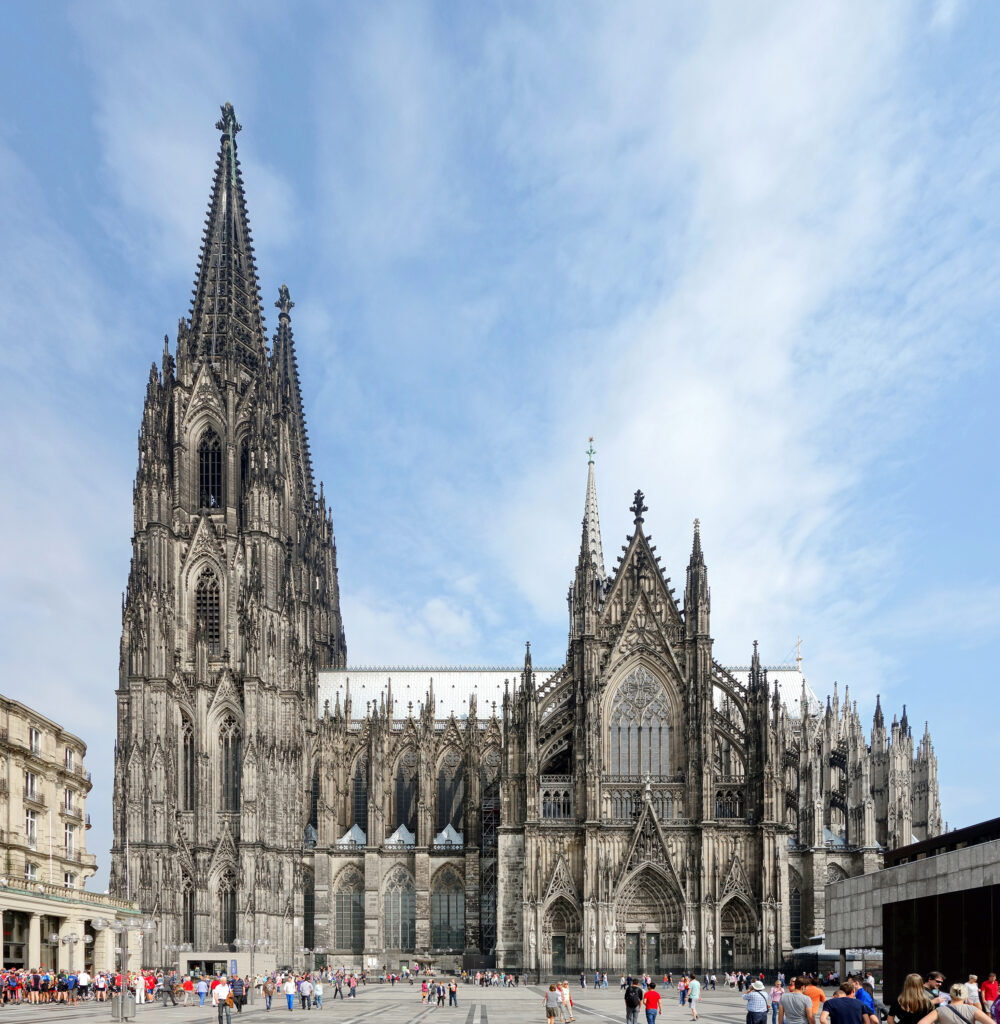
In Medieval Europe, when architects embarked on a project to build a cathedral, they knew they would never be around to see the result. Over the centuries that followed, generations of workers pooled their resources toward a shared vision of something great that transcended their own lives.
However, even as we engage in cathedral thinking, we don’t actually need to leave the achievement of an ecocivilization to the distant future. Just as Third Horizon ideas can germinate within current policy debates, each of us can choose to create with others collective islands of coherence — generating a field of life-affirming values and practices that resonates far beyond our direct relationships. Every day of our lives, in the decisions we make and the actions we take, we can choose to be the future we aspire to, even while we are creating it together.
Humanity is at a turning point in its story. We happen to have been born at a fateful time when we can influence which direction it will take. We may never know the ultimate outcome of our collective actions at this juncture here on Earth, but we can devote ourselves to this calling with the knowledge that there is nothing we can do that is more deeply meaningful.





Comments
We changed commenting systems on September 10, 2026 as part of a site-wide functionality and security upgrade. Your past comments have not disappeared, and you can still log in with your old Disqus account credentials if you wish. Contact us with any questions.
"The neoliberal takeover was well funded but required deceiving most people into supporting policies that worked against their own better interests. The movement for an ecocivilization may be relatively short of funds, but can appeal to the hearts and minds of billions of people around the world who desire a better future for their children on a regenerated Earth."
This is the part I question. Is it possible for 8 billion people to have the "better life" they envision AND bring about a regenerated Earth? I think–not unless billions of people are ready to accept a simpler life involving more physical labor, much less travel, acceptance of limits. And the corporate crew who are the descendants of the neoliberals are still–sometimes–braying about the glorious future of no work and endless prosperity–while trying to put into place the technology to cage and control the masses, so they can reserve most of Earth's remaining resources for themselves. We have two related problems here–the greed and immorality of the elite, who have been very successful in seizing power, albeit that power is shaky–and the greed and ignorance of the world's people, who arguably have been led to those attitudes by the propaganda of the elite. Neither is currently interested in assessing what it would take to transition to "a regenerated Earth." Therefore some programs like the Green New Deal also require deceiving the public, pretending that we can all live upper-middle class-style lives without damaging ecosystems, with a few simple painless tweaks.
Another problem is that the neoliberals are depicted as achieving their massive transformation of public opinion (actually a regression to older norms) over 50 or 60 years–but 50 or 60 years from now, if we are ready to transition to an ecosocialist utopia, it will be on a planet so ravaged by climate change, pollution and biodiversity loss that the issue will be survival. Somehow we need to make much faster change–which might be possible if we prepare for those crises–and no doubt there are plenty in the offing–in part by seeing to it that some of the "ideas lying around" our own regions are good ones. Start strewing good ideas now, as well as thinking about the "islands of coherence."