

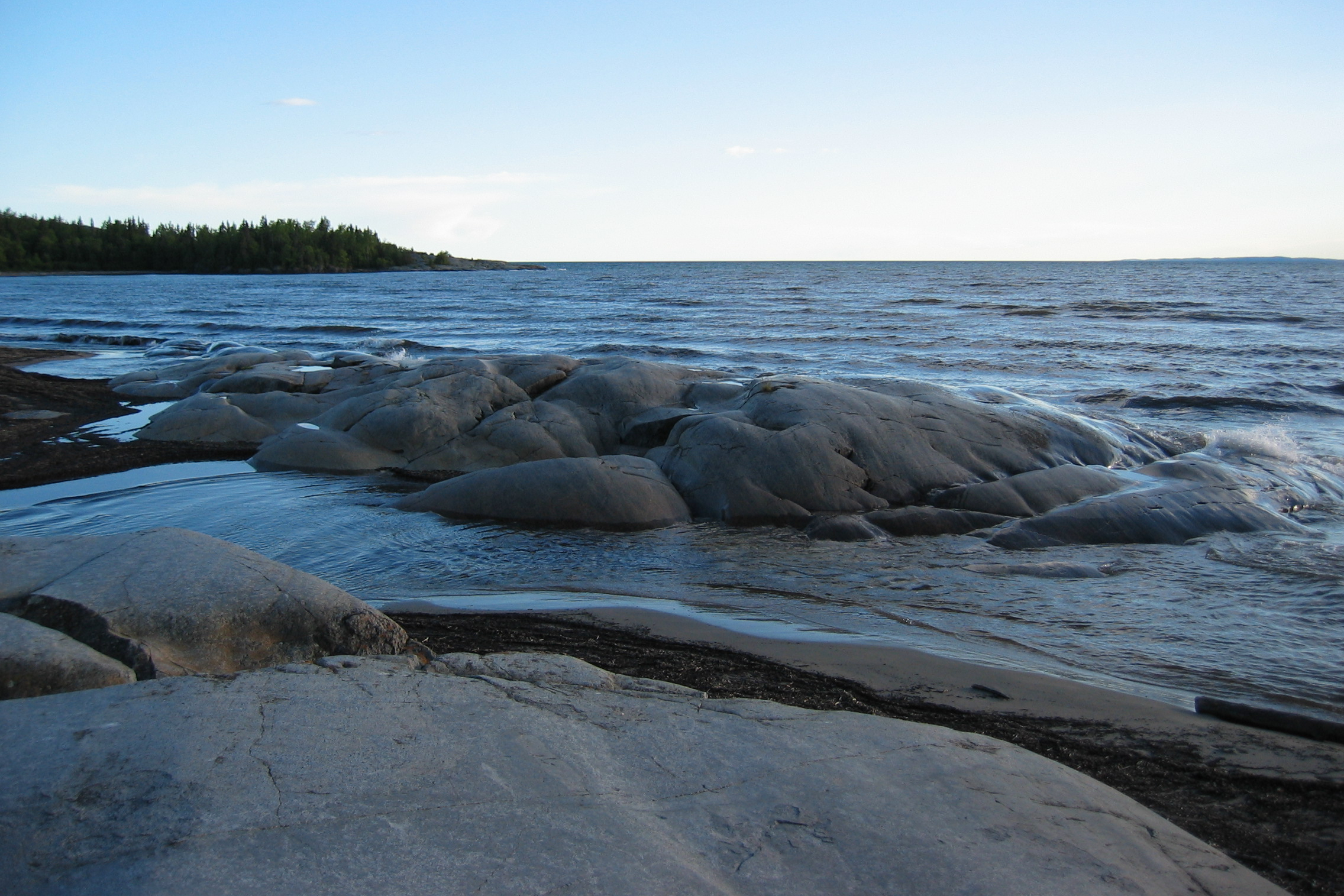
Late afternoon view of rocks on the north shore of Lake Superior at Neys Provincial Park, Ontario, Canada in June 2004. Photo: Kevstan
At the northern tip of Wisconsin, a river meanders northward to the world’s second-largest freshwater lake. As it flows, the river gives life to walleye as well as wolves and medicinal plants. Where the waters reach Lake Superior, abundant—but vulnerable—wild rice grows.
This land and this river have been home to the Mashkiigong-ziibiing and their ancestors, the Chippewa, Ojibwe, and Anishinabe, for more than 500 years. The wild rice (manoomin in Ojibwe) that grows near where Lake Superior meets the land is a sacred dietary staple. And it’s why the Chippewa settled near Lake Superior; their ancestors foretold to go west until they found food that grows on water.
Today, the Mashkiigong-ziibiing, or the Bad River Band of Lake Superior Tribe of Chippewa Indians, is up against the odds to defend its land rights, sovereignty, and healthy water.
The small 8,000-person Bad River Tribe has taken on a billion-dollar Canadian oil pipeline company to demand the removal of an illegal oil pipeline.
“Most communities can not afford those legal battles,” says documentary filmmaker and producer Mary Mazzio, who has been filming the land rights battle at Bad River since 2022. “This is not a wealthy community, but this is a priority for them because of what’s at stake for them: Lake Superior and fresh water for the country.”
Currently, more than 30 million people rely on fresh water from Lake Superior, according to the National Oceanic and Atmospheric Administration.
Mazzio released her documentary Bad River: A Story of Defiance in November 2024. It was awarded the best documentary film from the Environmental Media Association as well as being nominated for the Critics Choice best historic documentary and the best political documentary. The film has elevated the Tribe’s efforts and broadcast them across the country—even getting shared on social media by Leonardo DiCaprio with support from Mark Ruffalo, Edward Norton, Channing Tatum, and Jason Momoa.
“This is about a very small group of people fighting so hard for one of the world’s most precious resources, doing it at risk, at their own cost, for all of us Americans,” Mazzio says. It’s about redefining the American myth of conquest and Manifest Destiny.
As the case makes its way through the courts and environmental agencies, the Bad River Tribe is in a defining moment in its history, as members hold strong in their defense of manoomin and the fresh waters that sustain it—and sustain us all.
Treaties and a Sovereign Framework
The Bad River Tribe’s fight for sovereign autonomy is an all-too-familiar battle across North America. Since the 19th century, treaties, legal acts, and the Bureau of Indian Affairs have attempted to eliminate and control Native Americans. For example, the 1887 Dawes Act, also known as the Allotment Act, illegally broke up reservation land into parcels, which could then be purchased by private outside groups like timber companies.
“The Dawes Act intent was to assimilate people,” says Patty Loew, Bad River Tribal member and retired Northwestern University journalism professor. “We lost 98% of our land within 25 years.”
The Bad River Tribe’s 124,655-acre reservation—and tribal members’ right to fish, hunt, and gather on ceded territory as well as have a tribal government—still remains thanks to the seventh-generation mentality, says Edith Leoso, the Bad River Tribe’s former tribal historic preservation officer. Leoso says this framework is how the Ojibwe people made decisions during the time of the treaty signings as well as today: “How is what we’re doing now going to affect us seven generations from now?”
Despite the protections the Tribe had put in place through treaties and their own government, the Bureau of Indian Affairs allowed a Canadian oil company called Lakehead Pipeline, now Enbridge Energy Partnership, to build part of its 645-mile pipeline through the Bad River Reservation in the early 1950s.
And they did so without any tribal input.
The Enbridge Line 5 pipeline now runs from Superior, Minnesota, through Wisconsin and Michigan until it reaches Sarnia, Canada. Every day, it transports 540,000 barrels (23 million gallons) of crude oil through this landscape, threatening the beings who depend on this land and water.
Erosion Exposing the Pipeline
In the early years, the 12-mile segment of pipeline that sliced through the Bad River Reservation was overlooked. “The priorities were to buy back land that was originally in reservation borders,” Loew says. Thanks to the income from its casino, which opened in the 1980s, the Tribe has managed to buy back about 70% of that land, says Tribal Chairman Robert Blanchard.
This is no small feat for a community of this size. “The average income of the people living on the reservation is $8,000 annually,” Leoso says. Their progress has taken decades of commitment and investment, using the casino income, which brings in about $40 million a year.
When a number of easements granted to Enbridge expired in 2013, the Bad River Tribal Council voted against renewing pipeline access. The council was motivated by a spill a few years earlier, when another Enbridge pipeline burst and poured more than 800,000 gallons of oil into the Kalamazoo River in neighboring Michigan. Leoso says this influenced the Bad River Tribe’s decision to vote no.
“It was unanimous,” she says. “No one abstained. I was surprised because we’re so conditioned to just go along with everything. I was like, ‘Oh, OK. We’re starting to play ball now? Let’s do this thing.’”
In the 12 years since then, the pipeline has still been illegally operating on Bad River tribal land.
Because of climate change, the risks are getting closer to home. When the pipeline was originally installed, it was approximately 350 feet from the Bad River, but erosion and two catastrophic flood events in 2016 and 2018 shifted the river’s course, so the pipeline is now just 12 feet from the river.
While Bad River has been fortunate to have not yet experienced a spill or rupture, the risk is ever present. In 2017, the National Wildlife Federation found that 29 other spills have occurred on the Enbridge Line 5 between 1968 and 2017, totaling 1.1 million gallons of oil.
Still the pipeline remains on the Tribe’s land.
In 2017 the Tribe doubled down, passing a resolution insisting the pipeline be decommissioned and removed from the reservation. And in 2019, the Bad River Tribal Council sued Enbridge for violating its treaty rights.
Enbridge offered $24 million to settle the lawsuit. The Bad River Tribal Council declined to settle and persisted with legal action. When I asked then-Tribal Chairman Mike Wiggins in 2023 what this money could do for the Tribe, Wiggins replied with a question of his own: “How much is your water worth?”
The pipeline, should it leak, threatens the very thing that brought the Tribe to this land and allowed its members to thrive.
“We’re facing a threat to wild rice from Enbridge,” Loew says.
Manoomin, or Northern wild rice, is particularly sensitive to pollution and flooding, according to a 2023 climate vulnerability assessment conducted by the Great Lake Fish and Wildlife Indian Commission, an intertribal agency of the Lake Superior Chippewa Tribes. Pollutants from industrial runoff, like sulphate, are linked to the collapse of rice beds.
Kathleen Smith works for the commission as the Genawendang Manoomin, which translates to “she or he who takes care of the wild rice.” Smith spends time surveying and collecting data in her canoe or via aerial surveys. She says that rain events can uproot the manoomin: “The 2016 flood prevented rice for a few years.”
For the people who depend on wild rice for physical and cultural sustenance, this loss is existential.
Defying the Odds
Enbridge’s proposed workaround is to reroute the pipeline to avoid crossing the Bad River Tribe’s land. The new segment of pipeline would be 41 miles long and would cost the company $450 million. Though the reroute wouldn’t cross the reservation, it would still cut through the Lake Superior watershed that fills the Bad River.
“We remain committed to finding an amicable solution that recognizes the sovereignty of the Bad River Band, protects the environment, and secures essential energy infrastructure that millions of people on both sides of the border rely on,” Juli Kellner, a communications spokesperson for Enbridge, said in an email in March.
The Line 5 Wisconsin Segment Relocation Project permit is the most-studied pipeline project in state history, she added, and called the pipeline an “energy lifeline, feeding a network of refineries that produce critical transportation fuels, propane, and thousands of everyday consumer goods.”
In September 2022, Judge William Conley of the U.S. District Court for the Western District of Wisconsin concluded that continued pipeline operations constituted trespassing. But he did not issue an injunction that would have shut down the pipeline immediately, citing “significant public and foreign policy implications.”
In his ruling in June 2023, Judge Conley ordered Enbridge to remove the portion of Line 5 that runs through the Tribe’s reservation by 2026. Enbridge would also need to pay the Tribe $5.1 million and a portion of their profits.
“It was good news,” current Tribal Chairman Blanchard says with trepidation. “At the same time, we’ve got to expect what has happened. They appealed it, and they have the money to appeal and appeal and appeal. We don’t.”
And so, the 12 miles of pipeline still cut across the Tribe’s land. As the community continues to wait for the pipeline’s removal, Leoso says they’re “on edge.”
“It was a victory,” Leoso says. “But a small victory. We know it’s never going to stop. They have acquired most of the land around the reservation for that reroute.”
Never Give Up, Prioritize Land
In March 2024, Enbridge offered the Tribe $80 million to “settle past disputes.”
The Tribe refused the money.
In April 2024, the Biden Department of Justice issued an amicus brief in the case, stating that Enbridge “lacks any legal rights to remain on those lands.” The U.S. Court of Appeals for the 7th Circuit heard arguments in the case in 2024 but has not yet issued a ruling.
As of May 2025, the Tribe still has not seen a decommission and removal plan. And Leoso hinted that she is fearful of what the Trump administration will try to come in and change.
“The Bad River Band is not looking for monetary damages. They want [Line 5] out of the watershed,” explains Mazzio, the filmmaker.
“We’ve been sending that message ever since Europeans touched foot over here,” Leoso says. “We keep telling the federal government they shouldn’t approve these things, they shouldn’t allow these things to happen, because it will impact the environment so much that it will kill us.”
As the oil continues to flow through the Line 5 pipeline and fossil-fueled climate disasters rage around it, Leoso says succinctly, “And now those things are killing us.”
In the fall of 2024, Enbridge was given reroute permits by the Wisconsin Department of Natural Resources to build the new 41-mile pipeline. The Bad River Tribe and environmental groups are now suing the department.
Enbridge is still awaiting federal permits, and Kellner says the company will not begin construction until all necessary permits are in hand. The U.S. Army Corps of Engineers has listed the project as eligible for emergency fast-tracking under President Trump’s executive order declaring an national energy emergency. After releasing a draft environmental assessment, the agency has received over 150,000 comments opposing the reroute.
Blanchard says the rerouted pipeline could still harm the Tribe’s ceded territory. “We do want it removed from the reservation, but we don’t want it within the Bad River watershed.”
Since the rerouted pipeline would be upstream from the Bad River, if there were to be a spill or leak, it could affect the Tribe’s ability to hunt, fish, and gather on the reservation, which he believes still violates the treaties.
“We are looking after our land, water, and harvest,” Blanchard says. “I do harvesting of wild rice and traditional medicine, all to feed my family, and I want my great-great grandkids to have what I have and to be able to do what I have done. Money is nice, but is it worth giving up land?”



Comments
We changed commenting systems on September 10, 2026 as part of a site-wide functionality and security upgrade. Your past comments have not disappeared, and you can still log in with your old Disqus account credentials if you wish. Contact us with any questions.