On this Frankly, Nate reflects on his experiences in the financial industry with the cognitive bias Loss Aversion and the ways it may manifest to the coming material throughput declines during The Great Simplification. Why do losses feel so much stronger to us than gains – even when we have an overabundance of wealth? Can being aware of this evolved psychological trait diffuse its intensity? How does this affect our ability to perceive and plan for the reality of less available energy and resources in the future?
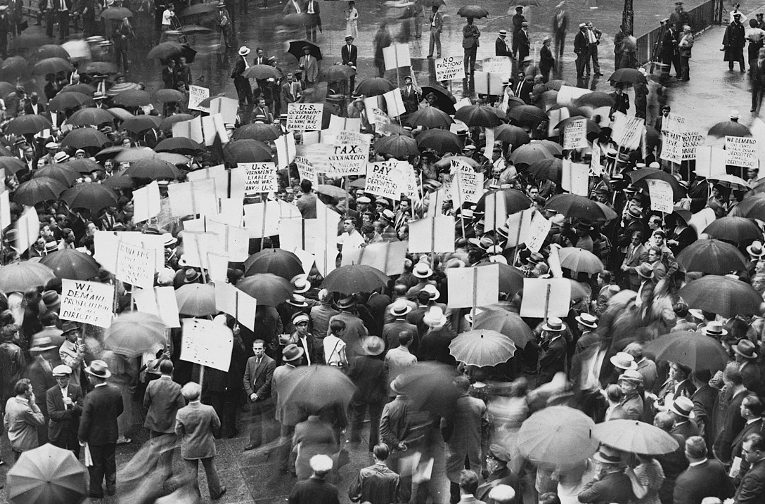
Teaser photo credit: Crowds outside the Bank of United States in New York after its failure in 1931. By World Telegram staff photographer – Library of Congress. New York World-Telegram & Sun Collection. http://hdl.loc.gov/loc.pnp/cph.3c17261, Public Domain, https://commons.wikimedia.org/w/index.php?curid=1302228
Nate Hagens is the Director of The Institute for the Study of Energy & Our Future (ISEOF) an organization focused on educating and preparing society for the coming cultural transition. Allied with leading ecologists, energy experts, politicians and systems thinkers ISEOF assembles road-maps and off-ramps for how human societies can adapt to lower throughput lifestyles.
Nate holds a Masters Degree in Finance with Honors from the University of Chicago and a Ph.D. in Natural Resources from the University of Vermont. He teaches an Honors course, Reality 101, at the University of Minnesota.
Tags: building resilient economies, material throughput, powering down, Resource Depletion
Related Articles
'SELECT SQL_CALC_FOUND_ROWS wp_posts.ID
FROM wp_posts LEFT JOIN wp_term_relationships ON (wp_posts.ID = wp_term_relationships.object_id)
WHERE 1=1 AND wp_posts.ID NOT IN (3496263) AND (
wp_term_relationships.term_taxonomy_id IN (2,5,8994)
) AND wp_posts.post_type = \'post\' AND ((wp_posts.post_status = \'publish\'))
GROUP BY wp_posts.ID
ORDER BY wp_posts.post_date DESC
LIMIT 0, 3'
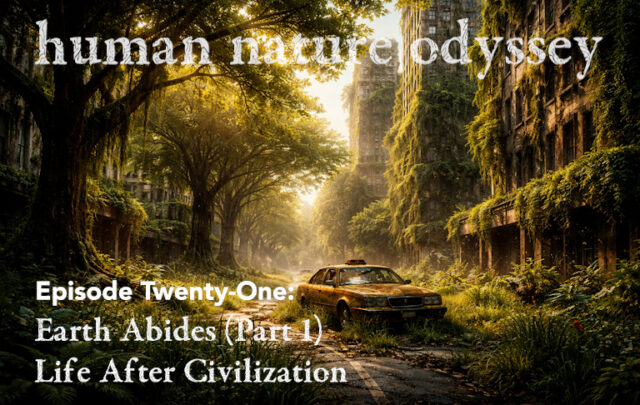
You ever go on a little trip, to just get away from it all — only to come home and find all of civilization collapsed while you were gone and you might be the last person left on earth? Well then you could totally relate to George R. Stewart’s 1949 science-fiction novel, “Earth Abides.”
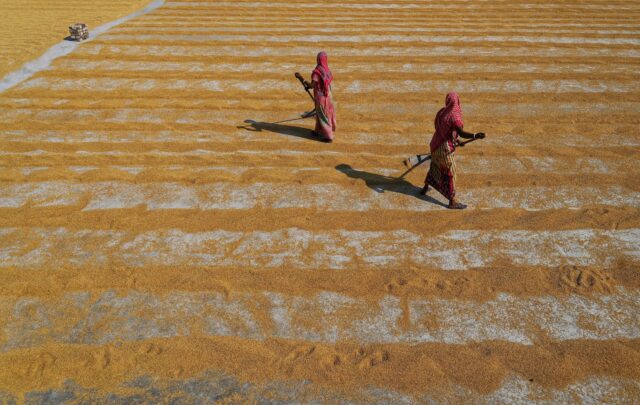
Modern economies depend on unpriced ecosystem functions and undervalued care and reproductive labor—essential inputs that are difficult to commodify. This tension helps explain environmental degradation, social strain, and the limits of market systems.
Jason, Rob, and Asher explore the world of competitive birding, the relationship between those who love nature and the technology they use to connect to it, and how even the most gentle of shared passions can get corrupted by status-fueled competition.