

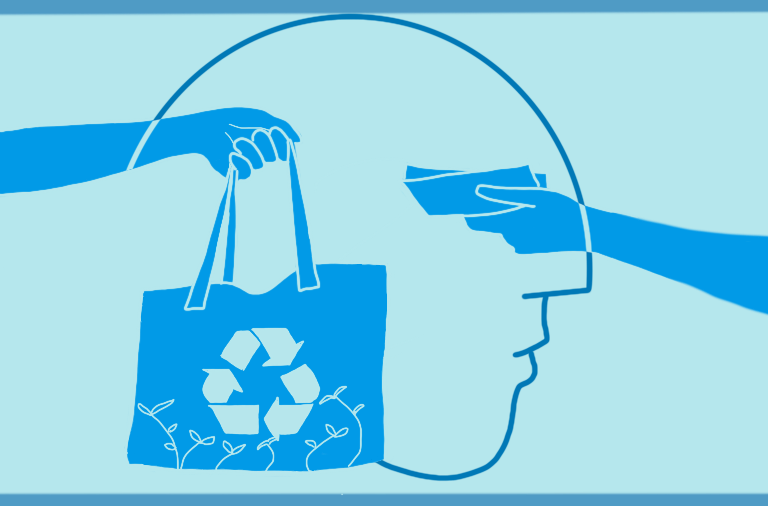

In 1883 renown Yale professor William Graham Sumner examined the question of what the social classes owe to each other. Sumner was a classical liberal–what we might call a conservative today if only we could find a real one–and his answer to this question can be summarized in one word: Nothing.
In 2009 in the grip of advancing climate change and rapidly depleting resources we are confronted with a more radical question: What do the generations owe to each other? The easy answer is to copy Sumner’s. And, some people have. (Scroll down to Sam Vaknin and expand his essay.) But given that most people have offspring, we can expect that their sympathies might extend to their children and grandchildren, but not much beyond. It is a natural impulse to want to sacrifice for one’s children or grandchildren. But is it natural or even practical to make sacrifices for people who will live a hundred or perhaps even a thousand years after us?
Let me illustrate the pitfalls of sacrificing for future generations. Let’s say we decide to go on a severe fossil fuel diet starting today and remain on that diet indefinitely in order to lessen the ravages of peak fossil fuels and climate change. Many decades later our descendents wake up to a world with a steady, livable climate and with a relative abundance of fossil fuels that are now used almost exclusively as chemical feedstocks except in a few small instances. These descendents decide that their lives could be improved somewhat quite cheaply by burning a little more fossil fuel. After all, the danger of catastrophic climate change has passed, and greenhouse gas levels have actually come down. Why not ease restrictions on burning fossil fuels?
Of course, this modest lifting of restraints probably won’t last long as the flush of enhanced living standards encourages a call for burning additional fossil fuels to increase living standards a bit more. And, of course, this unfortunate path could lead my hypothetical future society right back onto the road to collapse and destruction.
It should be clear then that the efficacy of our decisions to create a sustainable world will depend heavily on the self-restraint of future generations. That doesn’t mean we shouldn’t try. But it points to the necessity not just of a revolution in behavior–which can be accomplished using the right incentives–but to a revolution in values.
Values are never permanent, but they have more lasting power than mere behaviors which may persist only so long as an incentive or restriction is in pace. The current talk among policy thinkers concerned about sustainability leans heavily toward incentives and restrictions to achieve sustainability goals. This is the kind of structure we provide to children as we are trying to train them to be adults, and it has its place. But it is the fond hope of every good parent that their children will internalize the discipline which must be initially applied externally during a child’s formative years.
This internalization is akin to a revolution in values, and it is not so easily achieved. Values develop over time in response to actual physical and social conditions. They persist over time based on their perceived efficacy in ordering society and the life of the individual and in ensuring the survival of society.
We are now in the situation of the proverbial man who has jumped off the roof of a 100-story building. When you stick your head out at the 50th floor and ask him how he’s doing, he says, “Fine.” It is the speed with which we appear to be approaching our doom that gives values–which take time to test and validate–so little opportunity to change. They will undoubtedly change for our proverbial man in free-fall once he hits the ground. But only if he survives, and then we can expect him to be severely disabled.
Every human prefers the present over the future. And, that’s as it should be. One can’t live for the future if one fails to protect oneself from destruction or ruin today. This balancing act is one that every person concerned with sustainability is called upon to endure. It is easy to criticize others for failing to do all that is necessary to improve the chances of future generations for a good life. It is more challenging to support them in their attempt to bring off this ever more difficult balancing act.




Comments
We changed commenting systems on September 10, 2026 as part of a site-wide functionality and security upgrade. Your past comments have not disappeared, and you can still log in with your old Disqus account credentials if you wish. Contact us with any questions.