

Show notes
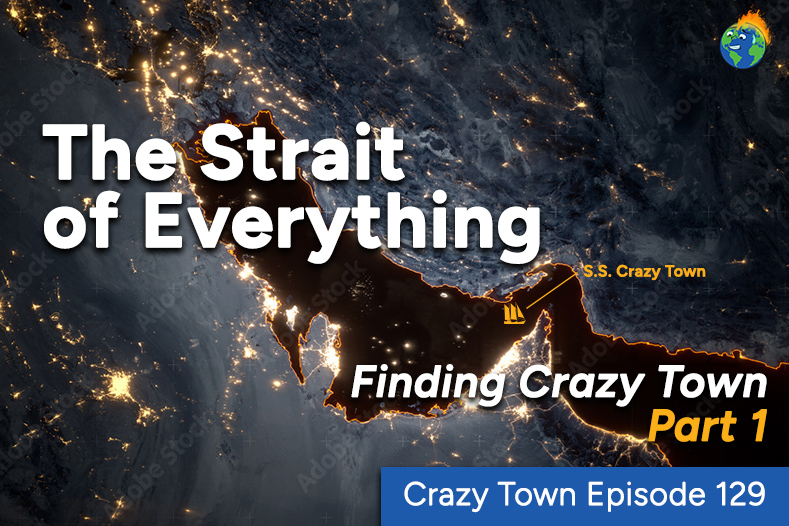
What happens when the global economy depends on fish traveling 10,000 miles, oil flowing through a single strait, and enough cheap fossil fuel energy to build civilizations that previous generations couldn’t even imagine?
In Part 1 of our six-part summer series, producer Alex Leff begins investigating the mysterious disappearance of Jason Bradford, Rob Dietz, and Asher Miller. Following the clues leads to international shipping, global trade, and the hidden energy that powers modern civilization. Along the way, we’ll revisit some of Crazy Town’s foundational ideas—and begin asking how our modern techno-industrial world came to be, why it’s so fragile, and what it would take to build something more resilient.
Originally recorded on 7/1/26 with archival episodes.
Related episodes
Credits
Production and editing by Alex Leff. Editorial assistance and transcripts by Taylor Antal.
Theme music is “Way Huge” and “Don’t Give Up” by Midnight Shipwrecks, used with permission.
Thanks to all the Crazy Townies, our listeners who are trying to understand humanity’s overshoot predicament and do something about it.
Transcript
Alex Leff:
Do you ever feel like you're living in Crazy Town? The news headlines are littered with tweets and scandals, UFC fights on the White House lawn. And meanwhile, something like the climate crisis is treated like a boring backstory. It's like if Star Wars spent all its time focusing on Ja Jarbanks' skincare routine. You'd think they'd want to talk a little bit more about the Death Star. If you find the way we look at the world is too zoomed in, too disconnected and doesn't have nearly enough dad jokes, then you've come to the right place. For eight long years, Jason Bradford, Rob Dietz, and Asher Miller of the Post Carbon Institute have joined forces to find some sense in the madness. And this summer, we're going to revisit some of the core insights they've uncovered. Consider it your Crazy Town orientation. If you're new to the podcast, this is a great place to start.
If you've been looking for some kind of onboarding you can share with friends and family, here you go. And if you've been wanting to review Crazy Town first principles, voila. And who am I, you ask. Good question. I'm crazy town producer Alex Leff, and the host of the Human Nature Odyssey Podcast, which you can also find at resilience.org. But okay, this is where I've got to level with you guys. Jason, Rob, and Asher have gone missing.
I know, I know. I was supposed to be watching them. I looked away for one minute and boom, they're gone. Post Carbon Institute is going to be so pissed, but I'm glad you're here. Together, we can track them down. They did leave one clue. The last thing I heard them say before they vanished was something about modern techno-industrial civilization. I know that doesn't narrow things down too much. But these guys are systems thinkers. They're never narrowing it down. Here's my theory: If we can better understand how Jason, Rob, and Asher see the modern world, how they think about systems, energy, economics, ecology, and all the ways those things are connected, we might be able to figure out where the heck they went, or at least where they're headed. So over the next six episodes, we'll follow their trail, scouring over some of the earliest Crazy Town episodes and revisiting some of the biggest ideas in Crazy Town. With diligence, determination, and a little luck, we should find them before the summer's over. Before the summer's over, I hope. Now, where to begin? Jason did mention something about being hungry.


Jason Bradford:
Hey you guys, you feel like staying over for dinner tonight? We're having fish.


Rob Dietz:
Always. I love staying for dinner.


Asher Miller:
That sounds good. Where's the fish from? Did you catch it?


Rob Dietz:
Did you get the trout right here out of Muddy Creek?


Jason Bradford:
No, no, no. It's really special. It's Chinese Scottish cod.


Asher Miller:
Wait, what? Chinese Scottish cod?


Rob Dietz:
Csh-od? Is that what it is?


Jason Bradford:
Yeah. Well, it's hard to really say where this fish is from because it's traveled so many thousands of miles in its journey from the ocean to your plate.


Asher Miller:
That sounds yummy.


Jason Bradford:
Well, let me tell you all about it. So the Herald, which is a newspaper heralding from Scotland, was writing about this. Cod caught off Scotland is being sent on a 10,000 mile round trip to China and back again to be fileted for supermarkets, shops and chip suppers. I love that term. Chip suppers.


Rob Dietz:
Wait, wait. Is our dinner tonight going to be chip supper as well?


Jason Bradford:
Maybe.


Rob Dietz:
I'm excited.


Asher Miller:
So they're saying caw that's caught off the coast of Scotland is then sent to China so that the Chinese workers could filet the fish and then it's sent back to Scotland?


Jason Bradford:
Yes.


Asher Miller:
So that people in Scotland could buy it in the grocery store and eat it?


Jason Bradford:
Yes. This is causing some -


Asher Miller:
What's the distance from Scotland to China?


Jason Bradford:
Well, it's a 10,000 mile round trip.


Asher Miller:
Okay.


Rob Dietz:
Yeah, that's substantial.


Jason Bradford:
It goes through the Suez Canal.


Asher Miller:
They must -


Rob Dietz:
They should just teach the fish to swim that.


Asher Miller:
Yes, seriously.


Jason Bradford:
Yeah. All right.


Asher Miller:
They just dangle something in front of it for 10,000 miles.


Jason Bradford:
Well, the reason this is happening is because it's processed by workers earning less than one pound a day before being refrozen. It's kind of madness. Some environmental groups are not happy about it. And then there's of course the local jobs are lost. So this one guy from Friends of the Earth, Scotland is like, "It's a real shame to think that this food could have been eaten fresh in Scotland, but is instead shipped around the world to make a processed packaged product." And so they're kind of harping on these other food companies like Don Fresh, a seedfood company in Udingston that supplies supermarkets and other large retailers. It cut 70 jobs in 2006 after deciding to ship Scottish prawns more than 5,000 miles to China to be shelled by hand. So it's not just fish. And it's also not just China. Stuff goes to Thailand. It seems to be like cheap labor in Asia.


Asher Miller:
So you decided you're having us over for dinner so that we could basically revel in the great culinary delight of globalized fish and seafood trade.


Jason Bradford:
Yeah. Well, it comes back. So the prawns come back to the River Clyde in Scotland and they're breaded for sale as scampi in Britain.


Rob Dietz:
It's like a salmon journey really. Returning from sea to the place it was born.


Asher Miller:
Except in this case, it's refrigerated going on big container ships through the Suez Canal.


Jason Bradford:
Okay. U.S. fish, this happens to U.S. fish all the time. It gets caught off of Alaska, goes to China, comes back to the U.S. So it's not just like the Scottish or some crazy folks. It's all over the world. Wherever cheap labor is, the processing demands hand processing.


Rob Dietz:
I mean, that's the whole notion is that wherever you can ship something, trade something, you'll do it if it's good for your pockets.


Jason Bradford:
Yeah, that's right. So it's follow the money. Whatever makes financial sense will be done, but it's because shipping is so cheap.


Alex Leff:
International shipping. That's a good introduction to Crazy Town. The idea that our global society depends on the constant movement of raw materials halfway around the world, processed and reshipped to another continent, only to be sold back in the hemisphere they came from. And that's just something we take for granted. But the Straight of Hormuz brought international trade into the headlines. It's funny how we only notice how unbelievably interconnected our global economy is once a piece of the puzzle comes undone. Most of us have heard how a fifth of the world's oil travels through the Strait of Hormuz, but it's not just oil. A third of the world's fertilizer passes through the strait. A significant portion of the petrochemicals used for painkillers, antibiotics and vaccines are shipped through the Straight of Hormuz. Oh yeah, and helium. Helium goes through the Straight of Hormuz. Why is helium important? Well, it doesn't just affect birthday balloons. Helium is crucial for manufacturing microchips, operating MRI machines and medical processes like cancer diagnoses and treatment. All the many, many things our modern system relies on comes from somewhere. It's not like there's a big supply of helium and petrochemicals sitting around in your local downtown. They have to be shipped vast distances through our highly complex global trading system. How did it come to this? And more importantly, how does this help us find Jason, Rob, and Asher.


Rob Dietz:
Let's look at this from the broad historical perspective for a second. I mean, why did trade grow in the first place? Seems to me that it was a way for us to just improve our lot in life. If you could get something that you didn't have and it was useful to you, then you'd go and trade. ces.


Asher Miller:
And humans have been trading for tens of thousands of years probably. I mean, even if it's at a more localized level, you had tribes trading certain things with each other and we definitely had global trade before the modern world. You talked about spice trade. There's the trading routes that, hey, we all played Marco Polo in the pool, right? That was all about global trade.


Rob Dietz:
Yeah. Well, and when you think about that, I mean, spice really did make your life more interesting. If you're eating the same gruel every day, the same Scottish Chinese cod, it'd be nice to put a little lemon pepper on that or something.


Asher Miller:
And there were also preservatives, spices that were used for preservatives, which wasn't just about like, "Hey, this tastes better." It was actually about preserving food before refrigeration. It's really important.


Jason Bradford:
Yeah. So there is like the dopamine hit, the novelty factor, but then there's some useful stuff. So I'm thinking around here, there's obsidian in artifacts from Native American.


Rob Dietz:
Yeah, this volcanic glass rock. It's like pure black glass almost.


Jason Bradford:
And the closest obsidian source is a few hundred miles away or something. So maybe not quite that far. But anyway, they had to trade for obsidian and that improved their ability to hunt and to
cut things and process.


Rob Dietz:
Yeah. You can make these razor sharp arrow points and knives.


Jason Bradford:
You do surgery with obsidian.


Rob Dietz:
Yeah, they still do, right?


Jason Bradford:
I think they might. So yeah, it's fine to do this maybe to some point. But now it's sort of huge. Phosphorus is primarily sourced from Morocco and sent around the world. It's fertilizer.


Rob Dietz:
What's the base product that the phosphorus is in?


Jason Bradford:
It's a rock. It's a high concentration of phosphorus in a rock called rock phosphate, which then gets shipped, mined and then shipped and then turned into superphosphates and fertilizer factories and then put on farmland.


Rob Dietz:
Okay. So I think we can all agree that there are some upsides to establishing trade and we've got probably a somewhat positive history with it, but things seem to have grown to the extreme.


Asher Miller:
Let me just say there's also a dark history to global trade as well. Talk about the trade of the enslavement of people. And then you also think about, especially with the "new" world bringing gold and silver and other things back to Europe.


Rob Dietz:
Or the commodities like sugar. Doing these sugar cane plantations.


Asher Miller:
But yes, I mean, obviously trade was established because it provided some value to the people that were initiating the trade.


Jason Bradford:
Sometimes it's a one way value. Sometimes it's two ways.


Asher Miller:
I think it's important though to recognize that things are different now. And maybe it's just that it's all been taken to the extreme. We've always been doing global trade, but now we have a situation where you can actually justify somehow or make it work out economically to do the batshit insane stuff that you're talking about, Jason, with the cod and the prawns. And it's interesting to think about what the change is there.


Rob Dietz:
It's funny that you say batshit crazy because that was one of the commodities too, was batshit.


Asher Miller:
Literally.


Jason Bradford:
Yeah.


Asher Miller:
Guano.


Rob Dietz:
So that's the thing is that it grew to the extreme. Why did it do that? I mean, one's just cheapness, right? Like you were talking about with people who are working at a really low wage. It's cheaper somehow to do all that shipping.


Asher Miller:
Comes down to the economics. What is the most cost effective thing for the companies that are doing this? And labor is their biggest cost.


Jason Bradford:
Yeah. In a country like Scotland or like the U.S., labor costs tend to be high in these sort of developed nations.


Asher Miller:
Right. I think there's also technological changes that have happened and some of those have to do with satellite tracking and computers to be able to sort of track inventories that allowed them to ship a lot more things. The big one obviously is the container.


Rob Dietz:
Yeah. I think Thomas McLean was the guy, the truck driver had the epiphany one day while he was waiting to get his truck unloaded. He's like, "They should just take the whole back of my truck."


Jason Bradford:
Really?


Rob Dietz:
Yeah. And the idea of the shipping container.


Asher Miller:
Yeah. So instead of you have to open up the back of the truck and take everything out by hand,
right? You have a container that just gets plopped down on the truck or the rail car or whatever.


Rob Dietz:
It was a huge efficiency gain there. I mean, it went from costing something like $6 a ton to load a cargo ship to costing 16 cents.


Jason Bradford:
Wow.


Asher Miller:
That's insane. And they're all uniform. They just stick them on boats. So what we've seen because of that, of these improvements and the drive for corporate profits, the opening up of global trade and trade agreements. The economic policy of pursuing globalization. And there's a World Trade Organization, the World Bank, these agencies that basically are incentivizing countries to open up to global trade as a way of growing their economies and providing economic benefit to their people. It's basically now connected the world. There's a great stat that I saw and I'm trying to remember the name of the book -


Rob Dietz:
Oh, I know which one you're talking about. It's Rose George's ,"90% of Everything."


Asher Miller:
That's right. Yeah. So she had this great stat that blew me away. It's changed. It's probably grown even since then, but one of the stats she threw out there was that U.S. ports, just U.S. ports, which are not necessarily the biggest in the world. Just U.S. ports in 2011 imported $1.73 trillion in goods. And just to put that in perspective, that's 80 times all U.S. trade across the board 50 years ago.


Jason Bradford:
Wow. The stat was in her book, but it's current still, it's "90% of the things you buy arrive by a container ship."


Rob Dietz:
Yeah, that's right from the title of her book, right?


Jason Bradford:
Yeah, 90% of everything. Yeah. And so there's 20 million containers moving around the seas at any given time.


Asher Miller:
20 million.


Jason Bradford:
Yes. And there's usually about 20,000 containers on the biggest ships. And there's 51,000 ships in the maritime fleet. So there's 51,000 ships going around the world with 20 million containers on them any one time.


Rob Dietz:
Think about that. You said 20,000 per ship?


Asher Miller:
Yeah, have you ever seen one of those containerships?


Rob Dietz:
Oh yeah.


Alex Leff:
Okay. So if Jason wanted Chinese Scottish cod, that means maybe they went to China or Scotland or any of the countries container ships go to. What did they say? 90% of the things we buy arrive by container ship. Oh man, why do we have to do everything on such a big scale? I get it. Modern global trade is clearly a vast system requiring incredible coordination, infrastructure, and technology. Conventional wisdom tells us that this is an efficient system, a system that's working. But what if the way we've structured global trade doesn't make nearly as much sense as we believe?


Rob Dietz:
Well, okay. So trade has gotten massively huge. I think we agree on that point. And we said there were some upsides, but there's clearly some downsides as well. And for your benefit, we've kind of put these into some categories and I wanted to start with one that I call insane trade. We got to pull this from our favorite economist, Herman Daly, the famous ecological economist.


Asher Miller:
One of only a few economists that we actually like.


Rob Dietz:
Right. Favorite economist is a short conversation, isn't it?


Asher Miller:
It's a small meeting room that we need to have.


Rob Dietz:
Right. So Herman Daly has this take on this illogical, inefficient kind of insane trade. And he says that the U.S. imports Danish butter cookies and Denmark imports U.S. butter cookies. So the cookies cross each other somewhere over the Atlantic.


Asher Miller:
Are they waving to each other?


Rob Dietz:
Right. And he says, okay, consumer theory would say you can get some gains from trading these commodities because you're expanding the range of consumer choice, maybe for the butter cookie connoisseur or something.


Asher Miller:
Yeah, the Danes love our butter and we apparently love theirs.


Rob Dietz:
But he blows up the argument there by just saying, couldn't we just trade recipes? Wouldn't that be easier?


Jason Bradford:
And that's the problem. You can't with the laws. It's hard actually.


Rob Dietz:
Intellectual property on butter cookies.


Jason Bradford:
The butter cookie property law. But there's also -


Asher Miller:
That is a cutthroat industry by the way.


Rob Dietz:
I do have a butter cookie lawyer if you need one. She's really good.


Jason Bradford:
But even this idea that we're better off with more choices is complete bullshit because all these other studies have shown, oh, which jam should I buy? And you're staring at this giant supermarket and there's like 80 varieties of jam.


Rob Dietz:
Your personal satisfaction is just in a tailspin.


Jason Bradford:
Right. You waste 15 minutes doing this complex calculations on sort of the optimization of your jam purchase. It's like, shit, just give me like five flavors in two brands and I'm done.


Rob Dietz:
Or one flavor in one brand you might even be done.


Jason Bradford:
Maybe. Right. But no, instead we just think, oh, more is always better. But no, it just floods your brain with this terrible decision, decision, decision.


Rob Dietz:
Okay. Well, let's go to our next category. That's insane trade, which Herman Daly has laid out so nicely.


Jason Bradford:
Well, I got one even worse, I think. Well, maybe not. I don't know. They're all bad. Frivolous trade. And this is like the rubber duckies that fill container ships. What crap? Why are we taking precious resources and turning them into disposable plastic junk and shipping them around the world?


Rob Dietz:
Yeah. You remember the rubber duck tragedy of 1992 where the container fell off and a bunch of rubber ducks and other plastic toys, like 28,000 rubber ducks went into the ocean and sailed the seas until they landed.


Asher Miller:
Because they floated.


Jason Bradford:
Oh my gosh.


Asher Miller:
We're free.


Rob Dietz:
Run away. Swim away.


Jason Bradford:
Wasn't that like though a research boom, like, oh, highly visible products that landed in one spot. We will follow them.


Rob Dietz:
Yeah. They actually learned some things about ocean currents.


Asher Miller:
See, you talk about that as a downside. I think there's clearly an upside to having plastic shit floating around the ocean.


Rob Dietz:
Well, for every rubber duck, there's also a rubber dog poo out there as well being traded.


Asher Miller:
Do they float as well?


Jason Bradford:
Stop it.


Asher Miller:
Yeah. And here's another one, what we call the Rube Goldberg trade. So the Rube Goldberg machine, the very complex machines that -


Rob Dietz:
Kind of start where they stop, but had all these twists and turns along the way. Yeah.


Asher Miller:
So there's this podcast called Planet Money and a number of years ago they actually did, I though a really interesting sort of investigative piece. They decided that they were going to make a T-shirt and they wanted to follow the process of how that T-shirt came into being. So they followed sort of the life cycle of the creation of that T-shirt. And I would suggest to listeners, go Google that because it's really interesting to listen to the stories involved. But if you look at the journey from the seeds to the final product, I mean, you've got, in their case, they had cotton for the T-shirt being grown in the Mississippi Delta in the United States. And then it gets sent to a number of different countries for different phases of kind of the manufacturing process. So it goes from the Mississippi Delta all the way to Indonesia. And then from Indonesia, it goes all the way back to Columbia. And then from Columbia goes all the way to Bangladesh before going in a container all the way back to the United States so that they go in the store and you can buy it.


Rob Dietz:
That's why the store is Old Navy. Figured it out.


Asher Miller:
Exactly. Exactly. They need their own Navy.


Rob Dietz:
So even if you can't travel the world, at least your shirt, the T-shirt on your back has been everywhere.


Asher Miller:
It's well traveled. And of course they do that because it's efficiency and particularly labor efficiency, right?


Rob Dietz:
And that's a T-shirt with not much in the way of raw materials.What does it take to make a modern car?What's the Rube Goldberg index on that?


Asher Miller:
Oh sure. Yeah.


Jason Bradford:
Yeah. Yeah. You can take one major part in that car and you're going to have a story like this and then just multiply that by all the different... Oh my gosh.


Rob Dietz:
Okay. Well, so from Rube Goldberg, let's get to another kind of downside of trade, which is this problem we have where the impetus to trade leaves more and more lands around the world vulnerable. So the folks with money are looking for more money. They're looking for opportunities. So there's an opportunity say to grow palm oil in Borneo and you chop down the native forest and kill off all the biodiversity there. Maybe most tragically orangutans are getting decimated. If you didn't have this huge international network of trade, that wouldn't happen.


Jason Bradford:
That wouldn't make any sense to do it.


Rob Dietz:
And that is just one tiny example.


Jason Bradford:
Oh, the Amazon rainforest right now is being decimated to expand corn and soy production, which is basically to feed pigs and chickens in usually like China and Europe.


Rob Dietz:
Well, and corn and soy in the Amazon's got to require all kinds of agricultural inputs from all over the world.


Jason Bradford:
Yes, it's massive chemical use. The soils are crappy for growing anything. It's just cheap land and decent weather and good rainfall, but the soil is really leached out. And so the fertilizers required are enormous. Way, way more fertilizers used to grow corn and soy there than would be in good soils like in the Midwest of the U.S. So it's just because also then you've got these cheap fertilizers also made from fossil fuels that also going to be shipped all over the world.


Alex Leff:
Okay. So global trade is a massive endeavor. And while it may be incredibly profitable for shareholders and convenient for consumers, it might not be as efficient as we believe. But how do we even create all this in the first place? How is it possible to move all these materials, products and fish around the globe?


Jason Bradford:
But here's what's interesting to me is like you add up the fuel. 2.1 billion barrels of fuel annually are used in the shipping industry. 2.1 billion barrels, which for perspective, that's about 6% of kind of contemporary global oil production. That's a pretty high percentage for that single industry.


Rob Dietz:
Right, right. Although - bad pun, but it fuels so much of the rest of economic action that's going on around the world.


Asher Miller:
Yes. And of course a lot of that is driven by the cheap energy behind that.


Rob Dietz:
Yeah, that's our usual suspect. It's always going to come back to that. We have cheap and easily available energy that can drive cargo ships, can drive trucks, can drive the planes and automobiles where all this stuff is circuiting the earth.


Asher Miller:
Yeah. I mean, if they had to do it by sales, there's a limit to how many containers you could put on one of those boats.


Rob Dietz:
Yeah. Or you're riding your bike down the street carrying the refrigerator too.


Asher Miller:
Some people do that. It's pretty amazing to see.


Alex Leff:
Ah, okay. Cheap energy. This is absolutely key to understanding Crazy Town. We take it for granted, but none of this will be possible without fossil fuels. The whole system is built on and powered by cheap energy. But because fossil fuels have been so abundant and cheap, we barely recognize just how incredibly valuable they are, or even where they come from. I think we're onto something. This is exactly the kind of rabbit hole Jason, Rob, and Asher would disappear into.


Jason Bradford:
Well, this algae died for us, right?


Asher Miller:
Yeah. This algae died for us. Is that literally like Jesus died for us?


Rob Dietz:
But wait, wait. Are you talking about how the fuel was made?


Jason Bradford:
Way back in time.


Rob Dietz:
I though somebody just put it there.


Jason Bradford:
We've got to be respectful.


Asher Miller:
The dinosaurs put it there.


Jason Bradford:
Yeah. Dinosaur blood and algae all kind of commingled and it got trapped and this stuff is precious.


Asher Miller:
This idea that this shit is so cheap that nobody even thinks twice about the fact that they're literally burning old ancient sunlight sitting there twiddling their thumbs, playing video games on their phone.


Rob Dietz:
That's a God-given American right, boy.


Jason Bradford:
Can I kind of lay down some information here?


Asher Miller:
Sure.


Rob Dietz:
Yeah.


Jason Bradford:
Okay. So I'm trying to give people that don't have a perspective on this a perspective. All right. So ancient Egypt, you guys heard of that place?


Rob Dietz:
It's kind of like the Bay Area, right?


Jason Bradford:
It used to be. It's like -


Asher Miller:
Future Bay Area.


Rob Dietz:
Silicon Valley, less of sand there. Right?


Jason Bradford:
It was the original - It was the original civilization. And in ancient Egypt, there were about three million people during the time of the pharaohs and all the pyramid building when all that big action happened. Yeah. So 95% of the people grew all the food for the 5% that could be pharaohs and the Pharaohs minions and could build the pyramids.


Asher Miller:
Oh, so you're counting in the 5%, the pyramid builders.


Jason Bradford:
Yeah. There were about 100,000 of them at a time.


Asher Miller:
Who probably weren't like...


Rob Dietz:
They were aliens, right?


Asher Miller:
I think the aliens did build the pyramids. Yeah. It's not like they were part of that set of the elite, like the pharaohs.


Jason Bradford:
I think they usually were worked to death within a few years. But you fed them, you had to feed them a few thousand calories a day. That was a surplus from the people who were actually doing the work for the rest of society. And it would take about 20 years to build a pyramid or something like that. So think of 100,000 people working for 20 years - for your average pyramid, for your average pyramid. And then today you can take a... There's a guy that wrote a book about this and he did a stat. It was great, a 2004 book. And the stat was, "One flight from New York to Cairo uses as much energy as it took to build one of those normal pyramids." It's called the step pyramid.


Alex Leff:
Ah! Maybe they went to the pyramids, or took a flight from the pyramids. It's pretty crazy to consider. One flight from New York to Cairo uses as much energy as was used to build the pyramids. It's kind of confusing because what do we mean the energy used to build the pyramids? It wasn't energy, it was human labor. But I guess human labor is a form of energy. We don't tend to think of human labor as energy, but imagine someone generating electricity by pedaling a bicycle. It's their actual muscle power turning the gears that creates the electricity. And the human body can't generate nearly as much power as we might think. The Crazy Town guys have talked about this before, about how this Olympic athlete named Robert hooked up his bicycle to a toaster to see if he could generate enough electricity to toast a piece of bread. But after a few grueling minutes of pedaling, he could barely get the bread toasted even a little. That's why it took so long to build the pyramids. The pharaohs had to rely primarily on human labor. But today, CEOs can erect skyscrapers 10 times as tall in just a year or two because they have access to something far more powerful than human labor. They have access to fossil fuels.


Asher Miller:
It's almost inconceivable thinking about human labor. We're talking about the average output a person can put out, which is something like 70 watts, and you extrapolate that over the course of a full day. Basically you take a barrel of oil and if you run the numbers, it's the equivalent of 11 years worth of human labor, right? Working full time over 2,000 hours a year. Get a little vacation time in there. Nobody thinks about that. How could you possibly imagine that this thing, which by the way its burning is ruining our chances of actually inhabiting this planet. But putting that aside, how could you possibly imagine this thing is so incredibly valuable. And the world right now consumes about a hundred billion barrels of oil equivalent. It's not all in oil, but if you equate it to barrels of oil -


Jason Bradford:
They take so many lumps of coal equal to a barrel of oil.


Asher Miller:
Exactly. Or even renewable energy. So 100 billion barrels of oil per year is what we're consuming, right? Right. So 100 billion -


Jason Bradford:
Times 11 years.


Asher Miller:
Times 11 years. 1.1 trillion years of human labor a year that we're consuming in energy.


Rob Dietz:
I'd have no clue what that means. It means a lot.


Asher Miller:
It's inconceivable, right?


Jason Bradford:
The universe isn't that old.


Asher Miller:
No, the universe isn't that old.


Jason Bradford:
Not even close.


Alex Leff:
Okay. So our modern world system depends on constant international shipping and global trade, which is only possible because fossil fuels provide us with more energy than ancient civilizations could have possibly fathomed. It's more energy than I can fathom, but we're getting closer to the core of Crazy Town, to where Jason, Rob, and Asher are coming from. But if we fully want to understand how they see the world, let's first understand what the opposite perspective would
be.


Rob Dietz:
I found our bizarro version of Post Carbon Institute.


Jason Bradford:
Another think tank.


Asher Miller:
Handsome people involved and incredibly well-funded.


Jason Bradford:
Yeah. Run by the wisest man in the world.


Rob Dietz:
Well, no. Okay. So I found this blog called Master Resource. Okay. And the master resource is fossil fuels.


Jason Bradford:
Okay. Yeah, we agree.


Asher Miller:
I would say, yeah.


Rob Dietz:
So the crazy thing, I started looking at this piece and it was written by a guy named Robert Bradley. And actually the article I was reading there was not his own writing. He was just putting an excerpt from something that came out of the Heartland Institute. You guys know the Heartland Institute?


Jason Bradford:
Unfortunately.


Asher Miller:
So for folks who don't know, Heartland Institute is a quote unquote "think tank." And they basically have gotten funding from fossil fuel industry to try to cast doubt on climate change.


Rob Dietz:
Robert Bradley posts this excerpt from the Heartland Institute and it says some stuff that I think we would all agree with. It says fossil fuels have made possible all these transformative technologies like nitrogen fertilizer, concrete.


Asher Miller:
True.


Rob Dietz:
Stuff from the past, the steam engine, the cotton gin. And so I feel like they actually do a pretty good job of explaining where humanity sits based on our relationship with fossil fuels. They even talked about the explosion of population. Population has increased 22 fold over the past millennium and GDP has gone up 300 fold. We both agree on where we sit today based on the just magical properties of fossil fuels.


Jason Bradford:
Yes. And this reminds me that we both recognize that we live in an unusual time then. They're talking about how the present day and age is so unique in history because of fossil fuels and what we've been able to do with technology. We totally agree on that. And there's a term for this. These anthropologists, Love and Eisenhower, they came up with this term in this paper in like 2016 in a journal, "Economic Anthropology." They basically are calling on anthropologists to say, look, let's define our current time as high energy modernity. This is such a unique period in human history. Naming the Bronze Age or whatever, or the Iron Age. That our age now is high energy modernity. And it kind of plays upon Marvin Harris' ideas of cultural materialism, and also sort of this guy White's law. The relation between energy and civilization and development. And they're sort of wrapping this up and saying, okay, this is going to be a defined era because the difference between them and the folks of the past, they say, and this era, is waning.


Asher Miller:
Oh really?


Jason Bradford:
Yes.


Rob Dietz:
Well see, that's the difference between us and the master resource type people. The part that makes them bizarro, rather than just a mirror image of us is that we look at where we sit today in our reliance on fossil fuel and we say stuff like, well, we better figure out what we're going to do as it depletes, or we better figure out what we're going to do if climate change forces us to leave it in the ground. These guys, they're kind of more along the lines of, wow, look at all the great stuff it's done and therefore it's going to keep going no matter what because it's not depletable and we just want it to be that way. Thank you, I'm out.


Asher Miller:
But that's one viewpoint on this. I would say the vast majority of people kind of assume that if we call it high energy modernity, that we're going to continue on that path indefinitely. And in fact, it's just going to continue to progress.


Jason Bradford:
Yeah. Even those that aren't necessarily like the extreme like them that believe fossil fuels never run out or whatever, they're going to say, well, we'll just swap out some new technology to do it. It'll be different, but it will be kind of the same. It'll still have high energy modernity. And Love and Eisenhower criticize that completely and say, this is a fantasy, that we're facing a global power down. And it's asking anthropologists and historians, sociologists to say, Hey, we need to start talking about what it means from a cultural perspective, a technological perspective to face power down.


Rob Dietz:
So you shared that article you're talking about from Thomas Love and Cindy Eisenhower. Something they said from there, they said, "Economic development and the build out of infrastructure and technology are a function of energy capture."


Jason Bradford:
Yeah.


Rob Dietz:
"And the world we know requires harnessing more and more supplies of high quality energy." And so that's why you're saying if we can't do that, we're facing something different.


Alex Leff:
Okay. So we've got three different perspectives here. The first school of thought is represented by the folks over at the Master Resources Blog, or the Heartland Institute. They see all the benefits fossil fuels have provided us. They recognize fossil fuels are the bedrock of high energy modernity and believe we should keep using them for as long as possible. But the second school of thought is concerned about climate change and the downsides of using fossil fuels. But the second school wants to keep high energy modernity going no matter what, maybe powered by alternative sources of energy. But the third perspective, Jason and Rob, and Asher's perspective, is that high energy modernity itself is what's wrecking the biosphere and making the planet unlivable. And that in order to live on this planet, we'd have to transition to something else. But before we can imagine what a world beyond high energy modernity might look like, let's see if they can help us better understand high energy modernity itself. That might give us a better sense of what the first two schools have thought miss about high energy modernity.


Rob Dietz:
I was wondering though, before we start thinking about what we're facing that's different, could we kind of take a tour of high energy modernity? What are the things that define it?


Asher Miller:
Yeah. So if we were anthropologists, how would we define it?


Rob Dietz:
I mean, the first thing that I think of is the high levels of consumption.


Asher Miller:
Sure.


Rob Dietz:
Especially those of us sitting here in the United States, not all of us. We know that there's unequal distribution, but by and large, we consume a lot of shit. That's super incredible mobility to be able to jet around the world or jump on a boat or get in a car or train or whatever.


Asher Miller:
I mean, that's a profound change in people's sense of reality and their lived experience. Not everyone travels, but the distances that people travel now, even those that don't have a lot of resources and capacity to do that are much greater than the distances people used to travel before fossil fuels.


Rob Dietz:
You could look at some of these things as pluses or minuses depending on how you look at them. It's some of these things that I think define high energy modernity that you have to call a minus or the rapid depletion of nature and the available high quality resources out there and the impairment of ecological systems the world over.


Asher Miller:
Well, there's this destruction of nature. There's a loss of biodiversity, loss of habitat, loss of issues.


Rob Dietz:
Fertility and soil.


Asher Miller:
But think of also just the sheer pollution. We're able to create all of this waste. There are more of us consuming more things. We're creating more waste. We're dumping that waste. We do live on a finite planet. There's not an edge to it where you just toss things off. So it's not going anywhere. So we're filling our oceans with plastic at this astronomical rate. There's definitely a lot of downsides. Plus, the sheer force of this modernity and all the resources required to support it. It means taking over indigenous lands and displacing communities. You think about damning of rivers and places and what that's done to ecosystems, but also human communities. I mean, they're doing this in Turkey now. I think the longest inhabited community in Turkey is basically -


Jason Bradford:
Flooded.


Asher Miller:
Yeah, flooded. Permanently inhabited for over 10,000 years.


Rob Dietz:
Well, I think that's the main difference. And we started this with we're kind of opposites with the Heartland Institute and with... It's that we're willing to look at what's actually happening, the good and the bad. Whereas for some reason they've got some weird cognitive dissonance where they can't imagine the notion that society may need to power down. That maybe we've grabbed a little too much, exploited a little too often or a lot too often.


Asher Miller:
They're maybe focusing on just sort of the positive elements of it. I think some people focus on the positive, some people focus on the negative. A lot of people are very aware of the downsides of fossil fuel use in extraction. The thing that I find so amazing is that it is kind of inconceivable for most people, no matter kind of where you fall on this, fossil fuels are good, fossil fuels are bad spectrum. The idea of modernity and that being almost synonymous with progress. These ideas, it's really hard for people to imagine that going away. Everything has got to get better and faster and bigger and more options. Now we're talking about autonomous self-driving cars and you can just sit there.


Jason Bradford:
Technology's going to awe us even more.


Asher Miller:
Right. We're going to live in shining cities and maybe there'll be solar powered and wind powered and maybe there's going to be rooftop gardens or something like that.


Rob Dietz:
Most of them won't even be on this planet, right? They'll be floating in space.


Asher Miller:
Yeah. Jeff Bezos thinks that to deal with these issues, we're going to have to have trillions of people in space in harvesting the moon.


Jason Bradford:
Not trillions, just trillion.


Asher Miller:
Oh, just one trillion.


Jason Bradford:
Don't exaggerate.


Asher Miller:
Excuse me. I'm sorry. .


Jason Bradford:
Come on. Geez.


Asher Miller:
Ridiculous.


Rob Dietz:
New meaning of harvest moon, huh?


Asher Miller:
Exactly. Yeah. Neil Young, I don't think he's a subscriber to this.


Alex Leff:
Okay. So Jason, Rob, and Asher see that high energy modernity has a limited lifespan that is inherently unsustainable. Does that mean they're rooting for its collapse? Should I be looking for them in Ted Kaczynski's cabin? Or do they have a different perspective?


Rob Dietz:
Well, so our worldview is you got to look this stuff in the face. You got to prepare for the realities. So I wanted to ask you guys, if high energy modernity is not something that can be maintained, if it was a one-time gleeful bounty of fossil fuel and it's going away, what are you guys going to miss?


Jason Bradford:
I mean, honestly, I'm going to miss out of season imported fresh produce. I mean, I think we take that for granted.


Rob Dietz:
Sure is nice to get a pint of cherries right now and just -


Jason Bradford:
The things that I think about, citrus. Remember you see these Norman Rockwell paintings or whatever and somebody's getting an orange for Christmas? I can get an orange anytime I want. I get bags of it and avocados for God's sake. I'm not talking about a Durian from Malaysia. I'm saying these things are -


Asher Miller:
Now you're freaking me out because forget oranges. What about coffee?


Jason Bradford:
Oh my God. I forgot about coffee.


Asher Miller:
I don't know that I could survive that.


Rob Dietz:
You're going to have to find a new stimulant like throwing dirt in your eyes or -


Jason Bradford:
Cold water bath.


Asher Miller:
Getting kicked in the balls first thing in the morning to wake up.


Rob Dietz:
You have to keep a pair of pliers by the bed so you can rip a tooth out or something.


Asher Miller:
That would only last so long.


Rob Dietz:
You only get 30 days or so.


Asher Miller:
That's not renewable.


Jason Bradford:
Yes.


Asher Miller:
No, actually that would be pretty bad. And if I can get serious for a second. I take medication every day for my thyroid. If I don't take that medication, I could die. I got to say, I like having... There's a lot of downsides to our modern health system. There's certainly downsides of the pharmaceutical industry, but the fact that I can get synthetic thyroid supplement and I can go down to the pharmacy and pick that up every 90 days to keep me alive, I kind of apreciate that.


Jason Bradford:
Yeah. Oh God.


Asher Miller:
There are things that we have gained from this anomalous period in human history. Our colleague, Richard Heinberg, talks about humanity having won the energy lottery. And there's a lot of waste and frivolity that came with that, but there are things that at least coincided, if not were directly caused by having this abundant energy that I would be really worried about us
losing.


Rob Dietz:
This is where the opposites of us, the master resource types, they don't deal with it. They just say, "Oh, we'll just continue. Technology will solve it."


Asher Miller:
It's non-negotiable.


Rob Dietz:
But what we're saying is yeah, there are things we want to hang onto and let's pay attention and make sure that happens. And so it's not like the three of us can sit here and tell anybody how that's going to happen, but at least we have a good idea that what we should prepare for is first valuing those things, making sure that we have a shared value about that, and then trying to figure out how do we hang on as we localize, as we power down, as we get smaller.


Alex Leff:
Well, we've successfully traced Jason's fish around the world. Unfortunately, we've made significantly less progress locating Jason, or Robin And Asher. The good news is we're starting to understand the world they disappeared into. And that world turns out to be a lot more complex than it first appears, which makes me think that next time we should probably investigate complexity itself. Hopefully before Post Carbon Institute realizes I've lost three podcast hosts. If you have a theory on where Jason, Rob, and Asher went, please share it in the comments or send us an email at [email protected]. You might just help solve this mystery.


Melody Travers:
That's our show. Thanks for listening. If you like what you heard and you want others to consider these issues, then please share Crazy Town with your friends. Hit that share button in your podcast app or just tell them face to face. Maybe you can start some much needed conversations and do some things together to get us out of Crazy Town. Thanks again for listening and sharing.



Comments
We changed commenting systems on September 10, 2026 as part of a site-wide functionality and security upgrade. Your past comments have not disappeared, and you can still log in with your old Disqus account credentials if you wish. Contact us with any questions.
Loved It!