


Click on the headline (link) for the full text.
Many more articles are available through the Energy Bulletin homepage
The future of the Earth depends on China
Johann Hari, The Independent
If you had said a decade ago that Al Gore would be organising the biggest rock concert in history, with two billion people watching and worrying about climate science, you would have been swiftly sectioned. But here we are: this weekend, the democratically elected 43rd President of the United States will be cheered on to the LiveEarth stage by hundreds of millions of viewers eager to know more about how we are, together, drastically altering the physical and chemical composition of our atmosphere.
Watch out on Saturday for the very first venue, because it is rapidly becoming the most important: Shanghai. This year, China overtook the United States as the biggest single emitter of greenhouse gases – way ahead of all the predictions. This tipping point is one of the biggest news stories of the year, and it’s only the start: if current growth trends continue, China’s emissions will exceed that of all industrialised countries combined by just 2030. But we have yet to redraw the map of green campaigning to catch up with this epochal shift.
The transformation of China today is so vast that it will be recorded by history as the Third Industrial Revolution. The positive consequences are plain to see: over 100 million people have been lifted out of near-permanant hunger in the past decade alone. But this is at the cost of an ecocide that will soon see that hunger return in ever-more vicious form if we don’t adapt, fast.
China’s cities are now lost in a permanant haze of smog that can render skyscrapers invisible at 100 feet. If you live in Beijing and simply breathe the air, it has the same effect on your lungs as smoking 20 high-tar cigarettes a day. Five of the country’s largest rivers are now so toxic that it is dangerous to even touch them. The Pearl River has been renamed “The Black Dragon” because it runs black with toxins.
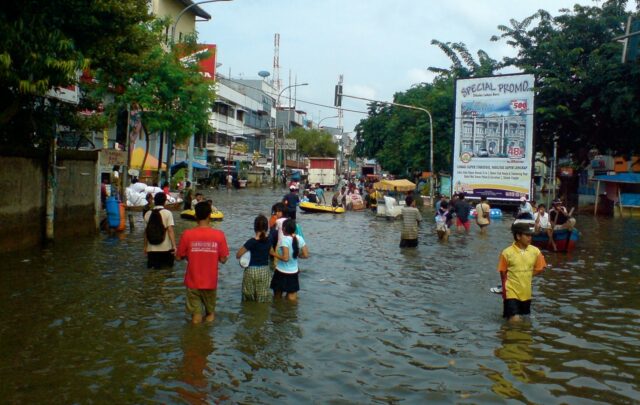
The effect of global warming on China is more vast still. Half of China’s population live on the country’s eastern seaboard – which will be drowned by just one metre of rising sea levels.
(5 July 2007)
Also at Common Dreams.
Global warming in Asia: Six degrees and China
Paul French, Ethical Corporation
What will likely happen to China as a result of global warming
—
Recently we were told a slightly scary story by a friend who had met with the head of China for one of the big global consultants (who have to remain nameless we’re afraid – but they are known by their initials, which narrows it down a bit).
This guy and his firm make millions (indeed he personally makes millions) of dollars from companies like yours dispensing advice to your boss.
The discussion centred on the most critical issues in the coming years in China: “climate change” said our friend, “there’s no getting away from it.” Then he and the partner consultants in the room were taken aback when the China head launched into a tirade about climate change. “All rubbish,” he said, “So what if the world heats up a few degrees? If it’s 80°C today and next year 82°C, or 83°C, who’ll notice? Next?”
The room sat aghast, and nobody said anything as they needed their jobs and our friend was pitching a bit of business. So as a service to the outraged China chairman, we’ll spell out what a few degrees of global warning means for China.
(5 July 2007)
U.S. is pressured to help China curb emissions
Robert Collier, SF Chronicle
Now that China has surged past the United States to become the world’s leading source of greenhouse gases, pressure is growing on U.S. policymakers to cast aside longtime anti-Beijing sentiment and help China clean up its emissions-spewing coal power industry.
The argument for aiding China is being made in the most urgent terms. While scientists agree that the United States and other wealthy nations caused the greenhouse gas buildup that has brought the planet close to a “tipping point” of irreversible warming, there’s also growing consensus that the growth of China’s emissions could push the world over the edge.
…Buried in these data, released by the Netherlands Environmental Assessment Agency, as well as in reports by other international agencies and the Chinese government, is the fact that China’s coal-fired power plants are increasing their emissions by an annual amount that is twice as large as the total emissions growth of all the world’s industrialized economies combined.
“If the United States and China don’t get together to solve the problem of clean coal, it doesn’t matter what anyone else does in world on global warming,” said Orville Schell, former dean of the UC Berkeley School of Journalism and now director of the Center on U.S.-China Relations at the Asia Society in New York.
China is building an average of two large, coal-fired plants per week, almost all of which use out-of-date, high-emissions equipment rather than more expensive, clean-burning technologies, Schell noted.
(5 July 2007)



Comments
We changed commenting systems on September 10, 2026 as part of a site-wide functionality and security upgrade. Your past comments have not disappeared, and you can still log in with your old Disqus account credentials if you wish. Contact us with any questions.