

Last December, a gust of wind signaled the arrival of a blizzard, followed by wet, heavy snow that accumulated in Chuck’s garden storage and forced his 20-by-8-foot barn door off its hinges.
Between Chuck, perched atop a stepladder, and his wife Mary, who held the door in place, it was clear how the barn door might be returned to its roller—all they needed was Roz from the Wild Robot, Marvel’s Iron Man, or the draft horses, oxen, and rope-and-pulley expertise of homesteaders of an earlier era. Having none of those, Chuck saw only the cost of a repair he could not handle himself, and he wasn’t sure who to call for such an unusual job.
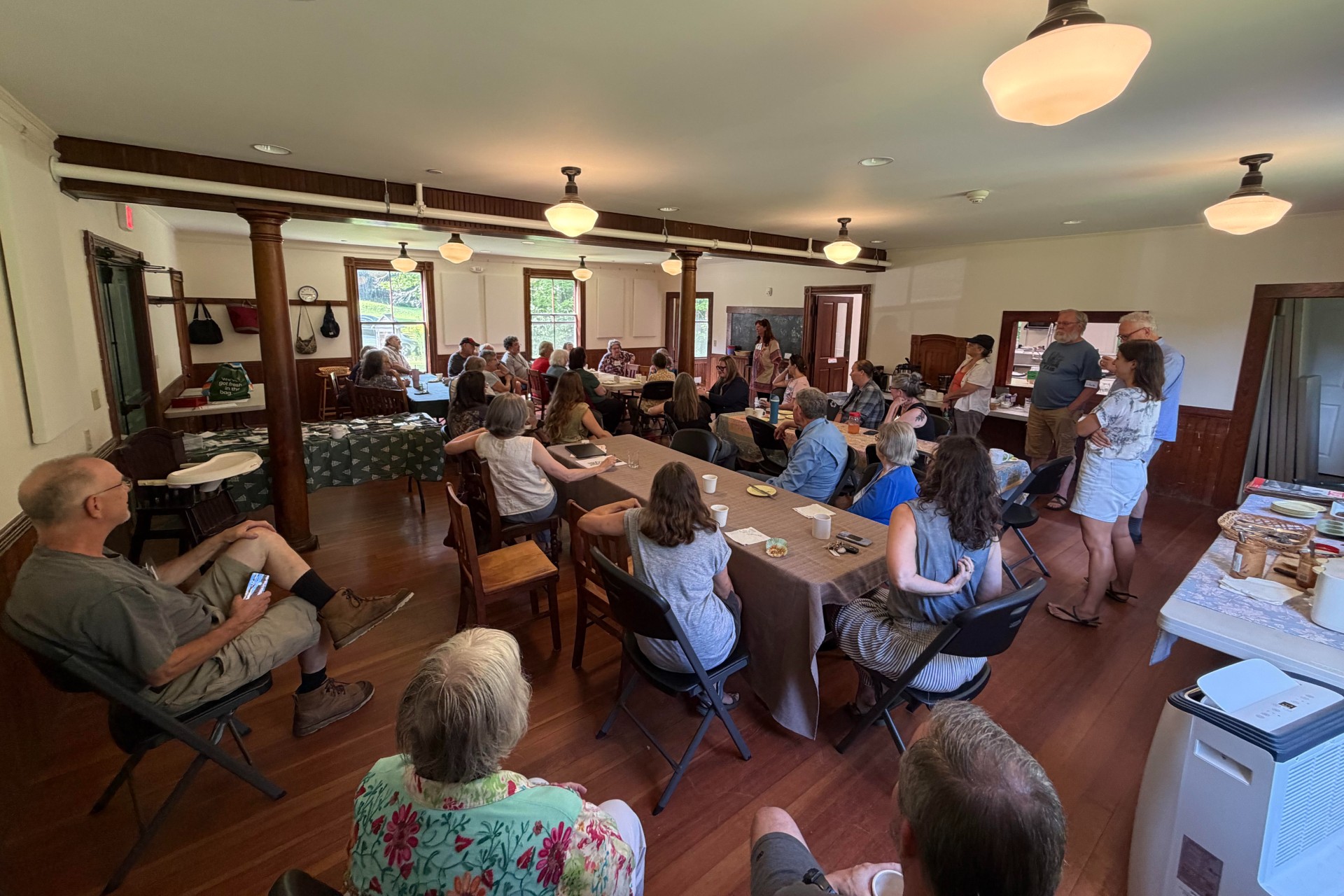
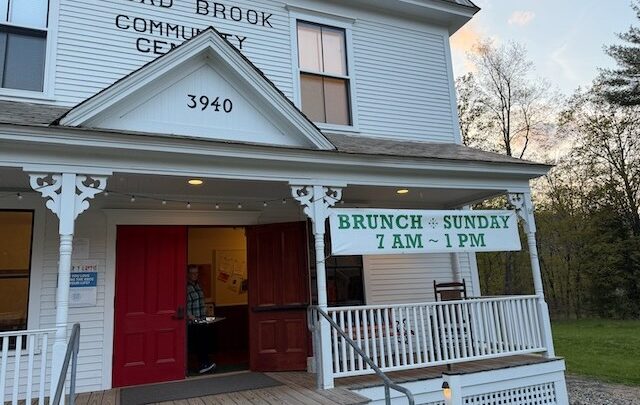
Chuck considered his community’s capacity. Guilford is a tight-knit town where potlucks, coffee klatches, and contra dances are regular fixtures at the local community center, a stone’s throw from Chuck’s farm. With about a dozen people, Chuck figured they could lift the door back onto its tracks in an hour. A barn-raising would have been a simple task in yesterday’s Guilford—or perhaps tomorrow’s. But in today’s America, coordinating the schedules of several families and asking them to give up a weekend felt far more difficult
It was exactly the kind of challenge Chuck had been trying to solve. Driven by a desire to build local resilience and help his community navigate what has been described as the “great unraveling,” he saw a need for greater community building.
His answer came after listening to an episode of Nate Hagens’s The Great Simplification podcast about an Arizona work-exchange network among homesteading households. Inspired, Chuck organized what the Amish call a “frolic” or “flurry”: a rotating work party among six households that meets every other weekend for a focused four-hour morning of labor. Farmer and author Kristin Kimball, of Essex Farm in the Adirondacks, described the “frolics” organized by her Amish neighbors as a neighborly work exchange—bigger than a potluck, but smaller than a barn raising.
What drew Tristan into the project was a bean trellis. Falling asleep with seed catalogs over the winter, he began imagining a structure that could support the “Cloud Lima” hybrid bean plant breeder Ken Asmus of Oikos Tree Crops says would require a trellis 10 feet high and more than 40 feet long. By April, when the snow had melted, Tristan was ready to till an unplanted orchard section with good soil and sun. He had black-locust posts, a cable system, and a 150-foot-long jute trellis delivered by UPS—everything but a practical way to get the project done. The daunting prospect of digging the post holes, then measuring, leveling and tensioning the cable kept the project little more than a dream.
Tristan’s Halifax community, one town over from Guilford, is older and stretched thinner, with residents busy tending to their own projects. It shares the same area and has roughly one-third of Guilford’s population, but not nearly the same pool of available hands.
The Halifax Fire Company relies on 30 volunteers. Every August, its clambake benefit draws about 500 people from across three states. But volunteers are scarce in small communities today, and most, Tristan included, dedicate their time to community-wide efforts and annual events like the clambake.
Families are more dispersed, more distant, and busier than they once were. Recruiting volunteers—let alone coordinating enough households to make a work party feel enjoyable—was a challenge even for Tristan, an experienced organizer who has hosted WWOOFers on his homestead for nearly 20 years and learned to work with people of all skill levels in the garden. As rain delayed planting season, he realized he needed more than one or two helpers. He needed a crew.
Even when Chuck invited him to join the frolic, Tristan was skeptical. Could families with few ties sustain communication and reciprocity for months on end? He held on to his trellis dream, but kept his expectations modest, hoping only that everyone would have a good time while it lasted.
How did it go? First came the practical question any homeowner would ask: why not just hire someone?
We had both entered homesteading believing that growing our own food and medicine would be more affordable, healthier and more resilient. In practice, though, a homestead can become as much of a money pit as off-farm income allows. Like many households, we were trying to balance necessary expenses against what the “barter way” might provide. We had household budgets to meet, and we had to decide what was feasible and what was merely desirable. The frolic emerged as a way to get over the hump on projects too difficult for one adult, or even one couple, to take on alone.
This isn’t the individualistic prepper model that dominates American preparedness culture. We were not building bomb shelters stocked with pre-cooked meal rations (MREs). We were building what humans have always depended on: networks of interdependence. In the Great Unraveling, real wealth is access to productive land, water, tools, and the social ties that make them usable. That is especially true in today’s labor market, where the low-wage manual help that small farms once relied on has largely vanished. Finding qualified help is hard enough; affording it is harder still.
Those pressures are familiar in rural communities like ours, and they are likely to worsen as rural capacity erodes in the decades ahead. Perhaps organizing work exchanges are key to any working-class household’s survival. In our case, homesteading is not a financial gain — it is a long-term investment. We see it as a loss leader for the future, and we believe deeply that ultra-local mutual aid networks are worth building.
The work exchange operates between charity and transaction. No money changes hands, no formal accounting tracks hours. Instead, we rely on rough reciprocity and the understanding that every weekend morning away from a person’s own projects is significant and deserves respect.
For this round, the payoff was real and sustained.
At Chuck and Mary’s place, the crew focused first on weeding and mulching an extensive garden and berry bushes. The barn door, which seemed too big a task to begin with, waited until after lunch. Even then, Chuck hesitated to ask the group for one more favor. Asking for help, even within a mutual-aid network, can still feel like a burden. But someone stepped in, and within 10 minutes the door was rolling again.
At Tristan’s, the group arrived to find him overwhelmed by the idea of coordinating three crews across three projects. The tension eased as people began taking charge. He had not worked with the cabling system before, but he passed the job to the group’s most capable problem-solver. By lunch, the posts were set, the cable was tensioned and the jute netting was stretched taut against the June sky. As the meal wound down, another member pulled out a guitar, and an impromptu dance party broke out—a small celebration of work done together.
For Astrid, the day’s big victory was hanging blanket insulation inside their new dome. A contractor would have cost thousands. Instead, Astrid and her partner watched teenage kids crawling through tight spaces with determination, while adults who had barely known one another six weeks earlier figured out the choreography to get the job done—one on a step ladder, one on the ground, handing off fabric hooks to each other. .
“I got to witness persistence. Frustration transformed into success through shared work,” she said.
That question: what’s one thing you can’t accomplish alone? became the organizing principle that lifted the frolic beyond honey-do lists and into projects with real payoff. Luke’s family had logs from land clearing and needed winter firewood. A crew of four tackled that while another group built a picnic table from supplies Luke had already prepared.
Six households, six Sunday mornings, four hours each. Each household sent at least one adult, often two. Kids came along too, helping with appropriate projects. Childcare was shared. Everyone was allowed to miss one of the six days. Predictably, there were lessons for next time.
Astrid went first and made enough lunch for 30, preparing three different entrees. Hunger was not in short supply, but later hosts refined the formula, focusing on hearty, abundant meals without turning hospitality into culinary competition. The demands of hosting six families and keeping everyone productive were real. Who had chainsaw experience? Who was good at detail work? What could the teenagers do? Meeting people where they are took planning.
One emerging idea: a buddy system, pairing households for advanced planning. Each family gets fresh eyes on their homestead: assess the dream, inventory tools, match projects to available skills. Reciprocity and accountability depend on trust, and trust grows through strong bonds. Another lesson: roll with the punches. When the group found one family’s truck stuck in mud, they immediately shifted focus to pulling it out before getting back on track. When Luke didn’t have the compound miter saw that would have made the picnic-table braces easier to cut, the group adjusted. What home improvement project doesn’t require at least one store trip after all?
“It’s okay. We’re here to help. We’ll figure it out.” Our messages of reassurance for stressed hosts.
What about conflict? Did everyone keep their commitments?
So far, the answer is yes. The six meetings went smoothly, and members left happy with the exchange. But these networks would be fragile if participants chose to leave rather than work through disagreements.
Astrid, a therapist, encourages groups like ours to establish social “norms” and communication as “practice, not protocol.” Instead of rigid rules for mediating rare emergencies, she advocates direct, honest communication as an everyday habit. Communities that do this well, she says, tend to become more compassionate, safer and more effective at understanding one another. She recommends nuanced communication where members can share, for example, “part of me feels angry, part of me feels sad” rather than going quickly to declarations of rights and wrongs.
Over time, we began to notice a subtle shift from the polished rugged individualism of American “I” culture toward a stronger sense of “we.” The rotation itself helped produce that change. One family’s success became everyone’s success. At the post-rotation debrief, members described genuine joy in seeing each household get its turn.
Another benefit was the willingness to share and receive advice. Astrid had hoped to plant two fruit trees, but instead got guidance on which trees needed removing and how to maximize sunlight. Accepting that advice, and benefiting from it, meant treating it as care rather than criticism.
“You don’t know what you don’t know,” Astrid said. In a community of homesteads with varying expertise levels, sharing knowledge honestly becomes care and a form of mutual aid.
In the end, it wasn’t just the barn doors that rolled more smoothly after the frolic started. So did the homesteads. Six households now know one another’s land, aspirations and capabilities. We are practicing the interdependence humans relied on long before capitalism turned every problem into a purchase. When Chuck’s friend in the Adirondacks heard about the project, she reminded us of these, once obvious, historical connections, “ we call those frolics too.”
There is real power in fusing work and celebration.
The more we looked into work-sharing around the world, the more obvious it became: this is not some radical experiment, it is the norm. Pre-capitalist societies depended on neighbors helping neighbors. This is how the world has worked for centuries. We are not inventing something new. We are remembering, one weekend at a time, skills once as common as lighting fires or preserving food for winter. These old practices may be our newest necessity.
Read more from the series:
- Navigating the great unraveling: How communities are building place‑based resilience
- Does your neighborhood need a coffee klatch?
- Our town, our table: The community-building power of a shared meal
Explore the Resilient Neighbors series here.
Tristan Roberts writes from Quill Nook Farm in Halifax, Vermont, where he grows and teaches about heritage plants. He was elected to the Vermont House and served from 2023 to 2025, and is also the founder of Metricorps, a community for sustainability practitioners.



Comments
We changed commenting systems on September 10, 2026 as part of a site-wide functionality and security upgrade. Your past comments have not disappeared, and you can still log in with your old Disqus account credentials if you wish. Contact us with any questions.