

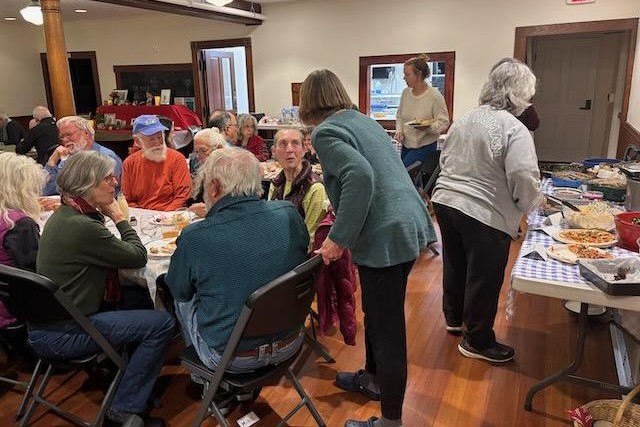
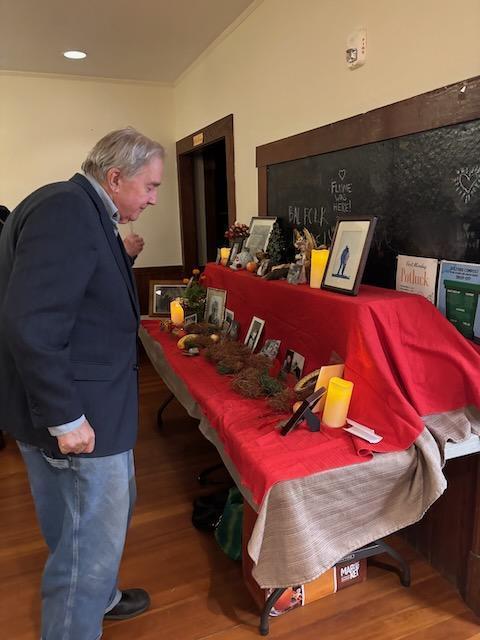
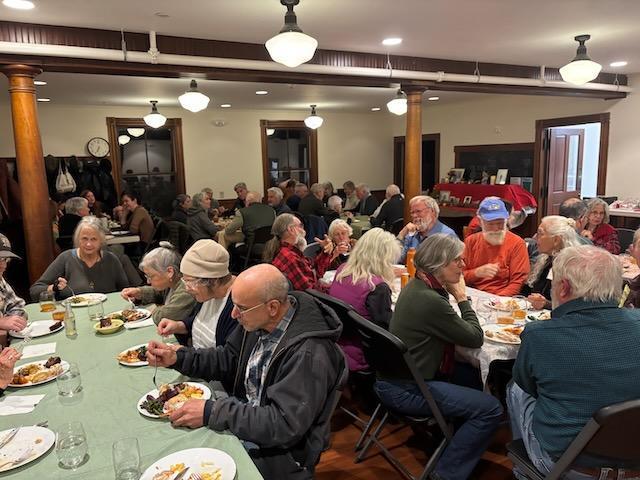
On the first Monday night of the month in Guilford, Vermont, residents gather at the Broad Brook Community Center for a potluck dinner. It’s November, and in keeping with the season, the organizers have decorated the meeting hall with votive candles and marigolds in a nod to both All Souls’ Day and the Mexican tradition of Día de Muertos, Day of the Dead.
This month, the 55 residents who turned out were invited to bring not only a dish to share but also photos of deceased loved ones or beloved animals to place on the community altar.
Food and memory were in equal supply. Meg (that’s what her name tag says—neighbors know her for longtime involvement in the local community theater) brought a generous tray of macaroni and cheese that proved especially popular with children, who lined up for seconds. Dan and Mike arrived with marinated pulled chicken and always happy to talk about gardening. Rick and Jeanette’s enchiladas go fast—they’re both older and relative newlyweds, and bring the dish often—but there’s a healthy variety of chilli to choose from.
An open invitation is extended to everyone. Attendance is optional, and so is contributing a dish. Busy parents arriving straight from work bring Asian takeout. Chips and salsa are common offerings. All are clearly welcome.
After an hour of making plates and chatting among neighbors, one of the cohosts invites guests to speak about the people and animals they placed on the altar. Brian shows a picture of his best friend of 30 years who passed away last year. Mary tells us about her cat, Moxie, who was taken by a predator the previous month. Marli displays a photo of her son’s late father. Lauren recounts the loss of her dog, whose penetrating gaze suggested a deep spirit and a profound loss.
Murmurs of ‘thank you for sharing’ and long hugs at the end of the night offer an outpouring of care.
U.S. Surgeon General Vivek Murthy warned of a loneliness “epidemic” in a 2023 advisory, calling loneliness and social isolation public health threats that continue to “splinter and divide” the country.
In a New York Times op-ed, Murthy described his own experience with loneliness:
“After my [first stint as surgeon general] ended, I felt ashamed to reach out to friends I had ignored. I found myself increasingly lonely and isolated, and it felt as if I was the only one who felt that way. Loneliness — like depression, with which it can be associated — can chip away at your self-esteem and erode your sense of who you are. That’s what happened to me.”
Loneliness and isolation have significant mental and physical health implications.
“Social disconnection is associated with reduced productivity in the workplace, worse performance in school, and diminished civic engagement. When we are less invested in one another, we are more susceptible to polarization and less able to pull together to face the challenges that we cannot solve alone –from climate change and gun violence to economic inequality and future pandemics,” Murty wrote. “Loneliness and isolation hurt whole communities.”
One component of this isolation is the rising percentage of Americans who eat their meals alone. Eating meals alone has become more prevalent for every age group, but especially for young people. The World Happiness Report (2023), with a chapter dedicated to “How sharing meals supports happiness and social connections,” found that roughly 1 in 4 Americans reported eating all of their meals alone that day, an increase of 53 percent since 2003.
There’s nothing new about a community potluck like Guilford’s—in fact, the word “potluck” or to “take potluck,” is traced to the 16th century, when guests each brought a contribution to share to a community meal, with no coordination, “to take one’s chance at what is being served.” Thomas Nashe, the Elizabethan playwright, satirist and pamphleteer, recorded in 1592, “That, that pure sanguine complexion of yours may neuer be famisht with potte-lucke.”
“The potluck went mainstream during the Great Depression, as a way for poverty-stricken communities to ensure every person could eat with dignity,” writes journalist Matt Hongoltz-Hetling for the New York Times about potlucks combatting loneliness. “In the decades that followed, potlucks nurtured the labor movement by attracting new members to union hall meetings.”
The mid-century height of the potluck is long gone, but some towns are keeping the flame alive. In Maine, a statewide organization, Community Plate, promotes “Story Sharing Potluck Suppers” to deepen community connections. In Thetford, Vermont, with a population of only 2,775 people, the Rice’s Mills Community Association has hosted a monthly potluck for sixty years, gathering on the third Sunday from May through November.
A profile of the Thetford gathering described the diversity of participants, which included seniors, young families, MAGA-hat-wearing Trump supporters, purple-haired kids, and members of the LGBTQIA2S+ community. At their November potluck, residents were encouraged to send photos to a host who coordinated a community slide show. For after-dinner entertainment, participants delighted in watching a compilation of images from the previous year.
Tonight in Guilford, there are no lofty pretentions about the sociological meaning of the potluck. For two hours, 55 neighbors in Guilford chose to be together without screens, entertainment, doomscrolling on their phones, or any set agenda. Good food, neighborly chatter, new connections, and a few memorable stories of ancestors who also found their way into the room. But one fact is crystal clear: no one here ate their dinner alone tonight.
Follow all subsequent posts in this series, Resilient Neighbors, here.



Comments
We changed commenting systems on September 10, 2026 as part of a site-wide functionality and security upgrade. Your past comments have not disappeared, and you can still log in with your old Disqus account credentials if you wish. Contact us with any questions.