

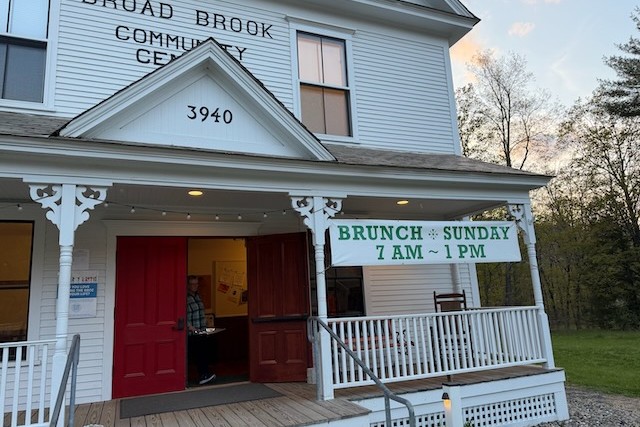
It’s a typical Friday morning, and the Guilford Coffee Klatch is in full swing by 9 a.m. Thirty-five neighbors are gathered around tables or standing holding mugs, buzzing with chatter.
Rick Zamore, a volunteer co-host, taps on his cup, bringing the room to a hush.
“As is our tradition, we’d like to have folks introduce themselves,” he said. “Please say your name, the road you live on, and one topic you’d like to talk to your neighbors about.”
The group went around the room. Candace doesn’t know what to do about a mangy fox that keeps showing up in her yard. Ann is concerned about the threat of ICE picking up her neighbors. David is curious if anyone has advice about moving a parent into assisted living. Bill mentions he needs a ride to Dartmouth Hitchcock Medical Center for a procedure, and he is immediately matched with a volunteer.
“You can’t help but feel the weaving of community relationships and bonds,” said Rick about the weekly gathering. “It’s become a necessary ingredient of any intentional mutual aid program in town.”
Founded in January 2025, the coffee klatch meets from 8–10 a.m.a.m every Friday at the Broad Brook Community Center in Guilford, a small southern Vermont town of 2,100. The hosts provide coffee, tea, baked goods, and a table for name tags. A donation jar sits in the background with a few dollar bills.
The term koffeeklatsch comes from the German “coffee chatter,” for gatherings there in the late 1800s. The term has long since been adopted all over. Chuck Collins was a teenager when his father first brought him to a neighborhood gathering in their small, northern Michigan hometown. Back then, the town’s elders, mostly retired men, met at the fire station to sip Sanka coffee from Styrofoam cups and exchange the day’s gossip. Germans have a word for these kinds of meetings: Koffeeklatsch, or “coffee chatter,” a tradition dating back to the late 1800s, when women would gather in villages over coffee and cake.
Gatherings like the one Chuck remembers have largely disappeared from American small towns as the casualties of economic consolidation, declining civic engagement, and the loss of what sociologist Ray Oldenburg coined “third places.” But amid growing concerns about the polarization of America, similar gatherings are being rediscovered as a tool to rebuild connections.
“It’s like the church coffee hour without the church,” said Mary Collins, co-founder of the Guilford, Vermont klatch and a board member of the town’s community center. (She is also married to Chuck.)
Guilford’s coffee klatch attracts a mix of neighbors across the political spectrum–some voted for the current president, while a few don “No Kings” buttons. “Old timers,” whose names you’ll find on local road signs, attend alongside “newcomers,” a designation given to anyone who wasn’t born in town.
“We make a point of welcoming newcomers to the klatch,” said Collins. “First-timers get applause and a real welcome.“ New arrivals are encouraged to leave their name tag behind for the next time they attend.
The event is a forum where community members can share their immediate needs and concerns, while steering clear of political discussions. With rotating hosts committed to steering conversations away from politics, the diverse mix of neighbors shows that this approach is working.
“First impressions matter,” said Collins. “If someone shows up and gets lectured to by someone treating it like a committee meeting, it will likely be their first and last visit,” she said. “We’re trying to do something different here.”
Similar coffee gatherings are cropping up across the country, including in Sperryville, Virginia, where The Washington Post journalist Dana Milbank profiled Ted Pellegatta, a retiree who convened a daily coffee klatch in the rural village.
According to the profile, the Sperryville coffee klatch attracted a wide range of regulars who learned to talk politics across divisions of party, age, race, and culture. Before succumbing to metastatic cancer, Pellegatta considered the klatch, then in its tenth year, his “singular achievement,” while its members have called their gatherings a bulwark against loneliness and isolation.
A growing body of public health research underscores the importance of social connectedness as a key determinant of well-being and longevity. In what became the longest scientific study of happiness, the Harvard Study of Adult Development followed a group of 268 Harvard sophomores for more than 80 years. The study’s directors, Mark Schulz and Robert Waldinger, summarized their findings in their book The Good Life (2023): “Good relationships keep us healthier and happier. Period.”
“I look forward to it every week,” says Cal, a Guilford regular. “I’m on town committees with some of these folks, but you don’t really get to know what makes people tick. Now I run into people I’ve met at the klatch and we have a foundation of connection.”
“I like coming here as I’m new to the community and I’m working to find where I belong,” said Pam, recently retired from teaching. “I’ve made a bunch of new friends at coffee klatch and I feel motivated to get out of bed on Friday mornings.”
“Every town should have [a coffee klatch],” said Linda, a senior attendee.
Want to organize a klatch in your town? Here are some tips from Guilford:
- Good coffee: The coffee at the Guilford Coffee Klatch is considerably better than the Nescafé sludge Chuck remembers from Michigan. If you’re lying in bed, wondering whether to venture out to the coffee klatch, knowing there is quality coffee at the other end matters.
- Name Tags: A table with name tags spread out welcomes guests in Guilford. If time allows, the host lays them out roughly alphabetized. Hosts welcome arrivals and hand them their name tag. Newcomers are encouraged to make their own permanent name tag (though temporary name tags are available). The message is clear: “You belong.”
- Protecting A Non-Political Space. The hosts need to set a tone that everyone is welcome. This morning coffee isn’t a political meet-up but a neighborly gathering where we share more in common than our differences. In a small rural town, the first person to stop and pull you out of a snowbank may not vote the same way as you, but they understand and practice neighborliness.
- Starting with Broad Social Group. If you’re starting a coffee klatch, consider inviting people in the community with wide social circles that cut across geography, age, socioeconomic status, education, and occupation to host. The more co-hosts you have who can draw from their own networks, the better.



Comments
We changed commenting systems on September 10, 2026 as part of a site-wide functionality and security upgrade. Your past comments have not disappeared, and you can still log in with your old Disqus account credentials if you wish. Contact us with any questions.