

Tadzio Müller is a climate justice and queer rights activist in Berlin and a political scientist. For 30 years, he has been involved in struggles against neoliberal globalization, nuclear waste, and coal, and more recently in what he sees as an anti-fascist struggle. Climate activist and professor Adam Aron spoke with Müller about his years of activism and whether the climate movement can still forge a meaningful path forward amid accelerating ecological and political crises.
Adam Aron: I want to start with your views on the climate struggle then and now. A few years ago, you were in Germany’s lignite pits trying to stop the coal industry. But more recently, you’ve said: “the climate ship has sailed.” What do you mean by that?
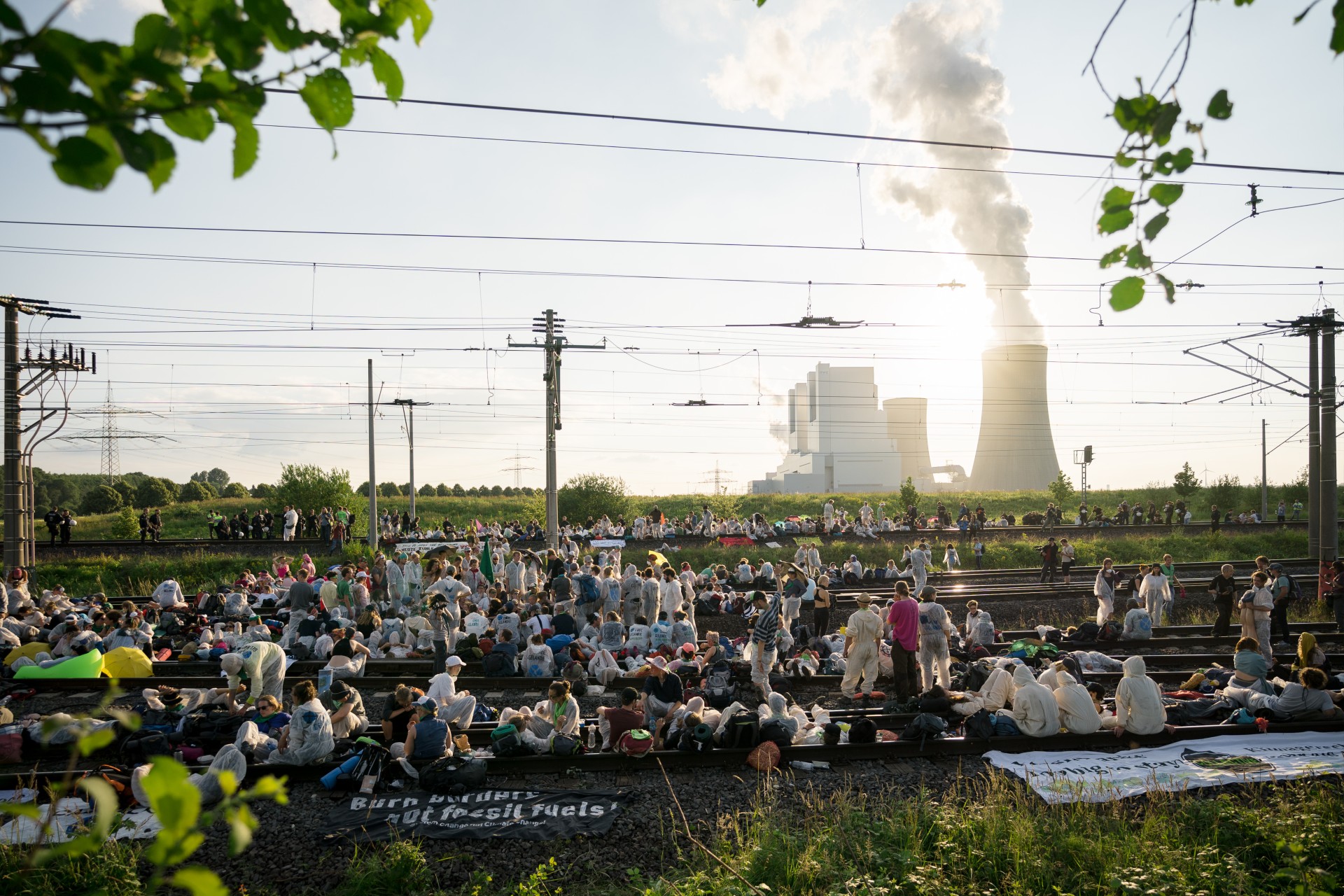
Tadio Müller: We were an extremely well-organized anti-coal movement. We were fighting a declining industry, and we managed to convene some of the biggest demonstrations in German history. And yet, with everything we brought to the table, great actions, huge demonstrations, an enemy who was behaving stupidly, all we got in the end was a coal phase out in 2038. Now that’s like 15 to 20 years after the world starts burning. So the first thing was that our struggle wasn’t victorious from a climate perspective – which is relevant insofar as the German climate movement was one of the strongest, if not the strongest in the world, and we still lost.
Secondly, the problem is the one we can feel all around us: the climate is in fact collapsing. We built the anti-coal movement to contribute to the struggle against climate collapse. And clearly that struggle has been lost because the climate is collapsing.
But the last sense in which the ship has sailed, I think, is the more controversial one. Society, which was always our main point of leverage, is tired of hearing about the climate. In rich countries—the UK, the U.S., France, Germany, Sweden—societies are done with this climate stuff. In those societies, we thought about changing our ways, realized it’s too difficult and expensive and makes us face questions of guilt, shame and fear. We don’t want to hear about it anymore. So our protests have lost their point of leverage. Society says, much like an abusive boyfriend, ” Honey, I’ve heard enough of your critiques; now shut the fuck up. There’s simply no realistic path towards ‘climate majorities’ anywhere in the global North, possibly anywhere in the world.
AA: Could opinion change in rich countries? Look at the multiple heat waves in Europe in 2026. Two hundred thousand people had to evacuate near Bordeaux. Does the moment just pass without gaining political traction?
TM: All environmentalists in the global North have operated from the same strategic assumption: the more the climate crisis hits us, the more climate rational we’ll become. But the last few years have falsified that hypothesis. In fact, the more the climate catastrophe escalates, the less we want to look at it. Shit has gotten worse. But shit getting worse in a way that reminds us of all the changes we should have made over the last 30 years doesn’t make us more rational; it makes us more ashamed. The more we’re reminded of our decades of inaction and centuries of exploitation, the more we’re going to turn away.
AA: How does your view that the climate ship has sailed square with the mainstream climate policy view these days, which is basically: hey, modulo the wrong politicians, victory is around the corner on climate with cheap solar, batteries, electric cars, and heat pumps?
TM: It’s a mélange of magical thinking designed to make us feel less bad. I used to work as an energy policy expert, and one thing that’s obvious when you look at the history of energy is that there has never been an energy transition. There have only ever been energy additions. Fun fact: at the height of the coal age, we burnt more biomass than ever before. At the height of the oil age, we burnt more coal than ever before. And at the height of the gas age, we’re burning more oil than ever before.
So all these people saying that adding renewable energy will mean fewer fossil fuels being burnt, that’s simply not true. In a world where the hunger for energy rises faster than energy production, renewables simply add more energy to the system. And if you imagine a green capitalist round of growth kicking off, you’d have to reconfigure the entire system, requiring enormous productive effort, all run from a fossil-fuel energy system. So basically, more renewables does not mean less fossil fuels; it just means more energy in the mix.
AA: Is one response to your concern that renewables simply add more energy to the mix, rather than displacing fossil fuels, to fight for governments to reduce material and energy use? That is, to implement policies for degrowth or post-growth?
TM: Well, it would, except it’s not happening, and as far as I can tell, it’s not really possible. From an ecological perspective, the degrowth argument is simple. We are living beyond our ecological means. Fact. But what do societies want? We want jobs, lower prices, lower taxes. And of course, capitalists want higher profits. So societies are addicted to growth. Growth is how we deal with social conflicts because there’s more to distribute, to grease the wheels of compromise. Which government is going to say, guys, we’re going to cut off growth because it’s ecologically bad? You’ll pay higher taxes, have lower profits, fewer jobs and higher prices. How about that? No government that relies on votes or legitimacy from the population is going to go for a degrowth strategy.
AA: Just to be clear about characterizing the degrowth position. They’re not arguing for a recession or an overall contraction whatsoever. It should really be called “selective degrowth”. They’re saying some things need to go down, other things need to go up.
TM: A degrowth position that takes itself seriously would have to support an absolute reduction in material throughput in the world economy. And that is simply not going to happen. Degrowthers might say, well, we’re going to grow renewables a bit, shrink fossils a little bit, and end up with a net reduction in material throughput. But the main critique of capitalist growth is not that some sectors grow too fast; it’s the two to three percent compound growth on which global capitalism relies. And that has got to end somehow. But how? Nobody knows, certainly not the degrowth school. You’d also have to redistribute to countries that have not enjoyed hundreds of years of imperialist profits. They would need huge resources in order not to grow.
We also had an interesting experiment in what degrowth looks like. During the first corona lockdown, the virus forced governments to implement a kind of managed degrowth. But most societies seem to remember that lockdown as a trauma. There was much less freedom of movement, fewer consumption opportunities, and basically we don’t want to go back there.
AA: Your new book is about collapse. What do you mean by collapse? And what kind of journey do you take the reader on?
TM: The usual understanding of collapse comes from movies like The Day After Tomorrow and things like St. John’s Revelation and Hieronymus Bosch. That’s where everything collapses and everybody lives in hell. But from the perspective of us living in society, collapse is actually just the disappearance of normality. Imagine a collapse in the agricultural or food delivery system. That wouldn’t mean nobody has food, but that there’s less food at higher prices, creating all sorts of social conflicts. Or, since I’m HIV positive, a collapse in the distribution system for those meds wouldn’t affect folks who aren’t HIV positive. So collapse isn’t the immediate end of the world. In the short term, it’s the disappearance of normalities we’ve gotten used to.
On a longer timeline, collapse is the end of the world of more. In a world of more, if we are defeated in our struggles for justice, we can win the next round, or the next. Martin Luther King said the moral arc of the universe is long and it bends towards justice. In collapse, the moral arc of the universe is short and it bends towards fascism.
And so you asked about the journey in my book. To talk about the end of the comfort of constantly accumulating more, that’s a conversation we don’t want to have. So I’ve constructed the story like an intervention with a drug addict. I start by creating emotional resonances, not throwing lots of facts at people. I’m saying, I know we’re all scared of the future, and we’re not really acknowledging that fear. So how about we start talking about it? And then I say, now that we’ve accepted the fact of collapse, let’s try and find, if not hope—because shit is just dark and I don’t want to sell people more false hope—then meaning.
Can we find meaning in a world that is constantly becoming worse? My argument is yes. Catastrophes escalate existing injustices and create fear and suffering. So coming from a climate justice movement, I think there is a lot for us to do in a future where the climate is collapsing. Preparing for these moments of catastrophe together with other people can give you meaning. That’s the important point I want to get people to. Acknowledging a future of collapse does not mean living a life of permanent depression. It means adjusting your expectations and working from there to create moments of agency and spaces of solidarity, love, happiness and, again, meaning. Because people can live without hope, that is proven, but they cannot live without meaning
AA: You’ve said that people are becoming more ready to talk about collapse. Who do you mean, and what are you seeing that tells you that?
TM: I really mean about two to three, maybe five percent of the population. My overall analysis is that we live in a society of denial. Whether it’s war, climate collapse, COVID or AI, we don’t have a realistic discourse about the dangers we’ve created. Most people, at least in the Global North, will continue living relatively comfortable lives because that’s easier than facing what’s coming down.
But denying reality takes energy. And the more catastrophic shit happens, the harder it becomes. Every catastrophe creates a window of opportunity for a few days or weeks. We can use those windows to talk to people who are done with the denial and false hope being peddled by our political system. I don’t think preparing together for catastrophe will be a majority movement. But you don’t need a majority in the beginning. You need groups with agency in those moments of catastrophe, and then you start thinking from there.
AA: There are suggestions that framing the ecological crisis in terms of inevitable collapse can play into authoritarian, nationalist, exclusionary, and even ecofascist politics. Are you concerned that framing our predicament in terms of ‘collapse’ could contribute to these tendencies?
TM: I think this infantilizes people. It’s an active anti-Enlightenment position, and the start of a slippery slope that ends in the full-blown denial of reality we see from actual climate deniers. First of all, global ecological collapse is inevitable. That’s a fact. And the response—oh no, don’t say that, because acknowledging how bad things look might lead people to think stuff we don’t want them to think—that seems crazy to me.
That’s precisely how today’s climate deniers started out. They wanted to view reality in a way that didn’t scare them too much, that didn’t force them to reckon with how our mode of production and living is making the planet unlivable for large-scale human civilization. So we get this discourse that people are too dumb, immature, or fragile to confront reality. But the truth is the opposite: only by facing reality without comforting emotional blinders can we start developing actual agency for the future that’s coming.
AA: Collapse has been part of the climate and environmental conversation for more than a decade. How does your idea of collapse, and what we should do about it, differ from collapsology, the Deep Adaptation movement, and climate doomism?
TM: Pablo Servigne and Raphaël Stevens, who wrote the first collapsiologie book in France, helped us understand what collapse means and how unavoidable it is. But that remains a largely academic discourse. Then a few years later, Jem Bendell writes his paper, Deep Adaptation, and starts a project very much about doing the emotional labor of accepting that collapse is going to come, which is a super important step. But we collapse folks, at least here in Germany, come from a much more activist background. Our story about collapse is not just about acceptance or understanding, it is about agency and practical solidarity. And I think it’s the most energizing of the collapse discourses because it brings the dynamic of the powerful anti-coal and climate movement we had in Germany.
We bring that fire to the collapse discourse because we’re not done fighting for justice. The important issue is: where is the point of leverage? How do we develop agency and make the world less shit? And my short argument is the point of leverage is going to be the moment of catastrophe. Folks have probably read The Shock Doctrine by Naomi Klein, where she explains how the right uses moments of catastrophe to further their agenda. And in that sense, we on the left are developing disaster communism or disaster anarchism or whatever you might call it, against their project of disaster capitalism and, increasingly, disaster fascism. Disaster is going to be the new normality. And we’re among the first left-wing and climate actors saying: let’s look at this, let’s not push it away, let’s not tell ourselves comforting stories about how the next windmill is really going to change it. Let’s look at this realistically and do what we’ve always done: identify points of leverage.
AA: During Occupy Sandy in New York, 50,000 people mobilized after the hurricane struck, and there are many other inspiring examples after catastrophes. But you’re talking about building a collapse movement before catastrophe strikes. Isn’t that an enormous challenge?
TM: Yes, it’s a challenge. But Occupy Sandy is a spectacular example of how these solidarity networks can work. It started small and became larger than the American Red Cross and FEMA. It was inspired by people who organized the Common Ground Clinic in New Orleans after Hurricane Katrina. That was also organized after the catastrophe. But the people around Katrina had previously organized the 1999 Seattle protests against the World Trade Organization (WTO). So there is always a pre-organized core. And in a catastrophe, even a small group can develop outsized agency because so few other actors can fill that political space.
Honestly, it was also very difficult to create a climate movement in Germany. We worked for years. Our initial climate camps were like 50 people, with hardly any attention for five years. Then the Paris summit happened; we had this great idea with Ende Gelände and these disobedience actions, and we exploded from there.
Imagine small nuclei of folks organized and capable of intervening in floods or heat waves. And, by the way, my notion of catastrophe is both political and ecological. A Nazi attack on a Pride March is as much a catastrophe to me as a fascist party getting 44% in part of Germany. These are all catastrophes. So we pre-organize nuclei of people, and catastrophes will come. If the right nucleus meets the right catastrophe, you can get an expansive dynamic: people saying, wow, that looks really cool, let’s do that. I think it’s a better bet than organizing the kinds of demonstrations nobody cares about anymore.




Comments
We changed commenting systems on September 10, 2026 as part of a site-wide functionality and security upgrade. Your past comments have not disappeared, and you can still log in with your old Disqus account credentials if you wish. Contact us with any questions.