

I woke up yesterday morning, after a late night watching coverage of the US midterm election results, with the dual and dueling feeling of excitement and angst. On the one hand, my imagination conjured up all kinds of ways that the so-called “blue tsunami” might positively shift sands across the globe. For instance, could last night’s overwhelming rebuke of Trump’s foreign and domestic policy halt his plans for renewed attacks on Iran? Could voters’ opposition to data centers all across the country slow the exponential growth of artificial intelligence and all the environmental and social damage that comes with it?
On the other hand, it seems unlikely that the message new leadership in the US Congress got from the electorate was “time to face the polycrisis.” Of the top issues animating voters, none included “climate,” “ecological breakdown,” “resource constraints,” or “the collapse of modern techno-industrial civilization.” When so many Americans are struggling, truly struggling, with the costs of things that the modern world has made them dependent on — like gas, food, healthcare, and housing — that’s hardly surprising. Then again, they also weren’t asked.
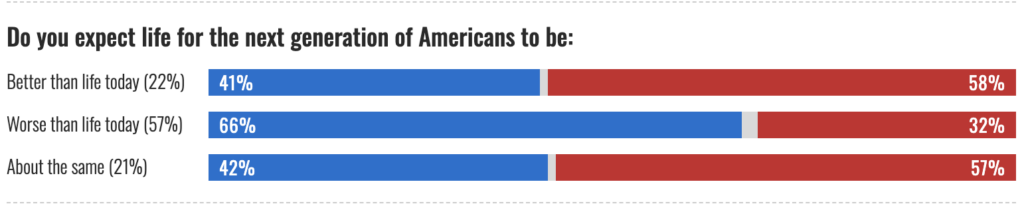
Interestingly, more than half of those polled did, however, say that they expected life for the next generation of Americans to be worse than life today.
Those of us who have come to realize that we are in the midst of a Great Unraveling of environmental and social conditions are probably not surprised that people are more focused on the struggles of today than the “big predicament” hovering over us, even while those same people feel in their bones that the promise of continual growth and progress is a false story. After all, one of the main obstacles in the way of us taking systemic, courageous action is how election cycles and human evolutionary biology tend to discount the future.
But that’s a tendency, not a law. Many Indigenous cultures have made the fate of future generations instrumental to their decision-making. In 2015, the government of Wales even passed the Well-being of Future Generations Act, an actual law mandating that all public bodies must act “in a manner which seeks to ensure that the needs of the present are met without compromising the ability of future generations to meet their own needs.”
For many people in the US and around the world, this election feels like a referendum on President Trump and his enablers in Washington, DC, and state capitols around the country. And many found joy and inspiration in a number of political firsts the 2026 election brought — the first Black and Native American female governors in US history, for example.
But I want to share something else that gives me a measure of hope in our capacity to respond to the inexorable crises coming our way (crises that no election can solve). And that is the public reaction to two messages voters heard, in two battleground states. One was a horrifically offensive ad run in Ohio’s race for governor; the other was the closing appeal by Senator-elect James Talarico in Texas. Ohioans — who elected a Republican in the last gubernatorial race by 15 percentage points — seemed to recoil at the cruelty of Vivek Ramaswamy’s attack ad on his opponent and react positively to Amy Acton’s response, including her candidness about the childhood trauma at the heart of Ramaswamy’s ad. In Texas, James Talarico’s surprisingly decisive victory was driven in part by his message of unity over division. This despite, if not actually fueled by, the hundreds of millions of dollars spent attacking Talarico’s faith and stoking anti-trans animus.
What matters most to me is not which party won. It’s the possibility that after years of worsening hyperpartisanship, fueled by divisiveness and increasingly hostile rhetoric, Americans could be turning away from affective polarization — the belief that those with different political or ideological views aren’t just wrong but a threat. Researchers like Daniel Aldrich, whom my colleague Richard Heinberg interviewed earlier this year, have shown how much the strength of social ties — including ties across different economic, ethnic, religious, or political groups — influences the ability of communities to respond to crises like natural disasters. Sadly, I suspect that we will have many opportunities in the coming months, years, and decades to test the strength of those ties.
I also suspect that no matter the balance of political power in Washington, DC (or Brussels or New Delhi, for that matter), the leadership needed to address the further unraveling of environmental and social conditions won’t come from national or international institutions that lack a long-term planning horizon and seem hell-bent on maintaining the current system. It will come instead from communities, from people who have strong relationships with their neighbors, both human and more-than-human, and a deep care for the places they live. For years at Post Carbon Institute, we’ve been showcasing practical, on-the-ground actions that people can take to build community resilience. And we’re thankful that other organizations, like the Together Up Institute, are modeling how communities can work together across differences to face their shared challenges.
This election was important, and the results should buoy anyone who cares about neighborliness, civility, and public decency, but it only sets the stage for the real work that we all need to be doing together in our communities.


Comments
Great article – ain’t that the truth. I listened to Bernie Sanders, and hope that the young/GND brigade overcome the Pelosi types – but the GND itself is not about sustainability. It represents – as do the UN SDGs – human arrogance vis-a-vis nature.
I wish I shared your optimism.
Even when Dems have had a Trifecta, they have accomplished nothing. And in this case, they have a whitehouse ready with a veto sharpie, and are unlikely to have a filibuster proof senate. So I see this sweep as a big nothing burger.
Worse, in two years, a presidential election year, the electorate will realize that nothing substantially improved with the Dems in power in Congress, so they’ll swing the pendulum in the other direction. Visualize the pendulum as a wrecking ball.
While I do run into “little people” who recognise the collapse happening all around us, 6 out of 7 of my local government officials, all Dems, staunchly believe (a) that there is no collapse, (b) there never will be a collapse, (c) nothing they do either exacerbates or mitigates either the collapse or its local effects, and (d) therefore, it’s full tilt ahead, catering to Big Money at the expense of the “little people.”
I think these people could be bludgeoned over the head with wildfire, drought, flash flood, polar vortex, empty grocery store shelves, inability to close a giant hole in the budget, and intermittancy in both the power and the water utility, and nothing would rock their techno-optimistic world view. As a result, taxpayers will be rewarded with higher taxes, new sources of pollution, unmaintainable new development, and an addition to the borough hall building, while the strains of unaffordability and ecocollapse continue to mount.
Cheers!
Hi Robin, I am not actually optimistic… just sharing what gave me some measure of hope. Sadly, my sense is that democracies will experience worsening pendulum swings as things unravel further — each side being unable to deliver on promises, since those promises will be different flavors of maintaining growth and “progress.” That’s part of why we’re so invested in community-level responses. I hear you about local officials. But real conversations and real relationships trying to solve real issues together is my best hope for how we navigate the unraveling in the most life-affirming ways.
I suspect we share a conviction that shocks/crises/collapse are going to be the primary drivers of change. Part of what can be done now is to work on the social ties… and planting the seeds of understanding the true nature of our predicament… that could help us navigate together. That’s my version of “optimism.”
More than a referendum on Trump, I felt it was a referendum on Big Money. As a Texas voter, I was keyed in on Talarico’s campaign message of rejecting left/right division and seeing it instead as a top/bottom division, referring to wealth inequality. I feel hopeful right now that an economic transformation could begin that brings people together and protects further ecological harm. Thus, the community resilience piece. Maybe it’s a long shot, but employing solidarity as a strategy feels closer than ever to possible at this moment.
Going back to Texas, the political shift occurred all the way up and down the ballot and in nearly all 254 counties – and that was largely enabled by community and familiarity established by local organizers (including movements opposing data centers and protecting ecosystems). I agree as well about the importance of continuing the work. Building momentum from this point forward is essential, so I hope everyone celebrating in the streets is motivated to keep exercising their personal power for the collective.