

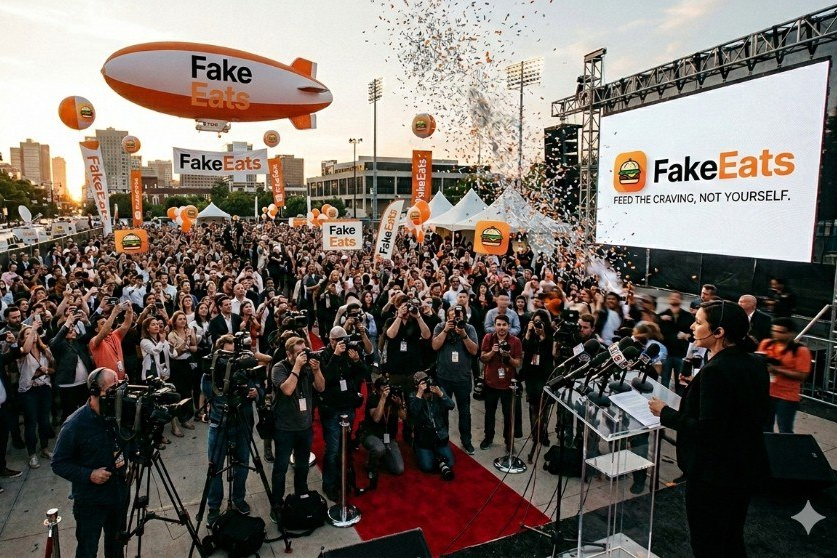
A staged promotional event for “FakeEats”, an app that lets users simulate ordering food without receiving anything, highlighting the growing commercialization of “dopamine shopping.” (Image from the FakeEats press kit)
It’s now been a few weeks since I was breathing smoke from Canadian forest fires, though it looks like this week we’ll be breathing smoke from Idaho and Oregon forest fires. What’s surreal is that while the world burns, we pretend all is well. I worked at my computer each day like I was sitting at a campfire, when in reality the positive feedback loops that are leading to runaway climate change and destabilization of human civilization have already been set in motion.
It’s a stark reminder that we’ll continue to pursue a sense of normalcy for as long as we can (and allow our brains to shift what normal means to extend this sense even further). Worse, corporations will continue to promote a consumer mentality (and we’ll buy into it) for as long as we can, driven by a need to sell more stuff, make more money, and for us consumers, to insulate our little selves from the horrors coming, mentally and physically.
So with that said, I want to share four of the stranger news stories I’ve read this past month. Mostly bad—in the sense that they impede progress toward sustainability, and sometimes surprising, and certainly worth sharing. So here we go:
Upsizing Elders

The first, from The Wall Street Journal, reveals a shift in housing trends in the U.S. Typically, seniors sell their homes and buy a smaller house as they grow older. But that trend is shifting, it seems. Instead, well-off American elders are staying put, even expanding their already gigantic homes to create more space for when their children visit (once or twice a year, most likely in this socially fractured culture).
Instead of selling those homes to larger families, or better yet to an entire ecovillage that sustains itself by converting their yards into yardfarms, these houses stay in the hands of two people, wasting huge amounts of resources. But I get it. My dad wanted to stay in his home—it was his haven—and if he hadn’t died in his 50s, he’d probably still be there in his 70s. (And the increasing value of the property would have justified any additional costs he’d have paid.) One senior interviewed even said, “We’ll downsize when they plant me 6 feet into the ground.” While another, who downsized, was upset because they “struggled to fit an art collection into the new home.” Ultimately, this suggests strongly the need to put serious limits on wealth, as very few people—at least those with excessive means—will make the sustainable choice.
Cultural Conservatism
Now, traveling to Japan and the New York Times, we find the Japanese government’s efforts to reduce energy usage (by setting workplace thermostats to 82 degrees Fahrenheit) to address climate change have faced a surprising impediment. What? Sunehara, or “leg-hair harassment.” Office workers are uncomfortable looking at naked legs in their workplace. Sigh. I don’t even know what to say. The Japanese shorts are below the knee and very conservative, but trying to understand, I guess I’d be disturbed if my colleagues came to work in bikini thongs, so perhaps that’s the equivalent in conservative Japan. But the bigger point: if we can’t make this scale of cultural shift without resistance, is there any hope?
Addiction to Shopping
Now, traveling west to South Korea (or east if you want to burn a lot more fuel), we find consumers shopping on fake shopping apps (via this article in The Washington Post). Ordering meals that will never arrive, luxury goods that won’t cost a dime, but will still give people the dopamine spike that shopping provides—just without the ecological impacts. It’s fascinating: the “dopamine websites,” as they are called, have names like Eumsignman-an-wayo (translating to “Only the food is not coming”). And these aren’t only in South Korea: you can check out Fakeeats.com or Dopahaul.com.
On the one hand, this might be a methadone-type alternative for an addictive behavior, though, on the other, perhaps it just keeps consumers on their phones fake shopping even more than before (knowing there are no consequences).1 As the article notes, until folks understand what they’re “really seeking” when shopping (“comfort, distraction, excitement or a sense of control”), they won’t be able to move beyond, or find better ways to fulfill those needs. (The article mentions calling a friend or going for a walk—I’d only add: getting out in nature!)

Echo Chambers of Denial
Finally, back to the U.S. for perhaps the weirdest trend: an anti-vaxxer dating site, as discussed in the Washington Post. This is the most confusing trend to explore, considering, as the article notes, many of the folks on Unjected.com are “politically independent, spiritual, vegetarian or vegan” (translation: eco-hippy). And some just were afraid of the COVID vaccine development process. But the founder notes she’s on a “divine mission” (not exactly clear what that is, but it seems to be resisting the pharmaceutical industry).
Is this a sustainability issue? It’s certainly a justice issue considering once herd immunity falls below a certain level, those with compromised immune systems (i.e. those who can’t get vaccinated) are at increased risk of getting sick and dying.2 Then again, and I hate to be dystopian here, but this could lead to the depopulation needed to get to sustainability—just in one of the worst ways possible.

But why I included this in the list is the fact that people have become so convinced that a basic life-saving tool is suspect, nay, is dangerous and should be avoided is deeply disturbing. To me, this conveys what a mess the future we’re unleashing will be. Denying climate change, the collapse of ecosystems, even basic public health measures that have been around for 230 years,3 until civilization falls away one piece at a time. At least in that case, the large Boomer homes will be available to house refugee communities from Florida, fake shopping sites will offer a bit of nostalgia for those who can no longer find food in their local grocery stores, and well, no one will probably be wearing shorts as they’ll be working in fields not offices, tending crops under the blazing hot sun (and will have to protect their legs from UV rays, mosquitoes and ticks).4 But in the meantime, we’re gonna keep watching the absurd addiction to consumerism grow and morph as both an acceleration of and reaction to the growing geopolitical and ecological chaos we’re experiencing. Fun!
Endnotes
- It reminds me of giving fake babies to dementia patients, who then care for them like real babies. That may be a good therapeutic intervention in that case, but for rational adults? Perhaps pacifying them in this way is infantilizing.
- While the app was created (as others were) for those against the COVID vaccine specifically, it seems it’s expanded to a broader anti-vax platform, with the website noting that “we do not support vaccination of any kind.”
- 1796: Dr. Edward Jenner inoculates a boy with cowpox to keep him safe from smallpox—and it worked. Hence, where we get the term vaccine, from vacca (cow). Wow! That assumes this fake news website, the World Health Organization, can be trusted! (Yes, of course I’m joking.)
- Which will have worsened due to climate change.



Comments
Welcome to the new Resillience commenting system!
We have moved from the former Disqus commenting system to a new system as of September 10, 2026.
We made this change because of privacy concerns regarding Disqus. It's also part of a set of changes to bring more services to the Resilience community under a single login: commenting, (coming September 2026), and online courses (coming 2027). Unfortunately, your old Disqus comments may not reliably link to your account in this new system. Please contact us if you have any questions or concerns.
My question is whether these are all serious trends, or just a phenomenon where somebody knew two well-off older couples who were upsizing, for example.
Though reducing environmental impact is a necessity for a move to sustainability, I think this article again misunderstands sustainability (which is sad given that Richard Heinberg laid out the rules in his Five Axioms of Sustainability). If our society is based on use of non-renewable resources (it is) then it will always be unsustainable, no matter how many people we squeeze into a mansion, no matter how many office workers wear skimpy clothes.
The barrier to sustainability is that no-one wants to live in a way that is sustainable (the only one proven to work so far is hunting and gathering). Efforts to reduce our impact are really just efforts to keep the unsustainable going for longer.