

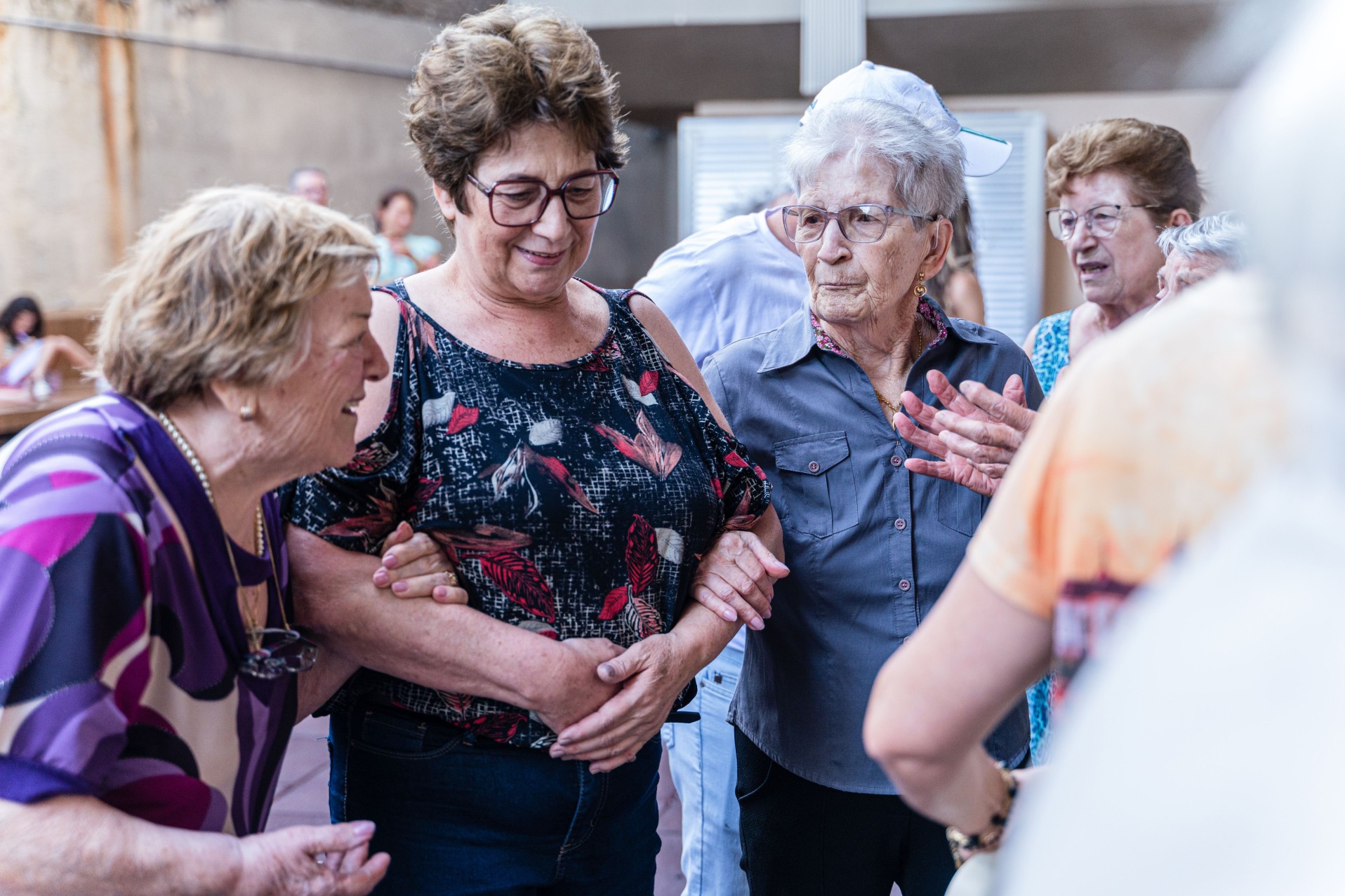
Trigger warning: slightly offensive slang. Fifteen years ago, I used a term for a committee we formed to grow our local food system. I called us the “fat-bottomed (cause I have one) middle-aged women (cause I was one) who run the world” (FBMAW) – the older women who volunteer for committees, organize groups, answer phones, facilitate meetings, run events, see what’s needed and act. You could call us matriarchs, and we, FBMAW, are everywhere.
Two weeks ago, at a three-day celebration of community resilience, ThrivingFest, I looked around the auditorium and on the stage. There we were. The FBMAW, staffing and volunteering with the organizations featured in dozens of films that together make a “thriving community.”
Yes, other ages, genders and body types were present but in fact, it looked to me like a festival of matriarchs.
The Thriving Communities Project History
Fifteen years ago, the executive director of the Whidbey Institute, Jerry Millhon, met with one of our matriarchs, Lynn Willeford, to feature our community in short films about the organizations nurturing our well-being.
The project, Thriving Communities, asked, “What makes a community thrive and what makes a thriving community?” Its motto: Common people doing uncommon work for the common good.
Each year we explored a different aspect of thriving – nourishment, farming, land, business, caring for elders, housing and more. Sixty films and 15 years later, at ThrivingFest, we watched the films, listened to panels and asked, “what’s next for thrivingness here?”
While it can feel pretty self-congratulatory here on Whidbey with how amazing the community is, there does seem to be a secret sauce for a whole village thriving – with no one person in charge but many people getting up and doing what needs to be done.
Community Matriarchs
Lynn Willeford and Nancy Nordhoff were two such women. We used the occasion of the festival to celebrate these two beloved matriarchs. Lynn died during the pandemic, and we’d never had a celebration of life. Nancy died this year.
Why do I call these two women matriarchs? According to the Cambridge Dictionary, “a matriarch is the female leader of a (family or) society in which power passes from mother to daughter (or younger people)”. It’s an older woman who assumes leadership but cultivates the next leaders.
Lynn, who died five years ago, was a grounded, no-nonsense, get-it-done woman who, in addition to helping launch Thriving Communities, started multiple neighbor-helping-neighbor organizations: Hearts and Hammers, an annual work day during which hundreds of people fan out to dozens of homes where elders can no longer patch their roof, fix the deck or beat back the blackberries; Friends of Friends, which raises money to help with medical bills, particularly the cost of ferries off the island to doctors on the mainland, South Whidbey at Home, a mutual aid network helping us age in place, and the Whidbey Island Local Lending network, which connects people with money to invest to local businesses needing a loan. I was a collaborator on some of these. Lynn kept it simple and assigned anyone within earshot to roles so she could step back quickly.
Nancy was a very down-to-earth philanthropist who, through her organization, Goosefoot Community Fund, built physical and social infrastructure for community resilience. She bought up the land and buildings at one of the prime intersections on our long skinny island, restored old buildings with reused lumber, and upgraded the grocery store that’s a marriage of a for-profit and non-profit and raises tens of thousands for local organizations. But that was just the visible part of Nancy. If you had a project and had your head screwed on straight and a plan, Nan might donate at a scale that could truly make a difference. Most of the essential Island institutions have benefited from her pragmatic and visionary largesse. When she died earlier this year, she said, “I’ve done my job. Now you do yours.”
What are the keys to thriving other than respected, benevolent women who lead but don’t dominate?
Thriving Communities and Blue Zones?
Over the weekend, I wondered whether thriving communities are actually Blue Zones, or where the overlap is.
Blue Zones, a term coined by National Geographic Explorer and Fellow Dan Buettner, are regions around the world where people live exceptionally long, healthy lives. His research team identified five such regions and nine lifestyle habits they believe contribute to this longevity:
- Keeping the body moving.
- Having a sense of purpose.
- Shedding stress.
- Eating enough but not too much.
- Eating food, mostly plants, as Michael Pollan said.
- Drinking a spritz of spirits daily.
- Belonging (All but five of the 263 centenarians they interviewed belonged to some faith-based community).
- Mutual (intergenerational) aid.
- Long-time friends and social circles.
Is South Whidbey a blue zone? Or is it something similar but different – a community that thrives, not just a place where people tend to live a long time.
Thriving doesn’t come easily in our fragmented society. Under political and environmental siege, shedding stress itself needs to be an intentional daily activity! Perhaps it’s sipping a glass of wine with friends at a weekly dinner party group, at a church event or over dinner with your big “fat” greek/jewish/italian/intentional family.
The Secret Sauce of Thriving Communities?
What makes a village live long and prosper? We marvel at European cities thousands of years old. We see Indigenous tribes living in landscapes that give them everything they need from time immemorial, until the settlers come.
I’m curious if there’s a pattern worth noticing. For South Whidbey, I suspect four elements.
In short, I’d say it’s village longevity or cultural longevity, not just a static backdrop for personal longevity.
- Generations of people in community, solving problems together, with shared stories and landscapes. When I arrived here in 2005, I felt like I’d had the good fortune to arrive in a vibrant small town with a hundred-year history. Trying to describe it, I said, “It feels like high school”, that is, different kinds of people, living in the same place, going through changes and crises, for generations. You could say I am at least a 6th-generation South Whidbey settler. I didn’t belong here just because I rented and then bought a place to live. I have come to belong (at 20 years I’m still a newbie) through respect, humility and participation in making life here better
- Elders who transmit culture, ensuring that those who follow embody its spirit and traditions and are supported as they forge their own paths. In time, they become their generation’s leaders and elders, creating new cultural expressions rooted in enduring social and political patterns.
- Traditions open to everyone. Our parades include the Whidbey Island Fair, Gay Pride, the Fourth of July, and Welcome the Whales. We gather for the fair, music festivals, street dances, farmers markets, the Rhododendron Festival, garden and artist studio tours, Penn Cove Indigenous People’s Day, the annual choir concert and performances at music venues across the island. There is always something happening. When I first arrived, I was thrilled to live in a place with traditions I could become part of.
- Creativity. I don’t know if this is the right word for anyone with a good idea to try, with community support. Generative? Without novelty, a community could cease to thrive because of the weight of deeply entrenched traditions or expectations.
(Update: Post publication, two other models, one created by The Rippel Foundation and the other by North Sound Accountable Community of Health, were sent to me from a reader).
While we are a wet-behind-the-ears town compared to, say, London, we have enough longevity to have established a culture of mutual aid, of tolerance, of service, of belonging, of giving back, of civility and of creativity (so many creative artists of all sorts). A hundred years ago the mayor, Helen Coe, and entire city council of my village were women. These matriarchs cleaned the town up, imposed order, doled out fines and generally set a standard that seems to have held.

When you have elders who both support from the sidelines and inspire when they step into the center, and when each generation has support from prior generations to rise to this level of practical service with humility and a sense of humor, you may be in a thriving community blue zone. When these elders model and encourage participation, mutual aid, sufficiency of food and housing and well-being, and you all cherish the abundant natural world and want to protect it (for hunting or foraging or hiking or just quiet), then there’s a collective creation called a thriving community. No one runs it, owns it, or defines it – we all participate in belonging to a community of people doing our best to live well and love others.
Like a Blue Zone, a thriving community might measure success through longevity. But while a Blue Zone extends individual lives, a thriving community sustains the life of the community itself. Is there a road map for creating such a village? I am going to keep pondering what I saw at ThrivingFest, what makes a thriving community, and whether writing about it is one way I can get up and do what needs to be done.





Comments
We changed commenting systems on September 10, 2026 as part of a site-wide functionality and security upgrade. Your past comments have not disappeared, and you can still log in with your old Disqus account credentials if you wish. Contact us with any questions.