

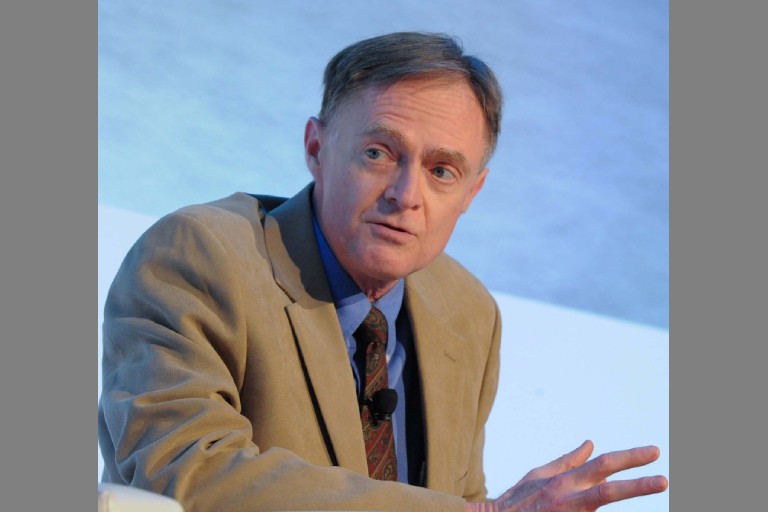
We were deeply saddened to learn of the death of Richard Heinberg last week. Over the course of his life, Richard became one of the clearest and steadiest voices addressing fossil-fuel dependence, ecological limits, and the cultural changes required to build a more resilient world.
In remembrance, we are returning to a lecture Richard delivered for the Schumacher Center in October 2006 at the 26th Annual E.F. Schumacher Lecture.
Written in the context of the peak-oil debates of the early 2000s, the lecture analyzes the prevailing food system—one made more productive but also more vulnerable by cheap energy, mechanization, long-distance transport, and centralization. Richard identifies four converging pressures on that system: fossil-fuel depletion, the declining number of farmers, freshwater scarcity, and an increasingly unstable climate.
As he writes:
“Modern industrial agriculture has been described as a method of using soil to turn petroleum and gas into food. We use natural gas to make fertilizer and oil in order to fuel farm machinery as well as to power irrigation pumps, as a feedstock for pesticides and herbicides, in the maintenance of animal operations, in crop storage and drying, and for transportation of farm inputs and outputs.
Approximately 1,500 liters (350 gallons) of oil equivalents are required to feed each person in the United States each year, and every calorie of food produced requires on average ten calories of fossil-fuel inputs. This is a food system profoundly vulnerable, at every level, to fuel shortages and skyrocketing prices.”
Richard’s response is not to call for new technologies capable of preserving the existing system. Instead, he asks whether agriculture might be intentionally de-industrialized—drawing upon ecological knowledge, traditional farming practices, and forms of production organized around local needs.
“I believe we must and can de-industrialize agriculture. The general outline of what I mean by de-industrialization is simple enough: this would imply a radical reduction of fossil-fuel inputs to agriculture accompanied by an increase in labor inputs and a reduction of transport, with production being devoted primarily to local consumption.
Once again, fossil-fuel depletion almost ensures that this will happen, but at the same time it is fairly obvious that if we don’t plan for de-industrialization, the result could be catastrophic.”
The lecture looks to Cuba’s response to the loss of Soviet oil, the victory gardens of the World Wars, and the development of permaculture and biointensive farming as examples of how food production might become more localized, labor-intensive, and ecologically grounded.
At the core of Richard’s “Fifty Million Farmers” proposal is the realization that many more people will need to participate in growing food.
“One way or another, re-ruralization will be the dominant social trend of the twenty-first century. Thirty or forty years from now—again, one way or another—we will see a more historically normal ratio of rural to urban population, with the majority once again living in small farming communities. More food will be produced in cities than is the case today, but cities will be smaller.
Millions more people than today will live in the countryside growing food although they won’t be doing so the way farmers do it today and perhaps not the way farmers did it in 1900.”
For Richard, this transition is not solely a matter of ecological or economic data. It represents an opportunity to rebuild local culture, restore democratic participation, and strengthen small communities.
The lecture culminates in a call to view ecological necessity not merely as a constraint, but as an invitation to imagine a different civilization:
“Rather than consigning ourselves to that fate, let us accept the current challenge—the next great energy transition—as an opportunity not to vainly try to preserve business as usual, the American Way of Life that we are told is not up for negotiation, but rather to re-imagine human culture from the ground up, using our intelligence and our passion for the welfare of coming generations and for the integrity of nature’s web as our primary guides.”
Richard’s writing never minimized the severity of the challenges before us, but neither did it surrender to hopelessness. Again and again, he insisted that another path could be imagined and designed—one based on ecological understanding, community-based economics, and a renewed culture of commoning.
Read the full lecture here.
We extend our deepest condolences to Richard’s family, friends, and colleagues at the Post Carbon Institute, and join the many people around the world mourning his loss.
We would love to hear from you. You can share your remembrances of Richard here.





Comments
We changed commenting systems on September 10, 2026 as part of a site-wide functionality and security upgrade. Your past comments have not disappeared, and you can still log in with your old Disqus account credentials if you wish. Contact us with any questions.