

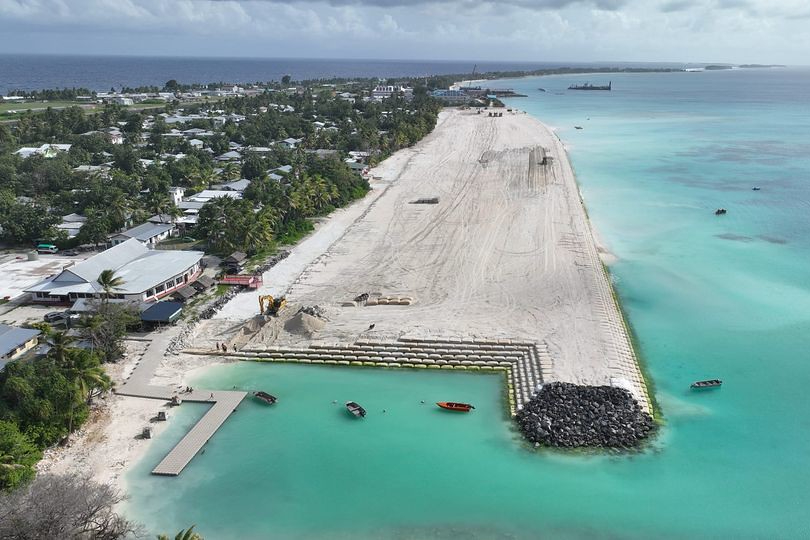
In 2025, Australia offered the world’s first ‘climate refugee’ visas to the citizens of Tuvalu—an island at almost certain risk of sinking beneath the waves in the not-so-distant future. Indeed, two of the archipelago’s nine islands are already nearly submerged, so it’s not exactly a theoretical concern. All the available visas for this scheme were snapped up within four days, with over 3,000 people (a third of the population) applying for the 280 visas available. Australia intends to release the same number of visas annually, but if the current pace of visa releases is maintained, then Tuvalu will be largely submerged long before the entire population has evacuated.
This process is a difficult one for the Tuvalu government to navigate. A rich, wealthy nation taking in your displaced citizens saves the cost of relocating them from their sinking, eroding, and salinising homes yourself. Assuming, of course, there’s any more high ground for you to move them to in the first place—Tuvalu is only 25 square kilometers, and never more than two meters above sea level. Yet to accept these visas is, in one respect, openly abetting the dissolution of your nation. Naturally, the government of Tuvalu does not intend to simply wind itself down and let its sovereignty and the unique Polynesian culture they represent wash away in the rising waves. Plans, involving measures such as coastal resilience infrastructure, ‘Land raising’, and reclaimed islands (which have already achieved limited success), are the main plan of action. But it’s unclear how realistic these are in the long term, with Tuvalu’s own Long Term Adaptation Plan cautioning that such a programme is impossible to conduct with their own resources. These interventions will be costly, require outside support, and attain dubious results. The Tuvalu Coastal Adaptation Project, for example, is projected to cost 50% more than the economic damages it will help avoid over the next 40 years. Protecting Tuvalu is, even in their own telling, a money sink with little hope of long-term success.
Plan B is to become a landless nation, supported by the climate reparations of the major emitters that cause this mess, and to shift their focus from territorial stewardship to maintaining their culture and its people in their permanent exile. Various efforts, such as creating a ‘digital twin’ of their island, have been undertaken in this vein, all aimed at the as-yet-unattempted challenge of administering a landless nation-state.
All this raises the uncomfortable question: At what point will climate change start to drive states out of their national territories, and can they exist in permanent exile? This is a pressing and immediate priority for small, low-lying island nations, but in the deserts, the high Arctic, and other vulnerable regions of the Earth, the same questions will play out again and again over the coming decades.
An AOSIS or a mirage?
This is not a new challenge for small island developing states (SIDS). They have been staring down the barrel for a long time and, crucially, they have been planning.
In 2015, during the Paris Agreement negotiations—coming not long after the debacle of the Copenhagen Accord, a weak, opaquely constructed agreement with little force behind it—emerged a powerful bloc: the Alliance of Small Island States (AOSIS). This group, which included Tuvalu, represented a collection of nations that were individually politically inconsequential and climatically vulnerable. But combined, the system of ‘one nation one vote’ allowed them to wield significant power, even without the same political might or army of lobbyists and diplomats as China, the US, and European nations.
AOSIS had one major demand: 1.5°C. “1.5 to stay alive” became the catchy logo and chorus of a popular Soca hit. The previous Copenhagen Accord had been based on limiting warming to ‘no higher than 2°C’—because, it was assumed, this was a safe level. Newer research has shown that anything above 1.5°C—and the sea-level rise and hurricanes it promises—is a virtual death sentence for much of AOSIS. So they were determined, negotiating fiercely, presenting compelling moral arguments to those who’d listen, cutting deals where they could.
But the overall strategy of AOSIS was more comprehensive—and considerably more farsighted—than the surface agreement implied.
The AOSIS diplomats were not naive; they knew that an agreement alone was not likely to compel the world’s most powerful petrostates to turn off the taps in time. In this, they were pretty prescient—with no targets on track, the carbon budget due to be exhausted in a “matter of months”, and the world’s second-highest emitter twice pulling out of the Paris Agreement. But by having agreed to the principle of 1.5°C, signatory nations were theoretically liable for the results of their failure, and could be legally compelled to pay reparations when they fell short.
In other words, the Paris Agreement was not only a climate accord for AOSIS but also the opening move in a longer legal and financial strategy. One aimed, ultimately, at securing their nations’ survival beyond their own coastlines.
We might be seeing this process mature now. After a proposal by legal students in small island states, a 2025 advisory decision by the International Court of Justice (ICJ) ruled that countries can sue each other for their emissions and related damages. Obviously, this concept of wealthier nations paying poorer ones out of moral and legal obligation seems ever more remote given the current multipolar shift—and the ICJ ruling is non-binding, after all. The ruling might, in retrospect, be seen as the high-water mark of multilateralism.
Nevertheless, for AOSIS, reparations likely had a deeper motive than moral restitution and adaptation alone: they could provide the financial basis for the continued existence of extraterritorial states once their landmasses became unviable, uninhabitable, or simply ceased to exist. Tuvalu is, I think it is worth reiterating here, expected to be 95% submerged by 2100 even under more optimistic scenarios. The Paris Agreement, read this way, was not just a climate deal. It was, perhaps, the first constitution of a post-territorial future.
If Tuvalu and others can claim climate reparations, it might be a lifeline—assuming anyone pays up. But would it be enough? Regardless of the financial resources, is it even possible to maintain a non-territorial state?
Stateless, not nationless
Tuvalu’s proposal to run a non-territorial—or post-territorial—state is a radical one. There are some governments currently that don’t have territorial states—the Burmese National Unity Government (NUG), for example—but none I could find (aside from the actual Knights Hospitaller) that don’t at least claim a territorial basis. And even here, post-territorial island nations might not intend to wholly give up their claims to the submerged lands, with the potential riches (and ecological catastrophe) of expensive polymetallic nodules sitting on the ocean floors around them. These nodules contain the critical minerals that are being so vehemently fought over for the twin energy and digital transitions.
The structural conditions for post-territorial statehood, while novel, are not entirely without foundation. We are entering a time of non-traditional governance arrangements—a period where the spaces between multipolar spheres are allowing alternatives to traditional state structures to exist, if not necessarily thrive. And a time when disaggregated digital culture and politics are more immediate and formative for many people than real, territorial experiences. Technology in this space is, for better or worse, only going to accelerate, providing post-territorial nations like future Tuvalu with the technical architecture for their continued existence.
But the range of outcomes here is wide, and the conditions matter enormously. The fracture zones of a multipolar world open up new governance possibilities, but these are often Islamic theocracies, ethnocidal chiefdoms, narco-statelets, or permanently embattled quasi-anarchistic communes. The same goes for new digital infrastructure, which offers the possibility of post-territorial states, but it also promises brainrot and cyberpunk techno-feudalism. In one sense, the most dangerous place for a nation to exist is online, replete as it is with post-human death cults, authoritarian oligarchies, and digital marauders.
Which brings us to the question of what, in its lowest and most ignominious possible form, post-territoriality can look like.
The Manchurian option
When Manchukuo collapsed through combined Soviet and Chinese invasions (and internal revolts), no one mourned its passing or gave it a second thought. Apart from, that is, the people who’d thrown in their lot with its state apparatus—those that escaped and weren’t shot, anyway. Because the government-in-exile of Manchukuo still, remarkably, exists in 2026. It’s just a few aged Sino-Japanese ‘statesmen’ who maintain a website mainly dedicated to Manchurian history and culture. But not much more. In fact, the biggest political splash it’s made in the past 80 years has been the bemused ‘rediscovery’ of it by people on Twitter. The government of Manchukuo is a forgotten remnant of an unloved and shameful nation that had no right to exist in the first place. A pathetic reminder of how low a post-territorial state can go. Proving that just ‘existing’ is not enough for a national government once its territory is irrevocably gone. If it is not wanted, relevant, or provides some future for the people it represents, the lot of post-territorial governments is to become retirement clubs for an incredibly niche subsection of international relations scholars.
So, how could Tuvalu avoid this outcome? Reparations as the basis of a post-territorial state budget is a perfectly legitimate (and arguably moral) aim, but how feasible is it?
Look at nations with similarly large proportions of their state expenditure funded by international aid: pre-Taliban Afghanistan, Somalia, and the Democratic Republic of the Congo (DRC). Hardly a list of thriving utopias. Now, to be fair, they had other intractable issues driving their dysfunction, but if your entire sovereign territory being underwater or uninhabitable isn’t ‘intractable’, then I don’t know what is.
And, let’s not be coy about it, international developmental assistance could well be in its death throes. The US Agency for International Development (USAID) was effectively killed, the UK dropped many commitments to climate aid, and in 2025, global development assistance fell by 23%—the largest annual drop ever recorded, taking it back to 2015 levels. Germany became the world’s biggest donor, not through generosity, but because the US reduced its own output by 57%. The Organisation for Economic Co-operation and Development (OECD) projects a further decline in 2026.
So, even if high and historic polluting nations are found liable for damages, will they pay? This is not only a question of uncooperative, nation-centric administrations, but also one of electorates.
Speaking from the UK, this feels particularly stark. Major debt, institutional crisis, economic stagnation, and an electorate who feel both squeezed and underserved. They are already flooding to nationalist and populist parties (left and right), and so the commitment to send money to support a post-territorial nation—when there are already major political tropes about foreigners free riding the system—feels like a political non-starter for crisis-enveloped incumbents. This is also all before we consider that those same climate impacts, drowning SIDS will (though not nearly as totally) also be wracking the potential payee states. Australia, cast as a benevolent benefactor in the Tuvalu story, conducted a climate security assessment so dire its results were hidden from the public.
I think similar lines of logic apply to the potential critical minerals nodules lying within the Exclusive Economic Zones (EEZ) of these small island states. If the governments, which ‘own’ these minerals are not physically situated on the island that ‘controls’ these waters, and prove nothing but legal obstacles—to which, say it again, the powerful, extracting nations are paying increasingly mumbled lip service to—then the likelihood of post-territorial nations availing themselves of this potential wealth to fund their activities seems slim.
Administering the diaspora
I’m not here to say what a small Island state facing post-territoriality should or should not do. But the challenge, as much as it is to secure funding for this future, must be to present a vision of that future to the people they ostensibly represent and govern. Could this be cultural preservation and adaptation? Representing a parallel legal status to their host nations? Or something new and entirely different?
Constantly offering something will be the key to any enduring paradigm. Any reparations or resource-based income—no matter how realistic—is unlikely to represent an enduring paradigm in a chaotic climate and geopolitical future. Nauru, whose one-time phosphate windfall once gave it one of the highest per-capita incomes in the world, knows that small island states are not averse to squandering resource bonanzas. Nauru is, not coincidentally, now betting big on reaping the benefits of its oceans’ polymetallic nodules.
Hopefully, any resource or reparations finance provides the bridging loan towards their next iteration of statehood. A midwife for whatever is struggling to be born, if you will. Material support from their own constituents—taxation, effectively—will probably be the only way forward long-term. But they will need to justify this ask to this total diaspora, who will probably also be paying tax in their host nations. A world in overshoot of 1.5°C is neither safe nor stable. The compounding crises may finally scatter the SIDS diaspora further and further from the sovereign entities they are ostentatiously part of—and risk the ignominious fate of their governments fading in relevance, influence, and actuality, only being ‘rediscovered’ in the latter century by bemused Twitter scrollers going ‘hey, did you know the government of Tuvalu still technically exists?’
But I don’t think this is their fate. If AOSIS showed anything, it’s that small island states are well ahead of the curve on grappling with the existentiality of the climate crisis, and can punch well above their weight diplomatically. And the disruptions of an overshoot world may well be turned to advantage. If post-territorial states can foster diaspora cohesion and act as nodes of mutual support—in business, health, accommodation, and so forth—they may even give their constituents a competitive advantage in a world where polarisation and isolation are becoming such debilitating issues. Perhaps they can even coordinate the economic specialisation of their entire ethnic group, slotting themselves into some critical juncture of their host economy and providing an enduring fiscal basis for post-territorial statehood.
Under current climate trajectories, many small island states (and perhaps other states) will sink or otherwise become uninhabitable. This is not a question. What is up for debate is how they approach what comes next. Will they successfully navigate the unfamiliar terrain of post-territoriality, or tumble into the same ignominious obscurity as Manchukuo?
An earlier version of this article was published in The Geopolitical Climate.



Comments
We changed commenting systems on September 10, 2026 as part of a site-wide functionality and security upgrade. Your past comments have not disappeared, and you can still log in with your old Disqus account credentials if you wish. Contact us with any questions.