


Civilisations rarely unravel in a single event. More often they are worn down slowly, through adaptations that once made sense and later became impossible to sustain.
Something like this is happening now.
Across much of the developed world, people report exhaustion that resists rest, illness without clear cause and a persistent sense that ordinary life asks for more than it returns. These are usually framed as personal difficulties, described in the language of stress or individual limitation.
A longer view suggests something else.
The human body is registering conditions it was never shaped to endure.
This analysis traces dynamics that shaped Western industrial societies where these patterns reached their most developed form.
When life was still legible
For most of human history, survival depended on proximity.
Human nervous systems developed inside small groups, embedded in land, weather, animals, seasons and one another. Sensation carried information that mattered immediately. Hunger shaped movement. Fear sharpened attention. Fatigue organised rest. Grief slowed the group when something essential had been lost.
In those times, emotion functioned as a signal rather than pathology. Anger marked the edge of what mattered, sadness registered loss, desire oriented attention toward what sustained life. These responses lived in the body and were acted upon quickly because ignoring them carried consequences.
Feedback loops stayed short while action and outcome remained close together. A person tracked an animal, felt hunger sharpen, brought food back, ate and rested — the gap between effort and result rarely exceeded a day. Cause and effect stayed within view.
Power emerged locally and temporarily, taken up for protection or coordination and released again once the moment passed. Authority stayed fluid because relationships endured beyond any single decision. You had to keep living with the people you led.
Story and ritual processed uncertainty collectively, allowing fear, loss and change to move through bodies together rather than becoming isolated burdens. Regulation happened through rhythm, repetition and physical presence.
From the perspective of nervous system functioning, these conditions supported coherence. Life demanded effort and often ended early through violence, disease or starvation, yet people could still read what their bodies were telling them.
Surplus and the stabilisation of power
In the societies that would become the modern West, agriculture altered these conditions in ways that continue to shape the present.

The Harvesters (1565), Pieter Bruegel the Elder By Pieter Brueghel the Elder – Google Arts & Culture — PAH1oMZ5dGBkxg, Public Domain, https://commons.wikimedia.org/w/index.php?curid=22554956
Surplus allowed storage, and storage enabled ownership — the capacity for some to claim resources as exclusively theirs and control who could access them. This was the birth of hierarchy, creating the first structural divisions between those who controlled surplus and those who depended on access to it, as power shifted from coordinating people to controlling what they needed to survive.
Land became leverage and access to food became conditional, allowing hierarchy to stabilise and harden. Distance entered the system for the first time, both physical and psychological, separating those who controlled resources from those who depended on them.
This stabilisation of power later crystallised in feudal lordships and hereditary monarchies, where control became permanent, extraction became generational and defended structures emerged to protect accumulated advantage.
These changes supported permanence, scale and complexity while thinning collective care, shifting survival from shared coordination toward controlled distribution where endurance replaced agency for many.
Inequality ceased to be situational and became structural as authority accumulated upward and stayed there. Those beneath adapted by adjusting their nervous systems to the conditions required for survival.
The adaptation worked, but it carried cost.
Time, labour and the sidelining of the body
Industrialisation intensified this separation.
Work moved away from home and community, time fragmented into units that could be sold, schedules replaced seasons and the body’s rhythms lost authority to the clock.
This pattern of strained relational presence had begun centuries earlier when agricultural hierarchies demanded that leaders and labourers alike prioritise surplus and control over sustained emotional availability. The increasing load on adults gradually reduced the attunement and care that small-group life had made possible, passing a subtle but accumulating strain across generations.
As parents became pressed by factory demands, children adapted early: vigilance earned praise, self-containment looked like maturity and independence was read as strength. Many learned to hold themselves together long before conditions supported it.
These adaptations enabled productivity to rise and systems to scale while training the body to override discomfort in order to remain functional.
Population as defended system
The most rapid population growth in human history followed the same logic, surging from roughly one billion in 1800 to 1.6 billion by 1900, then exploding to over six billion by 2000.
More bodies meant more labour could be extracted, more surplus accumulated, more complex hierarchy sustained, and more hierarchy required more bodies to perpetuate it.
A pattern emerged, whether through deliberate policy or accumulated self-interest: abundance of humans served accumulation, while material scarcity maintained for each individual — regardless of overall population size — served control through unequal distribution. Large populations normalised scarcity for individuals, which normalised endurance, which enabled further extraction.
The pattern mirrors what ecologists call overshoot — when a population exceeds its environment’s carrying capacity by consuming resources faster than they regenerate. Just as a body pushed past its limits eventually collapses from exhaustion, populations and their ecosystems reach thresholds where continuation becomes impossible. The 1972 study Limits to Growth modelled this dynamic at planetary scale, showing exponential demands on finite systems produce eventual contraction regardless of technological optimism.
Extraction as an organising principle
Late capitalism extends these dynamics further.
Work expands beyond time and labour to include attention, which becomes another commodity to be harvested, measured and monetised. Emotional regulation becomes an expectation built into job descriptions that never name it, and cognitive capacity joins the expanding list of resources employment assumes unlimited access to.
These demands often go unnamed, which is part of how they function. They feel ambient and continuous, shaping behaviour without requiring explicit consent. Boundaries blur as work seeps into evening hours through devices that never fully switch off, and recovery gets postponed indefinitely.
Burnout follows with striking consistency, especially among those tasked with holding coherence together. Women carry a disproportionate amount of this load, serving as emotional regulators for families, organisations and communities — absorbing volatility, smoothing conflict and translating pressure into continuity.
This labour remains largely invisible because the system depends on it flowing freely, unacknowledged and therefore uncompensated.
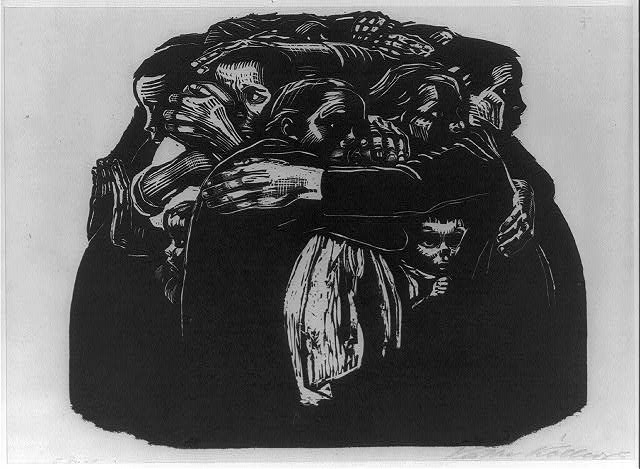
Die Mütter [The Mothers], Käthe Kollwitz, 1922, woodcut, Library of Congress
Bodies adapt again. Sensation narrows as signals become inconvenient. Endurance, once a survival response, becomes cultural currency — praised and mistaken for strength.
Systems under strain behave like braced nervous systems
Under sustained pressure, nervous systems tighten. Control increases. Speed accelerates. Accumulation intensifies. Flexibility declines.
Large systems follow the same pattern: as ecological, social and economic conditions grow less predictable, institutions double down on the behaviours that once delivered stability, demanding more output from diminishing reserves while offering less in return.
Studying collapsed civilisations from Rome to the Maya, Joseph Tainter observed that complexity increases to solve problems until maintaining complexity itself becomes the primary problem. Diminishing returns set in. The cost of problem-solving exceeds what the system can generate.
At the institutional level, this operates exactly as it does in bodies under sustained threat: meetings proliferate when trust erodes, surveillance increases when control feels uncertain, demands for speed intensify when outcomes seem unstable. The tightening looks like strength but registers as fragility.
What makes a system defended
A defended system is one whose continuation requires suppression of signals that would otherwise halt it. What characterises defended systems is the wholesale suppression of signals rather than engagement with them.
Material conditions that demanded extraction — agricultural surplus, industrial production, late capitalist competition — favoured suppression at every level. Systems organised around override. Individuals who could override limits thrived within them. Over centuries, institutions and the people who run them co-evolved under the same selective pressure: both learned to function through signal suppression. The system reproduces in everyone required to function within it the same pattern it depends upon.
This explains behaviours that seem irrational from outside: why companies prioritise quarterly returns over long-term viability and why economies require infinite growth on a finite planet.
Collapse as root mechanism
Those who rise to lead extractive systems are often those whose own functioning depends on not registering costs. Positions that require the most override tend to be occupied by people most capable of override. The feedback that would trigger course correction cannot be received by those positioned to act on it.
Alongside institutional tightening, a different response emerged from people whose nervous systems had not adapted as thoroughly to defended functioning. Those who retained greater relational capacity began registering the structural cost. Participation felt increasingly hollow, the effort to maintain appearances rose steadily.
A quiet question has surfaced, often without language: what is the purpose of continuing to stabilise arrangements that cannot reciprocate, repair or rest?
Collapse appears less as a future event and more as a condition already underway — a system operating beyond the limits of what human bodies and ecosystems can carry.
This may be the mechanism itself.
Other analyses trace collapse to resource depletion, climate tipping points or rising costs of complexity. These are real — topsoil erosion, aquifer depletion, and atmospheric carbon concentrations now exceed thresholds that enable the stability systems depend upon. They are also consequences of the pattern described here.
Technologies that accelerate abstraction and override, including AI, compress the timeline, making the underlying pattern harder to ignore.
Systems that require bodies to override their signals in order to function will extract without limit. Pause would mean attending to what has been suppressed. Attending would mean acknowledging cost, which would threaten the arrangement.
This is why defended systems accelerate even as conditions worsen. Collapse becomes inevitable not when resources run out, but when the suppression required to keep extracting exceeds what bodies can maintain.
Double binds and the exhaustion of clarity
Many people wonder why understanding fails to free them. The answer lies in double binds.
A double bind arises when every option carries loss and the system refuses to acknowledge that loss. Choice remains mandatory while penalty follows regardless.
Participate, and values erode.
Withdraw, and income or belonging falters.
Speak up, and polarisation intensifies.
Remain quiet, and harm continues.
These conditions exhaust rather than mobilise, trapping energy and converting awareness into fatigue.
The temporal bind deserves particular attention. Many professionals operate on the logic: “I’ll do this extractive work until I can afford to stop.” But conditions deteriorate faster than savings accumulate. The exit point keeps receding. Meanwhile, the body continues filing reports — override layered on override.
Trauma therapist Deb Dana, translating polyvagal theory into everyday experience, describes the state many now inhabit: dorsal vagal shutdown. Neither fighting nor fleeing, the nervous system chooses immobilisation. Energy withdraws and connection becomes effortful. What appears as apathy is a protective response to chronic impossible situations.
Endurance becomes framed as maturity. Adaptation receives praise. Responsibility individualises. The system remains untouched.
Hopelessness, in this context, reflects accurate perception rather than personal weakness.
The body as the suppressed witness
Something essential had to be overridden for this arrangement to persist. The human body, once a primary source of orientation, became inconvenient.
Participation increasingly requires ignoring internal signals. Fatigue is managed, anger contained, grief postponed. Function continues even when sensation registers misalignment.
This training proved effective. It allowed survival inside structures unable to accommodate human limits.
It also left traces.
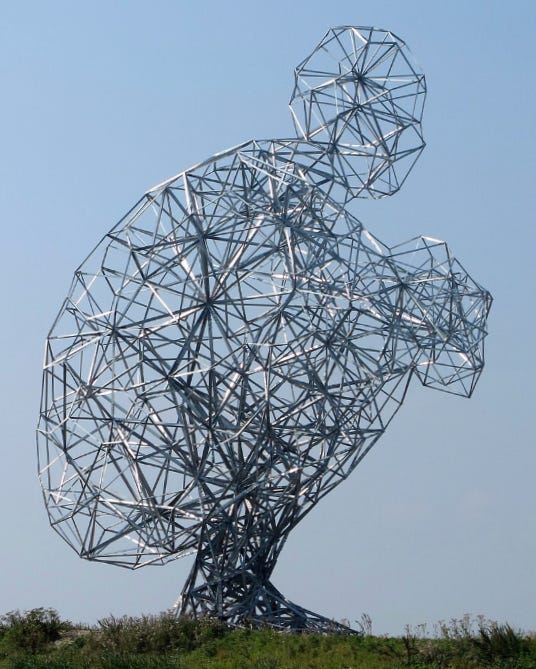
Sculpture Exposure (2010) by Antony Gormley in Lelystad/The Netherlands. By Herman Verheij, CC BY-SA 3.0, https://commons.wikimedia.org/w/index.php?curid=12638426
Trauma researcher Bessel van der Kolk documented how bodies encode what consciousness cannot process. Suppressed experience doesn’t vanish — it manifests in tissue, nervous system and immune function. When signals cannot be acted on repeatedly, the nervous system braces. Vigilance rises. Sensation dulls. Over time, numbness appears.
Rising rates of chronic illness, autoimmune conditions and diffuse pain lose some of their mystery from this perspective. The issue was never resilience. The issue was carrying impossible demands that never got resolved.
Time as constraint
These shifts unfolded across centuries. They do not unwind quickly.
Nervous systems adapt over generations. Reorientation moves at the pace of safety, trust and lived experience.
The delay between cause and effect obscures the pattern.
Suppression learned in childhood may remain adaptive for decades, with its cost appearing later under sustained strain. Extraction that began in the nineteenth century now registers as climate crisis. Systems that override signals for centuries can appear functional, until they fail rapidly rather than gradually.
This lag generates false confidence while harm accumulates out of sight, building toward the threshold where everything maintained through effort comes apart faster than expected. The apparent suddenness is compression — centuries of deferred consequence expressing all at once.
Urgency amplifies strain. Shame accelerates collapse.
Holding this wider view reduces pressure to immediately resolve what actually requires time to reorganise.
Rewinding the arc
If this is how we arrived here, then what now makes sense follows directly.
This is not a blueprint for systemic transformation. It is recognition that those who are overfunctioning and absorbing system volatility through their own nervous systems have the capacity to notice where their participation costs more than it returns, and to make choices accordingly. Whether individual withdrawal aggregates into systemic change or simply allows people to survive what cannot be prevented remains an open question.
Expansion of systems increased abstraction, distancing people from bodily signals that once held authority, making endurance central and normalising extraction at rates impossible when bodies still had permission to object.
Reversing this arc requires moving back toward conditions human nervous systems can recognise.
Simplicity appears first as reduced load: fewer simultaneous demands, shorter chains of consequence, less distance between action and impact.
In practice, this might mean choosing work structured around completing things, where the nervous system can maintain coherence by tracking projects through to finish. The difference is felt as reduced bracing.
Presence comes next: actually being available when someone needs you, close enough to notice things quickly and respond before small problems turn into big ones.
Smaller loops restore accountability. When work, care and decision-making occur closer to home, responsibility circulates and repair becomes possible because relationships persist.
Reduced extraction becomes a practical necessity. Stepping back where choice exists slows harm, even when it cannot halt it entirely.
Trusting signals completes the reversal. Bodies once guided survival. Many learned to distrust sensation in order to remain productive or useful. Relearning attention to these signals re-establishes orientation.
Attention as the quiet lever
Much modern power persists through participation.
Organisations demanding constant availability, emotional suppression or values compromise gradually form workers who can provide those things.
Cultural influence economies depend on attention flowing upward asymmetrically — status concentrates, reciprocity disappears — so withholding attention from these dynamics redistributes power quietly.
Money directs where labour goes: supporting smaller enterprises where contribution stays visible keeps feedback loops short and accountability intact.
Time spent on relationships and projects that return coherence strengthens local resilience instead of feeding extraction.
These shifts unfold gradually through discernment about where choice exists and what the real constraints are — operating through attention to what costs too much versus what returns enough, rather than ideological purity that ignores how complicated real lives are.
What nourishes rather than depletes
Purpose matters, but its source determines whether it sustains or drains.
Working toward distant abstractions — causes where impact remains invisible, organisations where contribution disappears into bureaucracy, goals measured only in metrics — can feel hollow even when the mission seems worthy. The nervous system struggles to register meaning when feedback never arrives.
Purpose that sustains tends to be close. Visible. Reciprocal. Helping a neighbour and seeing relief in their face. Growing food and tasting it at dinner. Teaching a skill and watching someone use it. Building something with others and standing inside what you made together.
This is about the body’s need for coherence between effort and result. Large-scale change often depends on millions of small, visible exchanges that make sense to the people involved.
The same principle applies to connection. Presence builds trust and trust builds slowly. Small communities that form at the speed of relationship, where people know each other’s rhythms, notice absence and show up in tangible ways, create resilience that institutions cannot replicate.
These are conditions that make life liveable while systems reorganise. They also happen to be the direction circumstances will eventually require. As complexity becomes unsustainable, as supply chains fail, as institutions hollow out, the capacity for local coordination, visible contribution and embodied trust becomes survival.
Moving toward body, nature and human connection now is reorientation toward arrangements that might actually hold.
The friction of reversal
This friction deserves acknowledgment.
Withdrawing from extractive arrangements carries real cost. Colleagues question commitment. Family worries about trajectory. The internal voice that once praised endurance whispers about falling behind and letting people down.
These pressures reflect genuine consequences. Reducing hours often means reducing income. Stepping back from visibility can mean losing opportunities. Choosing coherence over advancement feels, to those still invested in the system’s logic, like giving up.
Not everyone can reduce extraction equally. Some face immediate survival trade-offs while others carry responsibilities that limit options.
The point is developing the capacity to recognise where participation costs more than it returns, and making choices, however constrained, from that recognition rather than from shame about failing to endure.
This is where theory meets lived constraints.
Participation, resistance and restraint
Total withdrawal remains unrealistic for most because systems shape livelihoods, safety and belonging.
What remains is calibration.
As instability grows, authoritarian tendencies expand, making speech consequential and silence costly. Yet constant reaction pulls attention into polarisation, concentrating power and hardening systems under strain.
Learning when to withhold energy, when to refuse quietly and when to intervene with precision becomes an ongoing practice. I am learning this too. There is no clean formula, only attention to timing, consequence and capacity.
Resistance that preserves coherence endures longer than reaction that exhausts itself.
Grief and orientation
Loss runs through this story. Loss of rhythm, trust and futures we imagined under different conditions.
Grief arises naturally here. It does not require conversion into productivity or purpose to justify itself. Sometimes it simply acknowledges what has passed, and what has been asked of the living to keep going anyway.
In earlier conditions, grief moved through groups as part of continuity. It slowed people down long enough for meaning to catch up with reality. It softened what might otherwise have hardened into cynicism, detachment or contempt.
In modern systems, grief is often treated as interruption. It is deferred, medicated, intellectualised, spiritualised or turned into performance. The nervous system learns, once again, to override a signal that exists for a reason.
Psychologist Pauline Boss studied ambiguous loss — grief for losses with no clear resolution. The person with Alzheimer’s who is physically present but psychologically absent. The soldier missing in action. The way of life that dissolved without ceremony.
This form of grief is particularly disorienting because there’s no permission to stop and grieve. No ritual marks the ending. No collective pause acknowledges what changed. You’re expected to carry on while carrying grief that has nowhere to land.
This is part of why collapse feels so disorienting. It involves loss at multiple levels: ecological, economic, cultural, relational and internal. Many people are grieving without language, grieving while remaining productive, grieving while being told to remain optimistic, grieving while continuing to feed the very systems contributing to what they sense.
Under those conditions, numbness is an adaptation. So is exhaustion.
When grief is allowed to move without demand, something else becomes possible. The body releases bracing it has been carrying as a form of loyalty. Attention returns. Discernment sharpens. A person becomes more available to reality, and more capable of choosing where to place their finite energy.
Orientation begins when signals regain legitimacy
The body speaks in tightening, heaviness, fatigue, agitation and quiet clarity. It registers extraction long before the mind constructs a justification for enduring it.
If something in you tightened while reading, that signal may carry intelligence. It may be showing where your participation costs too much, where your attention is being converted into fuel, where a double bind has been quietly shaping your choices, and where a smaller loop would bring you back into contact with your own life.
In earlier conditions, the body functioned as a guide. Sensation signalled when to act, when to stop, when to gather, when to grieve. These signals kept people alive and kept groups coherent.
What surfaces now feels like information arriving after a long delay.
The direction being indicated is toward arrangements that might actually sustain: shorter feedback loops, visible contribution, embodied relationships and reduced extraction. These conditions serve not only the people who move toward them now but the wider reorganisation that circumstances will eventually require.
The future remains uncertain. The conditions keep shifting.
What remains available is the most basic human capacity.
Listen. Then place your energy where it returns coherence.



Comments
We changed commenting systems on September 10, 2026 as part of a site-wide functionality and security upgrade. Your past comments have not disappeared, and you can still log in with your old Disqus account credentials if you wish. Contact us with any questions.