


Click on the headline (link) for the full text.
Many more articles are available through the Energy Bulletin homepage
Iran: High-octane politics
Julian Borger, Guardian
If Iran’s leaders were really so dictatorial, they would have the courage to cut the country’s absurd petrol subsidies
—
The first taste of Iran is almost always the petrol fumes from the capital’s near permanent traffic jams. Tehran is a city of about eight million people – 14 million if you count the outer suburbs – and they seem to spend much of their time in cars.
And why not? Petrol here is subsidised and costs about 6p a litre. There is consequently huge demand, but limited supply. With that price at the pumps, it has not made economic sense to build refineries, so Iran has managed to become an oil-rich nation with chronic petrol shortages.
President Mahmoud Ahmadinejad introduced rationing last year, limiting drivers to a draconian 120 litres a month – four litres a day – but it does not seem to have made much of a difference to the Tehran traffic. It still takes an hour or so to get across the city centre. Apparently people have found ways of getting around the ration cards, trading them and paying bribes at the pump.
… The whole system is daft, and not just from the point of view of global warming. Iran is blowing its oil profits on petrol subsidies, so that people end up spending hours a day in traffic jams. There are a few nods in the direction of public transport. On some of the wider boulevards, there is a fast lane in the centre for special high-speed buses, but there are clearly not enough buses. Each one is crammed to bursting.
At this rate, Iran will burn through its oil wealth in a generation, ultimately justifying all the effort it is putting into nuclear development.
(11 March 2008)
Political elites everywhere have made a Faustian bargain with their populations: keep us in power and we’ll keep you supplied with cheap fuel and consumer goods. -BA
Political impact of climate change on six regions (photos)
Guardian
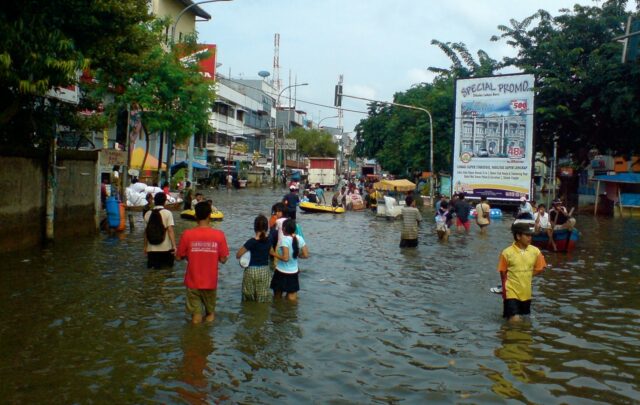
According to senior EU foreign policy officials climate change will lead to a wave of millions of ‘environmental migrants’, destabilisation of areas vital to global security, radicalisation of politics, north-south conflict, famines, and wars over water, energy, and other natural resources
(11 March 2008)
Khartoum’s boom
Simon Tisdall, Guardian
Sudan is modernising quickly and oil revenues are turning the country’s capital into an economic powerhouse
—
… Relatively poor, undeveloped Sudan is under sanctions imposed by the US and followed, somewhat reluctantly, by the EU. The ostensible reason is the continuing war in Darfur. It receives no help from the IMF, to which it must make large debt repayments each year. Influenced by the US, other international institutions and businesses tend to steer clear.
Yet 10 years after the US bombed the country, and three years after the peace agreement that ended the civil war in the south, vibrant Khartoum is beginning to resemble a boom town.
The reason can be spelled out in three letters: oil.
(11 March 2008)



Comments
We changed commenting systems on September 10, 2026 as part of a site-wide functionality and security upgrade. Your past comments have not disappeared, and you can still log in with your old Disqus account credentials if you wish. Contact us with any questions.