

A few months ago at the Global Earth Repair Convergence, I was honored to have both Anastassia Makarieva, co-originator of the biotic pump principle, and Susan Masino, co-creator of the proforestation concept, join me for a panel discussion called Saving What’s Left: Why Earth Repair Also Means Land Protection. Before introducing them both, I tried to briefly summarize why I’ve come to think that, if the goal is to cool and stabilize the climate through the power of living systems, land protection needs as much attention as land restoration. Here is the first part of the same basic summary in essay form.
A fresh conception of climate is attracting a growing community of people around the world. I’ve called it the living climate movement, or community, but it would be more widely recognized as the Earth repair movement, the regen community, or what institutions like the UN refer to as Natural Climate Solutions. The basic premise is that life—living things and the relationships between them—uphold and regulate Earth’s climate in key ways. Therefore, from a climate perspective alone, we urgently need to regenerate Earth’s degraded landscapes and ecosystems, through things like regenerative agriculture, water retention and land restoration. By regenerating life, we regenerate Earth’s capacity to heal its climate and cope with heating already baked into the cake.
This would not only draw down massive amounts of atmospheric carbon, it would calm flood/drought/fire cycles, restore and create habitat and help cool the planet through increased evapotranspiration and cloud creation. When you consider the sheer amount of degraded land around the world, up to 40%, the potential is enormous. When you consider that restoration work puts people on the land in a healing rather exploitive relationship, the potential becomes a kind of healing. Imagine an economy based on that.
Yet there’s another side to this equation: those areas not yet degraded, or what’s left. Unlike damaged lands, we’re not talking about a vast expanse but a remaining sliver, only about 2 to 3 percent. It includes what remains of Earth’s primary forests: the Amazon, the Northern Boreal forests, the Congo, the rainforests of Southeast Asia, and smaller areas of land scattered amongst various parks and preserves. To this we can add those ecosystems which, though disturbed at some point, have maintained the biotic legacy of the original, with time to mature and complexify, thus recovering their biotic integrity and climatic function. A good example of such forests are the legacy forests being fought over in Washington State.
These are what the paper, Intact Forests in the United States: Proforestation Mitigates Climate Change and Serves the Greatest Good, would describe as “intact forests,” broadly defined as forests “largely free from logging and other forms of extraction and development.” It’s a useful term because “intact” implies complexity, something held together and interrelated. It also implies time, that these places still connect to an original integrity, where the legacies of natural evolution persist to a meaningful degree. Besides their beauty, besides the irreplaceability of the creatures and cultures that live there, the remaining landscapes of what’s left harbor something modern humans can’t create: natural biotic complexity evolved over time and the resultant capacities of environmental regulation.
This is why Masino argues for “proforestation,” essentially protecting forests to do what only complex, self-developed forests can do, not least of which is safely sequestering carbon. It may seem odd, or perhaps unfortunate, that forest protection needs to be argued for as a management strategy, but if the goal is climate regulation and water-cycle support, it makes perfect sense. It’s also why Anastassia Makarieva calls for a global moratorium against cutting intact forests.
Here I offer my own perspective, born from having one foot in the forest protection world and another in the living climate community. I arrange it according to various observations and questions which braid into a single conviction: that “what’s left” needs us.
Observation # 1. There’s no substitute for natural ecosystems.
A few years ago, at a panel on regeneration, the mic was handed to Anastassia Makarieva. She had a point she wanted to make: that regenerated land can’t be compared to natural ecosystems, that only intact ecosystems have the higher-order capabilities to “perform the climate regulating function for us,” particularly intact forests.
She began by describing the complexity of the climate system, how clouds can either cool or warm, depending on whether “the right type of cloud is produced at the right time.” Natural ecosystems which have evolved in place seem to have this ability, or as Makarieva put it, “kind of know, and evolved to know, when and how to transpire” in a beneficial way, an ability a human-restored landscape can’t be expected to share, at least not without decades to mature naturally and develop the complexity out of which the capacity for climate regulation depends.
She uses air quotes when she says “know,” because she’s not suggesting a conscious entity that’s thinking and planning for the ecosystem. Rather, she’s referring to what she calls biotic regulation, the evolved capacity of natural ecosystems to maintain their environments “in a stable state optimal for life.”
In particular, she was referring to how trees in the Amazon begin transpiring two months ahead of the rainy season, essentially priming the atmosphere for rain and the working of the biotic pump. While new science is just beginning to quantify such capacity, the indigenous have observed it for centuries. According to Yanomami elder Davi Kapenawa, “As soon as you cut down tall trees such as wari mahi kapok trees and the hawari hi Brazil nut trees, the forest’s soil becomes hard and hot. It is these big trees that make the rainwater come and keep it in the ground. The trees that the white people plant — the mango trees, the coconut trees, the orange trees, and the cashew trees — they do not know how to call the rain.”
Such capacity is not only found in primary forests, but is also rebuilding itself in recovering forests. I’ll never forget when I visited a legacy forest named Bessie. To get there, we had to hike up a couple of miles of Department of Natural Resources logging roads. Stands of crowded, monocrop fir passed side to side, their interiors dark, as their density of trees blocked out almost all light. At the end of a turnaround, we picked up a trail and began passing out of the DNR plantations. As we approached Bessie, I noticed mist ahead. I mentioned it to the forester we had hired to do some tree ring sampling. He dismissed it. “Could be altitude,” he said.
He may have been right, but maybe not. We hadn’t climbed that much and were mostly traversing the side of a hill. And it’s not difficult to imagine how Bessie could create mist while DNR’s plantations couldn’t. Begin with the high, arching canopy. It not only provides the right mix of shade and light, but it also provides something of a lid. By absorbing sunlight, the canopy becomes warmer, forming a classic temperature inversion, holding cool air down, keeping the soil cold and moist, the air still. And though the canopy shades out a lot of light, it was surprisingly bright and open underneath, with plenty of light for young trees, devil’s club, mossy vine maple and a host of other shrubs, which cool the air even more through their transpiration.
There is also the contribution of cloud-condensation nuclei, the microscopic “seeds” around which atmospheric moisture condenses to become eventual raindrops. These emerge from the life on the ground and in the trees. They include chemical terpenes (the conifer scent), fungal spores, microscopic bits of moss and leaf. It’s reasonable to assume that a more diverse forest will provide a wider spectrum, and larger volume, of such rain seeds than a monocrop, particularly of fungal spores.
Add the superior condensation-nuclei profile to lower temperature and moister air and you may just click past the dew point. And if you do, as Bessie seemed to have, you’ve managed to milk the atmosphere of that much moisture. Clever Bessie.
Intact forests are pretty special, but can we keep them?
Unfortunately, intact forests are at risk everywhere. Though deforestation in the Brazilian Amazon slowed during the Lula Da Silva administration, a rightward shift in South American politics doesn’t bode well for the future of the Amazon. Besides, a slowdown isn’t enough. Amazonian researchers, such as Antonio Donato Nobre, believe the Amazon is hovering at a tipping point, where it will lose the capacity to maintain its wet condition and collapse to a drier, savannah-like ecosystem, potentially turning to desert.
A loss like that is hard to fathom. But on top of it, you must add the climatic effects. The Amazon sits near the equator, absorbing direct solar radiation year-round, and therefore processing massive amounts of heat. It processes this heat using water, which it also moves around in massive quantities. As the forest vegetation transpires, the heat is absorbed in the work of turning water to vapor. The vapor rises and eventually condenses into rain. At that moment, two things happen. One, the heat is released back into the atmosphere, only higher, where greenhouse gas concentrations are lower and the heat can more easily escape into space. At the same time, when the vapor, occupying a large volume of air, condenses to water, there is an implosion, a vacuum effect, helping draw currents of moist air in from the distant Atlantic Ocean. As the Amazon pumps out heat, it pumps in water. At the same time, it acts like a fountain, delivering sunlight-reflecting clouds and rain to neighboring biomes, particularly the agricultural regions to the south, and even as far away as South Africa and the US Midwest. For now, at least.
That deforestation is pushing this essential hydro-climatological system to collapse has yet to be taken up by the mainstream climate narrative, which continues to focus only on CO2 and the energy transition. Even when meeting at the “gateway to the Amazon,” as COP 30 did in Belém, Brazil, in 2025, the program was still so carbon-centric that Nobre penned an op/ed titled The Amazon’s Climate Engine is Dying: Why COP’s CO2 obsession is a catastrophic blind spot. “Will we finally acknowledge the elephant in the room?” he asked, calling on the world to “finally elevate ecosystem protection and recovery from a peripheral concern to the core of global climate action.”
Similar dynamics exist in the world’s other primary forests, the Congo, the Boreal and the rainforests of Southeast Asia. They’re all vital to regional/global hydrology and climate and all are under steady assault. The Congo Basin, where rain recycling is especially pronounced, lost 1.5 million acres in 2024 alone, due to charcoal production, slash-and-burn agriculture, urban expansion, road building and logging. The particularly biodiverse forest of SE Asia lost around 235,000 square miles between 2001 and 2019. The Boreal, with its short growing season and nutrient-poor soils, is especially vulnerable to widespread logging and mining.
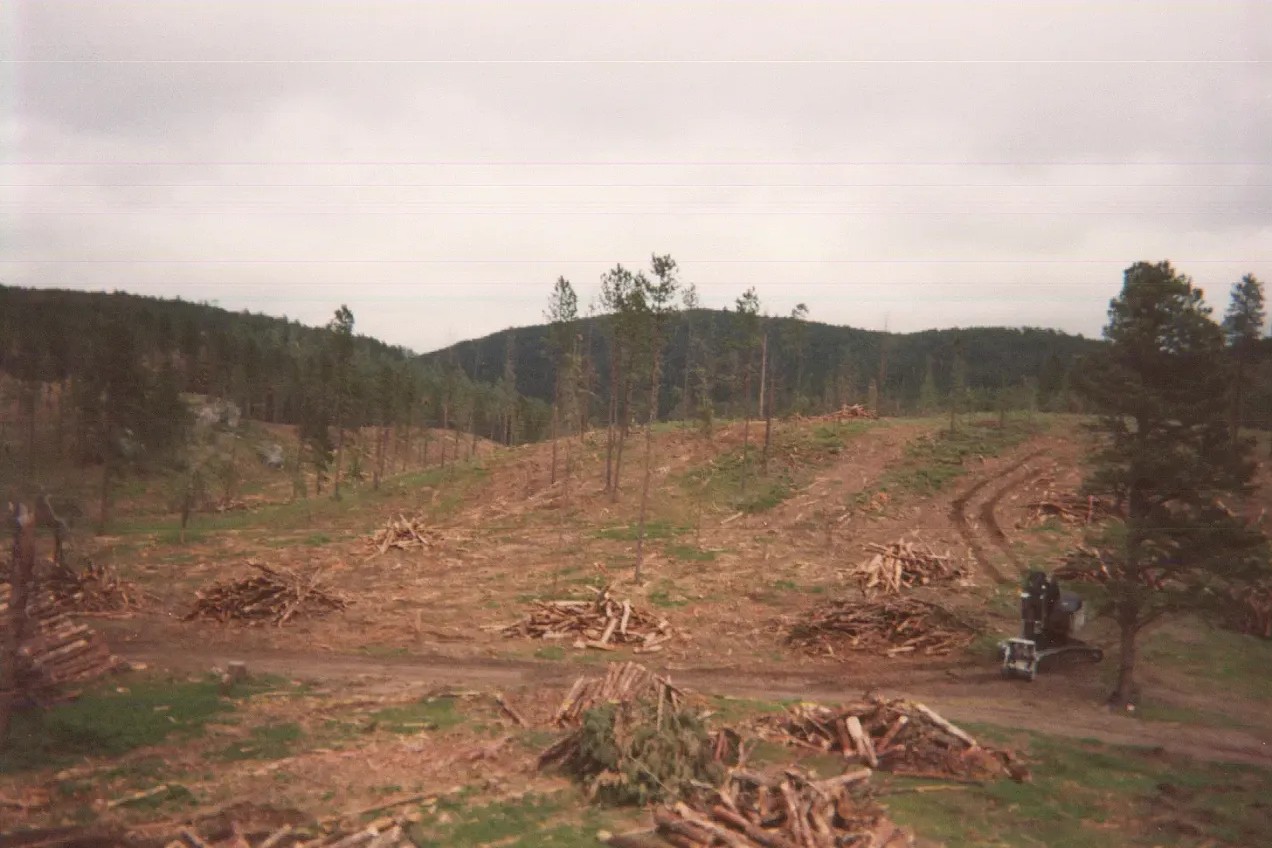
At the same time, recovering ecosystems, such as legacy forests like Bessie, are also in jeopardy. Threatening such places is a wildfire narrative developed in the US and gaining traction around the world. Its proponents argue that when forests are protected from logging, they become overcrowded with “hazardous fuels,” thereby becoming susceptible to fire and insects. The solution requires various forms of “fuels management,” “mechanical treatment,” “prescriptive thinning,” and “restoration,” but looks a lot like what used to be called logging.
Fire prevention has become the new rationale for logging, used to justify everything from rescission of the Roadless Rule to legislation like the Fix Our Forest Act and the Save Our Sequoias Act, both of which clear away environmental and judicial hurdles to mechanical treatments. And unfortunately, the mainstream, CO2-only climate narrative isn’t helping, with some climate organizations, like the Citizens’ Climate Lobby, actively working to pass Fix Our Forests and Save Our Sequoias. It’s ironic, because even a strict carbon perspective argues against fuel treatment. When a forest burns, it is mostly needles and limbs that are consumed, with most of the carbon remaining in the trunks and roots of trees, as well as the soil. When forests are logged under the guise of preventing such fire, carbon sequestration capacity is directly removed, slash is left on the ground to decompose or burn and carbon is released from disturbed soil. There is also the growing link between thinning and biofuels, a very high carbon-emitting source of energy.
But what happens when you widen the perspective to include water storage and recycling? What happens when you add land change to the climate equation, as a regional climate factor in its own right?
Stay tuned. We will take up these questions and more in the next installment.



Comments