

Songs of the Mangroves
La espalda a mí me duele / My back hurts
Ay, de tanto yo piangüar / Oh, from so much piangua digging
Ya no quiero sacar piangua / I don’t want to dig anymore
Lo que quiero es conservar / What I want is to conserve
Y si a mí no me jubila / And if I don’t get to retire
Yo no sé qué irá a pasar / I don’t know what’s going to happen
La conservación existe / Conservation exists
Las parcelas en lo’ manglar / The plots among the mangroves
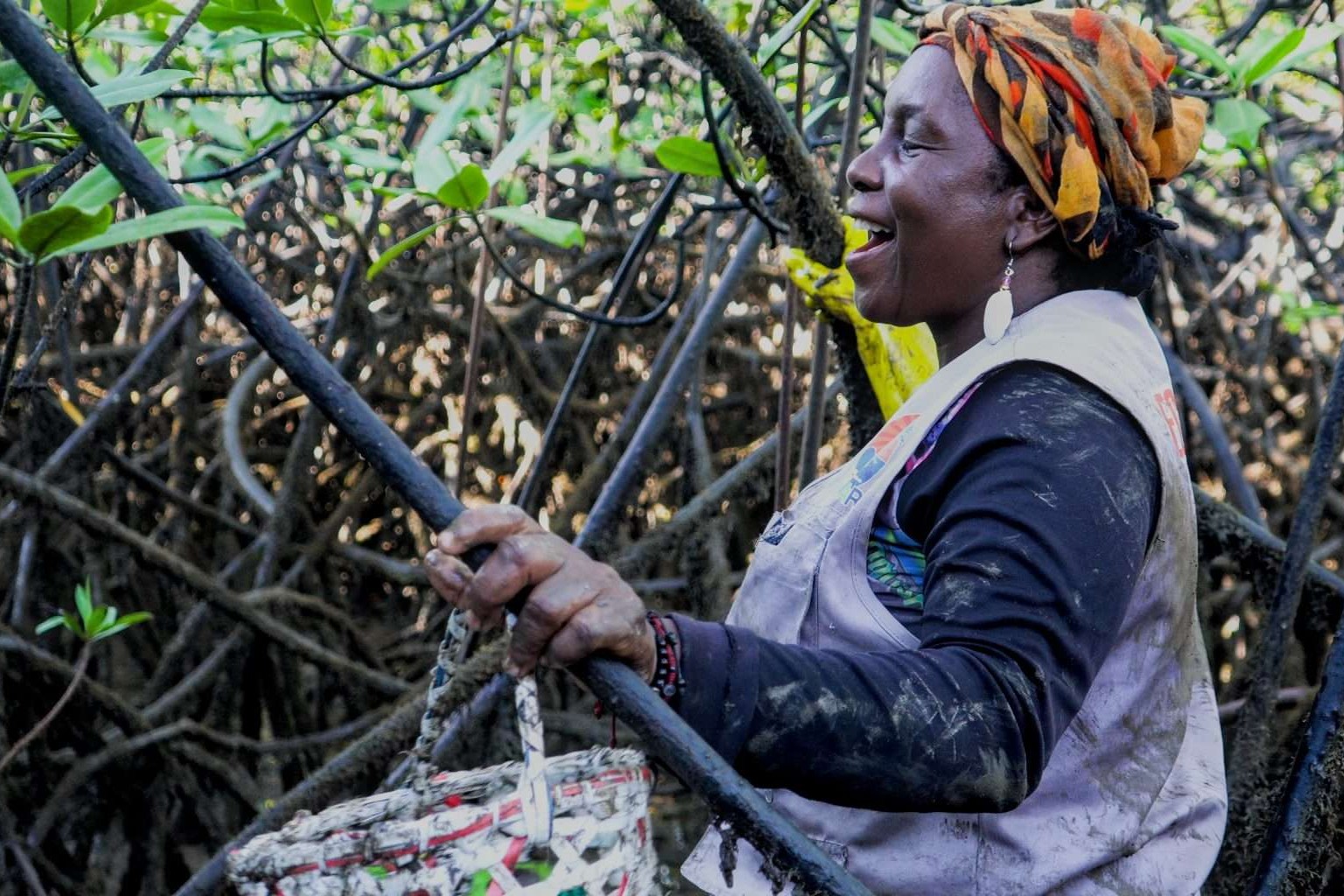
These plaintive lines echoed in time with the oars that carried our canoe across the calm waters of the Colombian Pacific at low tide. Just past six in the morning, a twilight murk still veiled the brilliant hues of one of the world’s most exuberant biomes. The morning’s repose was broken only by the soft splash of paddles cutting through the gray shallows and the melancholy song of Aura Nelly Díaz, head of the Bahía Málaga community piangüeras association. Her daughter-in-law, Rosa Angulo, hummed a tune of her own as we drifted tranquilly toward a thicket of mangroves.

We had just set out from La Plata, one of four small Afro-Colombian settlements in Bahía Málaga. This coastal inlet, several hours by speedboat from the bustling port city of Buenaventura, is legally designated the Uramba Bahía Málaga National Natural Park. A decentralized community governance structure manages the small-scale tourism that contributes to the bay’s largely circular economy. Thousands of tourists flock here each year, many hoping to glimpse the humpback whales that annually migrate from their feeding grounds near the poles to their breeding grounds in these warm equatorial waters. Natural scientists such as marine biologists and ecologists are also frequent visitors, while social scientists like me are drawn in by the unique socioecological traditions of the malagueños, the folk of the bay.
The Afro-Colombians of the Pacific coast are an amphibious people, their lives and livelihoods entwined with the sea and its bountiful produce—a way of life that endured despite their enslavement from the sixteenth to the mid-nineteenth centuries. This aquatic intimacy traces back to West African coastal and riverine communities from which many enslaved people were taken. Their relationship with water mirrors that of the region’s Indigenous Emberá and Wounaan peoples, for whom rivers and estuaries have long been arteries of life, suggesting a remarkable convergence of socioecological practices across distinct cultural traditions—a local instantiation of a broader pattern of Afro-Indigenous cultural exchange throughout Latin America.

Early each morning, taking advantage of the low tide, women like Aura Nelly and Rosa paddle canoes deep into the coastal mangrove forests of the Colombian Pacific, wading through thick mud and tangled roots in search of the coveted piangua—an endemic ark clam species (Anadara tuberculosa) and a cornerstone of the local diet. These women, called piangüeras, work in teams and sing as they gather up the mollusks they will later sell or prepare for their families. Boiled, cleaned, and shelled, piangua is the nutritional centerpiece of a wide variety of traditional meals, from the famous ceviche to lesser-known staples like encocado, sudado, and cazuela.
The songs of Bahía Málaga reflect the rhythms and concerns of everyday life in the Afro-Colombian Pacific. Many carry a didactic tone, teaching listeners the importance of conservation or the proper techniques for harvesting piangua sustainably. From a cultural perspective, these songs valorize the customs and beliefs they reference. From a cognitive perspective, they may also act as efficient mnemonic devices, aiding in the recall of important information by embedding it in structures of repetition, rhythm, and melody. As anthropologists have documented in other cases, songs can operate as a form of environmental folklore, storing and transmitting ecological knowledge and ethical guidelines.
More broadly, these songs, like the traditions they refer to—not only the clam-harvesting art of piangüar but also traditional agroforestry systems, foodways, economic patterns, kinship structures, oral literature, religious life, and so on—form part of this region’s distinctive biocultural heritage, an adaptive socioecological system that keeps the balance between human communities and the ecosystems they coexist with.

Anthropologists invoke “biocultural heritage” to refer to the complex entanglements between biological and cultural diversity. This term encompasses the ecosystems, knowledge systems, livelihoods, and cultural practices that communities and environments shape together as they coevolve. This concept challenges older distinctions between cultural heritage (with tangible and intangible expressions) and natural heritage. Instead of treating these categories as separate, the biocultural perspective foregrounds the relationships through which communities and ecosystems are mutually constituted and sustained across generations.
The stakes of this conceptual shift are high. A growing body of research demonstrates that the world’s remaining biodiversity hotspots overlap with the territories of Indigenous and Afro-descendant communities, and that the erosion of traditional ecological knowledge tends to accelerate ecosystem degradation. To protect one, in other words, is to protect the other. The Pacific coast of Colombia, one of the most biodiverse regions on Earth and home to Afro-descendant communities deeply rooted in its ecosystems, offers a compelling case for taking biocultural heritage seriously as a framework for research, governance, and conservation.
A growing body of research demonstrates that the world’s remaining biodiversity hotspots overlap with the territories of Indigenous and Afro-descendant communities, and that the erosion of traditional ecological knowledge tends to accelerate ecosystem degradation.
With equal skill and grace, Aura Nelly landed the canoe on a gravely beach adjacent to a dense patch of mangroves, one of many that blanket the islets dotted throughout Bahía Málaga. Whereas the piangüeras know this archipelago like the back of their hand and can readily distinguish one stand of trees from another, my untrained eye registered little difference between any two muddy tangles of aerial roots. Yet there are seven distinct mangrove species in the Colombian Pacific. An additional two species are found on Colombia’s Caribbean coast, for a total of nine throughout the country. Six are found in Bahía Málaga, making it one of the most biodiverse zones of Colombia’s extensive network of mangrove forests.
“Most of our mangrove forests are in the Pacific coast,” says marine biologist Ernesto Mancera, one of Colombia’s foremost experts on mangroves. “Eighty percent of the mangrove forests that we have in Colombia are in the Pacific. In the Caribbean, we have the other twenty percent, mainly in the Ciénaga Grande and also in Urabá.” Mancera’s work on mangroves and coastal ecosystems in the Colombian Pacific, as well as the Caribbean, has demonstrated the efficacy and importance of nature-based solutions for addressing ecological challenges in complex socioecological environments.

Mangroves are keystones in coastal ecosystems. They provide physical infrastructure for countless other species of flora and fauna, anchor shorelines with their roots, cycle nutrients, filter pollutants, and sequester carbon. And, crucially for local communities, bivalves like piangua and other species thrive in the intertidal zone at the mangroves’ muddy roots, which provide a safe sanctuary for shellfish to spawn and mature. Or, as recounted more poetically in another one of Aura Nelly’s songs:
La piangua viene de afuera / The piangua comes from outside
¿De dónde viene la piangua? / Where does the piangua come from?
La piangua viene de afuera / The piangua comes from outside
Ella viene a los esteros / She comes to the marshes
Ella viene a desovar / She comes to spawn
Ella viene a los esteros / She comes to the marshes
A dejar su cría en lo’ manglar / To leave her young in the mangroves
A dejar su cría en lo’ manglar / To leave her young in the mangroves
Y si amanece lloviendo, nos dificulta salir / And if it’s raining at dawn, it’s hard for us to go out
Por buscar nuestro alimento nos toca salir así / But to find our food, we have to go out like this
A buscar la piangua en el manglar / To look for the piangua in the mangroves
A buscar la piangua en el manglar / To look for the piangua in the mangroves
Leaving the canoe on the beach, we wrestled our way into the mangrove thicket and found ourselves under its dim and humid canopy, our tall rubber boots squelching with every step. Though twice my age, Aura Nelly spryly ducked and dodged her way through the maze of roots with evident ease. Rosa was just as nimble, while I trailed behind both in clumsier fashion.
At last we came to the edge of the mangrove forest, where the mud and roots merge indistinctly with the gentle lapping waves of the great Pacific Ocean. The bay’s geography buffers its islets from the forceful oceanic tides that batter much of Colombia’s wild Pacific coast—one reason, perhaps, why many communities have preferred to settle on higher ground, in coastal inlets like Bahía Málaga, or along the many rivers flowing down from the western arm of the Colombian Andes, rather than directly on the coast itself.

Such precautions are prudent. In late 2025, the nearby town of Juanchaco was hit by dangerously high tides, locally called puja, that destroyed numerous homes, flooded the town’s streets, and eroded stretches of coastline. Global sea level rise only exacerbates the vulnerability of coastal communities already facing an array of local environmental issues both on land and at sea.
“In the past, the tide didn’t reach as far as it does today,” said José Daniel Mosquera, the young legal representative of Ecomanglar, Bahía Málaga’s community tourism association. “The beaches and islands are eroding, and the erosion is getting worse. Roots that used to be buried deep in the ground are now coming to the surface. That’s a result of the erosion that’s taking place. These climatic changes are very significant, very noticeable.”

Environmental pressures such as illegal logging, wildlife smuggling, coca cultivation, and gold mining—with downstream effects including deforestation, biodiversity loss, coastal erosion, and heavy metal contamination—pose constant threats to life in the Colombian Pacific. Afro-Colombian and Indigenous communities are disproportionately affected by these operations, which are largely controlled by armed groups implicated in Colombia’s long-running internal conflict.
Agroindustry businesses in the private sector, such as palm oil plantations and cattle ranches, are also responsible for deforestation and community displacement. Despite their nominal legality, these businesses often employ paramilitary groups as muscle. Similar processes drive social and ecological problems in other endangered Colombian wetlands.
Colombian land system scientist Paulo Murillo uses datasets derived from high-resolution remote sensing to monitor mangrove ecosystems and other environments in relation to human activities, including illegal activities like coca cultivation, logging, and mining. Murillo stresses the importance of collaborating with local communities in this work. “In these locations,” he says, “the role of communities has been very important. They know pretty well all the benefits that they receive from nature, from forests, from mangroves, from the ocean.”
Originally published by The InterPlex, this article has been adapted for publication in two parts. The second part will appear in a subsequent post.




Comments