

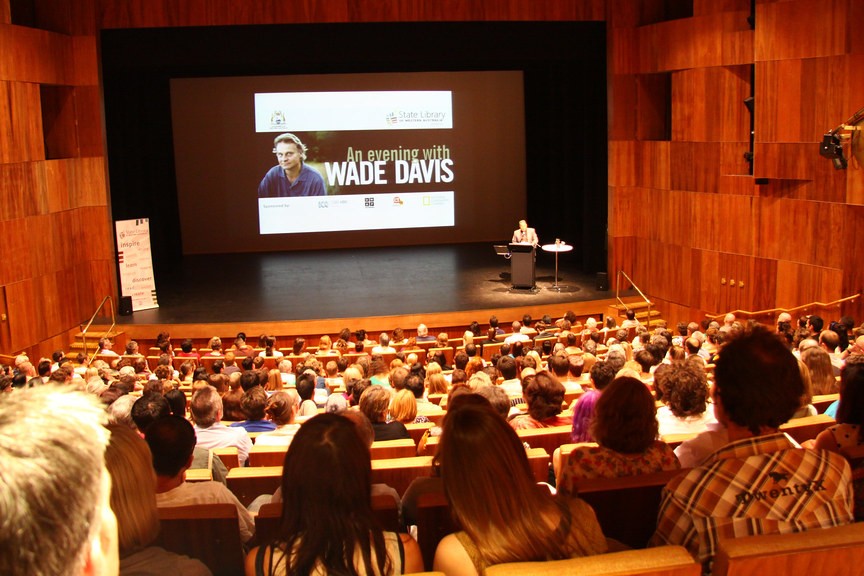
We were delighted when Wade Davis agreed to visit Denman Island for two special events organised by our Readers and Writers Festival. It is not every day that someone whose journeys have carried him from the Amazon to the Himalayas, from Borneo to the Arctic, finds his way to our small island. Having read several of his books, I welcomed not only the chance to hear him speak but the prospect of a conversation.
His presentations were magnificent: elegant, authoritative, alive with stories that made distant worlds feel recognisable. I admire Davis enormously. Few writers have done more to reveal the ingenuity of human cultures or unsettle the complacent conviction that Western civilisation represents the summit of human achievement. Yet something in his work had been nagging at me, perhaps because of my own training in political economy: an apparent reluctance to examine systematically the economic forces transforming the cultures he chronicles.
In our conversations, the mere mention of Marx or political economy provokes in Davis a reflexive recoil from the taint of ‘ideology’. Davis makes his distaste for the political left and right plain, and his condemnation of communist regimes is unequivocal. I understand the revulsion. But I wanted to talk about capitalism: the commodification process, privatisation of the commons, expansion imperatives, the class system it structures, imperialism, and its extraordinary capacity to reorder societies that have never consented to its assumptions.
Davis stands in the anthropological tradition of Richard Evans Schultes, Franz Boas, Margaret Mead and Claude Lévi-Strauss, thinkers who challenge the ranking of cultures on an imaginary ladder leading inevitably to Western modernity. His concept of the “ethnosphere”, the collective inheritance of humanity’s languages, knowledge, beliefs and cultural imagination captures what is at stake when a way of life disappears. When we lose customs or stories of a peoples, we lose one vastly complex and immeasurably valuable subset of the collective pool of human experience.
The power of his work lies in the particulars. Davis recalls being raised in British Columbia to see forests as timber, measured in board feet and cellulose. His Kwakwaka’wakw friends understood those forests through ceremonial relationships with a world alive with spiritual presence. Among the Kogi, Wiwa and Arhuaco of Colombia’s Sierra Nevada de Santa Marta, he encountered traditions in which human responsibilities help maintain the balance of the living world. Rather than quaint beliefs waiting to be corrected by modern science, they are sophisticated ways of relating to land and existence.
And then there are the Penan of Borneo. Davis describes a people whose knowledge of the rainforest was inseparable from practices of sharing and social obligation. Wealth could be measured in the strength of relationships rather than accumulated possessions. Industrial logging arrives and the forests become concessions, trees become export commodities, and logging roads cut through the material foundations of Penan life. The Penan resisted, but their resistance confronted companies, state power and an international timber trade.
Davis can tell us, in his exceptionally talented literary descriptions and deeply empathetic insights, what a forest means to the people who live within it. But what explains the machinery that turns that forest into someone else’s commodity? The answer requires more than a contrast between attitudes toward nature. It requires political economy.
Capitalism did not invent trade, conquest or human exploitation, and it is hardly the only system capable of cultural destruction. But it gave those processes a historically distinctive organisation and momentum. From colonial plantations and the dispossession of Indigenous lands to factories, mines, global supply chains and financial markets, ever more components of existence have been drawn into the production and circulation of commodities. Competition and the pursuit of returns compel enterprises to seek new resources, cheaper labour and fresh opportunities for accumulation, even when all those who may be involved personally deplore the damage.
One of Davis’s literary gifts is his ability to discover entire worlds in the particular: a river unfolds the history of Colombia; a coca leaf opens onto Indigenous knowledge and colonial exploitation; a poison leads into Haiti’s spiritual traditions and troubled past. Marx makes a surprisingly similar intellectual move, though his destination differs.
Marx begins his book, Capital, not with a revolutionary slogan or all-encompassing grand theory, but with the seemingly inert “commodity”, the kernel that illuminates the social relationships and underlying logic of capitalism. A thing may have a use and meaning particular to the lives of those who encounter it; under capitalism it also assumes a value expressed through exchange. Land becomes real estate, forests become timber, labour-power something bought and sold. Market value does not necessarily extinguish other meanings, but the institutions enforcing it can subordinate those meanings, and the social relationships sustaining them, to economic calculation.
Marx’s idea of commodity fetishism goes further: relationships among people come to appear as relationships among things. The market begins to look like a force of nature rather than a human institution. Karl Polanyi later called land, labour and money “fictitious commodities”: foundations of social and ecological life treated as if they had been made for sale. Where Davis discovers an astonishing diversity of cultural worlds within the particular, Marx illuminates economic forces capable of drawing those worlds under a common, universalising logic.
The Penan did not lose access to forests because they revised their philosophy of the natural world. Institutions backed by capital and political authority acquired the power to decide what those forests were worth and what could be done to them. Different meanings of the forest mattered profoundly; they did not carry equal power. The argument becomes more provocative. Capitalism is not simply an economic force intruding upon culture. It is itself a cultural and institutional order, with characteristic ideas about property, individualism, progress, time and value. Growth is a measure of collective success. Nature is a stock of resources. A home is both shelter and appreciating asset. These ideas are no more universal or inevitable than the cosmologies Davis describes. They are backed, however, by extraordinary material power.
There is a remarkable convergence between Davis and Marx. Davis demonstrates that Western modernity is only one among many human possibilities. Marx reveals capitalist economic relations as historically made, rather than natural or eternal. One explores the diversity of worlds humanity has created; the other helps explain the forces reshaping the conditions under which those worlds can survive. In one of his interviews, Davis describes globalisation as “capital in search of cheap labour.” That is a striking political-economic observation. Why, then, the apparent reluctance to pursue the system’s logic further through radical systemic critique?
Understandably, because of Marxism’s association with authoritarian states and their brutal attempts to remake society. Those histories cannot be ignored. But neither can they dispose of Marx’s analysis of capitalism. A critique of the commodity form is not an endorsement of Stalinism or Maoism. Nor does studying capitalism require allegiance to Marx. Others in the canon, Adam Smith… Ricardo, Keynes, Hayek disagreed fundamentally about the economy while insisting that its organisation demanded explanation.
What if the greatest threat to the ethnosphere is not merely the triumph of one worldview over others, but the historically unprecedented ability of one economic system to subordinate all worldviews. At this time of so much destruction globally, should we not all be on an urgent course to understand and at the same time, to take apart the inner mechanics of that system?
Division between academic disciplines of anthropology/sociology and political economy are embedded partly in intellectual habits. Anthropology trains the eye toward particularity; political economy toward recurring structures. Each develops its own sense of what constitutes an explanation, and sometimes a suspicion of what the other finds persuasive. Davis may fear that Marxian categories flatten humanity into a single historical script. But explaining the economic forces that operate across cultures need not deny the diversity of their responses.
There are hazards on both sides. Political economy can turn into a grand theory that flattens human experience, treating living peoples as illustrations of structural laws. Davis’s attention to difference, imagination and agency is an indispensable correction. Yet an anthropology that vividly describes what cultures stand to lose, without adequately explaining why the threats recur, risks mistaking the symptoms of destruction for its causes.
Here on Denman, we cherish the possibility of a life less governed by the marketplace. Yet our forests have commercial value, our homes are financial assets, and the island’s desirability can make it increasingly difficult for working people and younger families to remain. Behind today’s property lines lie older ancient relationships with land that no market price can describe. Our circumstances are not those of the Penan, but we know something of the uneasy coexistence of community, ecology and exchange value.
Davis brought the world to Denman Island in those two days. I came away from Wade’s visit with my admiration deepened and our conversation unfinished. He has shown us so many ways there are to inhabit the world. But I’m still burdened by the thought that it is not enough to cherish humanity’s different ways of seeing. In a time when our way of life, our country, our imagination, is under threat, and when systemic transformation is an imperative, the need to make the character of the primary occupying forces of the enemy transparent… is ever more urgent.




Comments