

As the race to build data centers across the United States accelerates, local governments worry that the tech industry mantra of “move fast and break things” means their communities are at risk of being broken.
I’m a Harvard researcher studying the relationship between data centers and energy. I’ve closely monitored how local governments respond to proposals or even just concerns about the potential for data centers in their communities. What I’ve found is a complex story of community needs, political tensions and corporate power – all interacting with local, state and national democratic processes.
Promises and potential
Technology companies stay competitive by being ready to provide data and communications services even before customer demand rises. Data centers already power online communications, shopping and banking systems. Now, expanding demand for artificial intelligence has led to over 1,000 pending data center proposals across the country.
Federal actions also drive development. The Trump administration has identified data center build-out as a strategic priority. The administration has promoted data center capacity as a measure of American strength and signaled that federal regulations on data centers may be eased.
At the community level, technology companies claim that data centers bring jobs, economic revitalization, digital connectivity and economic growth to local communities.
Not great neighbors
So far, however, data centers’ benefits are overshadowed by more visible harms.
Nearby residents experience higher air pollution and excess noise. Data processing also uses a lot of water to cool the buildings and their equipment.
Simultaneously, electricity prices continue to outpace inflation, burdening families across the country. These trends reflect, in part, the costly infrastructure investments needed to power data centers.
The local movement
My research has found that local governments across the U.S. are trying to avoid or reduce these harms.
Some counties and cities that don’t have specific zoning rules and regulations for data center development are using short-term moratoriums. These pauses in data center permitting and construction give communities time to consider how to define new laws and regulations about the facilities’ location, electricity use, water conservation and noise buffering.
Speaking about his town’s decision to impose a one-year data center moratorium, Rick Bella, the town council president in Merrillville, Indiana, about 40 miles southeast of Chicago, stressed a desire to “evaluate real-world impacts and learn from a project developing right next door before determining what may or may not be appropriate for Merrillville.”
Other places want to block data centers altogether. In April 2026, for example, the Ypsilanti Community Utilities Authority near Detroit, Michigan, passed a yearlong halt to the “delivery, commitment, reservation, extension, or approval of water and sewer services” for data centers. The move blocks data centers, including one under development by the University of Michigan and Los Alamos National Laboratory, from getting the water they need to operate.
Separately, towns across Ohio, Wisconsin, Maryland, Nevada, California and Pennsylvania have put questions about data centers on their local ballots. Through these referendums, voters can weigh in on construction bans, tax incentives and zoning ordinances.
Power struggles
While public attitudes around data centers have remained largely nonpartisan, local and state officials don’t always see eye to eye.
Officials in Hood County, Texas, for example, rejected a proposal for a six-month moratorium after a state senator urged the Texas attorney general to intervene and prevent the measure.
In 2025, West Virginia passed a bill that reduces local governments’ zoning and regulatory powers in relation to data centers and microgrids. A similar bill in New Hampshire’s legislature was defeated in May 2026.
Tech companies are also flexing their legal and financial muscles. For example, data center developers sued Saline Township, Michigan, and Chatham County, North Carolina, seeking to overturn their local zoning decisions to be able to proceed with data center construction.
Changing tides
Local pushback comes at a pivotal moment for artificial intelligence technology itself.
As seen in objections to the internet’s expanding AI “slop,” backlash over AI-generated Super Bowl ads, worries about an AI-related financial bubble and complaints about Google’s pivot to AI-directed search, Americans are reckoning with AI’s role in society.
Further, many people are questioning the role of technology broadly. Increasing numbers of teens and adults are addicted to their smartphones, emotionally and psychologically dependent on their availability. Parents and teachers are questioning the usefulness of various types of digital technologies in classrooms. Even the pope has warned that technology must serve humanity – and not the other way around.
Americans are responding to this moment through the power of their voices and votes.
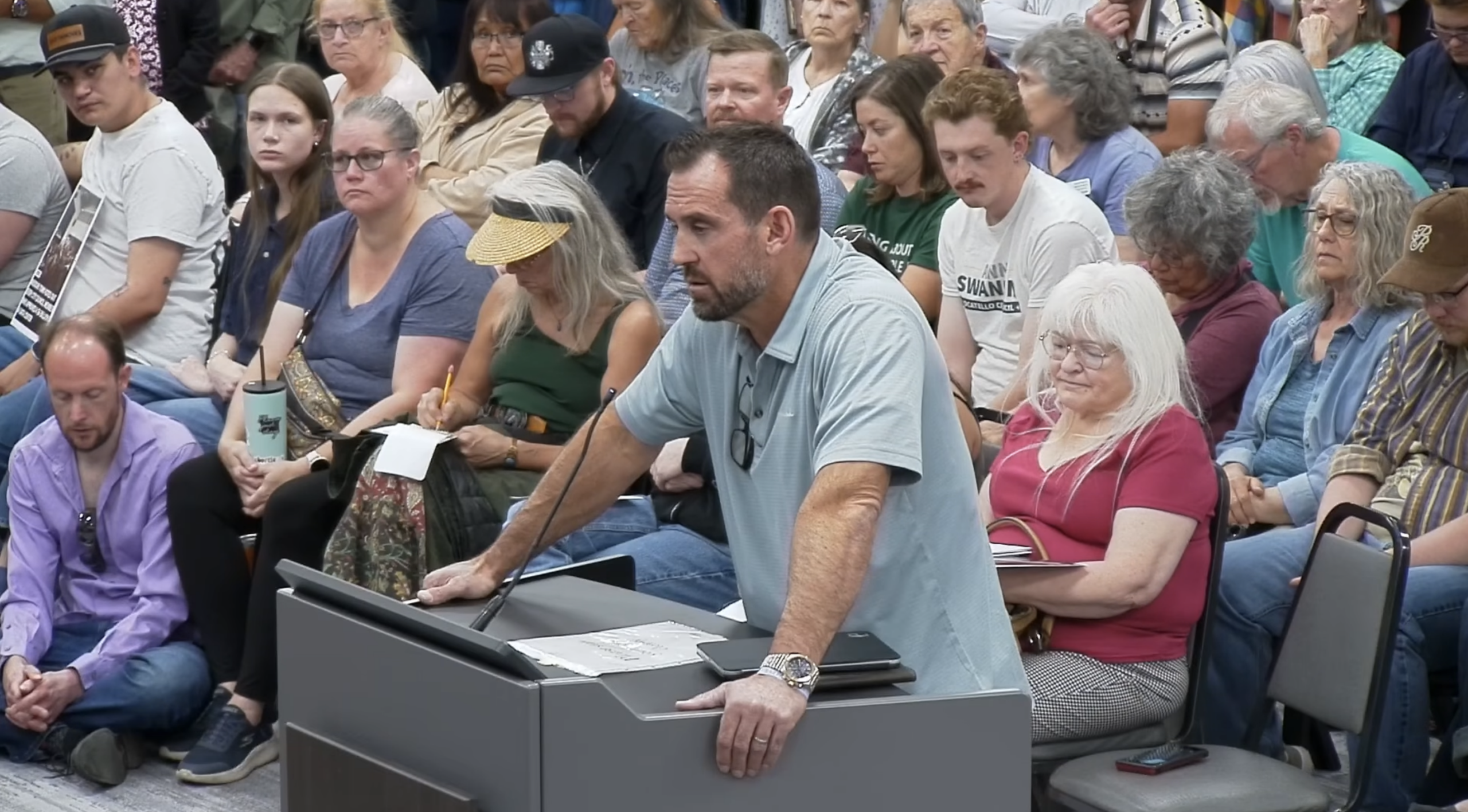
Technology companies may view moratoriums and new regulations as delays in project development. But the town hall discussions, community coalitions, public petitions and even farmers’ unions reflect American democracy at work.
In Sunbury, Ohio, local officials considered a moratorium only after witnessing the scope of public protest over a proposed data center.
In April 2026, voters in Festus, Missouri, removed several City Council members after they supported a new data center despite resident pushback.
The question of whether a community wants or should have a data center does not have a universal answer. I believe it’s a question that deserves deliberate processes, transparency and consideration.
To me, these local-level actions reflect a desire to slow down. There is little question that data centers and AI will be part of our collective future. Today, communities are asking for a fair say in what their futures will be.
Editorial note: We value this account of local resistance to data centers and AI infrastructure. While the author emphasizes the need for more democratic, deliberate processes around data center expansion, Resilience questions the assumption that continual growth of data and AI infrastructure is either inevitable or desirable. We share this piece for its documentation of local organizing and governance debates, though we do not necessarily endorse all of the author’s conclusions.



Comments
We changed commenting systems on September 10, 2026 as part of a site-wide functionality and security upgrade. Your past comments have not disappeared, and you can still log in with your old Disqus account credentials if you wish. Contact us with any questions.
Data centers seem to be the government (Chomsky calls the "Masters of Mankind") admitting that collapse is near and they need surveillance to know where to send the troops within the US to quell rioting, etc. – in a vain hope to deliver themselves from the collapse. I'm reminded of the movie "Don't Look Up."
I agree with the editors: we do NOT have to accept that AI is here to stay and the only question is which locations should welcome it–or have it foisted on them. This piece does not mention the proposed data center in Utah that would take up 62 square MILES and use twice as much power as the entire state of Utah, pushed through over a huge roar of citizen opposition; or the megacenter Musk built in Memphis, without waiting for permits, for which they were sued and the Trump administration is intervening on Musk's behalf, saying the center is necessary for "national security." It says West Virginia's legislators passed a bill reducing local officials' say over zoning and other regulation, which is incorrect–it completely stripped the people and the local officials of any say, and took 70% of any property taxes paid by the data centers for state use. It also rather downplayed the harms already caused by AI, like the suicides and the harms to learning caused by students outsourcing mental work to AI. Then there's the automated warfare and policing angle, in which we seem to be on a fast road to an amalgamated dystopia, all the fictional horrors of a sci-fi police state rolled into one. And then there's the minor matter that ramped-up fossil fuel burning to fuel AI is shoving us over more red lines on climate change, pushing us in precisely the wrong direction when we desperately need to be slamming on the brakes.
The techbros, who have FAR too much power, have been saying alarming things about how we need to jettison democracy in favor of having a corporate CEO rule us all, and how water should be prioritized for AI over humans as it's AI, not humans that will accomplish human evolution, and some races have different capabilities than others…nobody should have as much power as these guys do, but if someone does, any random selection would be infinitely better than these psychopaths. I'm glad to see so much talk about this, and opposition ramping up fast, but increasingly it seems to me that this battle is THE fight of our times, a kind of endgame.