

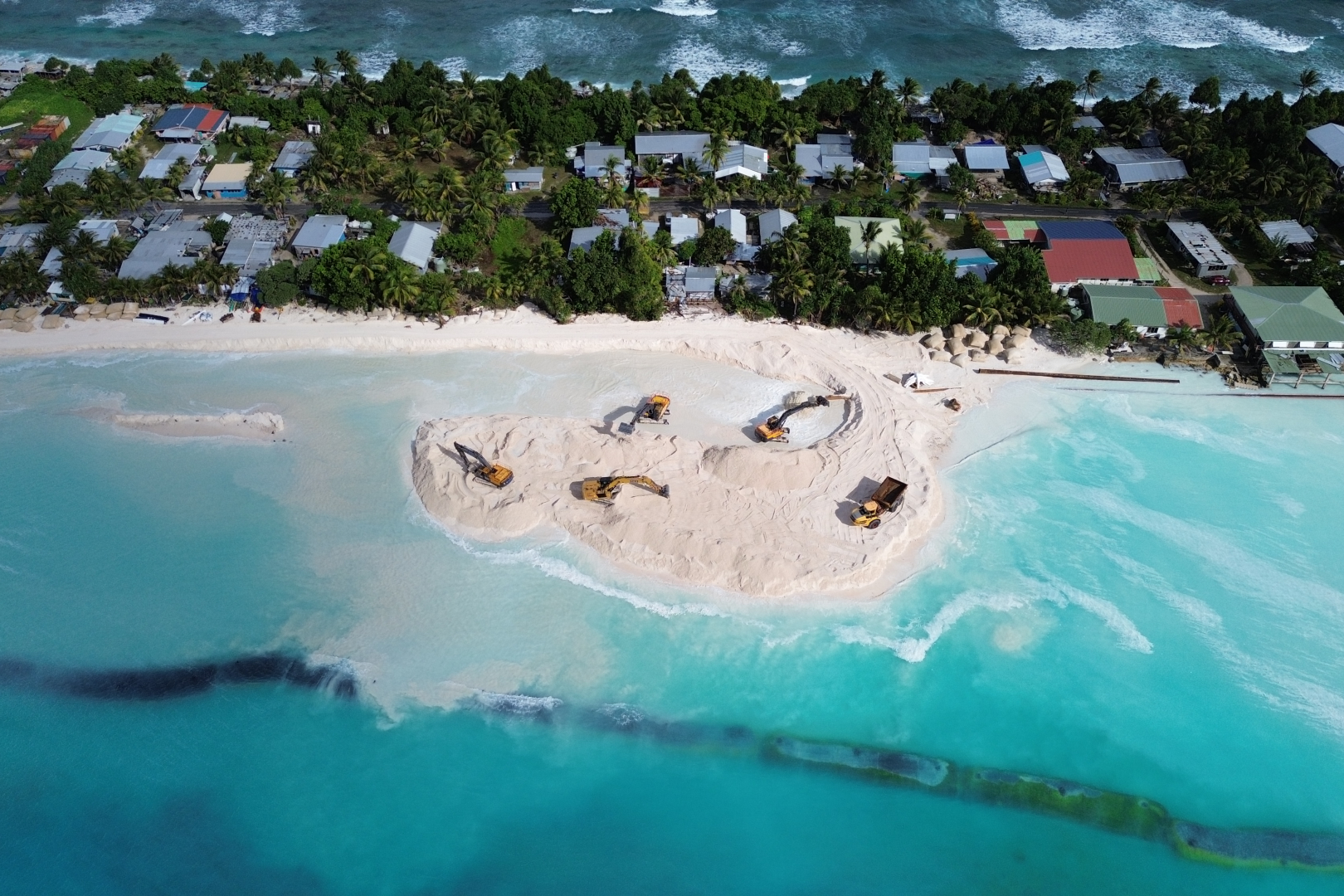
The Blue Ocean states of Tuvalu, Kiribati, the Marshall Islands and the Maldives are already contemplating a pilgrimage of recovery, reground nationhood not from war, political upheaval or desertification, but from dissolution as they are reclaimed by nature. Sea-level rise conjures fears of storm surge and flood, of inundation. In the non-dual idiom, the sea is not punishment for our excess, but a mirror of the unraveling certainties of separation, national boundaries and territorial sovereignty. The rest of us, the landed nations and more secure island nations, are barnacles clinging to rocky shorelines, about to be dislodged from the conventional, from certainties coming undone.
The people of these nations will be among the first to wrestle with the loss of national identity implied by the loss of territory. Their encounter with impermanence will ripple through global fixations on enclosure and permanence. For landed nations, it will not be the sea that reminds us of our vulnerability, but the rising temperatures, loss of vegetation, and water. The new identity of these island nations may be as teachers explicating a lesson on how to free ourselves from the illusion of separation, to restore knowing that we are eternally wed to the co-arising of all phenomena, that we have depended on a narrowing inventory of capacities, and that there is no such thing as remaining isolated from events that befall others. The wealthy nations of the world are inadvertently redefining the meaning of nation. Over the remainder of this century, the definition of a nation will shift from where one stands to how one remains standing amid everything moving. Failure to respond to these emerging conditions will mean abandoning a world already suffering from their effects.
Whether vulnerable island nations will continue to be nations in any sense other than having a defined territory is an open question. If they move and their people remain intact, with a government still in effect and the ability to conduct diplomacy, are they still nations? What new frameworks of relational cohesion will arise to retain nationhood in a post-sovereign world? What new intimacies will arise from the catastrophe of submergence? What new intelligence has already emerged in the deliberations on how to abandon an ancestral home? Where will the lifeboats land? How does a nation leave behind the taste of seawater or the wonder of an island sunrise?
International law is in conversation about how to meet severance from soil in practical and humane ways, reshaping law to strike a new balance. And well it might, because the era of displacement is upon us. What we seek today, given that the world is coming undone, is to hasten the dissolution of frameworks of individuality, entitlement and privilege and to explore our ongoing entanglement. This is culture giving way to the authority and reality of nature. Along the way, the sinking-island scenario of de-territorialized nations is a neon sign that says the human notion of sovereignty pales before the sovereignty of the sea. Submerged islands may well be only one test of many in the coming decades that will determine whether relational intelligence and restorative dialogue will guide international collaboration for the centuries to come.
The proper function of law is to transduce tensional acts, attuning the entire structure of governance to a homeostatic balance among shared vulnerabilities, to restore safety, reduce risk and bring systemic healing to historical distortions of cross-cultural relationships. Every sovereign boundary will be tested. Can one people relinquish territory to accommodate another? Can a wandering nation make a transition to a new location, new livelihoods, as they leave behind the burial grounds of their ancestors? A de-territorialized group will feel profound disorientation, displacement, social, spiritual and economic trauma of every kind, whereas the occupants at their destinations may feel invaded or even territorially dismembered themselves. That common sense of dismemberment may become a basis for a shared journey of recovery, a collective return to the irrevocable bonds that bind us all.
There is already legal standing for sustaining nationhood without territory. The International Law Association Committee on International Law and Sea-Level Rise ruled in 2018:
“Based on international law’s inherent bias in favor of stability and order, the ILA Committee endorses the view ‘that, as guidance and as a starting point, there should be a presumption of continuing statehood in cases where land territory was lost.’”
De-territorialized states are still states! A sitting judge of the International Court of Justice declared in 2006 that “a state is not necessarily extinguished by substantial changes in territory, population, government, or even by a combination of all three.”
This ruling stands as a guidepost to the future because when it comes to displacement, it is not only island nations that will disappear. For lack of the basic means of supporting life, it will be landed states as well. When masses are displaced, they can take with them everything that makes them a nation, except the land itself. Even if they are dispersed, the technical means to sustain a national ethos, governance, policymaking, law, and even democratic process already exist. How national coherence might be sustained as humanity shifts remains to be seen, but the question is rising like an incoming tide. It may even be coming sooner than expected in the form of nations losing cohesion due to political or economic collapse and subsequent migration.
In principle, at least, a people is still a culture (if not a nation) by its own definition, even if it no longer occupies a specific territory. And even if they are stateless, a submerged island nation could still retain its ocean entitlements, the limits of its former sovereignty (thousands of square miles of ocean) retained for commercial purposes and even continue to be fed by those entitlements. The question is whether a nation without landed boundaries will be adopted by the rest of the international community. The answer hints at a redefinition of belonging, expanding beyond the limits of geography to a new symmetry of common relationship, attuning to a new rhythm that sustains national identity beyond any boundaries.
The implication of lost territory is surely that nations lose their ability to determine their collective future, free from colonial influence or the difficulties of assimilation into an alien culture. But without boundaries, they are also free to seed the world with a cosmopolitan vision of unity in diversity. Is that not already the case in many nations? Are not the definitions of native and alien breaking down—and becoming tinder for those who would claim to define a nation? For lost island nations, the sea is fundamental to national identity as well as a source of livelihood. To disperse that identity is not to destroy it. It is an opportunity to reaffirm it, perhaps even softening the impact of such great loss.
In the parlance of modernity, the individual, possessing concrete boundaries and presumed autonomy, is analogous to a state. If international law is to meet the unfolding imperatives of national dissolution and displaced peoples, it must overcome the central pillars of separability. It must assimilate the realities of nature, one of which would be to regard the term ‘we’ to refer to a continuity of individuals, land and ecologies, implying a nested set of natural laws requiring regional stewardship and the aggregate of nations without contradiction. Geographical nations, for as long as we cling to that notion, could still create their own law to address domestic concerns. But such nations entering treaties on issues of human rights could not contradict the essential morality of natural law. Thus, from a non-dual view, financial plans for adaptation or mitigation projects in vulnerable nations subject to sea-level rise, or even the relocation of those peoples, are not charity. They are investments in the health and future of the entire planet.
Is there a legal basis for claiming the complete submersion of an island nation is evidence of a willful pattern of environmental destruction? Could such a circumstance justify reparations to a nation (or a national minority) for colonial exploitation—even if a physical nation no longer exists—or especially because the physical nation no longer exists? These questions throw the global and international response to climate change into a category of exploitation committed by wealthy, high-emitting Western nations.
Autonomy is based on the fantasy of immutable physical boundaries legally enshrined—because our separation appears self-evident–even though both individuals and collections of individuals are constructs of biology, ecology and law. Nations, like individuals, are defined by territorial limits considered to be sacrosanct. Expressions of sovereignty are becoming more rigid, and therefore more readily contested, whether landed (China-India, Libya-Chad, Ivory Coast-Guinea, Belize-Guatemala, just to name a few), or maritime (China-Philippines, China-Vietnam, Chile-Peru). The relentless effort to define states (and bodies) as distinct entities will persist despite accumulating evidence that what appears to be obvious is a conceptual illusion. The coming world will confront such illusions in ways that will not be ignored.
The principle of trans-corporeality claims a rigorous distinction between the substance of the human and the world can no longer be made. Bodies are porous; individuality cannot be differentiated from environmental impacts any more than it can from genetics. There is no such thing as a fixed individual. We are an Earth process in ongoing subliminal deliberation with multitudes arising and disappearing in every moment. But if the idea of one who steps back before making a choice and objectively reviews the whole is imaginary, then who is the actor? Who or what is the one declaring sovereignty? If there is no basis on which any human can declare individuality, let alone sovereignty, then there is no basis for any number of humans together to claim such a thing. What trans-corporeal reality suggests is that an anarchic interconnected global consciousness is the only operating principle. There is no environment, no consciousness separate from the world out there.
Accepting this, we begin to see how modern legal governance diverges from our intimacy with the greater context of life. Philosophy, biology and climate change are converging on a singular point: the individual, who cannot be regarded as a distinct, independent entity. The state, as well, is a creation of the mind—an imperfect but captivating myth. The rising challenges to state sovereignty are macro-reflections of the unique and independent ego questioning its raison d’etre, dissolving its armoring and recognizing its dependency on much wider relations.
In the face of climate change, as populations become more restless, territoriality may no longer be defensible. Borders are only conveniences, after all, formalities whose relevance will be under challenge later this century. Our immediate challenge is to comprehend that we are deeply and irrevocably entangled. As such, openness becomes more available. How global governance may evolve to reflect the relational intelligence holding us together remains uncertain, but Earth System Law could become a Declaration of Interdependence, even an accelerator of the transformations now unfolding. Like Doughnut economics, it is the most natural, the most difficult and the most necessary response possible.
“You develop an instant global consciousness, a people orientation, an intense dissatisfaction with the state of the world, and a compulsion to do something about it. From out there on the moon, international politics looks petty. You want to grab a politician by the scruff of the neck and drag him a quarter of a million miles out and say, ‘Look at that, you son of a bitch.'”
Edgar Mitchell, NASA astronaut
The agenda referenced at the outset of this chapter is only possible if it relies on a valid picture of key Earth system indicators. A reconstitution of law as a tensional mediator must reflect four things: that we are not separate, that we are not autonomous, that a directly realized morality based on safety and universal vulnerability must become the heart of law, and that anthropocentric law does not reflect reality. To acknowledge a single global dynamic would mean accepting what already is, with humility: the Earth does not answer to human mythologies.
To realize these four things will change the meaning of justice for everyone. The value of an integral vision is that we are infused with the truth of our entanglement. We would accede to the reciprocal responsiveness of the planetary system. Law would become a means of restoring integrity to relationships of all kinds. By attuning to the rhythm of Earth, law could hum like a tuning fork, sustaining the resonance we claim is impossible. In the meantime, prepare to have the many masks of our assumed identities, to which we are so attached, removed.
This piece is an excerpt from Just This! Reweaving a World in Crisis (2026) by Gary Horvitz.




Comments
We changed commenting systems on September 10, 2026 as part of a site-wide functionality and security upgrade. Your past comments have not disappeared, and you can still log in with your old Disqus account credentials if you wish. Contact us with any questions.