

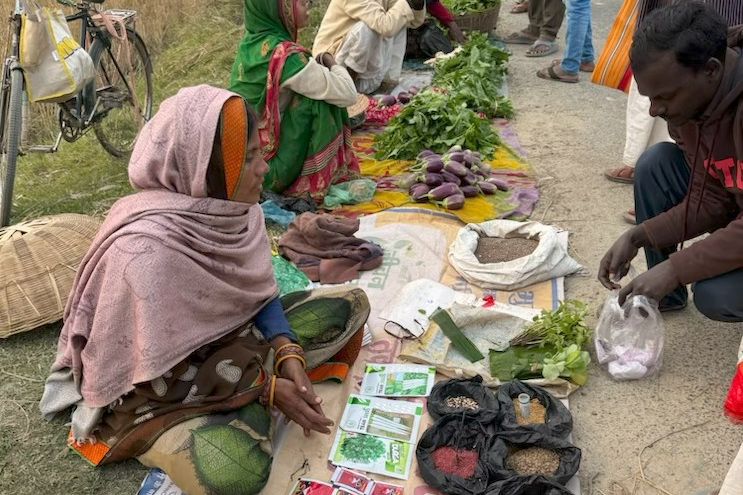
In the floodplains of northern Bihar, where seasonal migration has long shaped village life and women rarely handled money beyond household survival, a quiet transformation has been unfolding around something deceptively ordinary: a rural market.
Every Thursday and Sunday afternoon, as the heat softens and narrow roads begin to fill with bicycles, handcarts, and women carrying woven baskets, the haat bazaar in Nawani Panchayat, Madhubani, Bihar, India, comes alive. Fresh gourds, mustard greens, finger millet flour, lemons, fish, bangles, snacks and homemade pickles spill across rows of temporary stalls. Women bargain loudly with customers, compare prices, discuss crop cycles and count the day’s earnings tucked into the edge of their saris.
A few years ago, many of these same women had never sold a product in a market.
The transformation did not begin with the market itself. It began with a deeper crisis of poverty, debt and invisibility.
When international development organization World Neighbors and its local partner RDT (Rural Development Trust) began work in the Madhubani-Jhanjharpur region, baseline surveys across the Mahadalit, Dalit, and minority communities revealed a pattern of chronic vulnerability. Household incomes were low and irregular, while expenses remained high. Families were trapped in cycles of debt to local moneylenders. Women had limited mobility, little exposure to self-employment, and almost no role in economic decision-making.
Many families spent between ₹3,000 and ₹5,000 every month simply purchasing vegetables and basic food items from distant markets. Nutrition levels were poor. Awareness around sanitation, menstrual hygiene, maternal health, climate risks and government services was extremely limited. Farming practices relied heavily on expensive external inputs, while agricultural knowledge remained fragmented and insecure amid changing weather patterns.
The first step in addressing this was not focused on agriculture. It was an organization.
Women were brought together into savings and credit groups of 15 to 30 members. In monthly meetings, they began saving small amounts collectively, discussing household needs, planning activities and accessing loans from their own pooled funds instead of relying on moneylenders. For many women, it was the first time they had spoken publicly in a group or handled financial decisions collectively.
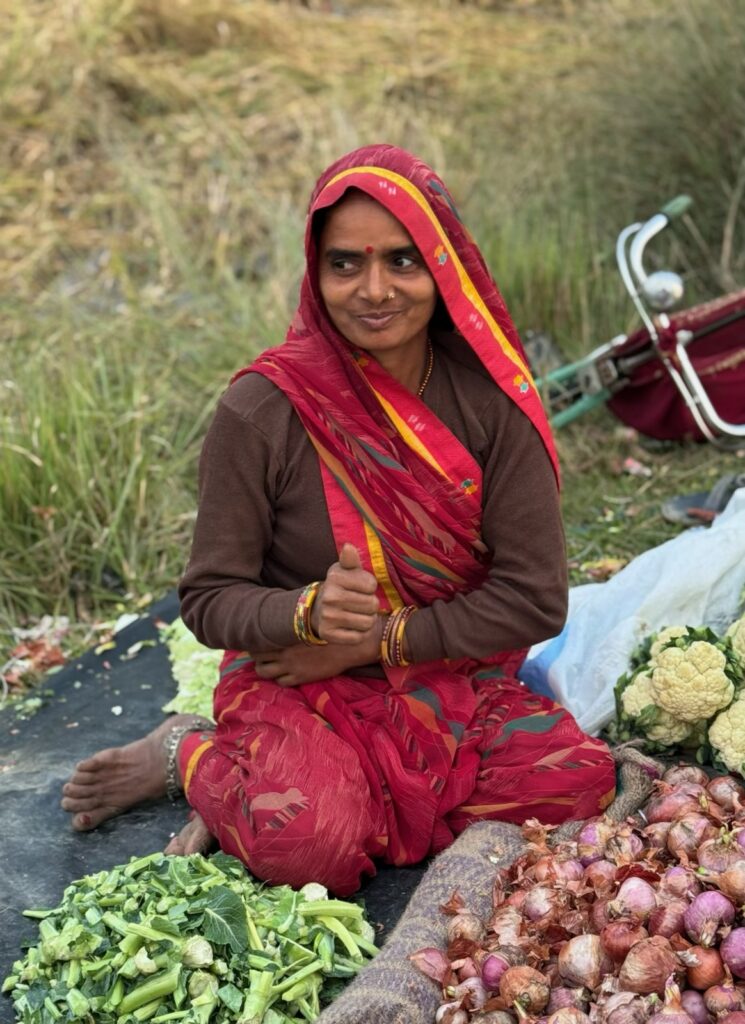
Over time, the meetings evolved into platforms for learning and negotiation. Discussions expanded from savings into sanitation, education, nutrition, climate adaptation, reproductive health and farming practices. Women who once depended entirely on landlords, traders or male relatives began developing a sense of agency over their own households and livelihoods.
“One realization slowly spread through the groups,” recalled a field worker associated with the program. “The women started believing that they themselves could change their situation.”
The next challenge was economic.
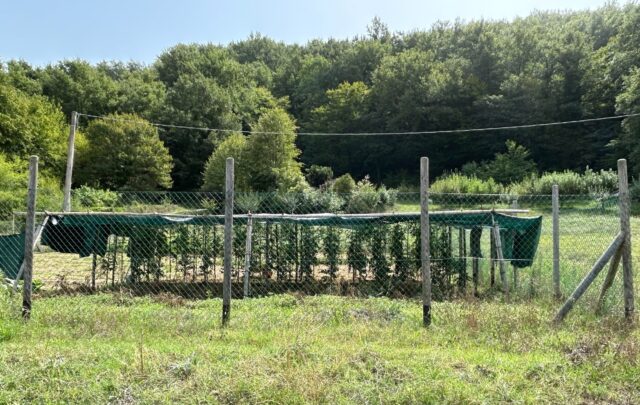
The program encouraged families to convert unused land around their homes into kitchen gardens. Women were trained in soil preparation, local seed preservation, composting and natural pest management. Within a year, many households were producing vegetables throughout the year according to Bihar’s agricultural calendar, dramatically reducing food expenses while improving dietary diversity.
Some women gradually moved from subsistence cultivation into commercial vegetable farming. What began with 54 women farmers expanded into more than 110 women cultivating vegetables for sale.
The shift toward local seeds and organic inputs proved crucial. Women learned to produce compost, bio-pesticides and natural growth solutions using cow dung, neem leaves, jaggery and other locally available materials. Production costs dropped significantly. Soil health improved. Yields increased. Vegetables remained fresh longer after harvest, allowing women more time to sell their produce without spoilage.
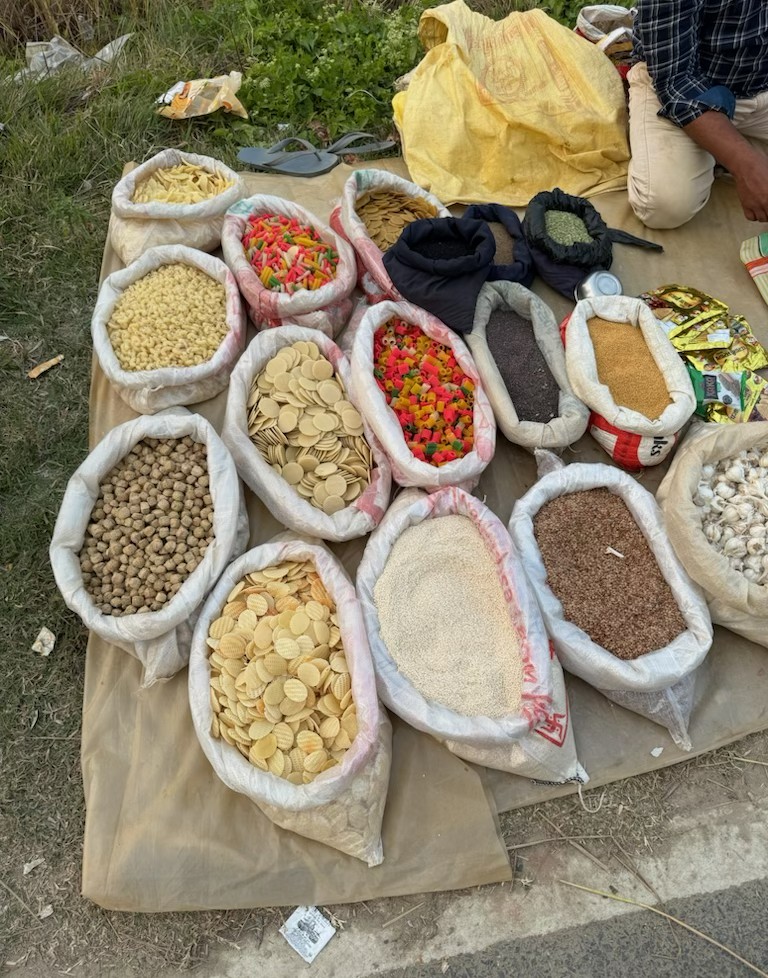
Climate adaptation became equally important in a region increasingly vulnerable to heatwaves, erratic rainfall and flooding. Women adopted low-cost trellis systems, mixed cropping techniques and millet cultivation that required less water and fewer chemical inputs. Finger millet cultivation alone brought food security for several weeks each year to participating households while reducing dependency on purchased grains.
But success in production exposed another problem: there was nowhere fair to sell surplus produce.
The nearest rural markets were seven to ten kilometers away. Markets operated only twice a week and were dominated by traders and middlemen. Women struggled with transport costs, safety concerns and lack of space to sell. During extreme heat or cold weather, many returned home early with unsold vegetables. Traders often dictated prices, leaving farmers with thin margins despite rising production.
Inside one monthly savings group meeting, women began discussing a question that would eventually reshape the local economy: What if they created their own market?
With support from field facilitators, the women identified a location near Nawani Panchayat Bhawan — a central point connecting three administrative blocks: Madhepur, Lakhnaur and Phulparas. The site was within roughly three kilometers of surrounding villages and accessible from multiple directions.
Community consultations followed. Local landowners supported the proposal, recognizing that a nearby market would benefit entire villages, especially women who otherwise spent money and time traveling long distances for basic purchases.
The market initially opened one day a week. Within a month, demand grew so quickly that the community added a second market day. Today, the haat bazaar functions not merely as a trading point but as a local economy in which women from numerous communities participate.
Its success rests on several subtle but powerful shifts.
The market is close enough for women to travel safely and independently. Because it specializes in fresh local produce grown through low-chemical or organic methods, customers actively seek it out. Women vendors no longer compete for marginal space under established traders. Middlemen have limited influence. Transportation costs have fallen sharply. Buyers from outside villages now stop regularly because the market sits along routes connecting multiple blocks.
Perhaps most importantly, the market operates around women’s realities rather than against them.
During periods of extreme heat, trading begins later in the day, after temperatures become manageable. Women vendors feel secure returning home after selling their products. Female customers similarly feel comfortable visiting the market, contributing to a distinct social atmosphere where commerce and community overlap.
Positive economic changes are increasingly visible. Forty-seven women now regularly sell vegetables, fruits, millet flour and oilseeds in the haat bazaar. Many earn between ₹4,000 and ₹8,000 a month from sales. Some cultivate crops specifically based on customer demand observed in the market.
Others have diversified into entirely new enterprises. Three women who had never previously operated businesses now run fast-food stalls during market days, earning up to ₹1,200 per haat. Two women sell tea and snacks. Another vendor sells bangles and cosmetics to women customers. Small food stalls selling puffed rice, fried snacks and local items have emerged as stable household income sources.
One of the more striking stories belongs to Vimli Devi. Using a loan from her savings and credit group, she began a small fish business, purchasing fish from nearby villages and storing them in a pit near her home before market days. As demand grew, customers started coming directly to her house to buy live fish. During the COVID-19 lockdown, when her husband and son returned from cities after losing migrant jobs, the family expanded the enterprise together. Today, her husband and son sell fish in the market while Vimli Devi manages sales from home.
The haat bazaar has also begun altering gender roles within households. Men increasingly assist women-led enterprises. Women who once hesitated to travel alone now negotiate prices, manage inventory and make investment decisions. Peer learning has encouraged minority community women to begin poultry rearing and goat farming, creating new streams of income from egg sales and livestock.
The market’s deeper achievement may not lie in the number of stalls or the volume of sales, but in the confidence it has generated. Women who once saw themselves only as laborers or dependents now speak of customers, profits, product quality and future expansion. They discuss market demand, climate risks and savings strategies with practical fluency. Economic participation has translated into public visibility.
In rural development conversations, markets are often discussed as infrastructure. In Nawani, the haat bazaar became something more intimate: a social space where women learn to occupy economic life openly and collectively.



Comments
We changed commenting systems on September 10, 2026 as part of a site-wide functionality and security upgrade. Your past comments have not disappeared, and you can still log in with your old Disqus account credentials if you wish. Contact us with any questions.
Local resilience eventually needs local exchange capacity. I keep coming back to the idea that community without exchange is fragile.