

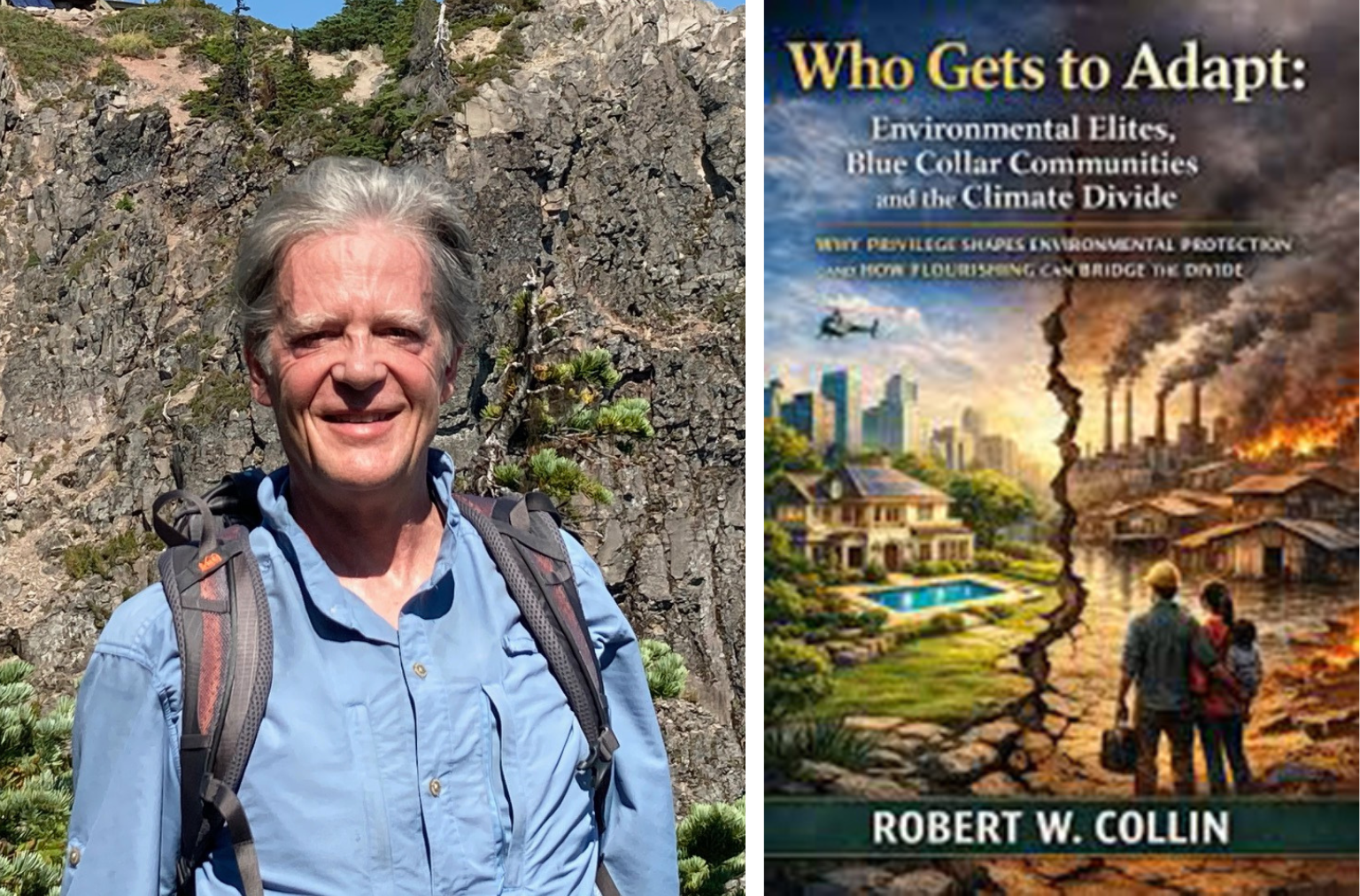
Robert W. Collin’s Who Gets to Adapt? Environmental Elites, Blue Collar Communities and the Growing Climate Divide is a solid examination of one of the most overlooked dimensions of climate change: not who is at risk, but who has the power to respond. The book’s core message is that climate vulnerability is deeply rooted in social, economic and political inequalities, and that if we are to build truly resilient communities, we must address these inequalities through targeted investments in infrastructure, public services and community-led resilience programs.
At the heart of the book is Collin’s concept of environmental elitism, which he defines as the concentration of environmental decision-making power in the hands of privileged institutions and actors. These include government agencies, large nonprofits, universities and the finance/insurance/real estate sector. Together, these institutions shape where adaptation funding goes, what kinds of solutions are prioritized and whose knowledge is considered legitimate. The result, Collin argues, is an adaptation system that consistently protects high-value assets while leaving vulnerable communities exposed.
Collin shows how this system works in practice. He shows how redlining, zoning and industrial siting have concentrated climate risk in low-income and minority communities. These same communities now face higher insurance costs, weaker infrastructure and fewer financial resources with which to recover from disasters. Meanwhile, funding for climate adaptation initiatives tends to flow toward well-resourced institutions better positioned to secure grants. These disparities are not abstract: Estimates suggest that climate change imposes nearly twice the economic burden on the average blue-collar American as on the average white-collar American.
Collin explains how the insurance and financial systems reinforce the climate divide. As climate risks intensify, insurers raise premiums or withdraw coverage from certain communities altogether. Wealthier households can relocate or absorb these costs; lower-income households cannot. The result is a pattern of displacement that Collin describes as “climate gentrification,” in which areas better protected from climate impacts become more expensive, in turn pushing out long-time residents who lack the means to keep up with rising costs. This dynamic is already affecting millions of homeowners in states like Florida, California, Oregon and Louisiana, where the phenomenon of insurance retreat has become particularly pronounced.
The solutions section is cogent and wide ranging. Collin argues that climate adaptation projects should be funded based on need, not property values, and that those investments should come with strong provisions to ensure vulnerable communities are protected against displacement. He’s critical of technocratic, market-driven solutions, which often come at the expense of simpler, more effective, more equitable ones. And he stresses the need for reforms to climate adaptation finance, which too often relies on loans that impoverish the very communities they’re meant to help.
Collin emphasizes that knowledge itself—in the form of climate data, planning tools and the know-how needed to successfully navigate the application process for climate adaptation grants—is a form of infrastructure. He shows how access to these resources is unevenly distributed, and how the resulting knowledge gap has become a key driver of inequality in communities’ ability to adapt. But he also points out ways in which the divide is beginning to narrow as these resources become more widely available.
One of the book’s most important contributions is its effort to redefine what counts as successful adaptation. Collin persuasively argues that adaptation should be measured not only by infrastructure protected or economic losses averted, but also by people’s ability to remain safely housed and healthy. Success should be judged by the degree to which it enables people and communities to flourish. This emphasis on flourishing sets the book apart from more conventional approaches to climate policy, which tend to put technical solutions and cost-benefit metrics above lived outcomes.
It’s also to Collin’s credit that he draws attention to the often-overlooked workers who make climate adaptation possible. He emphasizes that adaptation infrastructure is built by workers—construction crews, utility workers, emergency responders—who face some of the highest risks from heat, smoke and other hazardous conditions brought about by climate change. Yet these workers are rarely a priority in adaptation planning. He argues for stronger labor protections for those who make up the climate workforce.
He also stresses the importance of collective institutions like labor unions, community organizations and informal networks like amateur radio operators in building what he calls “community climate capacity.” These institutions empower communities to take action, rather than remaining dependent on outside institutions for help.
Apart from its critique of today’s prevailing climate adaptation systems, the book also functions as a practical handbook for those neglected by these systems. The book is filled with preparedness checklists and lists of resources aimed at both individuals and institutions. Collin makes clear the book isn’t just for policymakers and scholars, but also for workers, unions, community members and others seeking to understand and act within these systems.
The book isn’t perfect. Collin’s arguments are powerful, but they are often repeated across chapters with very similar wording each time. We read numerous times that insurance markets raise premiums and withdraw from high-risk areas, that wealthier communities receive investments in climate adaptation infrastructure while working-class neighborhoods remain exposed, and that adaptation systems tend to prioritize property and market value over people and the long-term stability of communities. This repetition dulls the book’s impact and makes its analysis feel less sharp than it could be.
Even so, Who Gets to Adapt? is an important, timely contribution to the field of climate policy. It challenges readers to rethink adaptation not as a neutral or purely technical set of solutions, but as a question of power, justice and collective responsibility. Collin makes a convincing case that unless adaptation efforts are reformed to include those most at risk, they will continue to deepen the inequalities they are meant to address.
Who Gets to Adapt?: Environmental Elites, Blue-Collar Communities, and the Climate Divide By Robert W. Collin. Environmental Policy Press, Kindle e-book edition, April 2026.




Comments
We changed commenting systems on September 10, 2026 as part of a site-wide functionality and security upgrade. Your past comments have not disappeared, and you can still log in with your old Disqus account credentials if you wish. Contact us with any questions.
Without having read the book, I hazard that this is a very good review, and that it summarizes the main point of the book well. But it needs to be pointed out that the advantages of the rich in adapting to climate change have an expiration date, as long as we exclude mitigation and are willing to expend resources only on adaptation. If we are determined to burn the very last of the fossil fuels, that will propel us to a point where no place is secure, the entire Earth is subject to unpredictable catastrophes and modernity is no longer possible. The kind of changes we need to make for serious mitigation often involve spending and consuming less, but also revamping the ways we do pretty much everything, which would have a price tag. For one thing, establishing enough renewable energy and battery storage everywhere to make possible a decent living–at a much lower energy-use level in the rich countries–will require diverting fossil fuel energy to production of the necessary components. In the long run, not only do we have to mitigate emissions to have a survivable future, we also need to stop our devastation of ecosystems and our pumping out of plastics, PFAS and other toxins. Which brings me to the other issue–it's fine to say that the current system privileges the rich and should be changed. But we've come to the point we have because only the rich, and the mindless corporations, have political power. How do we change that?