

Several commentators have remarked that the United States’ war on Iran carries echoes of 2008. I’ll argue here that a potential financial crash this year could actually be much worse.
The Global Financial Crisis (GFC) of 2008 was the biggest economic crunch since the Great Depression. Unemployment surged, topping 10 percent in the US. Global stocks lost trillions of dollars in value. Major brokerage houses collapsed. The US auto industry only survived thanks to enormous government bailouts. How could another crash top that?
Consider the causes. The 2008 Great Recession resulted from a confluence of three factors:
- Failed US wars in the Middle East, in that instance against Iraq and Afghanistan. Many economists argue the Iraq and Afghanistan Wars contributed to the GFC by fueling massive American budget deficits and worsening trade imbalances, and by creating a “capital flow bonanza” that triggered the US credit boom. While not the sole cause, the war compounded the vulnerability of the US economy.
- Soaring oil prices, following the plateauing of world conventional oil production in 2005. Oil demand continued to rise but the global supply of oil did not follow suit. On July 11, 2008, crude prices hit $147 per barrel, their all-time high. Since the economy runs on energy and oil is the world’s most important energy source, oil prices have a way of impacting all industries. Financial markets crashed three months after the oil-price peak.
- A bursting financial bubble inflated by subprime mortgages in the US and financial derivatives traded worldwide. The mortgage bubble involved $1.3 trillion to $1.5 trillion in high-risk loans issued during the 2000–2006 housing boom. It was a house of cards waiting to tumble.
The resulting unwinding of debt and derivatives came within a hair’s breadth of turning into a massive bank run and general economic collapse. Governments (led by the US) bailed out industries and banks, lowered interest rates to zero, purchased large tranches of financial securities, and instituted enormous fiscal stimulus programs and tax cuts. Even with these rapid and maximum-scale efforts totaling hundreds of billions of dollars, the GFC led to widespread housing foreclosures, a near-40-percent downturn in the S&P 500, and a substantial increase in the poverty rate.

Now consider the following:
- Today’s AI financial bubble is four times bigger than the subprime mortgage bubble of 2008 and 17 times bigger than the dot-com bubble of 2000.
- The Iran war, though so far not involving US ground troops, could possibly end up being more problematic than the Iraq invasion of 2003, if only from the standpoint of flows of energy and international trade. The war is likely to result in real oil shortages and prices potentially even higher than those seen in 2008. Additionally, more of the Middle East is now involved in hostilities, and oil and gas production and shipment infrastructure is being damaged or destroyed, thereby undermining the long-term economic prospects of the region, as well as destabilizing its politics. No one knows how this will end.
- For the US economy, warning signs were already flashing before the war: stubbornly high inflation, a bad jobs picture, and worsening consumer sentiment were indicators of a looming recession.
- The final factor can be stated as a question: Would today’s US Treasury head be as successful at averting financial doom as was Henry Paulson in 2008? Then, the US was able to enlist government and business leaders from the world’s key countries to cooperate in fashioning a collective survival strategy. Would current US Treasury Secretary Scott Bessent have similar success, given the recent global collapse of trust in US leadership?
In view of the possibly catastrophic consequences of the attack on Iran, many people wonder what motives could have justified it. Logan McMillen argues in Foreign Policy in Focus that the so-called “Donroe Doctrine” intends to freeze China out of the Western Hemisphere and to deprive it of cheap energy:
“The strategy is entirely zero-sum. By turning the Middle East and the Caribbean into militarized chokepoints, the United States is suffocating China’s independent oil supply lines, starving its industrial capacity while guaranteeing temporary windfall profits for Western supermajors. Concurrently, from the lithium flats of Bolivia to the ports of Peru, Washington is deploying right-wing proxies and military coercion to systematically dispossess Chinese capital in Latin America, re-colonizing the Andes to secure the supply chains of the twenty-first century.”
Other commentators see the war as being spearheaded by members of the Christian Zionist movement, which desires a fulfillment of biblical prophecies of the battle of Armageddon and the return of Jesus.
Even if McMillen’s analysis is sound and there is an arguably rational motive behind the war, that doesn’t mean the campaign will go according to plan or that it will achieve its aims. Many analysts see it already careening off the rails.
It’s too late to prevent the inflation of an AI bubble or to advise against a US attack on Tehran. At this point, the most we can do is to hope for a quick end to the war and for some improvisational brilliance among the world’s leaders of government and finance.
Meanwhile, it would be smart to make whatever preparations you can. For folks in the northern hemisphere, it’s time to start planning this spring’s food garden. You might want to plant a few more rows of beans than you do most years, so you have enough to share with neighbors.




Comments
We changed commenting systems on September 10, 2026 as part of a site-wide functionality and security upgrade. Your past comments have not disappeared, and you can still log in with your old Disqus account credentials if you wish. Contact us with any questions.
Aye, I have a friend who devolves every discussion of macro-threats to: "time to plant a garden".
Ultimately life is about access to energy – usually called food. Producing as much of your own as possible is the best card in your hand – all else is subsequent.
If you have time for subsequence, networking and skill-acquisition are the next two.
And the question to ask all the time is: Will this make me more resilient; more able to withstand and even better, to give?
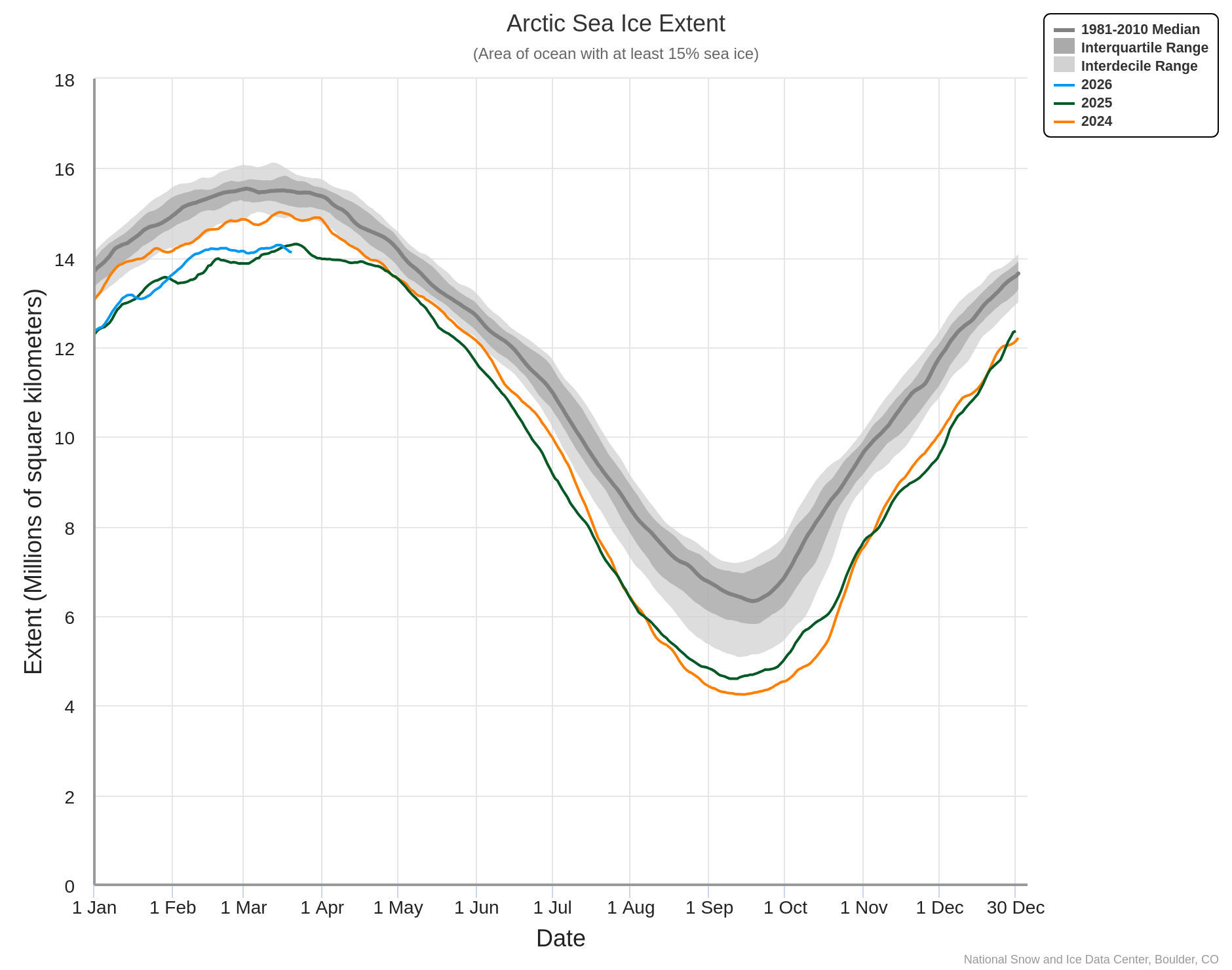
Richard, thank you so much for your years of output – and thanks for these recent series of assessments… I've been somewhat narrowly focused on the Arctic (following Wadhams) as a core driver of historic Holocene weather patterns, and was shocked when NASA/GISS AR6 model submissions showed an unbelievable end to Arctic Amplification under the worst case scenario. This is the second 'year without a winter' here in the central AZ mountains, consistent with the observation of persistent non-Holocene arctic ice that began ca. June 2024. Most ice monitoring has been shut down for some time by … *
So it's important for me to hear from someone like you who integrates perspective much more widely than I am able to. Yes, I would say there is great concern over food. Best to live within ez rail access to ports, I would suppose.
Chomsky spoke of a widespread understanding that one US political party being most dangerous for any continuing civilization. Despite the apparently divergent motivations you mention, are these bizarre actions somehow driven by a kind of unifying insanity?
___________
At this point, the most we can do is to hope for a calamitous defeat of the US in the Persian Gulf or a decapitation of the US leadership. Wars of aggression, especially wars started and approved by the Western world’s leaders of government and finance, require unconditional defeat if they are to result in a better world. As long as the US is able to use its surpluses to remain mobilized for total war, wars of aggression supported by the lords of finance will continue to make victims of nations coveted by the imperialists.