

As I learn more about the way humans used to live before agriculture (and a few still do today), I am often reminded of an experience I had in my youth that contains parallels to the situation Indigenous groups find themselves in today. Things were going pretty well for them before their lifeways were destroyed: they had life figured out.
Aside from a brief coda, I’ll let parallels speak for themselves. My small tribe will play the part of displaced people, and the Western “authority” figure will be obvious. In making this parallel, in no way do I mean to imply that my momentary discomfort has even the slightest equivalency. That said, the experience still offers a window, even if a very grubby one.
Oh—and if the story comes off as boring, I do apologize, but that’s only because it hasn’t been embellished.
When I was a co-operative education undergraduate student at Georgia Tech, I spent alternating quarters at the Naval Research Laboratory in Washington D.C. (eight 3-month stints in total). I was not the only co-op student at the lab, and we had a tendency to find each other and go on outings together (or take long government-job lunches together).
One time, six of us went on a weekend bike trip to Chincoteague Island off the DelMarVa (Delaware–Maryland–Virginia) peninsula. I can’t remember where we parked the cars to start the bicycle part of the journey, but the idea was to bike most of the day, arrive on the island, pile into one or two cheap motel rooms, and then ride back to the cars the next day. It was summer, and we were all around 20 years old give or take a year or two, traveling very light, wearing shorts and tee-shirts.
The first part of the journey went well enough, although we were all tired and a bit saddle-sore from a long ride. As far as I recall, our first order-of-business was to address ravenous bellies—which we did at a loud bar-type place, our bikes in a pile outside. It got dark while we ate, and when we came out, the mosquitos had come out as well.
I don’t believe I have ever experienced mosquitos at this scale. The explanation was that because Chincoteage was a wildlife refuge, spraying to reduce mosquitos was prohibited. Within five or ten seconds of brushing your forearms, each arm would re-populate with about a dozen mosquitos. They were pretty intense. We were glad to get back on bikes to look for a place to stay—sore undercarriages be damned. This is well before mobile phones and internet, so the most expedient option was just to bump around the small town, stopping at each establishment.
But here’s the thing: on this Saturday night in summer, no place we checked had any vacancy. Some of the kindly proprietors suggested a nearby campground, but we didn’t have tents and the mosquitos were a real concern. We exhausted every possibility, and came up absolutely empty.
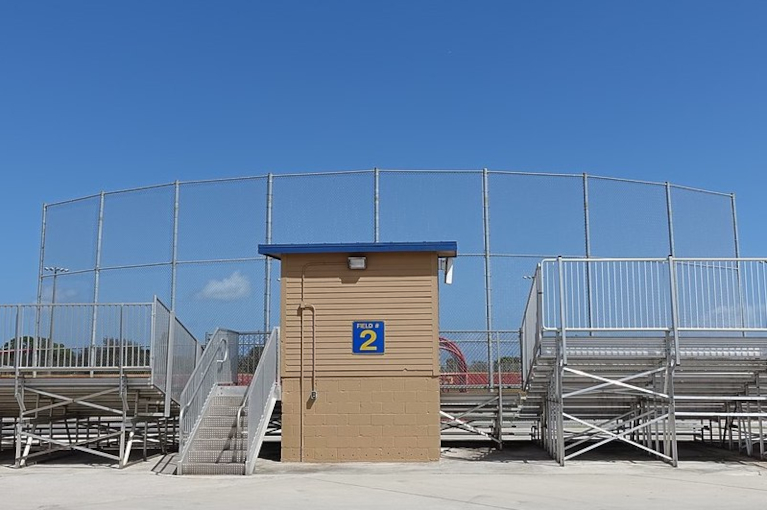
I can’t remember why we deviated from the main drag—probably both because we wanted to poke around for out-of-the-box options, and because riding around meant putting off mosquito battles. In any case, we came across a little-league baseball field. Something inspired us to wonder if the mosquitos would be troublesome on the flat roof of the little building behind home plate.
We stashed our bikes in the dugout area—partly shielded from view by plywood walls—and clambered up the adjacent chain-link fence onto the roof. One of our tribe had the foresight to bring a coarse bedroll blanket, which was large enough when spread out for all six of us to lie side-by-side, rather than on the gritty asphalt roof. It was a warm night, so being exposed to the clear sky was plenty comfortable in our pile.
Plus, we were so exhausted by this point that great comfort was not a requirement. It surprised and pleased us that the mosquitos didn’t seem to follow us up to the roof or find us once we were there. Within a few minutes I had drifted into a delightful sleep—as had, I believe, all the others.
We had maybe a half-hour of this intense sleep before being startled awake by someone rapping on the building and calling out: “Anybody up there?”
It was a policeman. He had seen our various bikes’ reflectors in the dugout, and stopped to investigate. We were not terribly pleased.
From our perch on the roof, illuminated by flashlight, we explained to him our plight, that we were not vagabond miscreants, and that this was a last-resort move on our parts. Could he please just let us stay? We’re not bothering anybody or causing any damage, and had just fallen asleep. But no: it was against some law of civilized behavior.
All the same, he wasn’t a total jerk. He offered to drive one of us around to all the places he knew looking for a proper place for us to stay. I ended up being the one to go with him, so I climbed down and hopped in his car—groggy from the exact wrong amount of sleep.
The accommodation story hadn’t changed, and the policeman was a bit miffed that his diligence was no better than ours (and that we were not, in fact, lying to him). The only difference this time is that he swung by the campground a little farther out of town.
The campground host said all his sites were occupied, but that on occasion he lets people set up tents in the field over yonder. When he learned that we had no tents, he told the policeman that he couldn’t in good conscience allow us to sleep in the field unprotected: the mosquitos would probably carry us off!
At this point, the cop turned to me and asked, “Were you happy where you were?”
I found it rather irritating that we had indeed been happy: we had worked out a comfortable situation, and had tried to indicate as much when he first came along. But at least it was clear that we were about to be granted off-the-books permission to stay, which was some solace. I longed to get back to sleep!
By the time we got back to the ball field, everybody was off the roof and ready to roll to wherever we’d be going, swatting the mosquitos away in silent grumpiness. As the cop drove off, I walked over and explained we could stay there after all. Groans.
So, we pulled ourselves back up to the roof. And so did the mosquitos. Maybe they would have eventually found us anyway the first time, but we were at least able to drift off to sleep before. This time, it was proving to be impossible. Our previous arrangement on top of the blanket was untenable.
We decided to lie directly on the uncomfortable roof with the blanket on top of us. It was too hot for six people to cram under a blanket in summer, and the roof was an unpleasant surface to be on. But being on top of the blanket was worse. Nobody slept. We simply endured until first light, when we got on our bikes and headed for the beach.
There, we crashed in the cool morning sand listening to the Atlantic breakers and plunged into the most delicious sleep I can remember. My body felt like it weighed 8,000 tons, and might fall through the sand to the center of the Earth. Two hours later, the full-sun heat woke us up. But we were young and refreshed enough to bike back to our cars.
Indigenous Coda
“Were you happy?” Yes, we were until you came along. We had it worked out and were living comfortably. Now the question comes a bit too late. What we had before is gone, and we can’t simply return to it. The damage is done. I mean, it’s something that you recognize the folly, and begin to suspect or admit that things might have actually been better before all this. But damn.




Comments
We changed commenting systems on September 10, 2026 as part of a site-wide functionality and security upgrade. Your past comments have not disappeared, and you can still log in with your old Disqus account credentials if you wish. Contact us with any questions.
Interesting enough parallel, but it doesn't help us where we are going. The combination of polarised politics (via self-reinforcing algorithms, in large part) and existing infrastructure (both built and social) is our starting-point. Plus the fact that we're overshot as a species and as he points out, we aren't going back.
There are always best cards to play, though, and usually a best sequence in which to play them – but you have to be aware of the venue, of passing time, and of who/what else is playing. We will probably attempt to 'hold' at ever-lower-but-still-unsustainable levels of material/energy throughput; wasting precious reserves of both in the process. Meantime the collection of 'already built' stuff will be available to repurpose/cannibalise, albeit it will be decaying. That could last for a century.
And we won't lose science completely, although great chunks of it will die a server-farm death. How to retain useful science (soil quality, seasonal tracking, health in an ex-commercial world) is a key question. How to lead the inevitably-smaller social groupings, is another. I'm fond of saying that Moses went around the corner and hammered-out 10 bullet-points on an A4; that keeping the message simple (call it science communication) will be the key to good leadership and group cohesion.
Interpersonal skills will be forced to improve (to where they were pre-screen, as in back in the days of Tom's anecdote). Also our reading of local biodiversity, nurturing it and understanding our limitations, will be a biggie. Currently in my country, introduced species are threatening indigenous ones, but our arrogance assumes we will win the eradication war – even though we haven't. We will have to come to terms with that; work out what to live with and what is worth fighting.
I find it all fascinating; from the short-focused political nonsense gripping the First World, to the climate-only virtue-signalling, to the self-reinforcement of most personal narratives. Learning how to work-to-live rather than live-to-work was one I learned early – although it entails more real work than so-called 'work' in the First-World sense. Being able to say 'I got that wrong' is important too – hard to do but important. 20 years ago I thought we could all live on renewables – became an early-adopter, pushed the change. I know now that isn't correct; but that reverting to fossil energy isn't either. We will end up on real-time solar, probably forced to be low-tech-collected and locally-used. Food-production will be a big part of that collection.
And fun/entertainment will be different, but what and how will depend on the people involved, given that culture is whatever we want to make it be. I doubt we'll lose music, or story-telling.
If people remember only one thing from the entirety of modern science their lives will be enhanced greatly, no matter the level of their technology – microscopic germs cause disease, so clean or boiled water is best. That's it.
Agreed. I save and restore robust – mostly hand-operated – tools. We will use them until we can't – which is why I agree with TM that we won't be 'going back'.
Incidentally, I have a lot of fun with people who (through fear, I suspect) parrot that old one about the stone age not running out of stones, therefoe the oil age won't… – I point out that it was the firewood age, in energy terms and that yes, they often cleared the vicinity of trees….