


This is the second-part of my climate-not-all-bad-news series, beginning with the state of the U.S. Here I turn to China, a paradoxical story of both immense challenges and great hope.
Growth as the world has never seen
It is the nation that holds the world’s climate future in its hands.
It is the nation whose 2014 commitment to peak climate pollution by 2030 made possible the 2015 Paris Climate Accord target to cap global heating at 1.5°C.
It is the nation which has made keeping that commitment most challenging, being responsible for 90% of the growth in global carbon dioxide emissions since 2015.
It is the nation whose rapid deployment of clean energy technologies may peak its climate pollution this year or next, offering the best chance for holding to at least not greatly overshooting the Paris commitment.
It is China, whose economic surge over recent decades has exceeded anything the world previously witnessed. China is now the world’s largest economy by purchasing power, with 19% of global output. In real terms it is over a quarter larger than the United States. Even that might understate the case.
China has experienced
“the greatest development surge in human history driven above all by an unprecedented and spectacular surge in urbanization,” writes historian Adam Tooze. “As a physical productive apparatus China completely dwarfs the United States (and any other comparator). China’s total electricity generation is twice that of the United States. China’s steel production is ten times that of the USA. China’s cement production is more than twenty times that of the USA.”
Tooze concludes, “It is China’s story, more than any other, that defines our current horizon of expectation and the scope of our current possibilities.”
“China is the worldʼs greatest emitter of greenhouse gases, therefore the countryʼs ambition in its climate agenda is decisive for keeping the international community on track for a 1.5°C or 2°C pathway,” notes a recent report from the Centre for Research on Energy and Clean Air (CREA). “China is responsible for 30% of global GHG emissions and more than 90% of the growth in carbon dioxide emissions since the signing of the Paris Agreement in 2015. Chinaʼs emissions have more than quadrupled over the past two decades, making it the primary driver of global emissions growth over the period.”
Though China is the world’s largest exporter, growth of the domestic economy has also played a significant role in emissions growth. CREA says industrial growth to supply export markets was the biggest player from 2000-8, but since 2009 building construction, infrastructure expansion and industrial development for domestic consumption have been the largest contributors.
China may be peaking now
Historic emissions, the cumulative contribution of climate-twisting gases over time, demonstrate how significant China has become to the global climate picture. Carbon Brief calculates China’s have now surpassed those of the European Union.
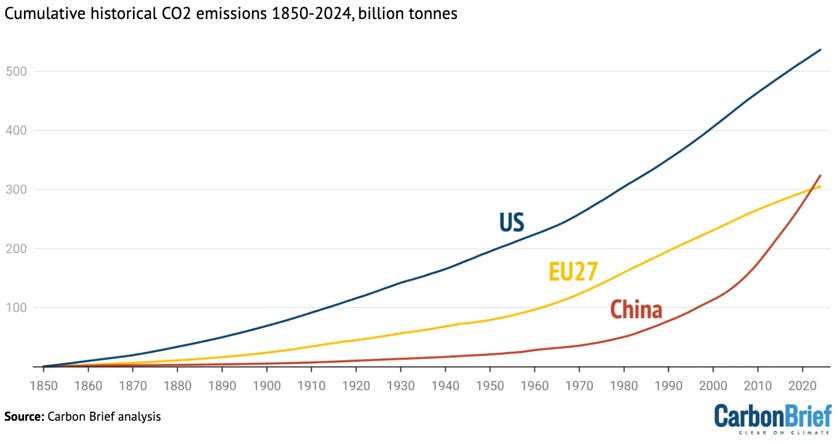
U.S. and EU emissions have been declining for some years, and will continue to do so, even in the U.S. under Trump. The momentum of clean energy technologies is now too strong, as I wrote in a recent post.
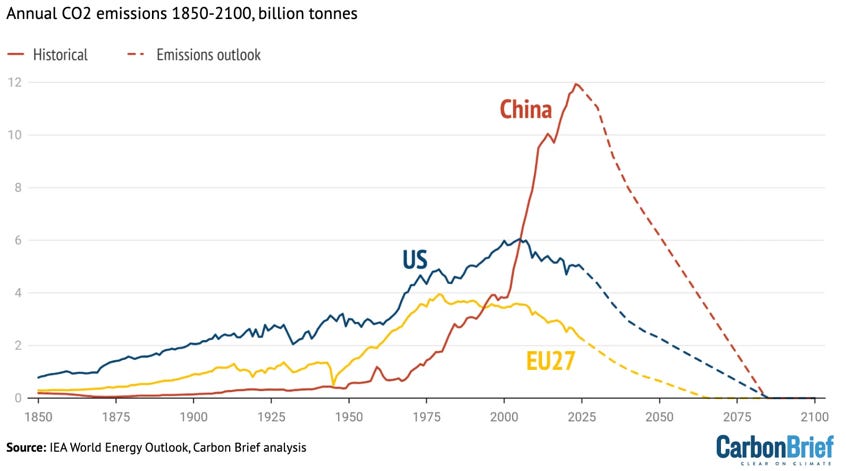
But China’s overall emissions might never exceed those of the U.S., underscoring the huge responsibility the U.S., still the world’s second largest climate polluter, bears for reducing its climate pollution.
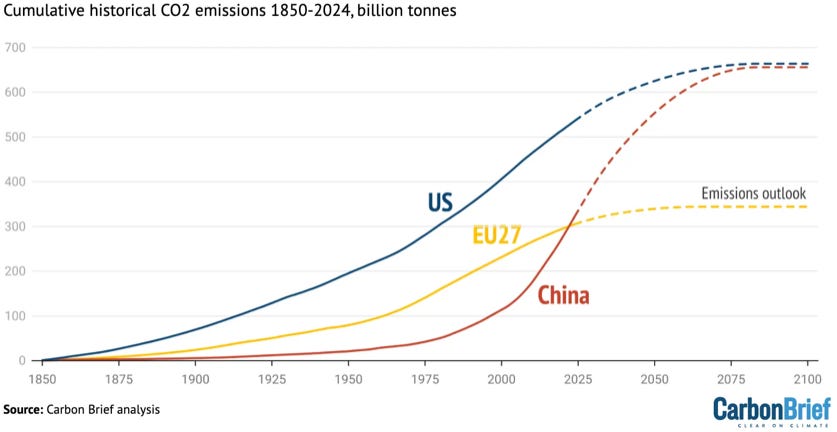
Still, whether the world has a shot at the 1.5°C target, or at least not going too far beyond that, depends on how quickly China peaks and reduces its climate pollution. China is slated to announce its 2035 target this coming February.
CREA’s survey of experts finds an increasingly optimistic perspective. Asked if China’s emissions have already peaked this year or will by 2025, 44% responded yes, up from 15% in 2022. Over 70% believe China will certainly achieve its 2030 peaking goal.
Importantly, 52% say China will peak coal consumption by 2025. The addition of over 200 new coal plants in recent years is a major reason for the surge in Chinese emissions. But only 9 GW of new plants were approved in the first half of 2024 compared to 52 GW in the same period last year. Similarly, a slowdown in addition of steel capacity – China makes over half the world’s steel – and move to greener and more efficient alternatives is a reason for optimism.
Building most of the world’s solar and wind
The greatest source of increasing optimism is China’s renewable energy boom, whose boggling scale has already exceeded its 2030 growth targets for wind and solar energy. In 2023 and 2024, China installed the majority of solar photovoltaic capacity, reports Ember. In 2023 it was 260 of 459 gigawatts, and in 2024 224 of 593 gigawatts.
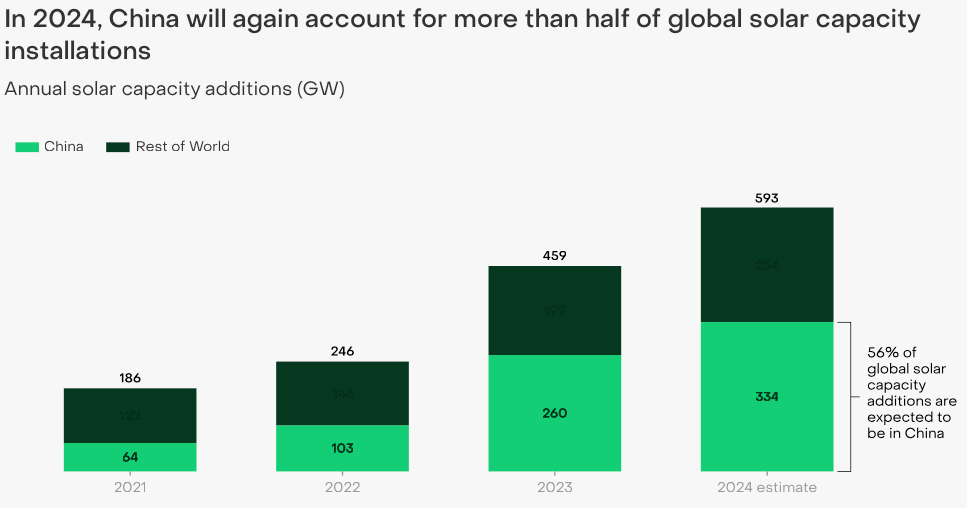
Credit: Ember
Putting together the picture for Utility-scale wind and solar growth, China’s lead over the rest of the world is stunning, accounting for 64% as of July 2024, Global Energy Monitor reports.
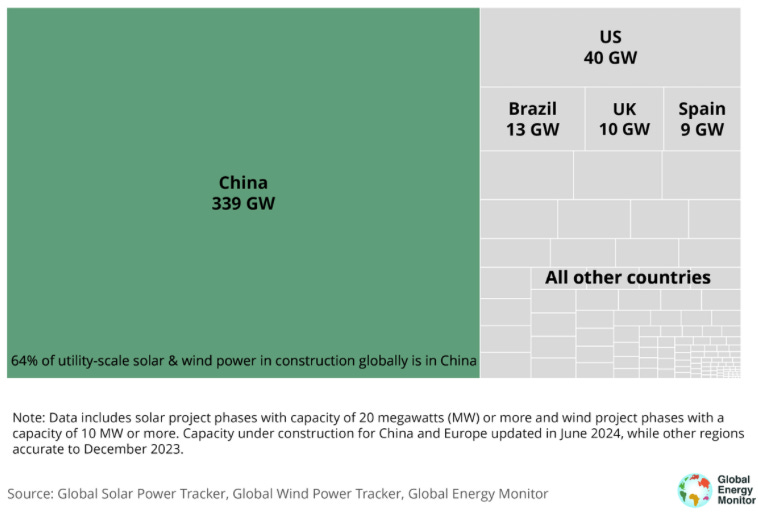
“China added almost twice as much utility-scale solar and wind power capacity in 2023 than in any other year,” says Global Energy Monitor. ”By the first quarter of 2024, China’s total utility-scale solar and wind capacity reached 758 GW, though data from China Electricity Council put the total capacity, including distributed solar, at 1,120 GW. Wind and solar now account for 37% of the total power capacity in the country, an 8% increase from 2022, and widely expected to surpass coal capacity, which is 39% of the total right now, in 2024.”
In fact, clean energy is taking up the slack for the downturn in China’s real estate sector, which has been an important source of the nation’s growth. Clean energy accounted for 40% of economic growth in 2023, CREA reports.
China on a 1.5°C track?
But will China be able to continue? On the plus side, utility-scale solar has now become the cheapest source of power in the Asia-Pacific region, its lifetime cost dropping 13% below coal in 2023 and expected to be 32% less expensive by 2023, Wood Mackenzie reports. Adding in battery storage to firm up power supply, utility-scale PV is competitive with gas generation now, and will be competitive with coal by 2030.
The critical issue is grid capacity.
“The key constraint on clean-energy growth will be the ability and willingness of grid operators to integrate very large amounts of clean energy,” writes CREA lead analyst Lauri Myllyvirta, also a senior fellow at Asia Society Policy Institute, China Climate Hub.
He continues, “Last year, numerous provincial grid operators began to limit additions of new wind and solar, due to concern over not being able to fully integrate the additional generation . . . The challenge is that China’s grid management is outdated. Reforming grid operation requires overcoming powerful interests, most notably the owners of coal-fired power plants who are reluctant to accept the reduced space for coal-power generation that follows clean-energy growth.”
On the other side of the equation are local governments, which on the China scale rank in population with many European countries. They have been a dynamic factor in pushing renewables forward as a rural economic development strategy.
China could cut its carbon pollution 30% by 2030 compared to 2023 if it achieves certain goals, CREA projects. Continuing its solar and wind growth could give the nation 3,500 GW of renewables by 2030 and 5,000 GW by 2035. Overall non-fossil electricity could amount to 65% of supply by 2035, putting that sector on a 1.5°C Paris path.
Reducing transport emissions to 2020 levels by 2035 would align that sector with the Paris target. That would require that 60% of auto sales be electric vehicles, not a far reach from the 50% level of EVs and plug-in hybrids. The share of freight going by rail would have to increase to 25%.
Industrial decarbonization is crucial. The largest source of growth in energy use from 2020-3, 4% annually, was government emphasis on energy intensive industries such as steel and chemicals to recover from the pandemic and downturn in other sectors, notes Myllyvirta. To stay on the Paris track, industrial emissions must decline 25% from 2023 levels by 2035, CREA says. That includes 45% in steel. China’s nationwide emissions trading system recently included steel, aluminum and cement, so that should help, CREA says.
Finally, building sector emissions could drop 40% by 2035 with elimination of coal use in buildings, still substantial, as well as low-carbon standards in new buildings, retrofit of 25% of old buildings, and heat pump penetration of 40%.
China has demonstrated remarkable capacity to rapidly make major changes. It also has a major stake. Notes CREA,
“Swiss Re, the worldʼs largest reinsurer, assesses that China is among the countries most affected by the economic and physical impacts of climate change, ranking far above regions such as the European Union and North America. At the same time, as the worldʼs largest greenhouse gas emitter, Chinaʼs own energy and climate policies have a major bearing on the severity of the climate impacts the country will face.”
China has its own fate in its hands, as well as the rest of the world. We can hope it will take the needed actions that will give us a fighting chance to hold at 1.5°C, or near it.




Comments
We changed commenting systems on September 10, 2026 as part of a site-wide functionality and security upgrade. Your past comments have not disappeared, and you can still log in with your old Disqus account credentials if you wish. Contact us with any questions.
Wrong. Geopolitical naivety. Naive belief that the world will just fall in line.
https://www.theguardian.com/business/2024/dec/18/coal-use-to-reach-new-peak-and-remain-at-near-record-levels-for-years
What this really says is coal is peaking through 2027, when use is expected to start going down. “The IEA said that the forecast boom in renewable energy over the coming years is expected to keep a cap on coal use for the next three years, even as demand for electricity is expected to surge in developing countries, before demand for the fossil fuel begins to fall by the end of the decade, the report said.” That is in line with the story I reported.
"The greatest source of increasing optimism is China’s renewable energy boom, whose boggling scale has already exceeded its 2030 growth targets for wind and solar energy."
You tell me, do you think buying trillions of dollars worth of solar and wind equipment will empower or disempower the dictatorship?
China has a collaborative system in which there are avenues to make complaints and have them responded to. Promotion to higher levels depends on how officials respond to complaints. Meanwhile we in the US have the best democracy money can buy. Somehow more people think they are living in a democracy than we do in the US. Maybe they know something we don’t. https://www.newsweek.com/most-china-call-their-nation-democracy-most-us-say-america-isnt-1711176
Why does this piece read like reality denialism? Or is it just me?
It treats the crises we face as solvable through technological fixes, which not only misses the greater picture that climate crisis is only one dimension in a multidimensional world, but additionally reinforces hubristic thinking that's at the core of the mess we made.
It should go without saying, especially here, that so-called 'clean energy' generation & accompanying infrastructure & personal EVs aren't a viable nor ecologically sound nor justifiable path for decarbonization. Tech-induced decarbonization is the worst possible course of action to combat climate crisis, which thus baffles my mind how we seemingly cannot come up with anything else.
Frankly, I lack the words and wisdom of people smarter than me to write a more thoughtful text at this point in time, therefore, I'm going to end this comment quite plainly with some food for though.
Think about this:
According to CEIC, there were 330 million registered vehicles in China as of Dec. 2023. In contrast, in the year 1949, there were only 51,000 registered vehicles in China. To get to that number, you'd have to write 51,000 for another 6,000 times.
Of these, as of Dec. 2023, only 20 million were EVs.
This leaves the need to manufacture 300 million vehicles, a feat that then would have to be redone every 10 years, or at a rate of 30 million vehicles each year, or 588 times the vehicle stock of 1949 every year.
Wouldn't it be more sound to rather work towards reducing the number of cars to that number of 51,000 instead? Or roughly 150,000 accounting for population growth. Since in no world can such a number of cars exist without unimaginable environmental degradation & destruction until resource taps eventually dry out, consequently collapsing vehicle stocks anyhow.
Why go through prolonged destruction and balloon emissions for something we can do away?
To the extent we use energy, it has to be non-carbon. To the extent we have cars they have to be EVs. Those are the trends in China. Better they are the trends than not. There is an active debate over the resource use of these technologies. In any event, it is far less than for fossil fuels. This piece lays it out. https://ageoftransformation.org/energy-transformation-wont-be-derailed-by-lack-of-raw-materials/ We have an issue with the use of fossil fueled technologies that requires we replace them with non-fossil-fueled technologies. What you are really getting at is the growth model. How much of the latter technologies and of what sort? China is also the leader in electric buses and trains. At this point, the question of what we can do is a matter of politics. People want those cars! Better half now sold use electricity than if they were 100% fossil fueled. Certainly we should be thinking in terms of deeper systemic realities. At this point, we need to take every practical avenue we can. China is certainly doing this within the context of current economic models. That is being as real as possible,.
OK good I can find a betting website and we’ll put some money on it – see how committed you are to your comforting story.
Jerry
I think you wandered onto the wrong website for you.