


It’s been days, now weeks, of smoke blowing in from the inland fires. The air is heavy, damp. Before green things burn, they steam.
In the bay the heron look especially vulnerable. I worry about them more than I usually do, as I worry about everything that depends on these tidal waters, and what they bring in, that they are solvent with life.
I suddenly notice the freight trains. Though miles away, across the farmlands, I can feel and faintly hear the ground-rumbling thud of iron on iron as they slam over the crossing beneath Bow Hill. As the tide slackens and the sun dips into an eerie orange glow, the heart-attack pace continues, unrelenting, rushing up to Canada and back, the conductor occasionally running the wipers to sweep the ash off the windshield.
Headed north, they haul hopper cars heaped with coal and black DOT 113’s loaded with LNG. Interspersed amongst those are empty centerbeam flatcars awaiting their loads of lumber. Coming back south, the coal cars and LNG tanks are empty, but the flatcars are stacked with fresh 2X4’s and plywood, wrapped like Lego blocks in bright white plastic.
It’s all right there, I realize, racing back and forth, the two main human causes of climate change, land damage and industrial carbon emissions. And with it the story of human causation in these fires.
There’s another story there, too, the story of my own thinking about climate and fires, how it’s changed. Though complexified would be a better word.
Years ago I was a classic climate activist. My attention focused fervently on CO2, not only as the sole cause of anthropogenic climate change, but as the overriding threat to the natural world I love so much.
One smoky day, held up at a railroad crossing, white bar down, my eyes followed the grim passage of the coal and oil cars as they passed. I sat powerless, lamenting the madness of continuing to burn what we know is warming the atmosphere, inching us toward catastrophe. Eventually I wrote a poem about it.
The Hauling

They are pushing the trains harder now
like profiteers in a time of war.
You can watch the dark loads passing
mounded like graves in chained procession.
There is a bad tremble in the town.

If you tilt your ear a little to the warnings,
if you peer through actual atmosphere
you will see the white flanks of glaciers
melting into the dark heaps.
You will spy charred stumps and branches
sticking out like animal bones.
You will hear holes tearing open in the sky
where songbirds are flying into extinction.

They are pushing the trains harder now
as if by redundancy they can attain normality
becoming landscape, becoming landscape, becoming landscape. . .

Growth they insist.
Freedom they promise
as the silent ash
of vanishing things
falls around our houses.
What’s interesting to me now, 12 years later, is that I didn’t even notice the timber flatcars going by, ready to pick up fresh loads. I didn’t think to consider how logging might be contributing to the fires. I saw only carbon.
Now I see both: the carbon going up, the trees coming down, carbon blankets thickening and water cycles crumbling. Both are causing climate change and both are contributing to the fires.
In the second stanza is evidence of another change in my perspective. There I refer to melting glaciers, burned landscapes and songbirds flying into extinction. And I lay all the blame on the “dark heaps” passing by, the carbon.
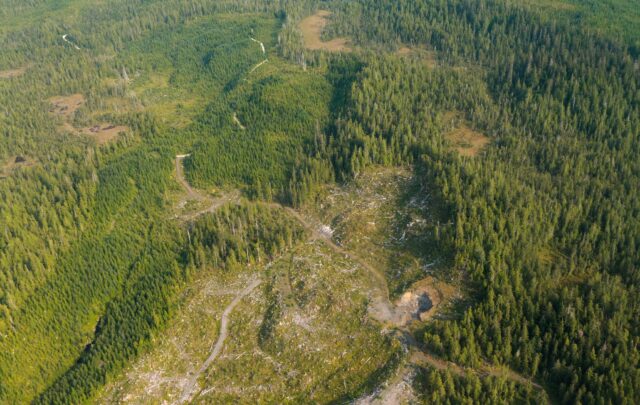
I don’t think that way anymore. Now I know that habitat destruction was and remains the main driver of extinction, in the US and the world. And as the peaks grey, I wonder about the winter moisture that’s been lost as the old, giant water towers were cut and the lowland marshes drained for cities and agriculture, as natural forests continue to be converted to plantations.
I still think about the coal cars and LNG tanks every time I hear the train go by. That hasn’t changed. But now I think also about feller bunchers and ruined forest soils. I think of how when I look up at the green hills, I am not seeing forests as much as plantations, tall green plantations.
And I think about the madness of seeing the world through the single aperture of a single gas, how limited the view, how distortive. The circling, interrelated complex of beings and relationships lose their centrality, become quantities in carbon ledgers. Worse, a narrative is emerging that says that with a warming climate forests can no longer take care of themselves, and therefore need heightened human management, continual thinning and clearing. The opposite is true. We need natural processes more than ever. They are the ballast holding the biosphere together against human disturbance.
So how would I write “The Hauling” today? It turns out only a little bit of alteration is needed. I just have to add the land-change reality to the picture. Most everything else remains the same.
The Hauling

They are pushing the trains harder now
like profiteers in a time of war.
You can watch the dark and bright loads passing.
The dark loads mounded like graves in chained procession.
The bright loads still fragrant with the once-breathing world.
There is a bad tremble in the town.

If you tilt your ear to the warnings,
if you peer through actual atmosphere
you will see white flanks of glaciers
melting off mountains.
You will spy charred stumps and branches
sticking out of the earth like animal bones.
You will hear holes tearing open in the sky
where songbirds are flying into extinction.

They are pushing the trains harder now
as if by redundancy they can attain normality
becoming landscape, becoming landscape, becoming landscape. . .

Growth they insist.
Freedom they promise
as the silent ash
of vanishing things
falls around our houses.


Comments
We changed commenting systems on September 10, 2026 as part of a site-wide functionality and security upgrade. Your past comments have not disappeared, and you can still log in with your old Disqus account credentials if you wish. Contact us with any questions.