

This article was produced by Human Bridges.
There is a great deal of attention in modern societies to inequality and the social problems it causes. Often inequality is considered to be the unavoidable consequence of how society operates in many cultures, with large population numbers and competition for resources requiring a hierarchy of successful and less-successful individuals. While our globalized world may seem dominated by this kind of society, there remain groups around the world who even today live very differently, despite continual and sometimes inescapable pressure. Anthropologists, whose science is the study of humans, have been fascinated by the diversity of ways our species have found to exist, and never more so than when confronted with cultures whose ethos and way of being are radically different from the urban societies that dominate our world: where words are weapons that actually win; where showing off your skills will get you mocked, and where every aspect of life is carefully organized so that no one person should ever have any more power than anyone else.
How do some people come to live in a group that has no one at the top, telling the rest what to do? Anthropologists call societies that do not have ranks egalitarian, which means that everyone in them is equal to everyone else. This is a form of social organization that is almost exclusively seen in groups of people who are not settled in one place, tied to one type of food or resource. Rather, they spend quite a lot of their time in small groups, moving around as suits their needs. These kinds of groups have been called hunter-gatherers, but a more accurate name might be foragers: they make their living by walking through their world and exploiting what comes to hand. More than a century of research into the groups who follow their food through the landscape, and do not tie themselves to one location or one crop, has built up a picture of societies that choose to organize themselves very differently from nation-states and kingdoms, and, most importantly, actively refuse to allow any sort of rank among themselves.
For a long time, there was an assumption that egalitarian societies were egalitarian simply because they were… simple. Living in small groups and moving constantly, they just couldn’t build up mountains of wealth to wield power over other people. And with very small numbers of people in a group—say no more than a few dozen—anthropologists theorized that it couldn’t be that complicated to run a society, so you wouldn’t need a chief or a king making big decisions. As archaeology has revealed the shape of our distant human past, it is clear that before about 15,000 years ago, every human on earth lived the same mobile lifestyle. Living with only what you can carry and constantly on the move would seem very taxing to the armchair academic of the previous century. The rather impolite implication then is that modern human societies who chose to live in these mobile, egalitarian societies, were simply the last vestiges of a primitive form of human social organization—people who hadn’t ‘evolved’ civilization.
It is actually quite remarkable that this idea that an equal society was an easy thing to maintain hung around for so long. One of the problems may have been that the groups who lived these mobile lifestyles were often in the process of being colonized and controlled when anthropologists arrived to study them, and so were in the middle of considerable social upheaval. But another problem may simply have been a failure of imagination. There was considerable shock when anthropologists like James Woodburn began to conduct fieldwork by actually learning the language of the group they were studying and going to observe and ask questions of the people themselves about how life worked in a small foraging group. His work with the Hadza people of what is now Tanzania set in motion a train of research that pointed out that life in a small group is anything but simple. Tempers flare, relationships break down, and when you depend on your group for survival, any social unrest could have fatal consequences.
Groups from around the world who maintain an egalitarian ethos have shown that rather than being too simple to ‘invent’ rank, they are instead too complex to allow one person or group of people to simply take charge. Keeping everyone in a group on equal footing requires a huge amount of effort, and has to be constantly maintained. The Ju/’hoansi people of southern Africa reckon it is particularly important to ‘cool young men’s hearts’; to stop them being prideful and boastful if they display some special skill, everyone agrees it’s very important to bring them back down to earth. A hunter is never allowed to distribute his own meat; instead, the distribution is done in public, with everyone watching. Among the Ju/’hoansi, the proper etiquette is to gently mock a successful hunter—for instance telling them the giraffe that they have killed and will be feeding several camps for days was actually a bit scrawny, perhaps.
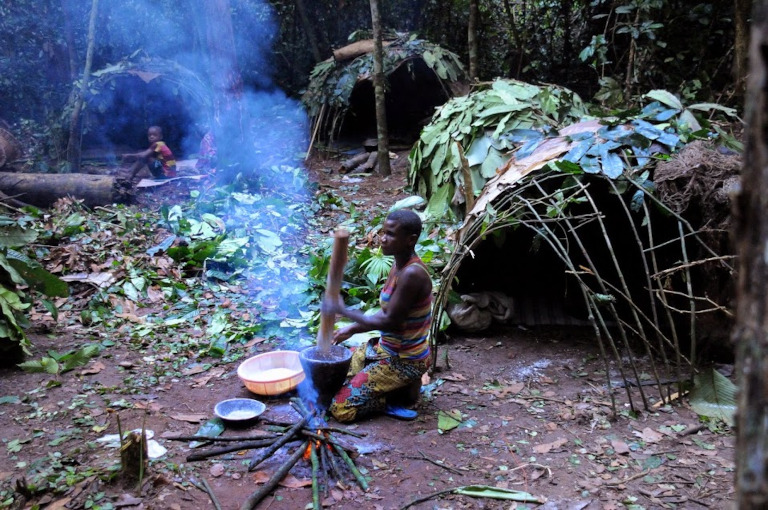
Mockery seems to be one of the most critical tools in the political inventory for groups that actively try to achieve equality. Jerome Lewis, an anthropologist who lived with the Mbendjele of Northern Congo for several years, tells how poor behavior is subtly (or not so subtly) corrected by women who act out whatever foolish or misguided thing someone has done. The improvisational theater always has an appreciative audience, and all of the group will laugh resoundingly at the person who has done something wrong. What might seem a recipe for social disaster in a group that must get along in order to survive is anything but; the mockery only ends when the person who is being made fun of eventually gives up and laughs along with the rest of the group.
We can now see that in those groups that refuse to have ranks among themselves, there are many ways that equality can be actively maintained, but they are almost entirely social. Many groups have a policy similar to that of the Ju/’hoansi when it comes to sharing meat or indeed, anything else that is in the camp—that it would be the height of rudeness not to. Those who transgress against the rules of society may have to face their whole society laughing at them. Even when and where groups choose to move is determined partly by social concerns. If you live in a small group, it is very important to stay connected to friends and family who live somewhere else, in case, for instance, you decide you just can’t stand who you are living with at the moment. It seems that the last human societies on earth to live the mobile lifestyles that our species maintained for hundreds of thousands of years do so largely as equals—but equals who must be very careful to stay that way.





Comments
We changed commenting systems on September 10, 2026 as part of a site-wide functionality and security upgrade. Your past comments have not disappeared, and you can still log in with your old Disqus account credentials if you wish. Contact us with any questions.
I have a slightly ugly interpretation of this question. Why is warfare so ubiquitous despite being obviously stupid, destructive, even insane? Why does it seem that "othering" is a human universal–perhaps hardwired? I think it's because it isn't easy to get along with the same smallish group of people every day–maybe the group is moving but the people aren't changing and there are tensions. Yet they must get along, the men have to work together in hunting, everyone must craft shelters–how do you blow off the negative emotions, the anger, resentment, jealousy, contempt that can be socially destructive? Well, if you can deflect those destructive emotions onto another group, that can be very emotionally satisfying–relieving the tension without the damage that would be caused if it were directed at the members of one's own group that stimulated it. Since survival is greatly enhanced by living in a group, for humans, this mechanism has been selected for. Hence the popularity of scapegoats, or projecting hostility onto the Other.
The short answer is men and the patriarchy. Men have used violence to establish a hierarchical social order with themselves at the top. As Hassett el al. make clear, it wasn't always that way.
What you say is true, but as you know, it is also "egalatarianism lite". Some hunteer-gatherers not only ostracisized the 'free-loaders", and "dominators", they sometimes drove them out of the tribe, and sometimes killed them. You must have read Christopher Boehm's book "Moral Origins: The Evolution of Virtue, Altruism and Shame". His hypothesis is that we are all wired, to a greater or less degree , to be both egalatarian, and to be free-loaders, or dominant, and that this genetic reality is why egalatarianism is enforced by these small bands. For a small band to survive and prosper, egalatarianism is necessary. Boehm puts together as much evidence as he could gather (including the work of the behavioral anthropologists you mentioned), as well as evidence from the social behavior of great apes, chimps, bonabos, and our immediate hominid predecessors, to create a scientific hypothesis about the evolution of morality ,a word that sounds almost arcane in our capitalist buzzsaw society in which the hungry, "darker angels of our nature" has taken control of our societies, such that dominators and free-loaders run our societies. Perhaps we should lock them all up. But who is they and who is us? We seem to have both the hierarchical predilections of the great apes, and the egalatarian morality of small bands of humans living in nature, where we evolved. I fear our morality is not up to the task of managing dominators and free-loaders with the powerful technologies we have created. If humans are to survive the crash, I think we are far more likely to then sustain successfully by staying in our ecological niche, in nature, in small social groups, seriously egalatarian.
For those who liked this article and want to read more political anthropology, I would highly recommend Pierre Clastres, watershed book, “Society Against the State.” In it, Clastres explores from an anthropological perspective key social issues such as what is power, society and the state. Reading Clastres confirms what David Graeber has said all along, it didn’t have to turn out this way.