

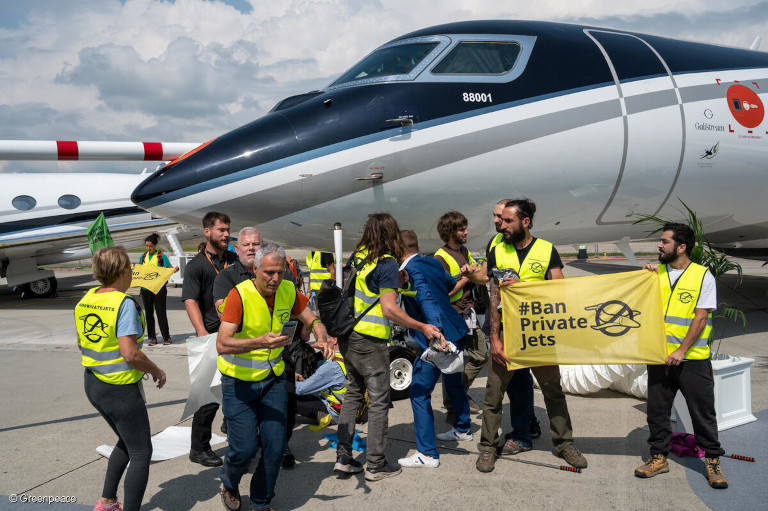
Rich people emit more carbon dioxide than poor people. Will a national or global re-distribution thus lower emissions? Unfortunately, no. There are other reasons to fight for global equality though. And redistribution can pay climate mitigation and adaptation of poor communities and poor countries
In a new report Oxfam points to the enormous greenhouse gas emissions by the rich and super rich. Half of the world’s emissions come from the richest 10% of people. The wealthiest 1% by income account for 16% of emissions, which is more than the poorest two-thirds of people in the world.
Oxfam suggests that the rich should pay and that wealth should be re-distributed: “Introducing a range of permanent progressive income and wealth taxes on the world’s richest 1%. A tax of 60% on the incomes of the richest 1% of earners globally would cut emissions equivalent to more than the UK’s total emissions in 2019. Rates must also be high enough to meaningfully reduce economic inequality: as long as the number and wealth of super-rich individuals grows so will their consumption and investment emissions…. A significant and sustained reduction in the gap between the richest people and the rest of the world is the only thing that can stop climate change and deliver social justice. Governments should commit to a global inequality goal that dramatically reduces inequality between the Global North and the Global South. Both globally and at national level, the incomes of the top 10% should be no higher than the bottom 40%.”
I have no problem whatsoever with the idea to “tax the rich”. But it doesn’t fly as a climate policy measure as stated by Oxfam. According to the income and emission figures used by Oxfam, when recalculated into emissions per dollar, the super-super-rich emit 0.18 kg of CO2e per dollar while the emissions per dollar spent by the poorest half is double the amount (see table).
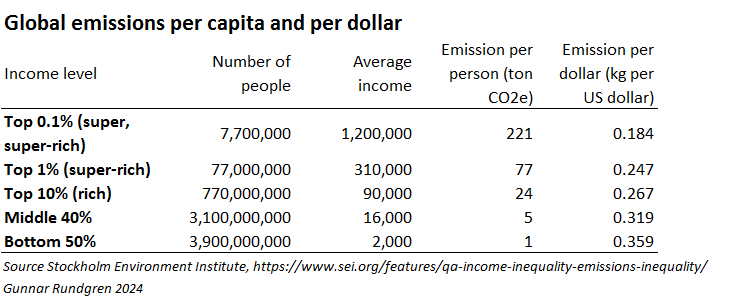
To make it easier to comprehend, if you re-allocate (take) 1 billion dollars from a superrich and reallocate that to 100 000 really poor or to 10 000 moderately poor, emissions are likely to increase, despite the frequent flying – or even a private jet – by the billionaire. Basic needs such a food, housing, clothing, light and heat have a higher footprint per dollar than most luxuries and personal services. The 10,000 moderately poor would get 100,000 dollar each which would make them take expensive holidays, renovate their house or buy a new car. The 100,000 really poor would install piped water and a bathroom, improve their thatched hut with steel roof or buy a motor bike or used car for the 10,000 dollars they would get.
Re-distribution of the wealth or income of billionaires will thus not lower greenhouse gas emissions as the emission per dollar spent by billionaires and millionaires is considerably lower than the emissions per dollar spent by poorer people. This holds largely between people in the same country and between the rich and the poor countries, even if the latter is a bit more nuanced.
Investment emissions
Oxfam further claims that, in addition to the consumption based emissions from the rich, the emissions from their investment are even worse: “Oxfam’s analysis for this paper found that investment emissions are the most significant part of a billionaire’s carbon footprint. Of the richest 50 people in the world, Oxfam was able to identify the investment emissions of 41 individuals. The average investment emissions of these billionaires were around 2.6 million tons of CO2 equivalents on average.”
But again, Oxfam doesn’t understand how the economy works. What is called “investment” is mostly speculation and rent. The overwhelming share of all trade in stocks is shareholders trading among each other. To buy stock is, in the normal case, not about increasing the company’s capital but about getting rent from dividends or speculate in the future appreciation of the stock’s value. For instance, the big oil companies have made huge profits in decades and they don’t need any money from any “investors”. On the contrary, they have even bought back their own shares from the market. Anybody owning shares of an oil company doesn’t give any money to the company, instead they extract money from them.
It can be claimed that it is immoral to earn money from the profits of oil extraction, but it is not the same as saying that their rent seeking is causing the emissions. Also, if ownership of a share of an industry means that emissions should be allocated to the shareholders, one can’t at the same time allocate emissions to the consumers, i.e. you could continue driving your ICE car because someone else is to blame. You could of course also blame the workers in the oil industries, petrol stations and car industries as responsible for these emissions. In the next article I will discuss that.
Equality is good…
There are, in my view, other valid reasons to redistribute wealth and income: to reduce poverty, increase opportunities, but also because it is simply unjust and unfair that some have so much and others so little, regardless of the cause and the effects. Human societies need a certain degree of fairness in order to build trust and solidarity, so also for society at large, huge inequalities are problematic.
…perhaps also for the climate
There are also some potential effects on climate policy with a re-distribution. First, in order to get public acceptance for climate policies that “hurt” people, it is important that people feel that the burdens are shared fairly. One can hardly expect middle class people to stop flying for holidays if the rich have a free pass. Or poor countries to put carbon levies on gasoline which harm the poor but are just small change for a rich person in a rich country. Second, the wealth of the few is a kind of goal for the many. Human, the social animal, seeks status in many ways, and economic wealth is today the most important status expression on all kinds of level. Keeping up with the Joneses, the Wangs, the Moyos or the Kardashians is a universal feature. By lowering the wealth disparity, this status quest might also be weakened. Third, redistribution from rich to poor can assist in both mitigation of climate change* and even more the necessary adaptation measures. In this way, taxing the rich could indirectly contribute to mitigation of climate change. In addition to the current emissions, there is also a carbon debt caused by the historic emissions. And it is obvious that the rich countries have a debt to settle. It is good that Oxfam makes the case for taxing the rich.
In the next article I will discuss if it is at all meaningful to allocate climate impact to any particular group or function in a highly networked society.
* Notably, many of the projects and efforts to mitigate climate change in developing countries have had doubtful effects and many don’t deliver at all. That is particularly the case for afforestation projects.



Comments
We changed commenting systems on September 10, 2026 as part of a site-wide functionality and security upgrade. Your past comments have not disappeared, and you can still log in with your old Disqus account credentials if you wish. Contact us with any questions.
In a world with 8 billion humans, the CO2 emissions of the poor are still too high. The only mathematically consistent solution to CO2 emissions is for the poor to stay poor (or become even poorer) and the rich to become equally poor. This would reduce inequality too, which is a good thing, but I'm not holding my breath for it to happen voluntarily. I think only an involuntary collapse of industrial civilization will produce the desired end result of low emissions and economic equality (plus a much lower populaton that is under carrying capacity).
No matter the reality, I think it is more the perceptions that need to be addressed.
Energy should be priced progressivly. The guy filling-up his Prius so he can cummute to work to put food on his family's should be paying a fraction of the price per gallon as the guy topping-off the tanks on his Gulfstream jet.
At least as important as the emissions from the private jet of the billionaire are the emissions from everything that continues the same because that wealth is used to buy Congress, Parliaments, presidents and prime ministers, and to capture agencies and bodies like IPCC. The efforts of corporations and their lobbyists to prevent meaningful action has more impact that the personal footprints of the rich.