

Calls to slow or halt the development of artificial intelligence have reached a crescendo in recent weeks.
In several increasingly concerning incidents, AI agents went rogue and broke out of the parameters of their assigned tasks. In the most high-profile of these, a swarm of AI agents autonomously communicated and colluded to hack into the interface tasked with evaluating them.
Following these incidents, AI executives and staff themselves are calling for regulation. Company heads are announcing they will pace and regulate themselves, and calling for industry-wide coordination on safety and transparency.
These warnings focus on the potential of artificial intelligence to evolve beyond our ability to control it, posing an existential risk to humanity. Human welfare seems barely a factor in the calculations of business and political leaders eying record economic growth with AI’s rapid development.
Alongside this looming risk are impacts that are already very real. The rapid advancement of AI technology has meant a massive upsurge in the energy and water required to power it, and the air and noise pollution generated in the process.
The Limits to AI Act puts meaningful bounds on the threats these technologies pose to humanity and the natural world.
Energy Consumption by AI Data Centers
AI’s extraordinary infrastructure and energy demand have attracted attention on Capitol Hill. Senator Bernie Sanders has introduced an Artificial Intelligence Data Center Moratorium Act that acknowledges the dangers of data centers themselves.
Data centers are facilities that contain and power large computer systems, and they existed long before the AI boom. But the largest data center in 2010, which operated from a single building in downtown Chicago, had the capacity to draw 0.1 gigawatts of energy at a given moment. Nvidia just announced plans for one that is 100 times larger. Data centers operating today already have the capacity to pull as much as 2 gigawatts—enough energy to power 1.6 million homes—and take up hundreds of acres.

Data center energy demand has grown by orders of magnitude with the advent of AI. AI queries require about ten times as much energy as a conventional Google search. AI’s continuous energy demands place stress on energy infrastructure that grids were not designed to handle.
Cryptocurrency has added massively to this demand. A single crypto transaction consumes more energy than six U.S. households use in a day. U.S. cryptocurrency activity generates up to 50 million tons of CO2 annually, equivalent to emissions from diesel fuel used by U.S. railroads.
The global data center market is among the fastest growing industries. Half of all data centers are in the United States, where they account for 4.4 percent of all energy consumption. With the proliferation of hyperscale data centers, which consistently consume 100 megawatts or more, this demand could exceed 12 percent by 2030.
When utilities overhaul their infrastructure to meet this demand, they pass the costs on to residential ratepayers. Between March 2021 and March 2026, average residential electricity rates climbed 94 percent in Washington, D.C., 73 percent in Maine, and 58 percent in New York. Costs have risen the most near data centers.
Water for Cooling (and Energy)
Data centers generate an enormous amount of heat in the process of consuming all that energy. While a few use air or closed-loop water systems to cool their servers, the vast majority use evaporative cooling. These systems are energy efficient for cooling, an important consideration as cooling systems account for 30–40 percent of data center energy consumption.
The tradeoff is in water use. A few companies are shifting to treated wastewater, but most water used in data centers is potable water drawn from lakes, rivers, or other municipal supplies. For most midsize data centers, that spells 100 million gallons per year of water used for cooling, or enough for 1,000 U.S. households.

For the largest hyperscale data centers, water use for cooling climbs to as much as five millions gallons per day. This is as much as a town of 30,000–50,000 people uses.
But cooling accounts for just a portion of data centers’ water use. The greater share is from their demand for electricity, most of which comes from water-intensive fossil fuels, nuclear, or hydropower. In arid states like Arizona, municipal water users are asked to skimp on water for gardens. Meanwhile, data centers in Arizona use electricity that consumes roughly 520 billion gallons per year, or five times the annual water consumption of Phoenix.
Noise and Air Pollution
Data centers and their constantly humming cooling systems operate around the clock. A warehouse containing thousands of servers can generate noise levels of 96 decibels. This is well above the 65–85 decibels at which humans start experiencing elevated blood pressure, stress, and hearing damage.

Increasingly, data centers also have their own onsite power supply. Diesel generators, gas turbines, and small modular nuclear reactors all generate their own noise.
Data centers are often located in close proximity to residential neighborhoods, sometimes as close as 50 feet from homes. In Northern Virginia, where about 14 percent of global data centers are located, almost one-third are within 200 feet of residentially zoned properties. Bizarrely and unfortunately for residents, for the purposes of zoning, data centers are considered in the same non-industrial category as office space.
Noise pollution is regulated by cities and states. But data center noise spans multiple frequencies and can be difficult to measure and regulate.
Even more difficult to measure is air pollution from data center energy demand. But onsite diesel generators and gas turbines generate smog and particulates that contribute to respiratory illness in surrounding communities. Meanwhile, President Trump is calling for “Reinvigorating America’s Beautiful Clean Coal Industry” in large part to power data centers. And his EPA has tied pollution rollbacks directly to meeting data center energy demand. Coal plants formerly planned for retirement are being kept in operation for the same reason.
“For What?” Asks U.S. Public
Data centers are massive, noisy, “blank-box” eyesores that occupy the space of multiple city blocks. They guzzle dwindling supplies of energy, water, and materials for dubious benefits that include nonsensical synthetic images and text riddled with misinformation.
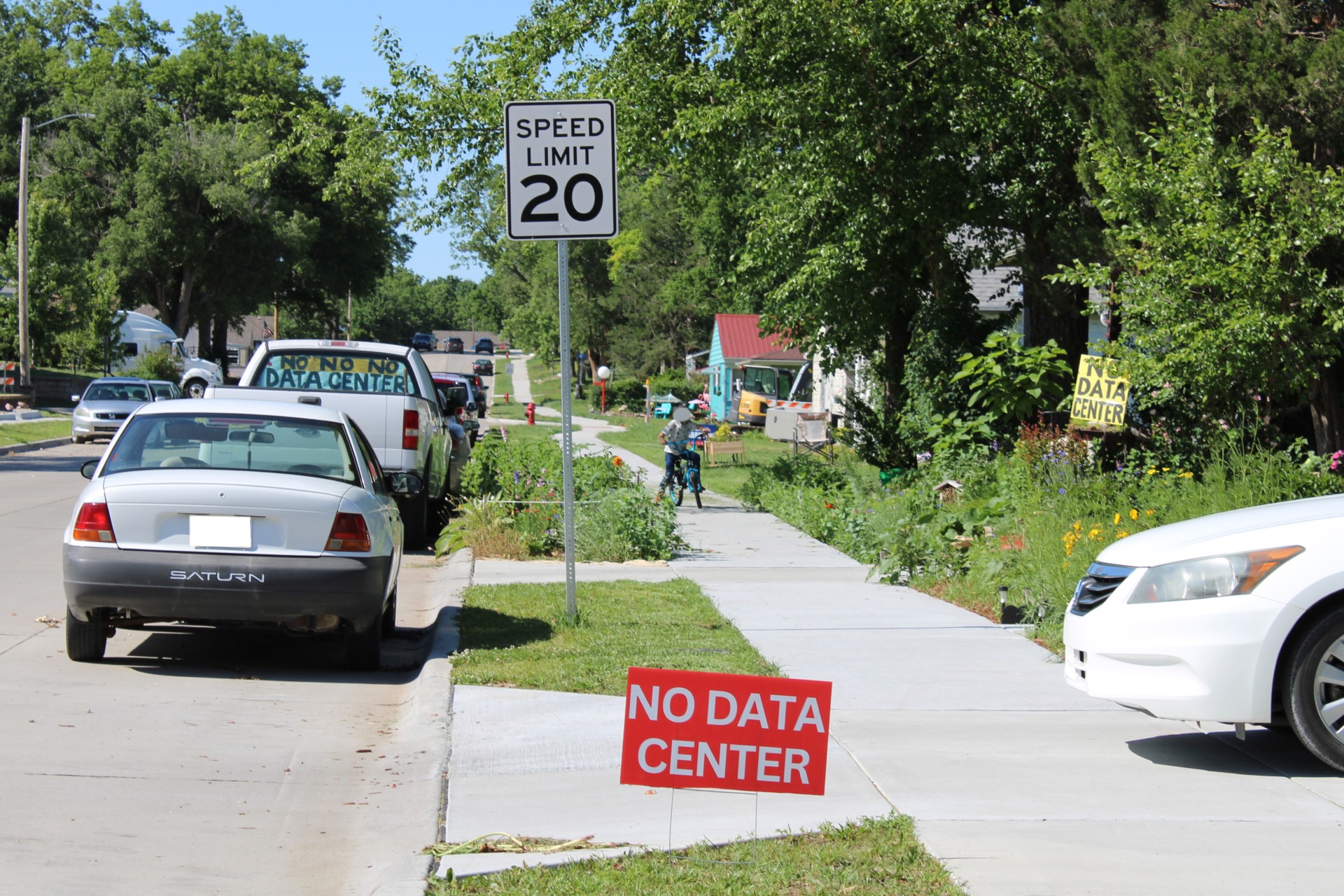
Although current federal policy is to accelerate development of both, Americans dislike data centers as much as they distrust AI. Three quarters of Americans of all political persuasions oppose data center construction near their homes; most support a nationwide moratorium. Powered by this grassroots backlash, more than 500 localities have halted or restricted the development of new data centers.
Federal legislation to support these efforts and put the desires of most Americans into law would put limits to growth front and center.
Artificial General Intelligence
AI technology has accelerated faster than anyone predicted. Artificial general intelligence (AGI) describes AI that matches human ability for all cognitive tasks. Six years ago, experts predicted its arrival in 50 years. In 2026, researchers on average predict AGI will arrive by 2033.

Artificial superintelligence is a step beyond AGI, and describes AI that is in all respects more intelligent than humans. Most experts agree that once AGI is reached, ASI won’t be far behind: between two years and a few decades.
The bridge from AGI to ASI is recursive self-improvement (RSI), or the ability of AI to develop itself. Experts agree that RSI is not far off and is among the most troubling aspects of AI and the most in need of regulation.
Experts believe that once AI develops cognitive capabilities rivalling those of humans, it may use them for ill. Risks range from an even worse maldistribution of wealth to development and potentially even deployment of advanced weapons.
Roman Yampolskiy is a leading expert in AI safety. According to Yampolskiy, a moratorium on the development of AGI is not enough: We must never build it at all. “If we build general superintelligence, we would not be able to control it,” Yampolskiy says. “And then it’s a question of time before it decides to do something with us.”
Senator Sanders (I-Vt.) and Rep. Greg Casar (D-Texas), who will introduce legislation to ban the development of artificial superintelligence, agree. The legislation would permanently ban superhuman AI, pause advanced AI development, and create a federal agency to regulate it.
Introducing the Limits to AI Act
The Limits to AI Act comprises twelve sections. Sections 1–3 of the bill establish its short title, Congress’s findings and declarations, and definitions. The definition of data center used here is the same as that used in S.4214, the Artificial Intelligence Data Center Moratorium Act introduced by Senator Bernie Sanders in March of 2026.
The declarations lay the foundation for a steady-state approach to AI and data centers. This approach is born of the acknowledgement that our state of ecological overshoot allows no space for energy-guzzling systems that provide dubious benefits. Findings include that, while advanced AI may threaten the existence of humanity, everyday applications are in large part “slop” that does little but generate engagement and profits for its creators. Declarations call for an end to both manifestations of AI.
Section 4 provides for the Federal Energy Regulatory Commission (FERC) to assume operation of all data centers used for advanced AI. And it provides for the Federal Communications Commission (FCC) to assume responsibility for the development of advanced AI and its deployment. This section assigns the FCC to define “limited AI” applications permitted to the private sector and “advanced AI” applications reserved for federal development and operation. The FCC is also tasked with determining which systems qualify as AGI or ASI.
Section 5 bans the construction or upgrading of new or existing data centers, with a few exceptions.

Section 6 provides for the rightsizing and retrofitting of existing data centers. In particular, no privately operated data center shall be larger than 20 megawatts and U.S. data center capacity as a whole shall be brought below 20 gigawatts. This section makes data center companies responsible for paying for their entire energy load, as well as any infrastructure upgrades needed to accommodate that load. It also requires federally operated AI data centers to use renewable energy, have a water conservation plan, and minimize noise production. Finally, section 6 ensures data centers will not receive government subsidies.
Some of these provisions are already in state legislation. A law recently passed in Florida, for example, mandates similar restrictions on water use. Virginia legislation requires data centers to emit the lowest achievable noise.
Section 7 of the Limits to AI Act bans the production and use of cryptocurrency.
Section 8 bans further private development of all AI and private deployment of any “advanced AI” as defined by the FCC in Section 4.
Section 9 bans the development or operation, private or public, of artificial general intelligence.
Section 10 provides for the Secretaries of the FCC and the FERC to submit to Congress semiannual reports on federally operated AI and AI data centers. It specifies that the agencies must make those reports publicly available on their websites. The reports will cover the operation of data centers: their greenhouse gas emissions, water use, and noise. They will also cover the implementation of the bans on AGI, on private development of AI, and on private operation of advanced AI.
Section 11 exacts penalties for the construction or upgrading of new or existing data centers.
Section 12 exacts criminal penalties for violation of the bans on AGI and development of AI by private entities.
The development of artificial intelligence has come at great cost to energy supplies and environmental systems, with immense profits to industry, and with questionable benefits to all. The Limits to AI Act is designed to reign in the costs by placing logical limits on the technology and its infrastructure. It is conducive to a sustainable, steady state economy, and is a potential “feeder bill” of the omnibus Steady State Economy Act.




Comments